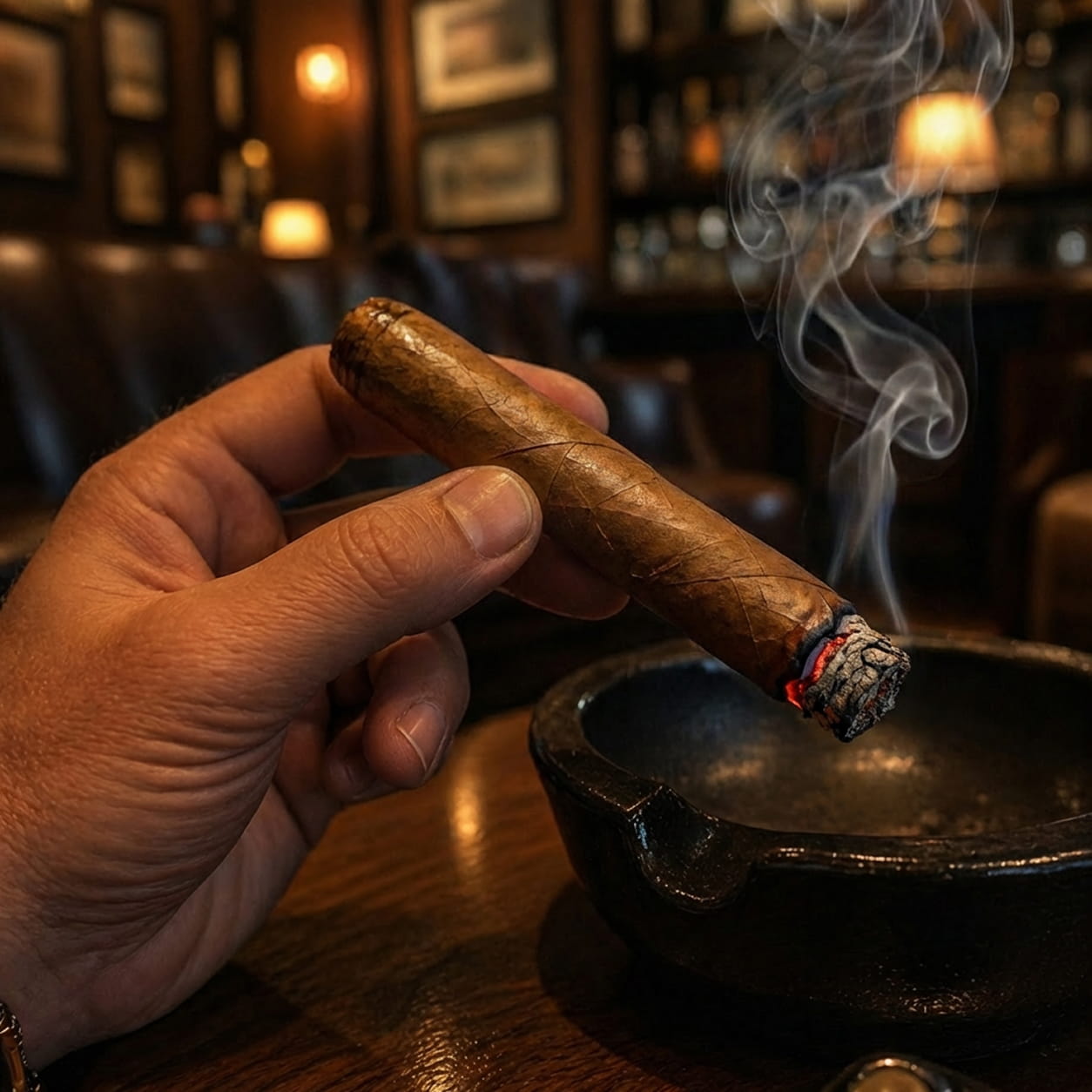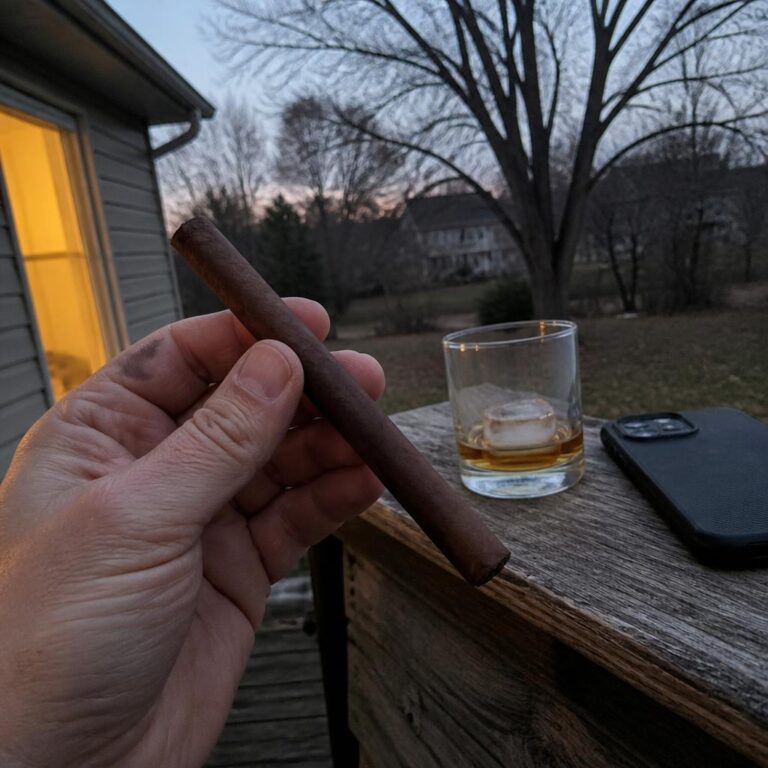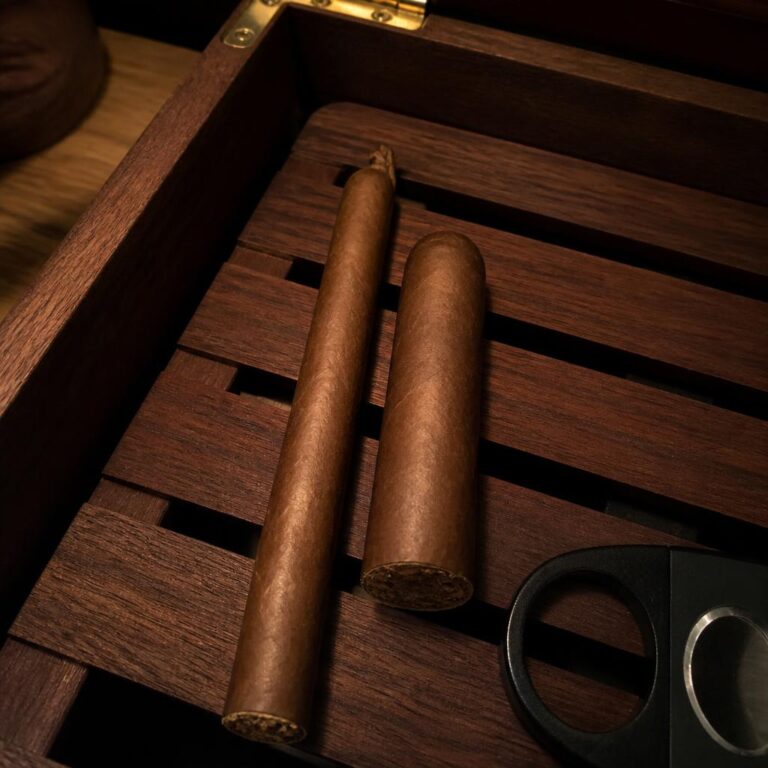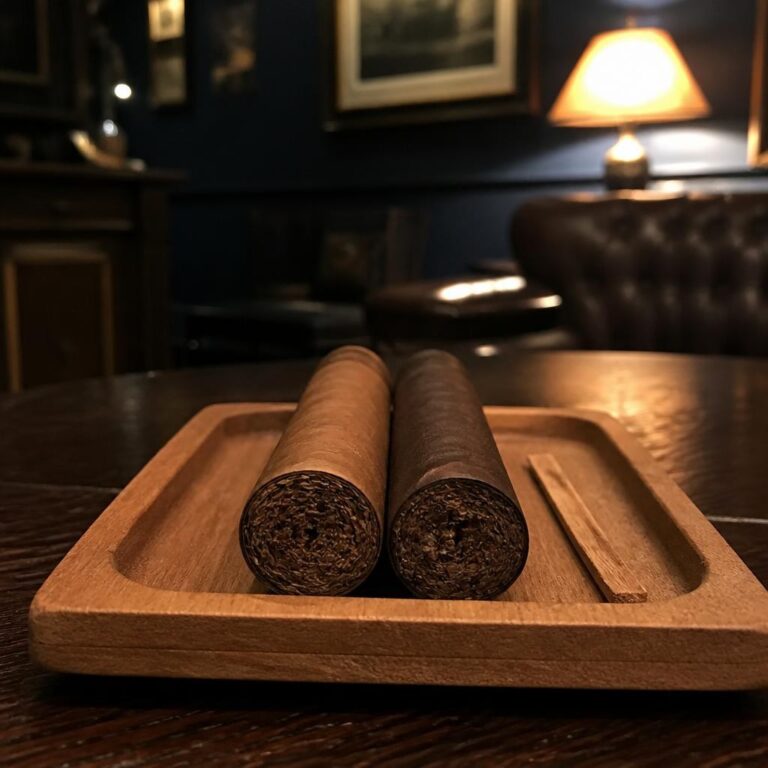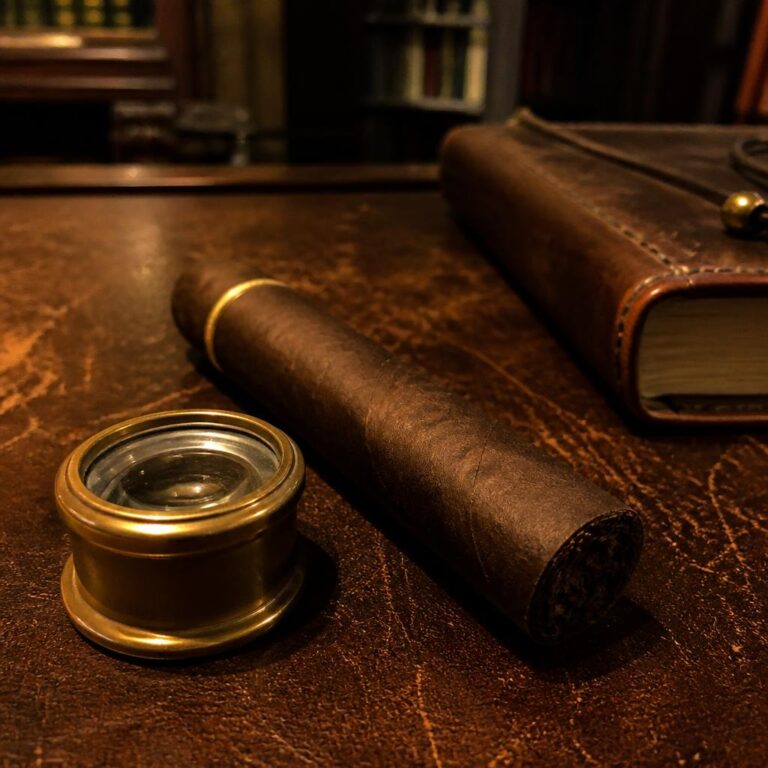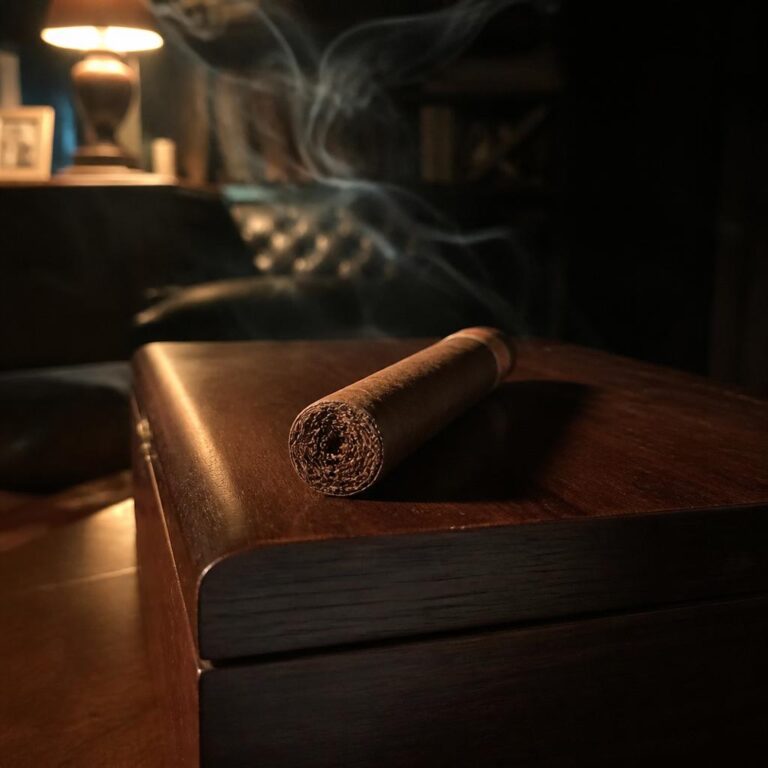
A cigar is a small piece of agricultural engineering wrapped in a leaf. Knowing the parts of one is not a test anyone makes you sit, but the names give you a vocabulary for what you are tasting, what is going right, and what is going wrong.
This is the short tour. The wrapper, the binder, the filler. The foot, the head, the cap, the shoulder. The band. Ring gauge and length. Then a few things the parts list usually skips, the bunch, the draw, the difference between body and strength. None of it is hard. All of it pays you back the next time you light up. Learn the parts in the order the smoke meets them, and the vocabulary stops feeling like a members’ handshake.
00 · The map
The parts of a cigar
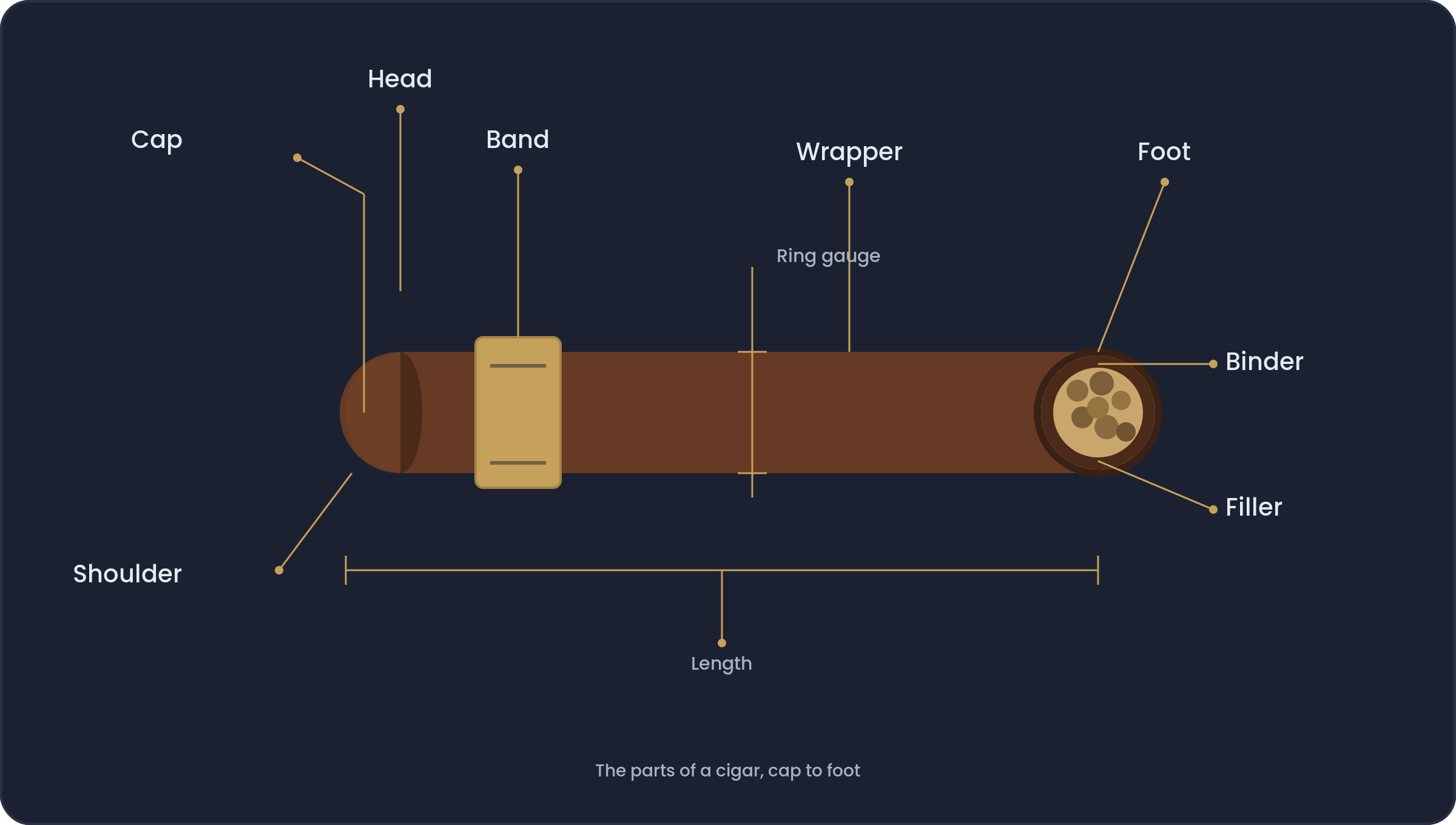
Every part of a cigar has a name, and knowing them turns cigar anatomy from trivia into something you can actually use behind the counter. The diagram above maps the whole construction in one frame, cap to foot, wrapper to filler, the two numbers on every spec sheet. The thirteen sections below walk through each part in turn.
01 · The outer leaf
The Wrapper
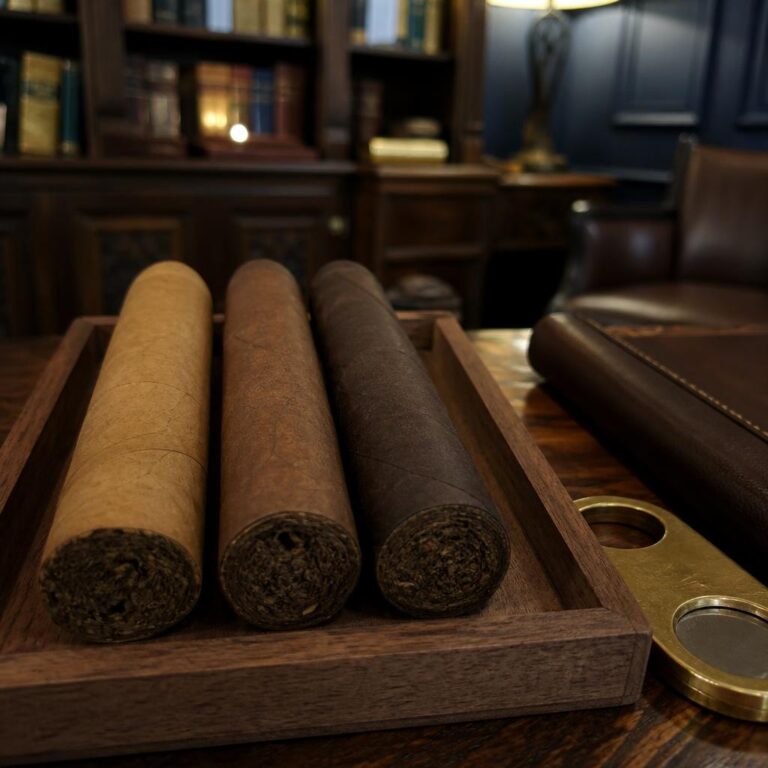
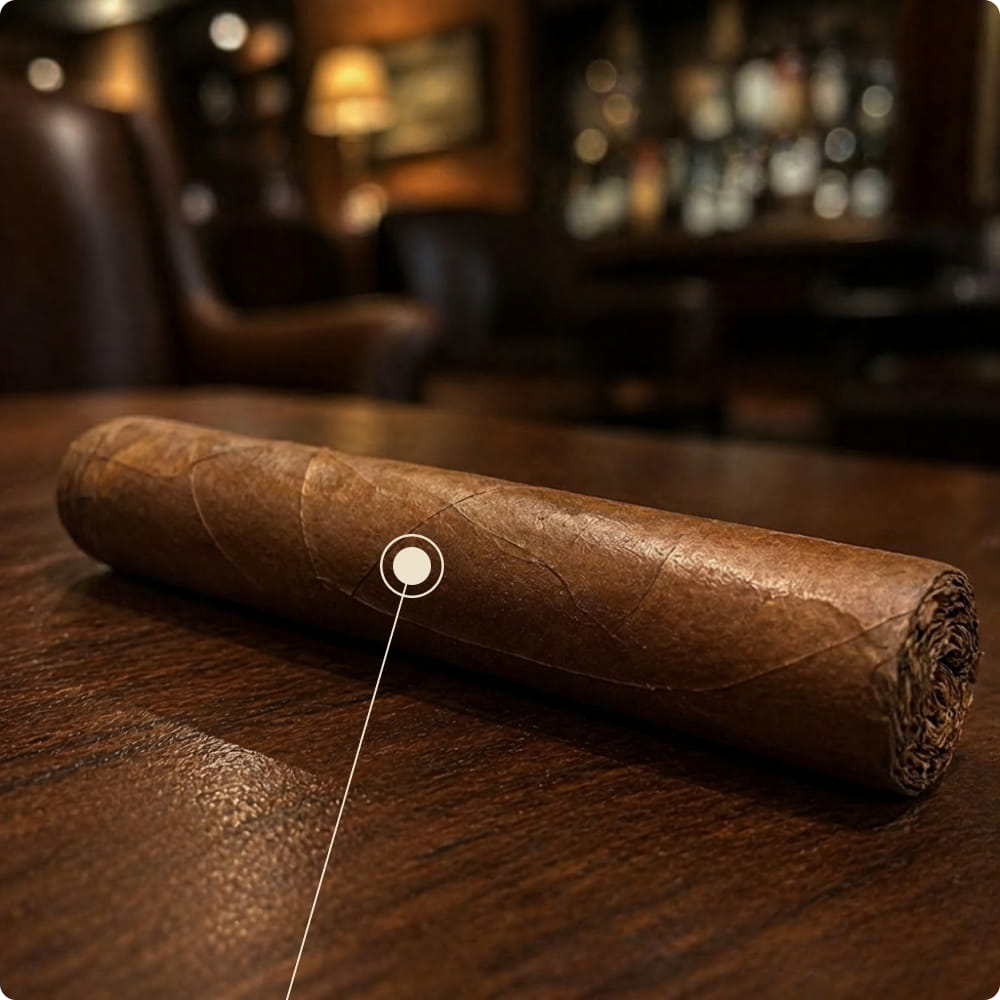
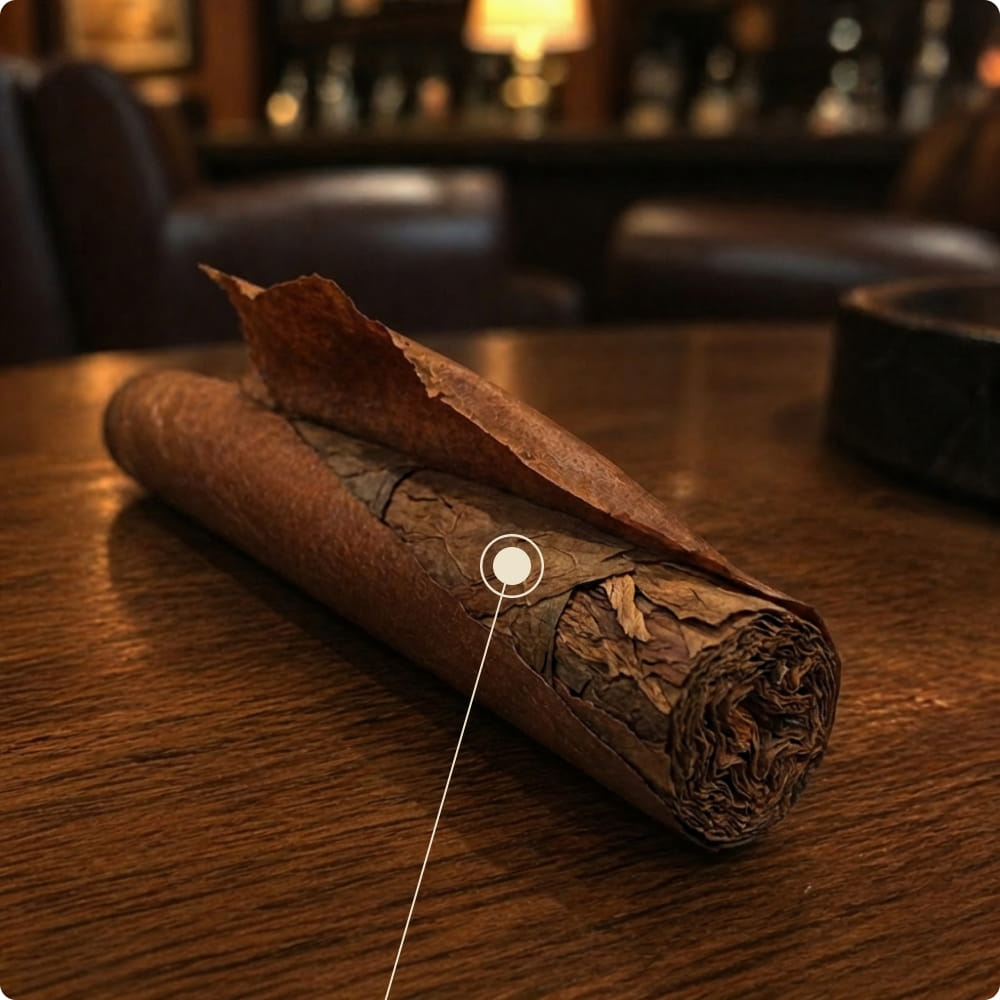
The outermost leaf of a cigar is its wrapper. It is the only part the eye ever sees, and it has an outsized influence on aroma, texture, and first impression. But the full flavour comes from the wrapper, binder, filler, size, and construction working together, not the wrapper alone. On larger ring gauges in particular, the bunch of binder and filler can carry more of the flavour than the wrapper.
A good wrapper has to satisfy more requirements than any other tobacco in the cigar. It must be elastic enough to roll cleanly, attractive enough to finish the cigar, and complementary to the blend underneath. It is selected for appearance, elasticity, colour consistency, texture, and relatively fine vein structure. Veins are a normal part of leaf anatomy; what blenders look for is fineness and consistency, not absence.
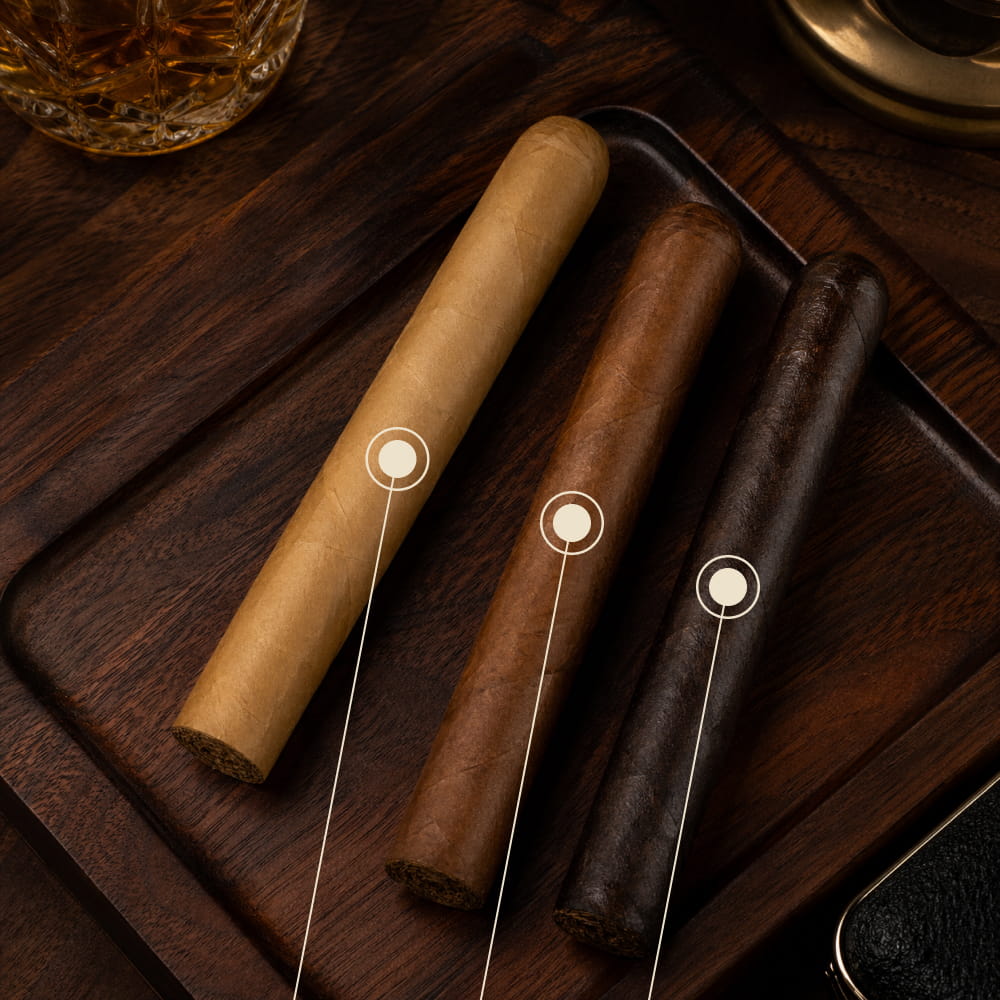
Wrappers are described by shade, country, seed varietal, growing method (sun-grown or shade-grown), priming, curing, fermentation, and aging. The labels are not as simple as they look. Connecticut can mean Connecticut Shade grown in the river valley, Ecuador Connecticut grown from Connecticut seed in Ecuador, or a wrapper finished in a Connecticut style. Habano usually refers to Cuban-seed tobacco grown outside Cuba, not necessarily Cuban tobacco itself. The darkest of these labels, Maduro, is a curing choice rather than a seed or country, and it is worth understanding the maduro process on its own terms before shopping by colour alone.
The wrapper is one of the most visible places a blender’s choices show up. The blend earns the reputation.
- A dark Maduro is not automatically strong.
- A pale Connecticut Shade is not automatically mild.
- Wrapper shade suggests flavour direction, not nicotine content.
- For strength, look at the filler blend, especially the ligero content.
02 · The inner wrap
The Binder
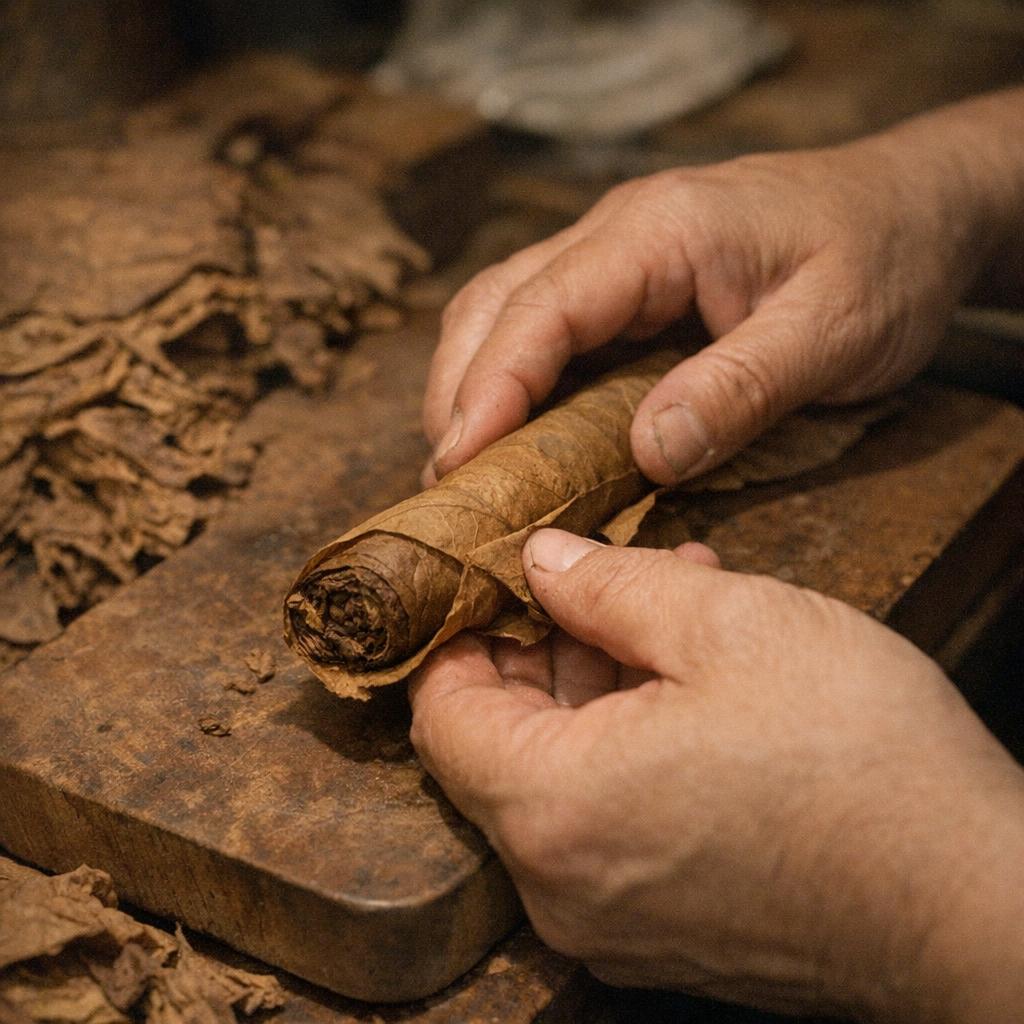
Beneath the wrapper sits the binder. The binder is one or more leaves wrapped around the filler to form what cigar makers call the bunch. Many cigars use a single binder leaf; others use two, depending on the blend and the construction technique.
A great binder rarely calls attention to itself, but it is doing real work. It quietly affects combustion, draw, structure, and flavour balance. A poor binder shows up as uneven burn, a hard draw, a tunnelling wrapper, or a split running down the side of the cigar. Binders are typically thicker, more robust leaves chosen for strength, burn quality, and compatibility with the filler, not for appearance.
03 · Where construction lives
The Bunch
Once the filler is gathered and the binder is wrapped around it, the result is called the bunch. The bunch is the heart of the cigar. It is what determines the draw, the density, the burn behaviour, and a great deal of the flavour. The wrapper goes on last, over the bunch.
Bunching is its own craft. Different schools, entubado, accordion, book-bunch, produce different draws and different burns from the same leaves. A cigar with a beautiful wrapper and a poorly built bunch will smoke poorly. A cigar with a modest wrapper and an expertly built bunch can be excellent.
04 · The interior blend
The Filler
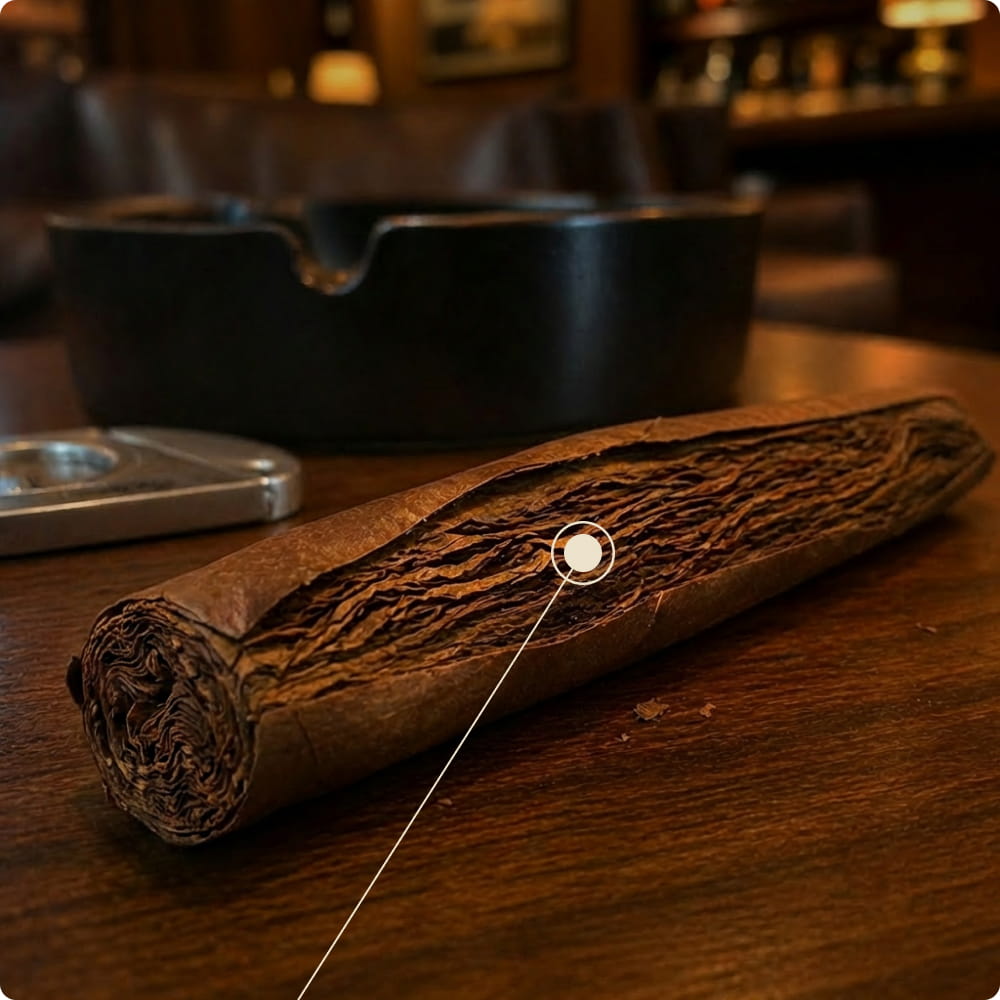
Inside the binder sits the filler. The filler is where the cigar’s character lives.
Filler is described by construction, not by grade. Long filler is whole leaf running the full length of the cigar, the mark of premium hand-rolled construction. Short filler is chopped tobacco, used in lower-grade and machine-made cigars. Mixed-fill, sometimes called Cuban sandwich, combines long and short filler in a single cigar. Most premium handmade cigars are long-filler cigars, though formal industry definitions allow for some mixed filler in cigars sold as premium.
Within the filler, blenders work with leaves drawn from different priming heights on the tobacco plant. The four common primings are listed below. Naming and placement vary by country and producer; not every blender uses all four.
The blend is not just a ratio of leaves. It is leaf priming, seed varietal, region, farm, soil, sun-grown or shade-grown, curing, fermentation, aging, sorting, bunching method, binder choice, wrapper choice, ring gauge, and final resting time. A puro is a cigar built entirely with tobacco from one country, wrapper, binder, and filler. A Padrón 1964 Anniversary cigar, for example, uses Nicaraguan tobacco for all three.
- Volado: lower leaves. Mild, prized for combustion. Helps the cigar burn steadily.
- Seco: generally milder, thinner leaves prized for aroma and combustion support.
- Viso: often the balance leaf. Medium strength, good complexity, good combustion.
- Ligero: upper leaves. Strongest in body and power, slowest to burn.
05 · The end you light
The Foot
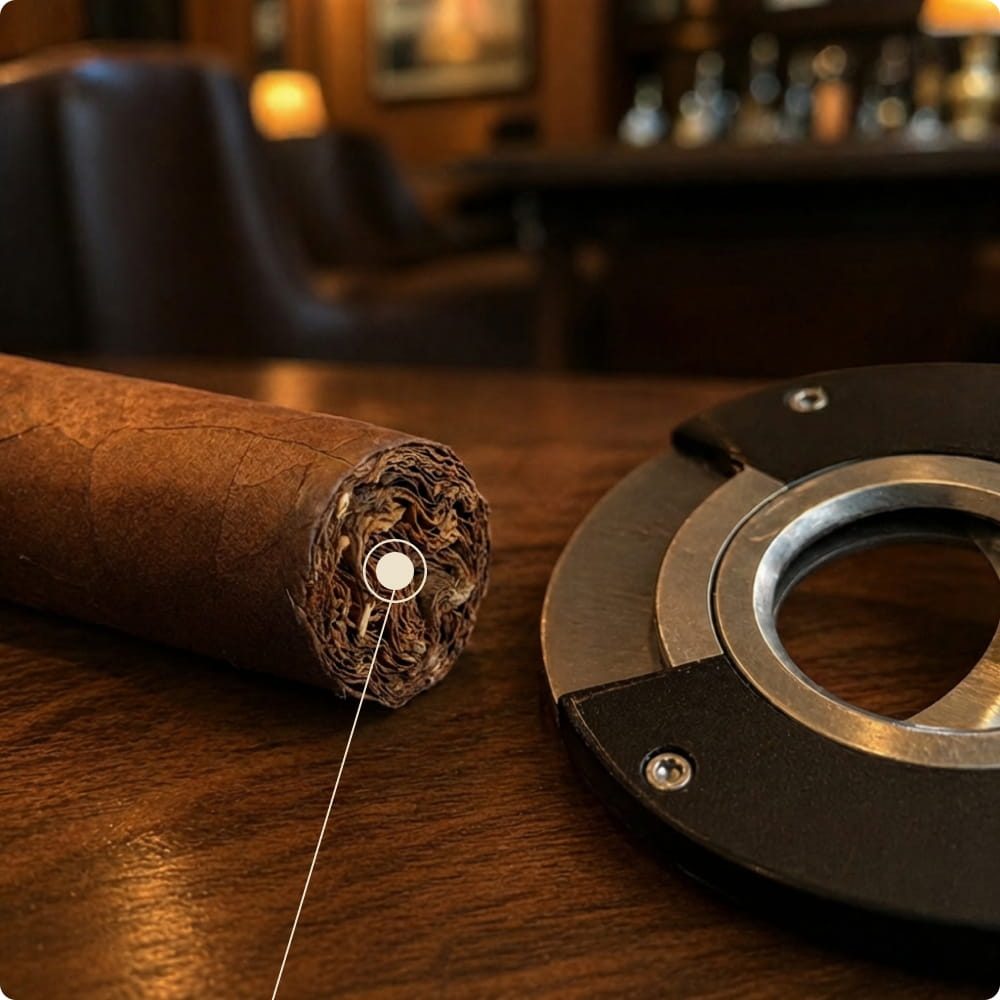
The foot of the cigar is the end you light. On most standard parejos it is open, with the filler tobaccos visible at the tip. Some figurados and special shapes are different. A closed foot means the wrapper covers the foot and requires a careful first light. A tapered foot narrows gradually as a feature of the shape. A shaggy foot is filler intentionally protruding past the wrapper, usually as a release-edition flourish.
On a standard parejo, a ragged, damaged, or unevenly cut foot can be a warning sign of poor construction or shipping damage. On a figurado designed with a non-standard foot, the same look is the intended finish. Knowing what shape you have in your hand changes how you read the foot.
The default. Filler tobaccos visible at the tip. Lights conventionally with a soft flame held just below the foot, rotating until the burn line is even.
The wrapper covers the foot. Requires a careful, slower first light because the wrapper has to ignite first. Releases the wrapper’s flavour notes prominently in the opening third before the filler joins in.
The cigar narrows gradually toward the foot. A shape feature on figurados, perfectos, and pyramids. The narrower opening intensifies the first puffs.
Filler tobacco intentionally extending past the wrapper, often as a flourish on release editions. Dramatic first light, exposed filler character before the wrapper engages.
06 · The end you cut
The Head and the Cap
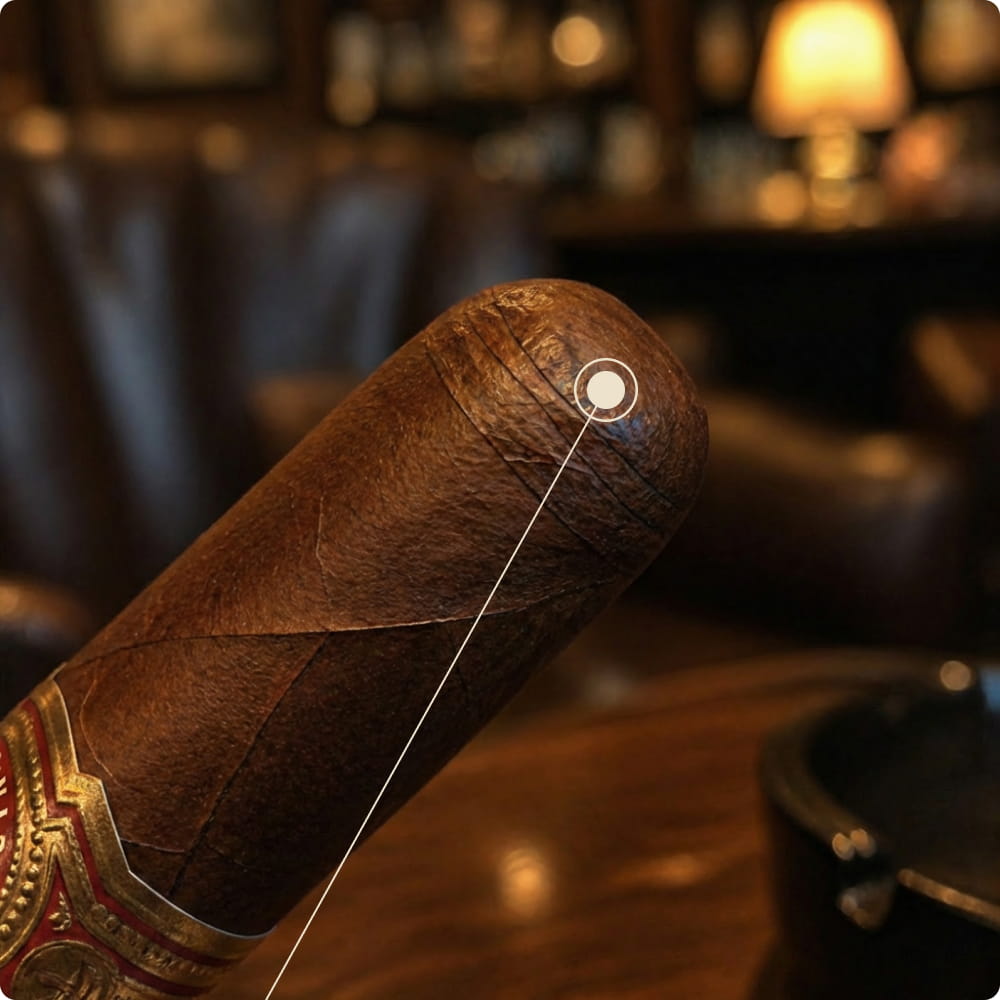
The head is the closed end you put in your mouth. It is also the end you cut. At the head of every premium cigar is a finishing leaf, the cap, applied to secure the wrapper and give you a clean place to cut.
Caps come in different forms. Many premium cigars are finished with a flag-and-cap method (a small piece of leaf wound around the head). Cuban cigars traditionally use a triple cap, applied in three seams. Some figurados have a pigtail cap or a torpedo cap. The article that says the cap usually means whichever finish a particular cigar uses.
A traditional Cuban-style triple cap shows multiple seams around the head, though they can be faint, partly hidden, or hard to spot under the wrapper. The triple cap is a signal of careful Cuban-style construction, not a quality requirement of every premium cigar.
When cutting, the rule is simple: cut above the shoulder, and remove only enough cap to open the draw. Leave the lower part of the cap intact so the wrapper does not unravel as you smoke.
07 · Where the cigar tapers
The Shoulder
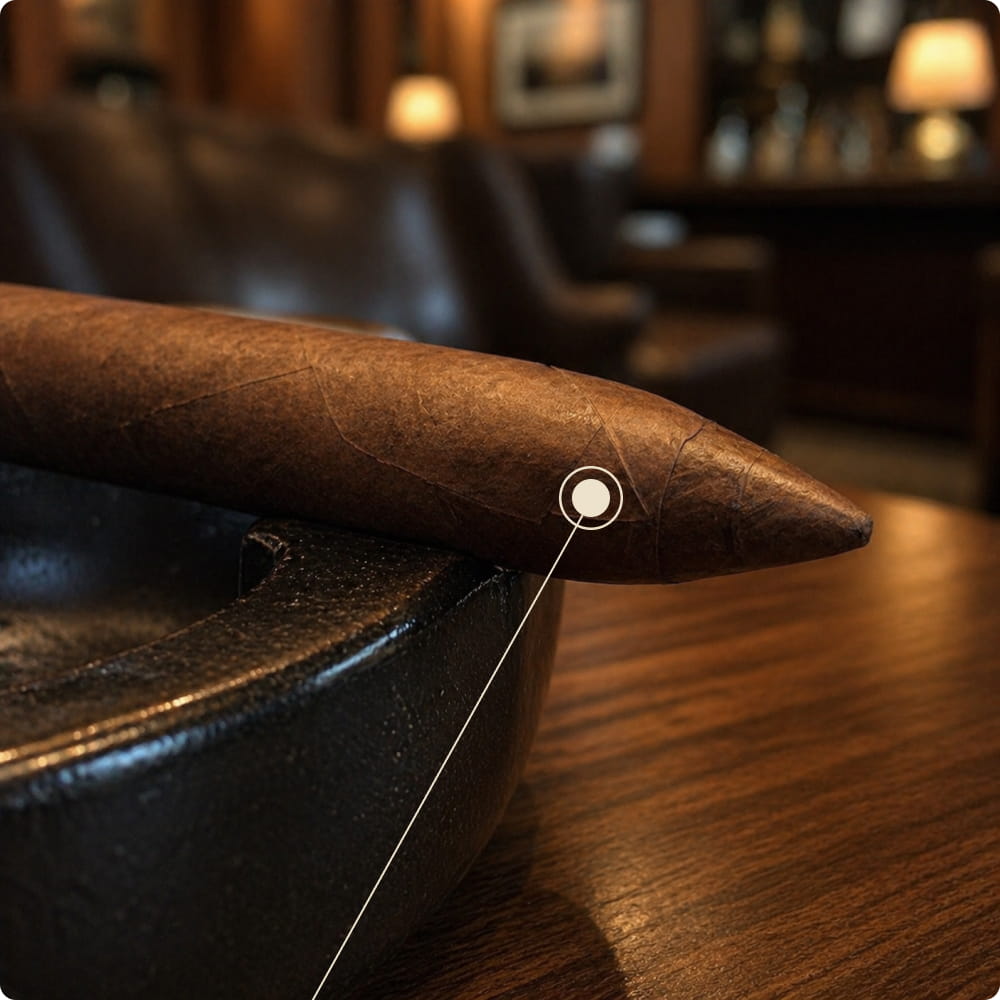
Between the head and the straight barrel of the cigar sits the shoulder, the short tapered section where the cap meets the body. On a cylindrical parejo the shoulder is subtle, almost a curve you would miss if you were not looking for it. On figurados, belicosos, and torpedoes, the shoulder is more pronounced because the head tapers more sharply.
The shoulder is the cutting boundary smokers most often cross by accident. Cutting below the shoulder removes too much cap, the wrapper loses its anchor, and the cigar can unravel as you smoke.
08 · The paper ring
The Band
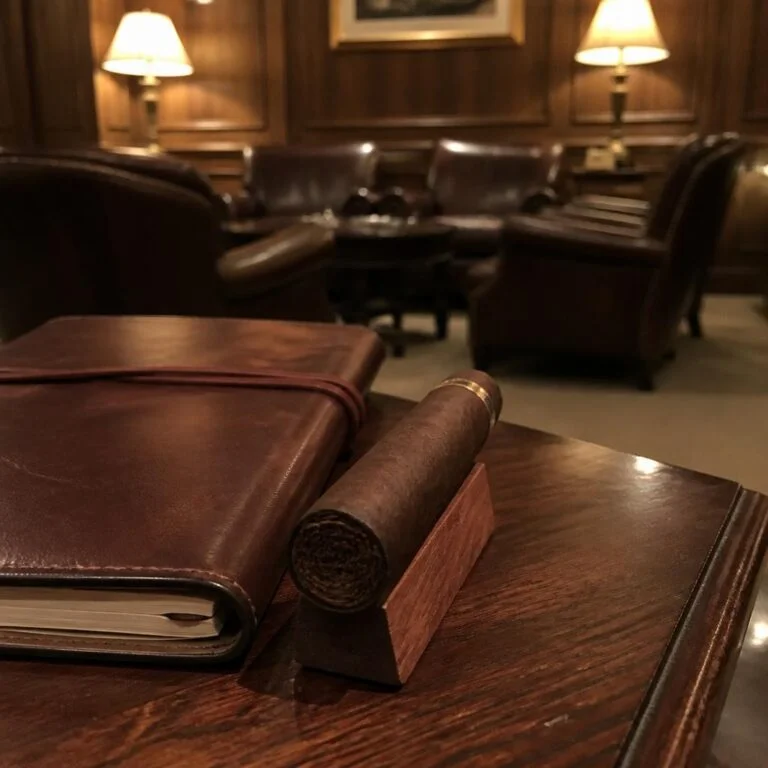
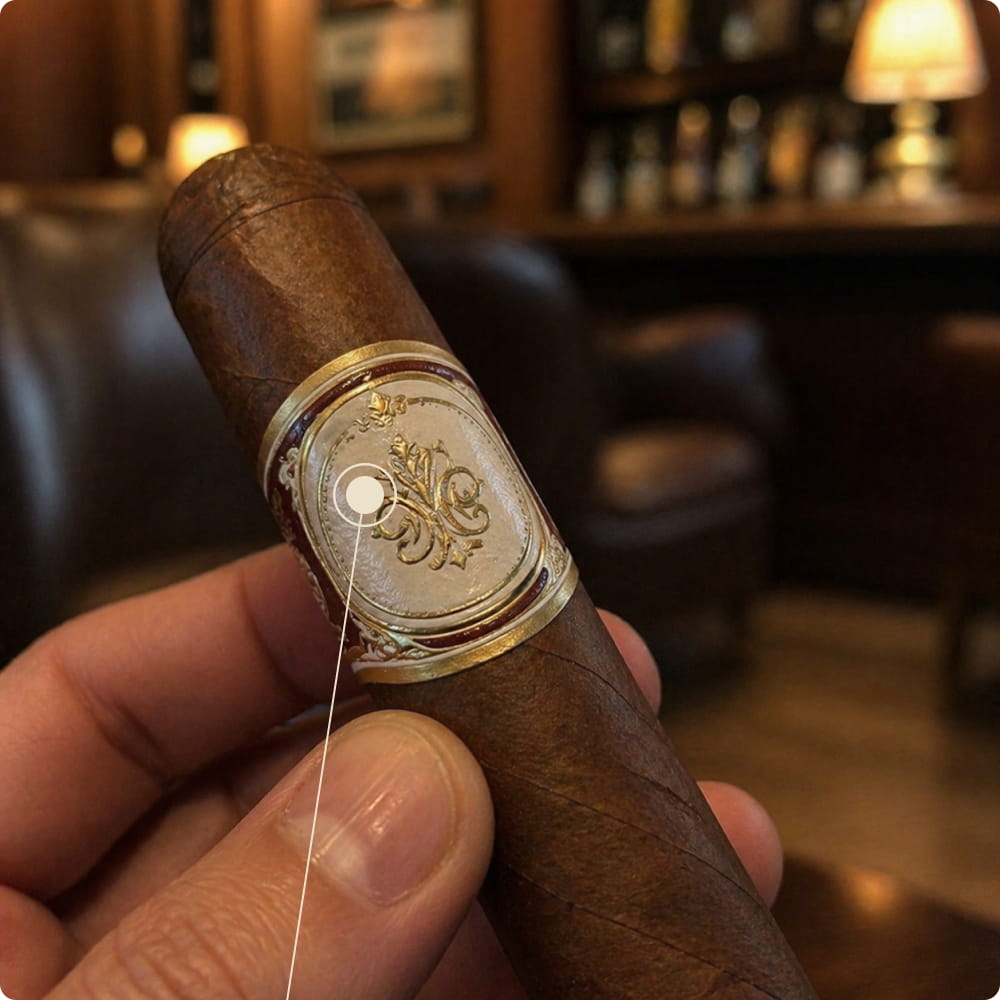
The band is the decorative paper ring set near the head. It is not structural. It identifies the cigar, the brand, the line, the country of origin, often the vitola, and sometimes the edition or release year. On Cuban cigars and a few others, a code on the band hints at authenticity, but most factory codes live on the box, not the band itself.
Bands originated in the early-to-mid 19th century. Popular folklore credits Catherine the Great or Spanish nobles with inventing them to keep wrapper oils off white gloves, but the more commonly accepted history credits Gustave Bock with popularising bands in the 1830s as a way of distinguishing his cigars from competitors.
The band gives you a first clue to the cigar’s identity. It is not the whole story. Counterfeits exist, bundle cigars often skip bands entirely, and the most informative markings on a cigar are usually on the box. If you want to decode what every mark actually means, here is how to read a cigar band. Slide the band off only after you have smoked enough to loosen the natural glue, never before. Pulling early can take a piece of the wrapper with it.
09 · Diameter, in 64ths
Ring Gauge and Length
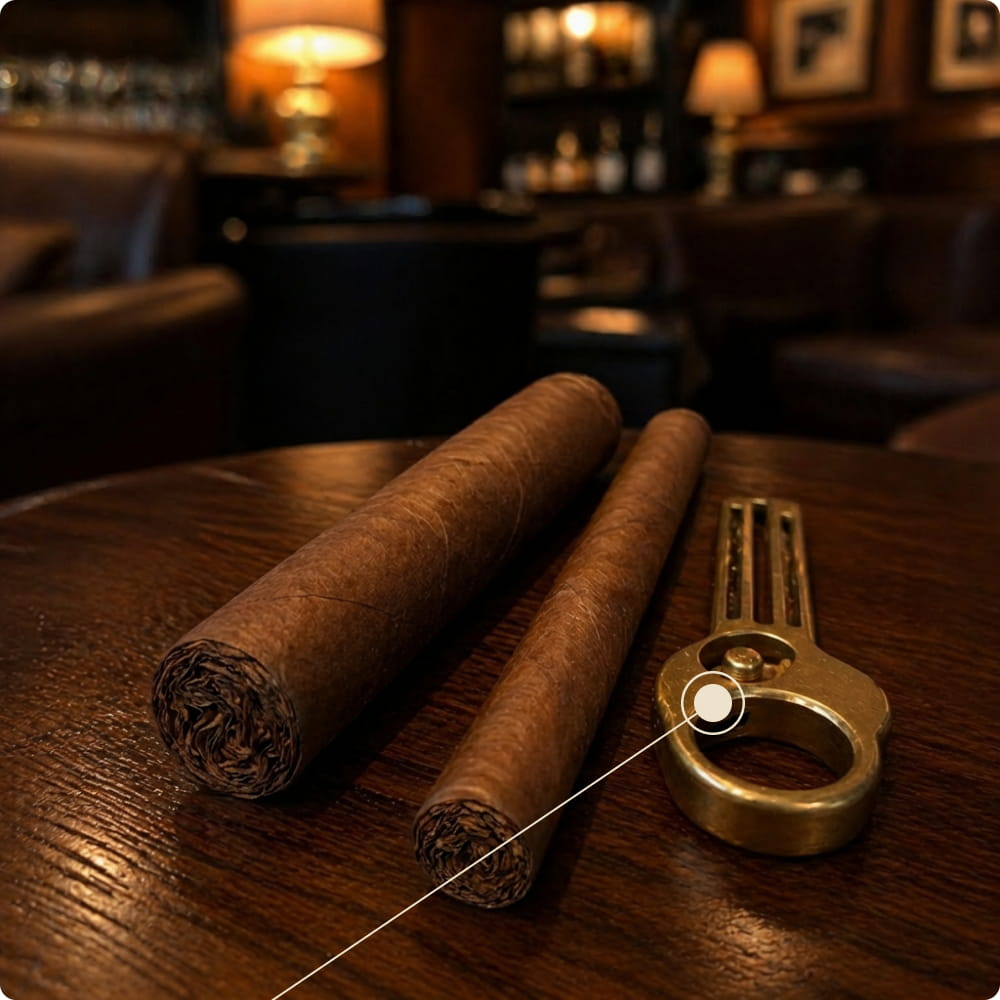
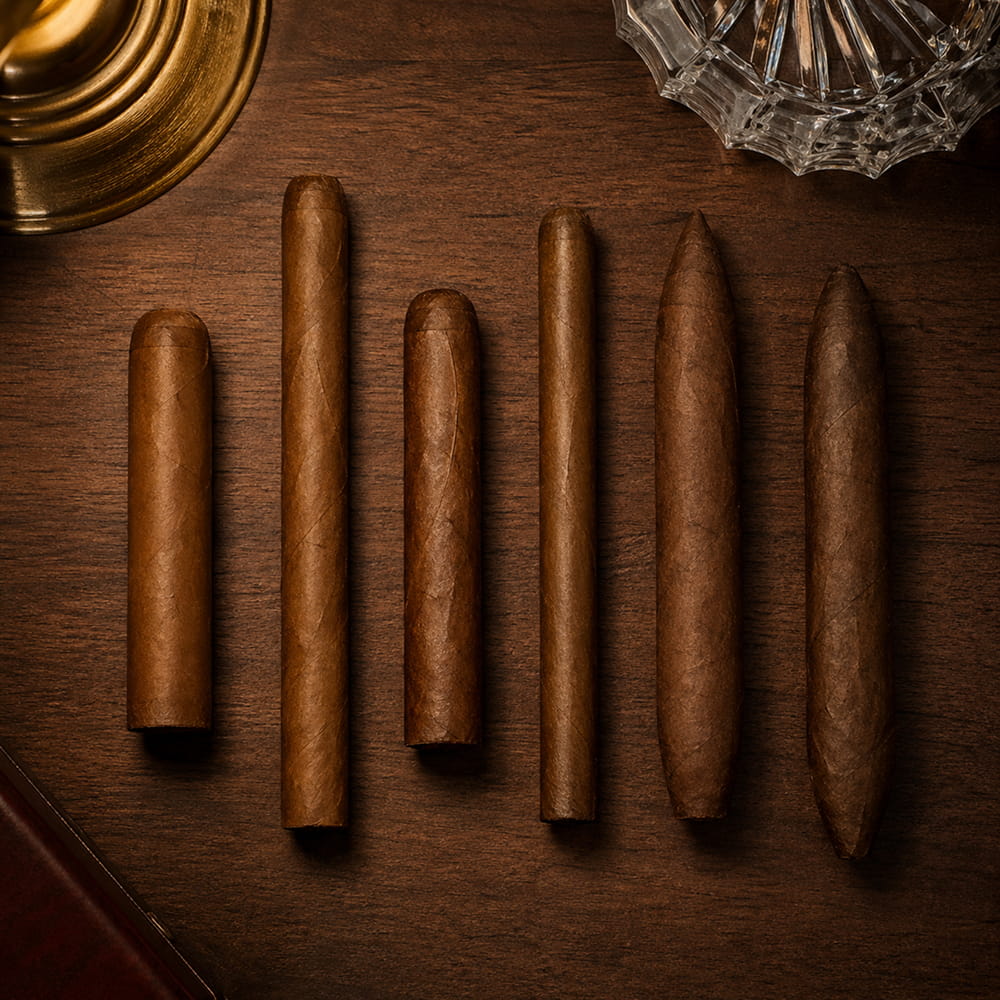
Every cigar has two numbers that define its size: length in inches, and ring gauge. Ring gauge is the diameter of the cigar, expressed in 64ths of an inch. A cigar with a 50 ring gauge is fifty sixty-fourths of an inch across, just under three-quarters of an inch. A 60 ring gauge measures close to a full inch.
The notation 5 x 50 means five inches long by 50 ring gauge, roughly the dimensions of a classic robusto. The common sizes take perhaps an afternoon to learn, and they pay you back every time you walk into a tobacconist and want to describe what you are after without pointing.
Manufacturers vary their sizes by an eighth of an inch or a ring or two; treat the values below as typical, not absolute.
- Robusto: roughly 4¾–5½ in. by 48–52 ring. The modern default.
- Toro: roughly 6 in. by 50–54 ring. Longer evolution, more flavour development.
- Churchill: roughly 7 in. by 47–50 ring. Long, classic, named after Winston.
- Corona: roughly 5½ in. by 42–44 ring. Slim and traditional, more wrapper influence.
- Lonsdale: roughly 6½ in. by 42–44 ring. Long and slim, refined burn.
- Petit Corona: roughly 4½ in. by 40–44 ring. A quick, traditional smoke.
10 · Shape and size
The Vitola
In cigar vocabulary, vitola can refer to either size or shape, and it is worth knowing the difference.
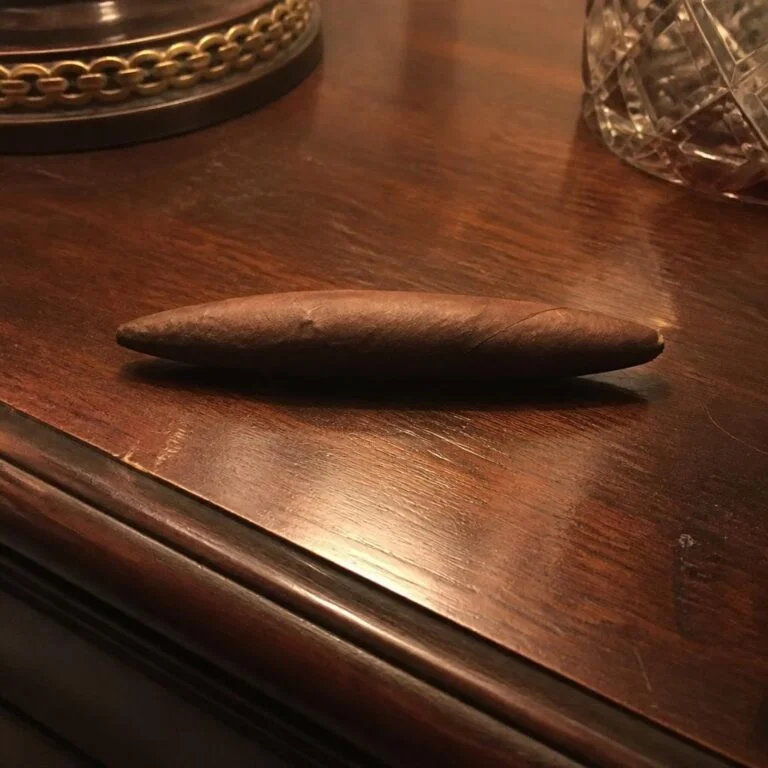
A robusto is a size format. A parejo is a straight-sided shape category. A figurado is an irregular or shaped category, which includes the torpedo (pointed head, straight body), the belicoso (rounded taper), the perfecto (tapered at both ends), the pyramid (gradually widening from head to foot), and the box-press (a parejo pressed into a square cross-section in the box).
A robusto is usually a parejo. A torpedo is usually a figurado. The two systems describe different things, and the same cigar can be named by both.
11 · Anatomy meets experience
The Draw
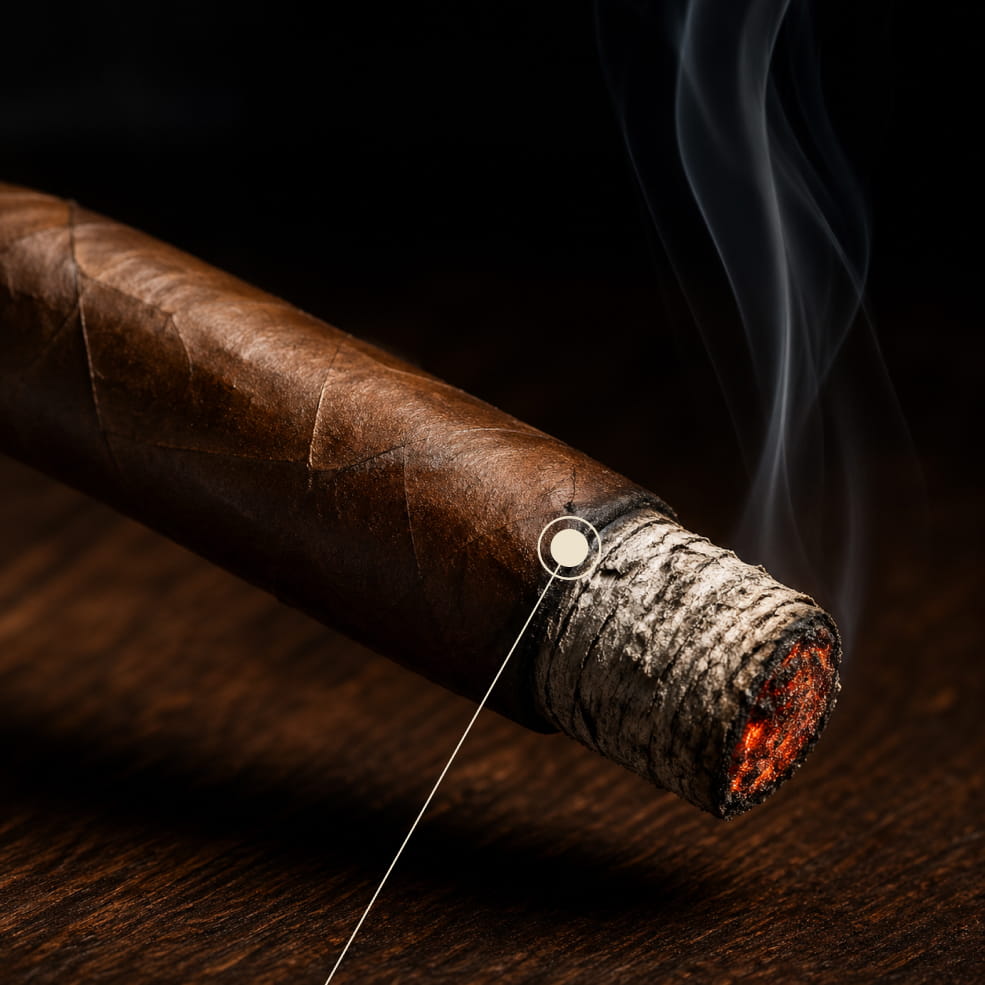
The draw is the airflow through the cigar after the cap is cut. It is not a part of the anatomy. It is what happens when the anatomy works. A good draw is loose enough to pull cool smoke without effort and tight enough to keep the cigar dense and even.
A tight draw usually means the bunch is overfilled, the cigar is too humid, or the cap was cut too conservatively. A loose draw, sometimes called easy, usually means the bunch is underfilled or the bunching technique was sloppy. Both can ruin a cigar that looks beautiful on the outside.
How to test before you cut: gently squeeze the cigar along its length. It should give a little, then spring back. Hard spots and soft spots are signs of an uneven bunch. Most experienced smokers also do a cold draw, pulling air through the uncut cigar after a careful nick of the cap, to feel the airflow before lighting.
12 · The three words
Body, Strength, Flavour
These three words get used interchangeably by people who think they all mean powerful. They do not.
A cigar can be full-flavoured without being strong. A cigar can be strong without being especially flavourful. A cigar can be light-bodied and complex. Reviewing a cigar is partly about telling these three apart.
- Body: intensity and mouthfeel. A full-bodied cigar fills the palate; a mild-bodied cigar feels light.
- Strength: nicotine impact. The head-and-chest hit. Largely controlled by ligero filler content.
- Flavour: taste and aroma. Cocoa, leather, cedar, espresso, pepper. Independent of strength.
13 · The whole picture
Construction & Combustion
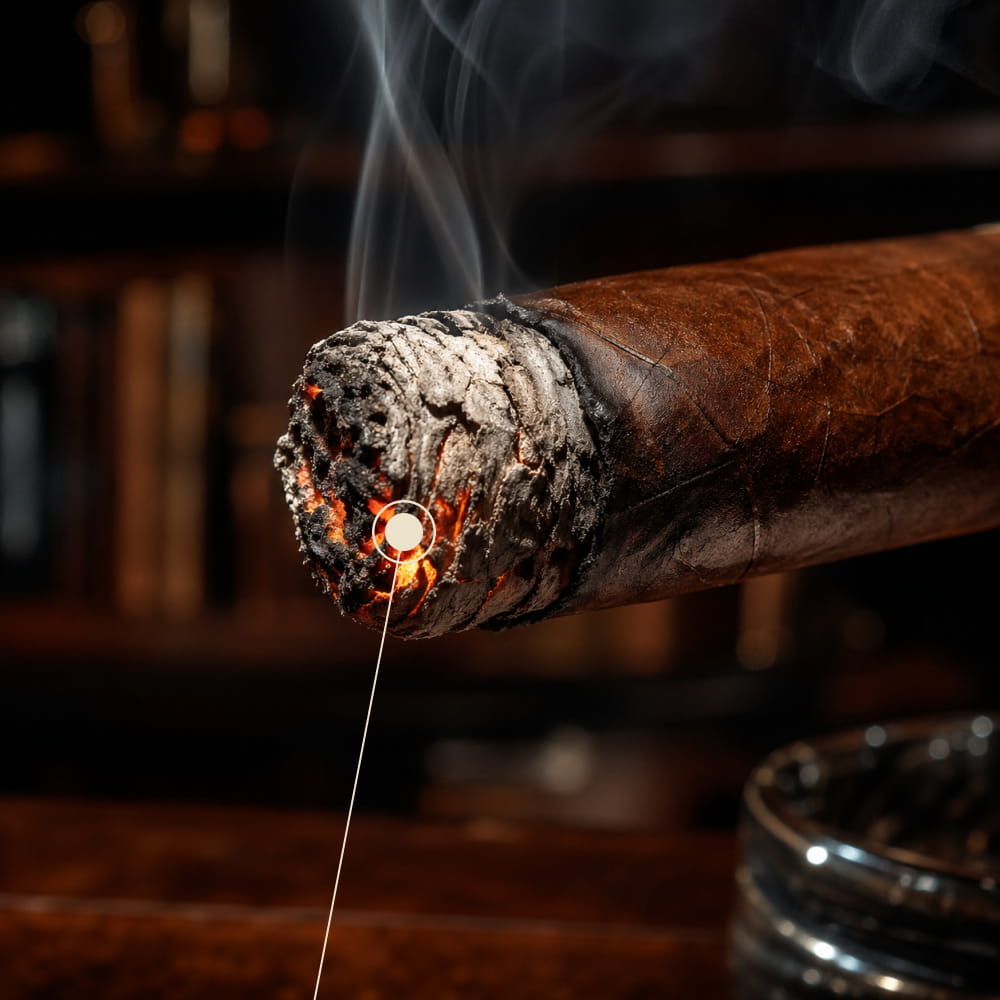
A cigar is not only a flavour delivery device. It is an engineered burn. Even a cigar with great leaves can smoke badly if the construction is off. A cigar with modest leaves can smoke beautifully if the construction is excellent.
Good construction shows up as a draw that is neither tight nor loose, a burn line that advances as a clean single ring, an ash that holds together for an inch or more before it falls, a wrapper that does not split or tunnel, and a cap that stays intact for the duration of the smoke.
What controls all of that: bunching method, filler density, leaf moisture, binder strength, ring gauge, the cigar’s age, and the ambient humidity in your humidor. Combustion is the result. Flavour rides along.
Why the vocabulary matters
Knowing these parts changes how you smoke. You notice the wrapper’s oils catching the light. You pay attention to the burn line rather than the smoke cloud. You cut above the shoulder because you know where the shoulder is and what happens if you cut below it.
A cigar stops being a mystery object in your fingers and becomes what it has always been, a small construction built to a recipe, carrying in its leaves the intention of whoever rolled it and the soil where the tobacco was grown.
The vocabulary is short. Use it the next time you light one up, and the cigar will smoke a little differently for you.