
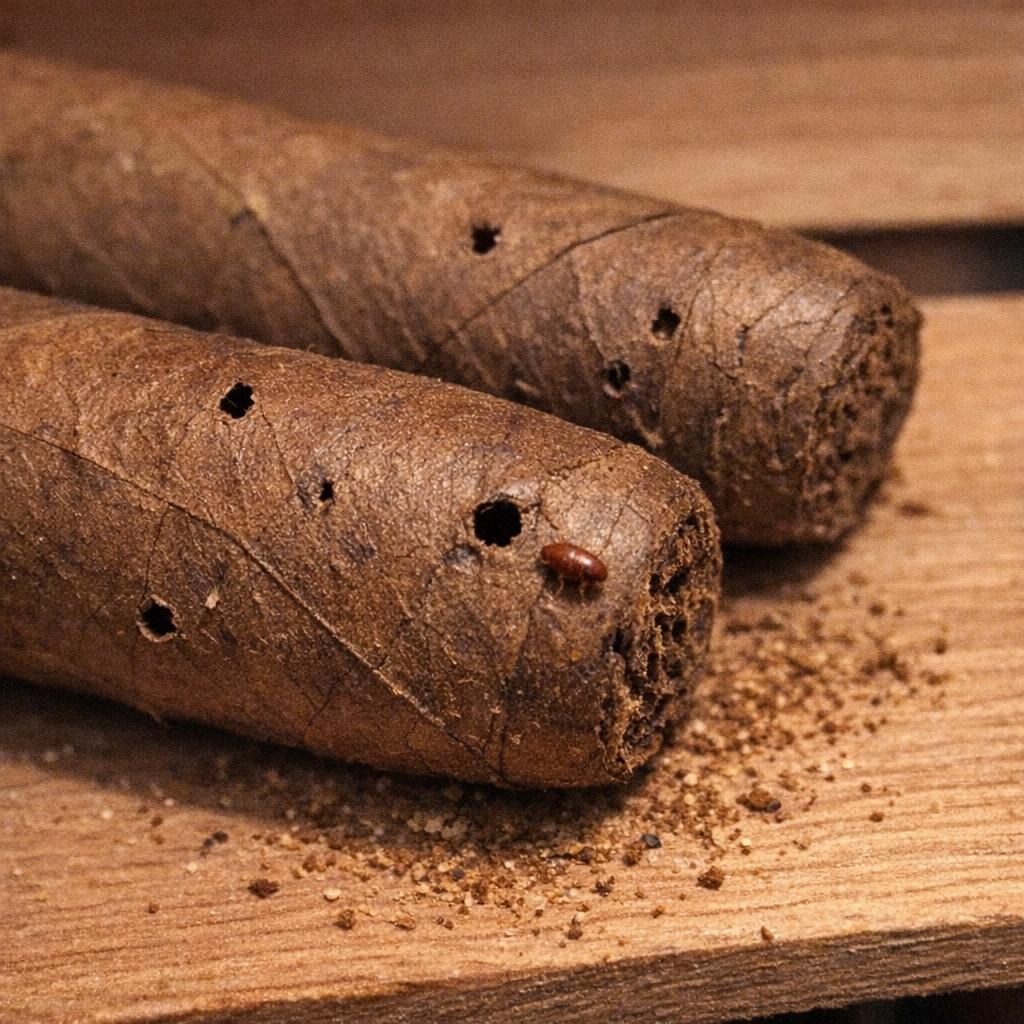
Cigar beetles, properly the cigarette beetle (Lasioderma serricorne), are small reddish-brown insects whose larvae feed on tobacco. The unsettling truth is that their eggs are often already present in cigars before they reach you. Manufacturers freeze finished cigars to kill larvae, but a small number of eggs can survive and lie dormant in the leaf for months. They wait for the right conditions, and then they hatch.
The conditions that wake them are warmth and humidity. Tobacconist University, the most cited industry reference, describes beetles becoming active above roughly seventy-three degrees Fahrenheit, particularly when humidity is also high. At fifteen degrees Celsius, about fifty-nine Fahrenheit, eggs do not hatch at all. Wherever you draw the precise line, the practical advice is the same: keep your humidor cool, stable, and out of direct heat. Below seventy degrees Fahrenheit is a sensible target. Above the low seventies, with humidity at seventy percent or more, you are doing the beetle’s work for it.
Two storage mistakes cause most outbreaks. The first is a humidor in a warm spot, on top of a fridge, against a sunny window, or near a radiator, so its temperature drifts up through the day. The second is a humidor run too wet. Bring both under control and the beetle has nowhere to start.
Know the warning signs. Small round holes in a wrapper, pin-prick exit marks at the foot, or fine tobacco dust collecting at the bottom of the humidor all point to an active infestation. A single beetle seen crawling is enough to act on. White powdery spots are a separate question, settled in our guide to plume on cigars.
If you find any of these, act at once, because one infested cigar will ruin a whole humidor. Remove and bin the visibly affected cigars. Seal the rest in a bag and freeze them: a day in the refrigerator first to settle them, then seventy-two hours at zero degrees Fahrenheit to kill any eggs, then a slow return to room temperature before they go back. The full sequence, with the exact temperatures and the reason for each step, is in our guide to freezing cigars to kill beetles. Empty and wipe the humidor down completely before you reload it, and recalibrate the hygrometer while it is empty. The full case on temperature, humidity, and stable storage is in How to Rest a Cigar.