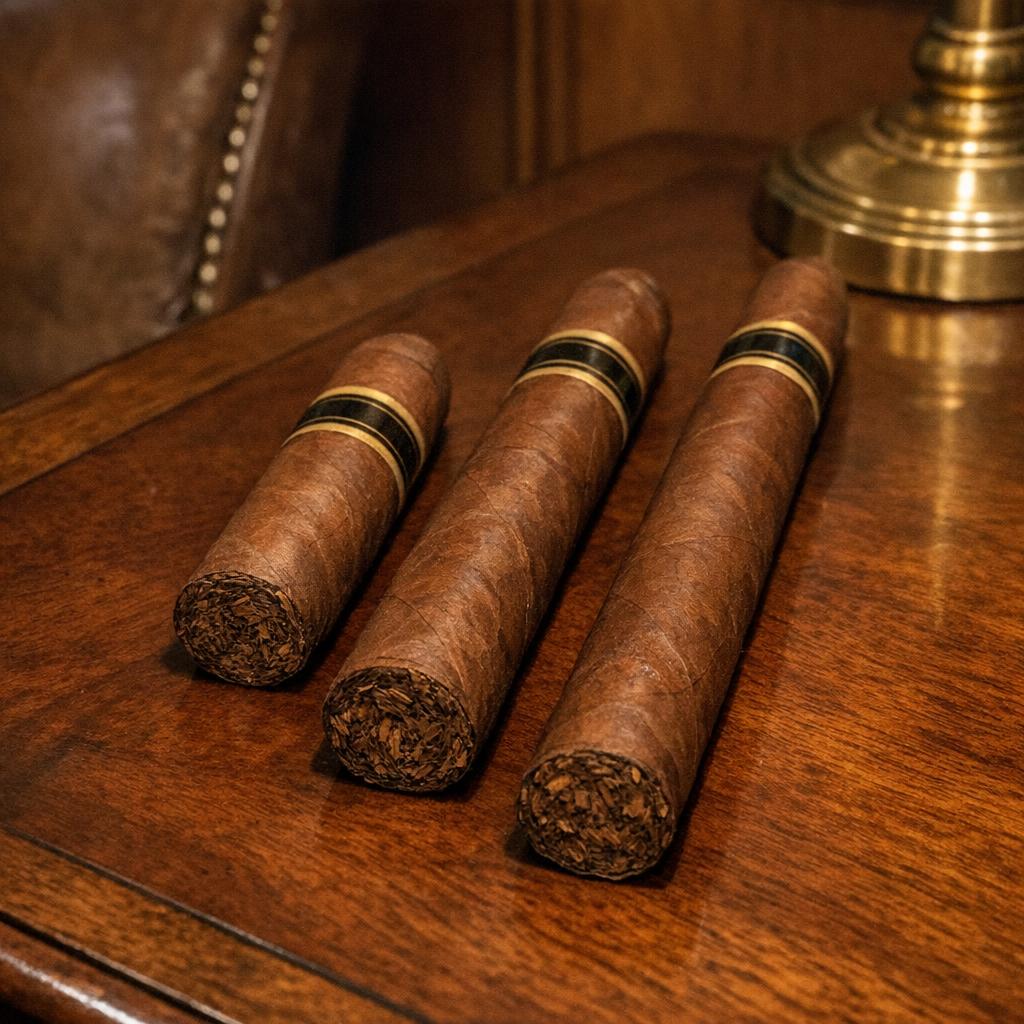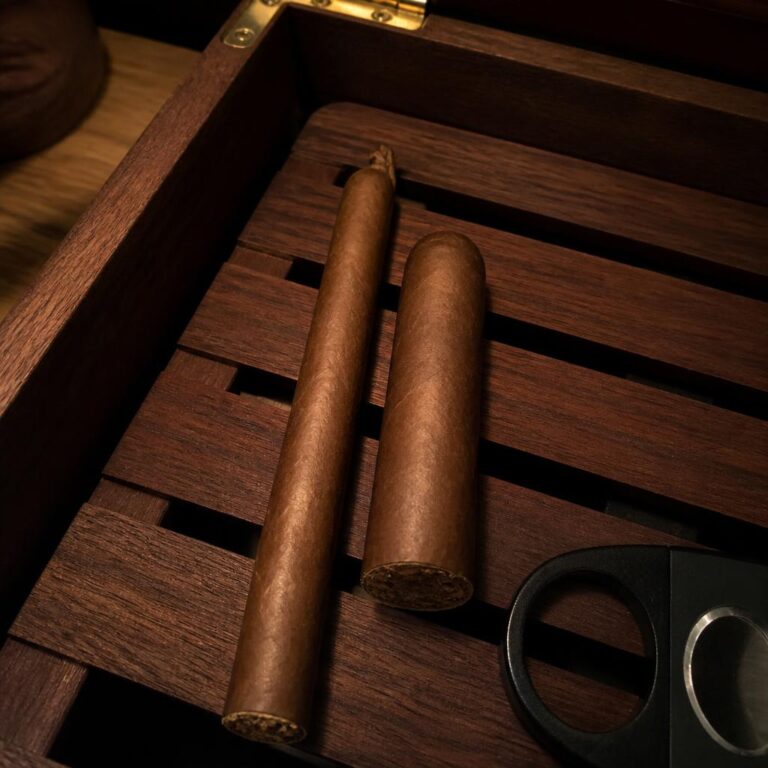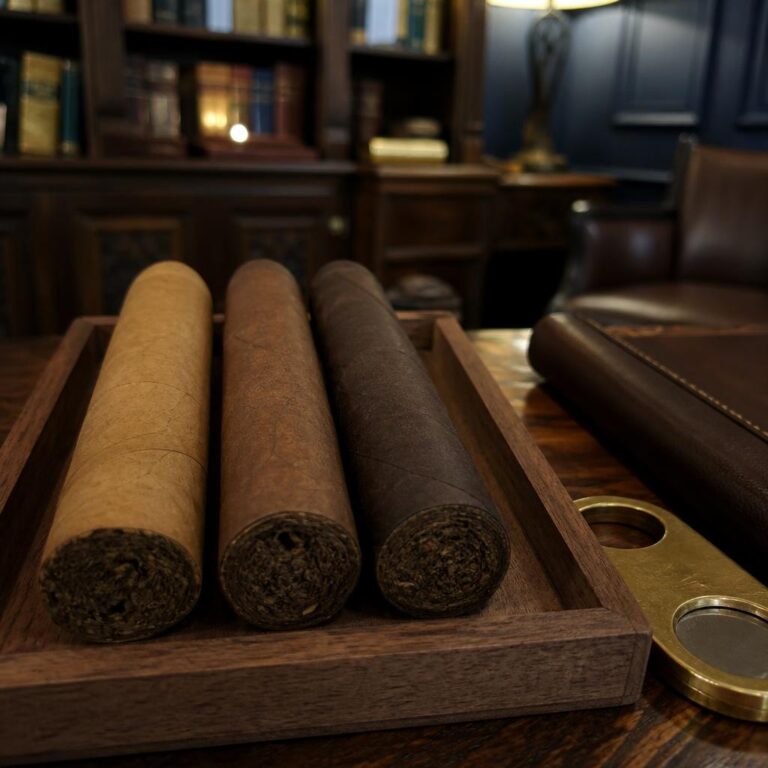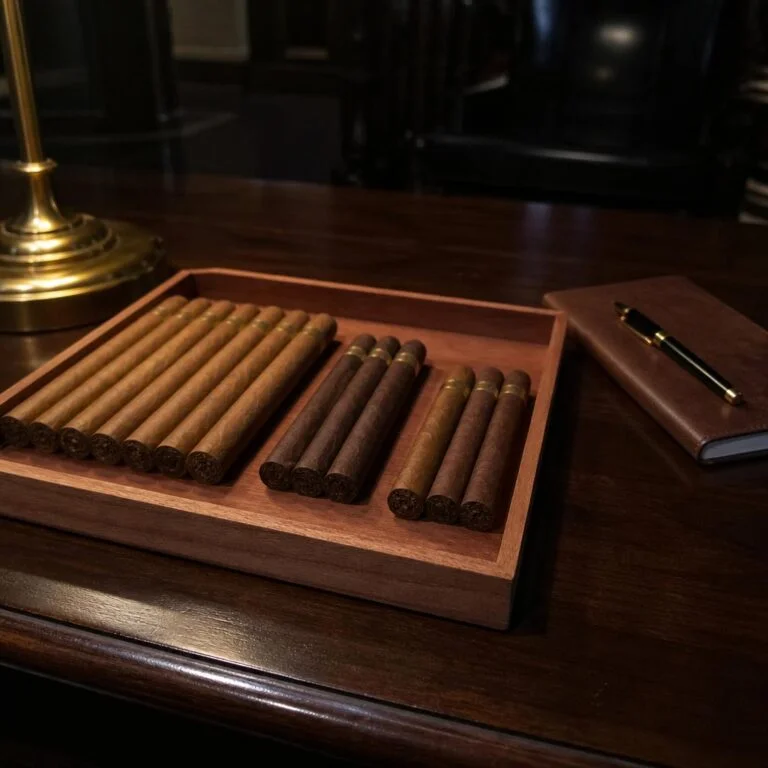
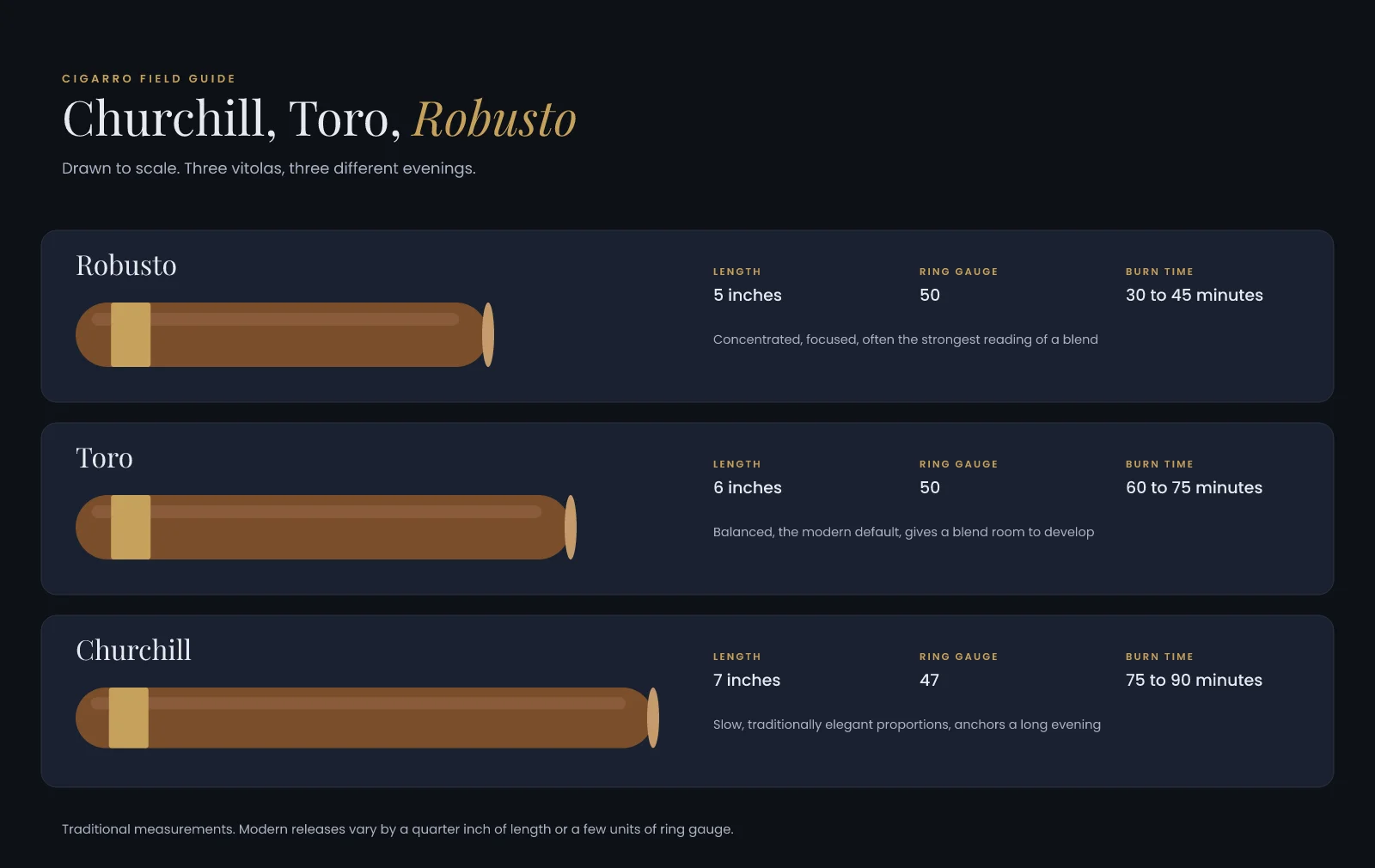
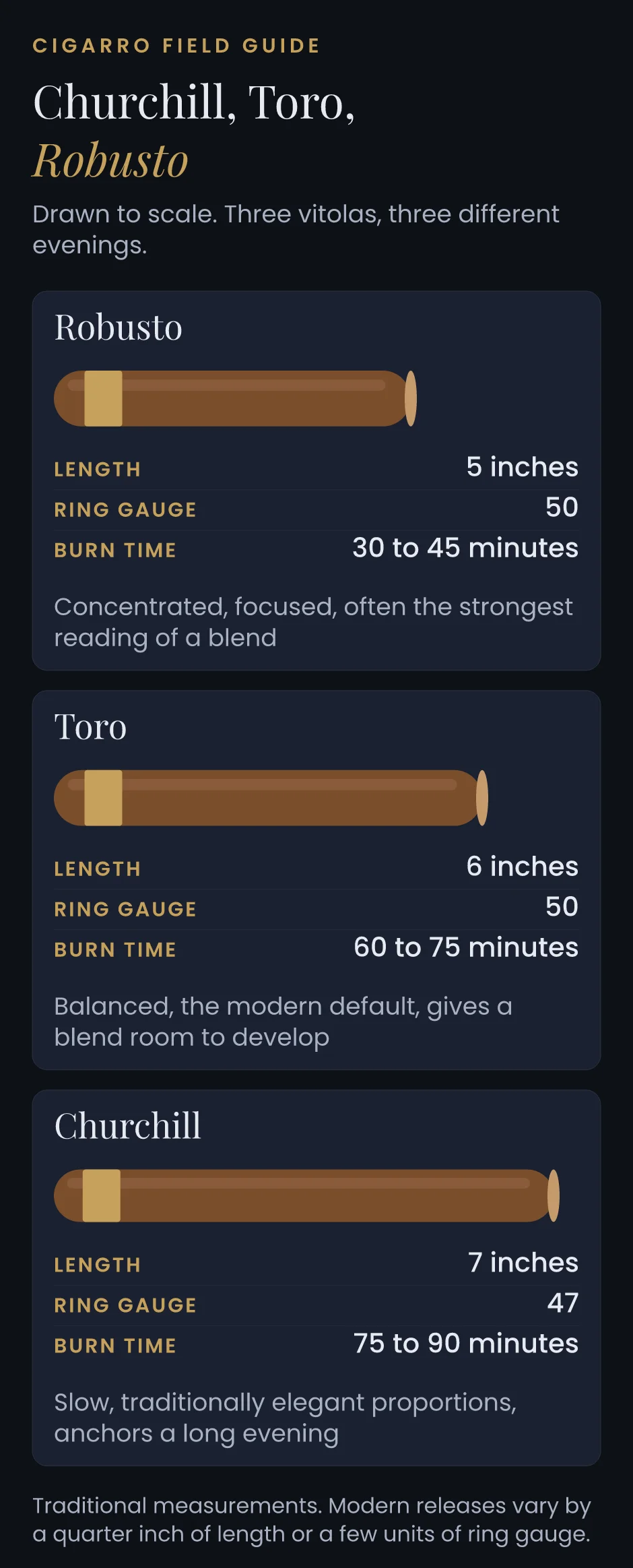
A Robusto is roughly five inches by 50 ring gauge and burns thirty to forty-five minutes. A Toro is six inches by 50 and burns sixty to seventy-five minutes. A Churchill is seven inches by 47 and burns seventy-five to ninety minutes. Those three cigars account for more shelf space in modern cigar shops than any other vitola, and most enthusiasts will smoke all three within their first year.
The differences are not subtle. A Robusto is built for a short, focused window. A Toro stretches into an hour with room for a single glass of whisky and a quiet conversation. A Churchill anchors a full evening, often ninety minutes or longer, and asks the smoker to commit before lighting.
The Robusto is the most-smoked size in the modern American cigar market. The Toro is the format most brand teams build their flagship blends around. The Churchill carries the most history. This is the short, working version of what each is, where the size came from, and which one to reach for on a given evening.
The Three Sizes at a Glance
Cigar Aficionado defines each vitola with a traditional measurement, and most modern releases sit within a small range of that standard. Ring gauge here is measured in sixty-fourths of an inch, so a ring gauge of 50 is fifty sixty-fourths of an inch across, or a little over three-quarters of an inch in diameter. The length figure is straightforward inches.
| Vitola | Length | Ring gauge | Burn time | Character |
|---|---|---|---|---|
| Robusto | 5 inches | 50 | 30 to 45 minutes | Concentrated, focused, often the strongest reading of a blend |
| Toro | 6 inches | 50 | 60 to 75 minutes | Balanced, the modern default, gives a blend room to develop |
| Churchill | 7 inches | 47 | 75 to 90 minutes | Slow, traditionally elegant proportions, anchors a long evening |
Modern releases sometimes push these dimensions out. Churchills can land at 47, 48, 50, or 52 ring gauge depending on the maker. Toros can run at 50, 52, or 54. Robustos most often hold close to 5 by 50, with occasional 5 by 52 variants. The traditional figures above are the centre of the range, not a rule.
Robusto: The Quick Companion
The Robusto is the most-smoked size in the modern American market, and Cigar Aficionado has long described it as the most popular cigar size in America. Short, comparatively fat, and compact in the hand, it concentrates a blend into a tight thirty-to-forty-five-minute window.
Because the wrapper, binder, and filler are pressed into a shorter cigar, a Robusto often reads as the strongest expression of a given blend. The same recipe in a Robusto and a Toro will frequently feel more intense in the Robusto, because the smoker reaches the strongest part of the cigar sooner.
This makes the Robusto the practical choice for an afternoon between obligations, a quick smoke on the patio after dinner, or a working test of a new blend before committing to a box. It is the cigar most enthusiasts reach for when they have something else to be getting on with.
Toro: The Modern Default
The Toro is the format most cigar makers build their flagship blends around. At six inches by 50 ring gauge, it offers enough length for a blend to develop through its three thirds without ever feeling rushed, and enough ring gauge to keep the burn even and the draw open.
There is a practical reason the Toro is the size both blenders and reviewers reach for first. The Robusto compresses a blend into a shorter window; the Churchill stretches it past the smoker’s natural attention span; the Toro lets it breathe. A blend that performs well in a Toro is usually a blend that performs well, full stop.
For most enthusiasts, the Toro is also the most pleasant smoking time: about an hour, plus or minus fifteen minutes. Long enough to feel deliberate. Short enough that a busy week can still fit one in. If you are buying your first box of a new blend, buy it in Toro until you know better.
Churchill: The Long Conversation
The Churchill is named, predictably, after Winston Churchill, who was known to smoke several large Cuban cigars a day through most of his adult life. Romeo y Julieta named a long-format vitola after him, and the name eventually became a generic size designation that other makers adopted across the industry. Cigar Aficionado’s glossary places the traditional Churchill at seven inches by 47 ring gauge, and classic Cuban examples sit close to that.
Modern Churchills often land at seven inches by 48, 50, or even 52 ring gauge, which slightly modernises the proportions but loses some of the elegance of the original. A traditional Churchill at 47 ring gauge has a long, lean, almost ceremonial silhouette. A Churchill at 50 ring gauge is, in honest terms, a long Toro.
The Churchill asks for time. Seventy-five to ninety minutes is realistic; some Cuban Churchills run past two hours. This is the cigar to reach for after a long dinner with no plans, on a quiet evening at home, or at a celebration where pacing matters as much as the smoke itself. A Churchill is not a weeknight cigar.
Toro vs Robusto, head to head
Strip away the Churchill and the comparison that actually gets searched is Toro versus Robusto, and it comes down to one number. Both run 50 ring gauge. The Robusto is five inches and burns thirty to forty-five minutes. The Toro is six inches and burns sixty to seventy-five minutes. Same diameter, same draw, same blend in most lines that offer both, the only variable is how long you want to sit with it.
That extra inch buys pacing, not a different cigar. A Toro gives a blend more room to open up: the first third has longer to settle before the second third arrives, which is why brand teams reach for the Toro when they want reviewers to see a blend’s full development. A Robusto compresses the same arc into a shorter window, which reads as slightly more intense simply because there is less time for anything to spread out.
Reach for the Robusto when the evening is short or you are still deciding whether you like a blend. Reach for the Toro when you have the hour and want to watch the same cigar change.
Robusto or Toro: The Short Answer
If you only want the verdict: a Robusto is the classic 5 inches by 50 ring gauge, burning thirty to forty-five minutes, and suits an evening that has other plans. A Toro is 6 by 50, running sixty to seventy-five minutes, and gives the blend more room to develop through its thirds. The Churchill, at 7 by 47, runs seventy-five to ninety minutes and is the long dinner of the three. Most collectors keep all three on hand and choose by the hour available rather than by loyalty to a size. A vitola is a promise about the length of an evening, and the only wrong choice is the one that outlasts the hour you have.
When to Reach for Each
A practical rule of thumb is to choose by available time rather than by character.
Forty-five minutes or less. Robusto. The shorter format respects the time you actually have. A Toro half-smoked is a Toro wasted, because few cigars improve when relit hours later.
Sixty to seventy-five minutes. Toro. The default for an evening with a single drink, a book or quiet conversation, and no need to keep checking the time.
Ninety minutes or longer. Churchill. Reserved for evenings that will be unhurried. The Churchill is also the traditional choice for celebrations and ceremonies, where its length is part of the occasion.
There are exceptions. Some Robustos are meditative slow-burners that stretch past an hour. Some Churchills draw quickly and finish closer to seventy minutes. The averages above are the centre of the distribution, not the whole of it.
A second working rule is the time-of-day rule. Robustos suit late mornings and afternoons. Toros suit early evenings. Churchills suit late evenings, often after dinner, often alone or with a single companion who has the same intention.
The Concierge's Default Is the Toro
If you ask a concierge to recommend a single vitola for an enthusiast still building a sense of their own preferences, the answer is the Toro. The reasoning is not glamorous.
The Toro gives a blend its fairest test. The smoker has time to taste the first third, watch the blend transition through the second, and finish in the third without the cigar feeling rushed or overlong. Reviewers default to the Toro for the same reason, and brand teams design their flagship blends with the Toro in mind.
A first cigar journal entry written on a Toro tends to be a more honest record of what the cigar actually is. A new humidor stocked principally with Toros, with a smaller selection of Robustos for short windows and the occasional Churchill for slower evenings, is a sensible distribution for most enthusiasts.
This is not a rule. Some smokers will land happily on the Robusto as their default because their schedule allows nothing longer, and some will end up with a humidor weighted toward Churchills because that is the pace their evenings keep. The Toro is the safe centre, not the only correct answer.
A Note on Size Variation
None of these dimensions are perfectly standardised across the cigar industry. Cigar Aficionado offers the traditional measurements; individual brands and even individual lines within a brand may vary by a quarter inch in length or a few units of ring gauge.
A Padrón 1964 Robusto measures slightly differently from an Arturo Fuente Don Carlos Robusto. A Cohiba Robusto reads differently again. The vitola names point at a centre of mass, not a precise specification.
If exact dimensions matter for the comparison you are running, the most reliable place to find them is the brand’s own product page or the Cigar Aficionado glossary entry for the specific cigar. Retailer listings are usually accurate but worth double-checking against the maker.
Frequently Asked Questions
What is the difference between a Robusto, a Toro, and a Churchill?
The three sizes differ in length, ring gauge, and burn time. A Robusto is roughly five inches by 50 ring gauge and burns thirty to forty-five minutes. A Toro is roughly six inches by 50 and burns sixty to seventy-five minutes. A Churchill is roughly seven inches by 47 and burns seventy-five to ninety minutes. The wrapper, binder, and filler can be the same across all three; only the dimensions change.
Which is stronger, a Robusto or a Toro?
The same blend often reads as slightly stronger in a Robusto than in a Toro because the flavours are concentrated into a shorter smoking time. The tobaccos are the same; only the smoker’s pacing changes. Strength itself comes from the filler and the binder, not from the vitola.
How long does a Toro cigar last?
A typical Toro burns for sixty to seventy-five minutes. Smoking pace, humidity, and ring gauge all affect this. A slow smoker may stretch a Toro past an hour and a half. A faster smoker may finish in around fifty minutes.
What size is a Churchill cigar?
A traditional Churchill measures seven inches in length with a ring gauge of 47. Modern Churchills often run slightly larger, sometimes at ring gauges of 48 to 52, but the seven-inch length is the defining dimension.
Why is it called a Churchill?
The size is named after Winston Churchill, who smoked several large Cuban cigars a day through most of his adult life. Romeo y Julieta named their long-format cigar after him, and the name eventually became a generic vitola designation as other makers adopted similar dimensions.
What is the most popular cigar size today?
Cigar Aficionado has long reported the Robusto as the most popular cigar size in the American market. The Toro has been gaining ground steadily and is the size most often used by reviewers and brand teams for flagship releases, but in raw sales volume the Robusto continues to lead in most segments.
Is a bigger cigar always better?
No. Larger cigars are not stronger or higher in quality by default. The vitola affects pacing, burn behaviour, and the time you spend with the smoke, not the inherent quality of the tobacco. A well-made Robusto is a better cigar than a poorly made Churchill.
What is the best cigar size for beginners?
The Robusto is often recommended for beginners because it fits a shorter window and feels less committing. The Toro is also a reasonable starting size for someone who wants to taste a blend’s full development. The Churchill, at ninety minutes or longer, is generally too much cigar to start with.
Is a Toro bigger than a Robusto?
Yes, by an inch. The classic Robusto measures 5 inches with a 50 ring gauge; the classic Toro runs 6 by 50. Same thickness, more length, which mostly buys you time and a cooler, more gradual development of flavour.
Which lasts longer, a Churchill or a Toro?
The Churchill. At roughly 7 inches by 47 ring gauge it typically burns ninety minutes or longer, against sixty to seventy-five minutes for a Toro. If the evening is short, the Toro is the safer commitment.
Which is better, a Toro or a Robusto?
Neither is objectively better; they are the same blend at two different paces. A Robusto (five inches, 50 ring gauge, thirty to forty-five minutes) concentrates the experience into a shorter window. A Toro (six inches, 50 ring gauge, sixty to seventy-five minutes) gives the same blend more room to develop across its thirds. Choose the Robusto when time is short, the Toro when you want to watch a blend open up.
Choose by Time, Not by Size
Three vitolas, three slightly different evenings, one consistent rule: choose by the time you actually have, not by the cigar you wish you had time for. A Robusto finished is better than a Toro abandoned. A Toro on a Tuesday is more enjoyable than a Churchill rushed. A Churchill on a Saturday, with no plans afterwards, is one of the more pleasant ways to end a week.
Logging which vitola sat best with which evening is the small habit that turns a casual smoker into someone with a real sense of their own preferences. The Cigarro method, smoking and reviewing in thirds, becomes more useful as soon as you have ten or twelve entries that you can sort by vitola.