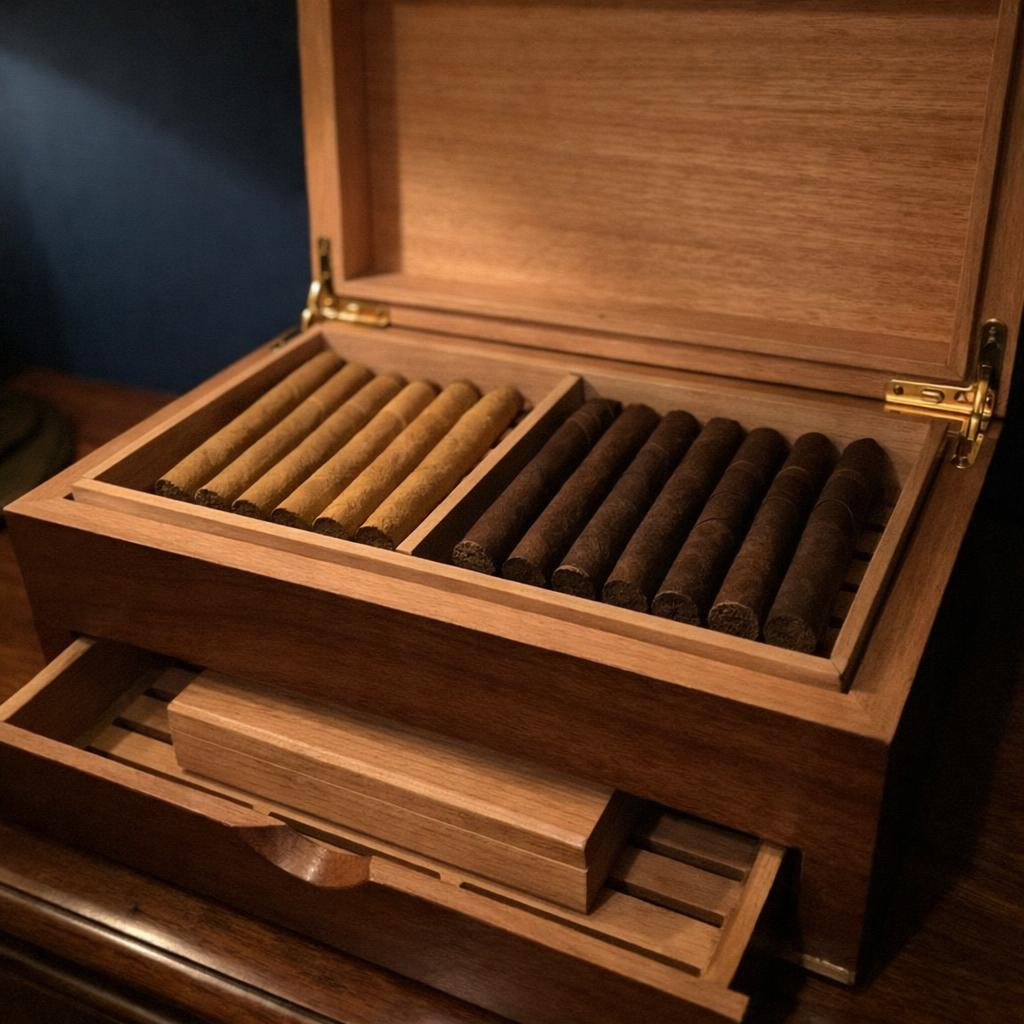
Most humidors do not look like the catalogue photograph. They look like a drawer that someone meant to deal with on Sunday. Cellophane jackets confuse each other, bands point in unrelated directions, a half-smoked box from August sits where the new arrivals should be. None of this is failure. It is simply what happens when nobody has thought about the box since it was filled.
What follows is the case for thinking about it once, properly, and rarely after. A humidor that is organised is not a humidor that looks neat. It is a humidor that surfaces what is ready to smoke, protects what is still resting, and leaves no question about which cigar came from which box. The four axes that get you there are wrapper, age, ring gauge, and occasion. The rotation rule is top shelf and bottom shelf. The connective tissue is Spanish cedar. The rest is discipline.
This guide is built around a system that has held up across several humidors and a great deal of moving. Where it speaks in absolutes, those absolutes come from the trade press, the manufacturers, and the tobacco itself. Where it expresses a preference, that preference is mine. Cigarro is at the end, briefly, as the digital mirror of whatever shelf you actually keep.
The Parts of a Humidor
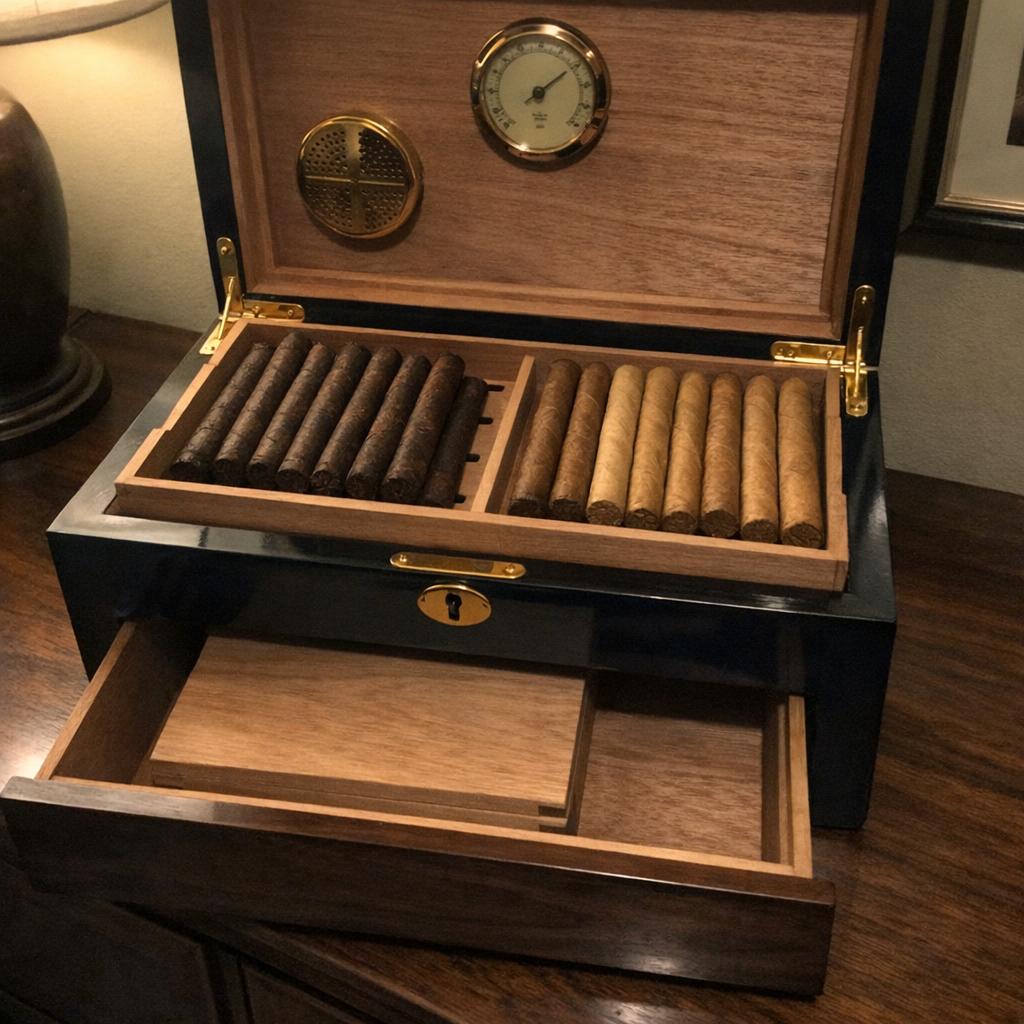
A humidor is a simple box until something needs explaining, and then the parts suddenly matter. Five components do the actual work: the lid and its seal, the hygrometer, the humidification device, the Spanish cedar lining, and the trays and dividers that hold the system together. Everything else in this guide, wrapper groups, rotation shelves, cedar trays, assumes you already know what these five things are and what each one is responsible for. Here they are, named properly, once.
Part by Part
The Parts of a Humidor
- Lid and seal: the join that keeps humidity in and outside air out; the part doing the actual sealing work.
- Hygrometer: the gauge that reads relative humidity, mounted in the lid or resting on a shelf.
- Humidification device: the pack, jar, or unit that releases moisture into the box, and in two-way designs, absorbs it back out again.
- Spanish cedar lining: the wood that buffers humidity swings and carries the aroma cigars are stored in.
- Trays and dividers: the cedar slats and shelves that keep wrapper groups and rotation batches apart.
None of the five works alone. A hygrometer paired with a failing humidification device only reports the bad news accurately. A humidification device without cedar trays and dividers cannot distribute what it releases evenly through the box. The rest of this guide assumes the vocabulary above and moves straight into sorting the cigars themselves, wrapper by wrapper, shelf by shelf.
What Organisation Actually Means
Organisation is often confused with neatness, and the two are not the same thing. A neat humidor has the bands lined up. An organised humidor knows which cigar in it is ready to smoke tonight.
A working humidor does three things, and only three. It protects the cigars from changes in condition, so that what you put away on Tuesday is still in the same state on Friday. It surfaces the cigars that are ready to smoke, so that opening the lid in the evening is a quick decision rather than a hunt. And it protects the cigars that are still resting, so that they reach their own readiness without being disturbed. The first of those three is a subject in itself, covered in our guide to storing cigars properly.
Most disorganised humidors fail on the second of these three. The cigars are well kept. They are simply unfindable. The new robusto that came in on Monday is buried under a box of churchills that should not be touched until autumn, and the half-finished bundle of daily smokes is mixed in with two limited editions you have been saving for a quiet night. The cigars are not lost. The plan is lost.
The aim of organisation is to make the plan readable from the lid down. A small amount of structure at the start saves a great deal of digging later, and saves the cigars from being disturbed every time you reach in. Tobacco does not enjoy being shuffled.
The Four Sorting Axes
At a Glance
The Four Sorting Axes
- Wrapper: lighter wrappers and darker wrappers kept apart; aromas migrate over months.
- Age: new arrivals at the bottom, ready cigars on top; the rotation moves upward.
- Ring gauge: thicker vitolas grouped together, slimmer to one side; the choice fits the evening.
- Occasion: regulars and specials separated; the regulars do not feel rationed, the specials do not feel ordinary.
Sorting a humidor by one axis alone produces a tidy-looking failure. A humidor sorted only by brand will mix maduros with claros and old with new. A humidor sorted only by date will mix cigars that should never share a shelf. The system that works is layered: four axes, applied in order.
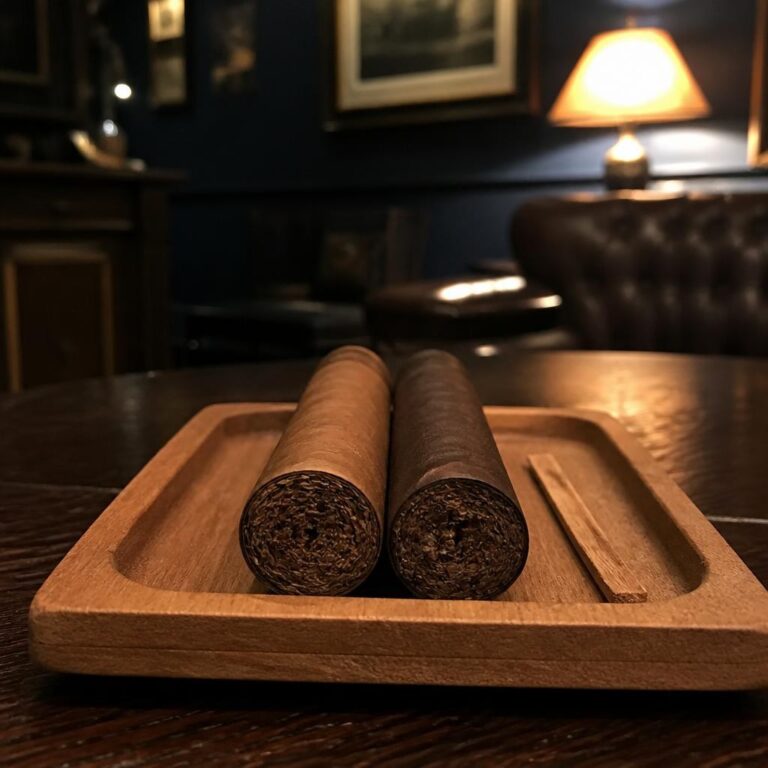
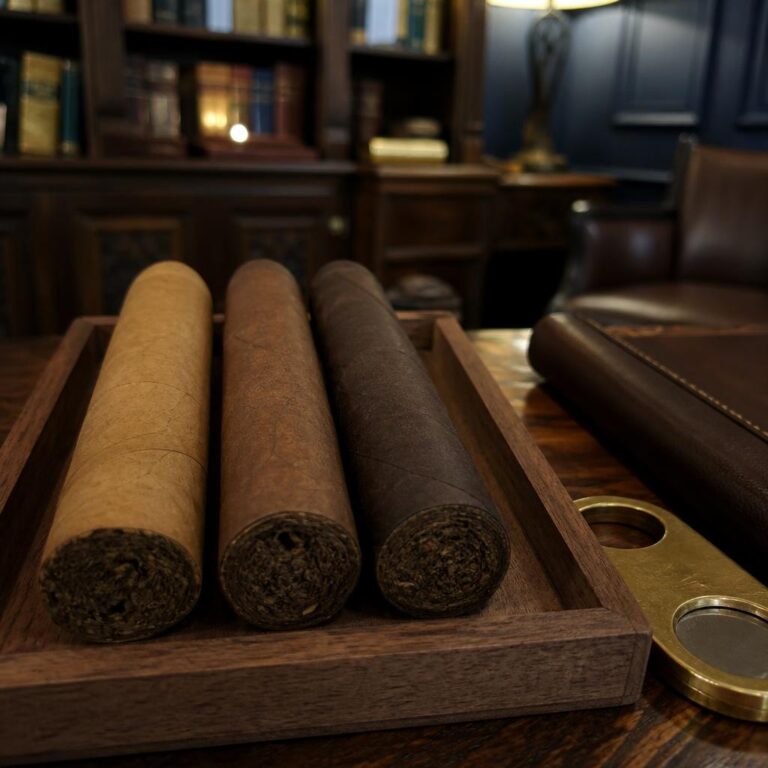
The first axis is wrapper. Lighter wrappers and darker wrappers do not belong in the same compartment over months. Connecticut shade and Ecuadorian Connecticut are the lighter end. Cameroon sits at the light side of middling and often groups with the lighter wrappers in practice, though serious smokers will keep it apart if they have the space. Habano and Corojo are middling. Sumatra varies by origin, with Indonesian leaf often sitting at the lighter end and Ecuadorian Sumatra closer to the middle. Maduro and Oscuro are the heavier end. Over time, aromas migrate. A Connecticut shade resting next to a Brazilian Mata Fina maduro for six months will pick up a sweetness it did not have, and the maduro may lose a little of its own. This is not catastrophic, but it blurs the cigars you are trying to know. The lighter wrappers go on one side, the darker on the other, and the middling can fall either way depending on what you smoke more of. For a deeper look at each of these leaves, see Cigar Wrapper Types Explained: From Connecticut Shade to Oscuro.
The second axis is age. Newer arrivals settle lower in the humidor, where the conditions are most stable. Cigars that have rested through their first month and are ready to be considered move up. Cigars that are mid-aging stay where the conditions are quietest. The point of the second axis is not date-stamping for its own sake; it is to make sure a cigar is not pulled before it has finished arriving.
The third axis is ring gauge, and it is the most practical of the four. A robusto takes around an hour, sometimes a touch longer. A churchill runs closer to two. A petit corona is a thirty-minute affair. The choice on a given evening is partly about taste and partly about what the evening can hold. Grouping by ring gauge means the decision is in the right neighbourhood before you have picked anything up. The thicker vitolas go to one side or one shelf; the slimmer to another. A figurado, being its own awkward shape, sits where it fits.
The fourth axis is occasion, and it is the one most easily skipped. Cigars fall into roughly two categories: the regulars, smoked without ceremony on a weekday after dinner, and the specials, kept for a quiet Saturday or a piece of good news. Mixing them produces the worst of both outcomes. The regulars feel rationed, and the specials feel ordinary. A clear separation between the two, even within a single humidor, is the difference between a working collection and a museum.
Four axes is the maximum that a humidor of any reasonable size can hold. Five is the start of fiddling. Three is usually enough for a sixty-count desktop. Wrapper and age are the two non-negotiables. The rest is geography.
Top Shelf, Bottom Shelf
The simplest rule in any humidor with more than one tray is also the most useful. The top shelf holds the cigars that are ready to smoke. The bottom shelf holds the cigars that are still resting.
The reason is partly atmospheric and partly behavioural. Humidors are most stable at the bottom, where temperature swings travel last and the air is least disturbed by the lid being opened. Cigars resting through their first month, or aging through their first year, want this quiet. They have nothing to gain from being reached past every evening.
The cigars on the top shelf are a different matter. They have finished arriving. They have lost their ammonia, their components have agreed with each other, and the wrapper has settled. They are, in the strict sense, ready. The top shelf is the shelf where the decision is made.
The rotation works in one direction only, upward. A new box arrives on the bottom shelf or in a lower tray. Thirty days later, if the cigars have made it through their acclimatisation cleanly, three or four move up to the top shelf and join the working stock. The rest of the box stays below, undisturbed, for whatever schedule the cigar calls for. A robust puro from a serious maker may want six months. A milder blend may be ready in six weeks. The bottom shelf accommodates both.
One implication is worth stating plainly. If you find yourself reaching past resting cigars to get to the smoking stock, the layout is wrong. Move things until the reach is straightforward. The cigars at the bottom should never be jostled to reach the cigars at the top. If your humidor is single-tier, the same logic applies horizontally: a back zone and a front zone, with the new arrivals at the back where the lid is opened least.
Active humidification works best distributed through the humidor rather than concentrated in one spot. Boveda’s own guidance is distribution: roughly one sixty-gram pack per twenty-five cigars, spread across the trays and the floor compartment. The bottom should never be starved, because the resting cigars there are the ones most vulnerable to a drift in conditions, and a single pack stuck in the lid will not reach them. The cigars on the top tray follow whatever the rest of the humidor is doing within a few hours, which is to say they follow what is happening at the bottom.
A Working Rule
Humidification Placement
One sixty-gram Boveda pack per twenty-five cigars is the brand’s own guidance. Distribute them; do not stack them in the lid. If you are mixing your own solution rather than using pre-charged packs, the choice of propylene glycol versus distilled water changes how the humidor performs over time.
- 50-count desktop: 2 packs (one per tray)
- 100-count desktop: 3 packs (one per tray, one in the floor)
- 300+ count cabinet: scale to one pack per 25 cigars, distributed across shelves
Spanish Cedar and the Divider
Almost every premium humidor is lined in Spanish cedar, the common name for Cedrela odorata, a Central and South American hardwood. The choice is not aesthetic. Cedar is the divider material the tobacco trade settled on because it does several things at once.
It buffers humidity. Cedar absorbs and releases water vapour slowly, which means the air around a stack of cigars stays more stable than the air in an empty bare-wood box. It contributes a faint, sweet aroma that complements tobacco rather than fighting with it. It is said to discourage tobacco beetles to a degree, though the evidence for that is more anecdotal than scientific and you should not rely on cedar in place of temperature discipline. And it does not bleed unwanted resins into the wrappers the way pine or some softer woods can.
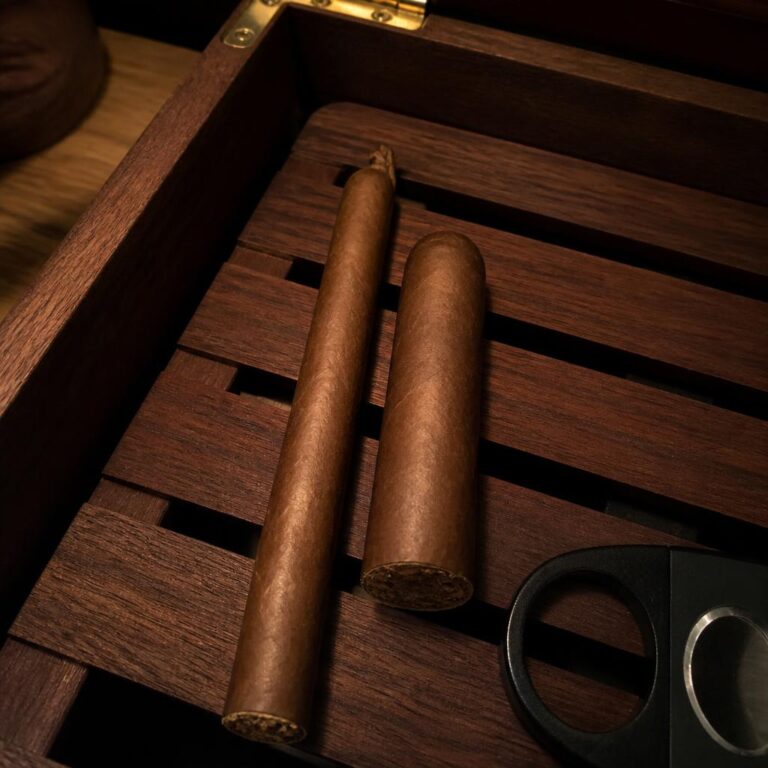
The practical consequence is that any internal divider in your humidor should be cedar, and ideally Spanish cedar specifically. The thin slats that come with most desktops are fine; full cedar trays are better. If you want to keep wrappers apart, a single cedar slat is enough; the cigars do not have to be sealed off from each other, only separated. Cardboard dividers, plastic spacers, painted wood, lacquered finishes, and anything from a craft shop should stay out of the humidor entirely. They will either off-gas into the cigars or hold the wrong amount of moisture.
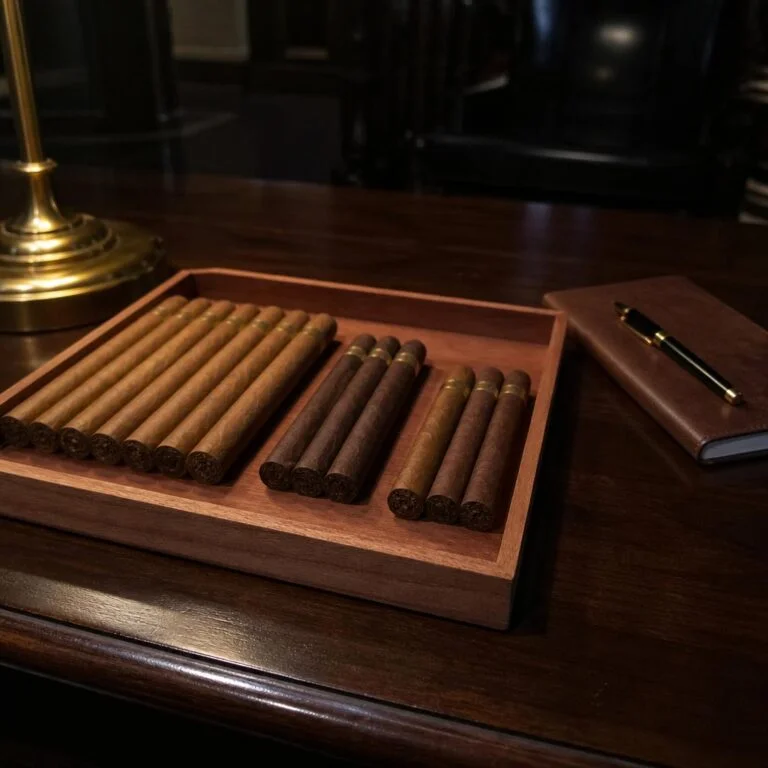
Cedar trays earn their keep when you have more than thirty cigars. A tray slides out, the cigars on it stay together, and the rotation becomes a tray-by-tray exercise rather than a finger-by-finger one. Trays also let you label a shelf without writing on the humidor itself. A small adhesive label on the tray, removable, naming the wrapper group or the box origin, is a small gesture that pays back every time you open the lid.
A worn cedar tray loses its aromatic contribution after a few years and is worth replacing. The wood does not stop working; it simply becomes neutral. If the inside of your humidor has the faint cigar-shop smell, the cedar is doing its job. If it smells of nothing, replace what is replaceable and consider a thin sheet of fresh cedar laid on the bottom.
One note on box storage. A cigar can rest in its original box happily, particularly a box made of cedar. Many serious manufacturers ship in unfinished cedar boxes for exactly this reason. The box becomes a humidor within a humidor, holding its own micro-atmosphere. The convention among careful collectors is to leave a box intact for at least its first weeks of rest, often longer if the cigars are meant to age, and only then break it down for working stock. The cigars in the unopened box continue to age in the conditions the maker intended.
When to Crack a Box
A box of cigars is a small architecture. The construction matters. Spanish cedar boxes hold a slow-changing micro-climate that helps cigars marry through their first months. Cardboard boxes are perfectly adequate for the cigars inside them but do not contribute the way cedar does. Slide-lid boxes, hinge-lid boxes, dress boxes, and bundles each behave differently inside a humidor.
The convention for serious storage is to leave a new box closed for its first weeks of acclimatisation. The cigars are already in conditions chosen by the maker, sealed against the open air. Opening the box too early breaks that micro-climate before it has done its work. Thirty days closed, in a humidor at sixty-five to sixty-nine percent relative humidity, will let the cigars settle into your conditions without losing the protection of their original packaging.
After the first month, the decision is whether to break the box down into working stock or to leave it whole for longer aging. A robusto box that you intend to smoke through over a few months can be broken down at this point. A churchill box that you intend to age for a year or more is better kept closed. The cigars at the centre of an intact box rest in the most stable conditions in your humidor.
Once a box is open, the convention is to take from the same end consistently, working through the row rather than picking from the middle. This keeps the unopened end of the box at maximum stability and means the cigars that have rested longest are the ones smoked first. It is a small habit and it pays back.
Bundles, by contrast, want to be loosened on arrival. A bundle of fifty cigars wrapped tightly will hold its own internal moisture poorly once it leaves the maker’s hands. Cut the string, lay the cigars flat in a tray, and let them breathe within the humidor. Most bundles are working stock by design, and a tray is their proper home. Some boutique bundles, the Tatuaje brown-label runs and a few of the small-batch RoMa Craft releases among them, are long-filler tobacco that rewards aging. Treat those examples like loose cigars from a box: a separate slot, a date label, and patience.
A Worked Example: The 100-Count Desktop
A 100-count Spanish cedar desktop humidor with two trays and one floor compartment is a useful working size for a careful smoker. It is large enough to hold a working collection and small enough to keep stable on a sideboard. The following is how mine sits, which is one configuration of many that work.
The top tray, around forty cigars, is the smoking stock. It is sorted first by wrapper. The left half holds Connecticut shade and Cameroon wrappers, including the lighter end of the working collection: Arturo Fuente Hemingway Short Story, Davidoff Signature 2000, a few Macanudo Cafés for very mild evenings. The right half holds the maduros and darker wrappers: Padron 1964 Anniversary Principe and Exclusivo, Liga Privada No. 9 robustos, a row of Punch Knuckle Busters. The trays are sized for cigars to lie in single rows, which makes the wrapper count visible from above. Light on the left, dark on the right.
The bottom tray, around thirty cigars, holds the resting stock. New arrivals come in here. A box of Davidoff Aniversario No. 3 from last month sits at the back; a half-broken-down box of Padron 1964 Imperials sits at the front, already partway through its rest. Anything that has been in the humidor less than ninety days lives on this tray, in roughly the order it arrived. When a cigar has earned its place on the top tray, it migrates upward.
The floor compartment, under both trays, holds the aging stock and any whole boxes. Whole boxes of Padron Family Reserve, an unopened Davidoff Royal Release, and a small set of OpusX that I have been saving sit here. They are touched rarely, the door is opened on them only to check the hygrometer, and they are tracked in the app so that I know what is where without lifting the trays.
Active humidification is two Boveda 60-gram packs at sixty-five percent, one in each tray, plus a third in the floor compartment. The hygrometer sits on the bottom shelf, where the air is least disturbed by lid openings. The humidor as a whole sits in a corner of the room that does not get sunlight and is not near a heating vent.
The whole configuration takes about ten minutes a month to maintain. New arrivals get dated and dropped on the bottom tray. Cigars that have earned the top tray move up. Anything smoked gets logged on the way to the cutter. The boxes in the floor compartment are checked quarterly. Everything else is conditions.
“Four axes, two shelves, cedar throughout, a record kept honestly. The rest is the cigars themselves, doing their slow work in the dark.”
Hugh Ashby
Tracking the System in Cigarro
Records are the part of organising a humidor that nobody enjoys and nobody can do without. A system on paper is only as useful as the writer’s memory.
The Cigarro app, briefly. Every cigar in your humidor is recorded with a date of acquisition, the country and brand, the vitola, the wrapper, and which compartment or tray it sits in. When you light one, you log it. The app then knows what came out, what is left, what is resting, and what has been on the shelf longest. Opening the lid at the end of a Friday becomes a quick check rather than an excavation.
The features that matter for organisation are these. First, the per-cigar location field, which lets you assign a tray or compartment so the digital layout mirrors the physical one. Second, the rest tracker, which counts forward from acquisition so that you know at a glance which cigars have earned their place on the top tray. Third, the box-level view, which groups all examples of a single purchase together and shows the shape of an aging line. Fourth, the journal, which pairs each smoke with the cigar that produced it, and over time becomes the record of what you actually thought rather than what you remember thinking.
Cigarro is not a replacement for the physical work of organisation. It is a digital mirror of it. The cigars still need to be sorted, the trays still need to be labelled, and the rotation still needs to happen by hand. What the app does is hold the dates, the counts, and the notes that would otherwise fade. If you have a system that works without an app, keep using it. If you have ever opened a box and wondered when on earth you bought it, the value of an app is in the answer arriving without you having to remember.
Questions worth answering
On Humidor Organisation
The Quiet Pleasure of Order
An organised humidor is not a finer humidor than a chaotic one. The cigars are the same. The conditions are the same. What changes is the quiet pleasure of opening the lid in the evening and finding a small architecture rather than a pile. The decision becomes faster, the cigars resting are left in peace, and the cigars ready to smoke are visible at a glance. The system is doing work even when you are not thinking about it, which is the point of any good system.
The case for the system is, in the end, the case for treating cigars as objects worth a small amount of structure. Four axes, two shelves, cedar throughout, a record kept honestly. The rest is the cigars themselves, doing their slow work in the dark, waiting for the evening you have chosen for them.