Seasoning a humidor is the act of raising the moisture content of its cedar lining before a single cigar goes in. A new humidor is, frankly, a thirsty box. Spanish cedar is hygroscopic, which is a polite way of saying it takes water from wherever it can find it, and if the nearest source happens to be your cigars, it will take from them without a flicker of remorse. Skip the seasoning and your first month of ownership becomes a slow audit of cracked wrappers and cigars that burn hot and fast.
Seasoned cedar does the opposite. Once the wood holds its own water it stops competing with the collection and starts buffering it, absorbing excess humidity on damp days and giving it back on dry ones, which is the entire reason humidors are lined with the stuff. The job takes twenty minutes of preparation and about a fortnight of patience. There are two methods worth your time: a seasoning pack at 84 percent humidity, which is the one I use and recommend, and the traditional wipe-down with distilled water. Both follow as numbered steps, with a shopping list, a pack-count table by humidor size, how to tell when the box is ready, which humidors need no seasoning at all, and what to do when it goes wrong. If you only read one section, read the first method.
Does your humidor need seasoning?
Only wood does. If the box is wood-lined, whether a desktop humidor, a cabinet or a chest, it needs seasoning before use.
| Humidor type | Season it? | Notes |
|---|---|---|
| Wooden desktop humidor, cedar-lined | Yes | The standard case. Fourteen days with packs, or two to three with a wipe-down and a water source. |
| Glass-top wooden humidor | Yes | Season the wood as normal. Glass-top boxes are more often draughty at the seal, so expect to top up more often afterwards. |
| Wineador or cabinet with wooden shelves | Only the wood | Boveda’s rule: season a wineador only if it has cedar shelves or drawers. Scale the packs to the volume. |
| Acrylic humidor | No | Nothing to season. Load it with maintenance packs and cigars on day one. |
| Tupperdor, coolerdor, humidor bag | No | Airtight plastic holds whatever humidity you put in it. |
| Plastic travel humidor | No | Add a pack and go. |
| Second-hand or long-unused wooden humidor | Yes, after a clean | Dried-out cedar shrinks and the seal fails. Clean, air, then season as new (see re-seasoning below). |
One check before anything else: open the new box and smell it. Fresh Spanish cedar smells sweet and distinct. If the box instead smells of glue, varnish or chemicals, leave the lid open in a ventilated room for a day before seasoning, and consider the wipe-down over packs, since the wipe will carry some of the residue away. A box that smells musty out of the carton is a box to send back.
What you need (and what it costs)
| Item | Needed for | Rough cost | Note |
|---|---|---|---|
| Boveda 84 percent seasoning packs, Size 60 | Method 1 | £3.75 to £4.50 each; four for a 100-count box | Do not substitute 69 or 72 percent packs for seasoning; they hold too little water to do the job in a fortnight. |
| Distilled water | Method 2, and refills later | £2 to £8 a litre; a 5-litre container from a motor factor or online is cheapest | Never tap or filtered water. Minerals and chlorine deposit on the cedar, and tap water can carry mould spores. Supermarkets rarely stock it. |
| A clean lint-free cloth or a new sponge | Method 2 | Pence | New, unscented, never used with soap. |
| A digital hygrometer | Both | £10 to £45 | Analogue dials are decorative. Buy digital, and calibrate it (below) before you trust it. |
| A hygrometer calibration kit, or a tablespoon of table salt and a bottle cap | Both | £5, or nothing | The salt test takes eight to twelve hours; do it while the box seasons. |
| A sealed food container and one 69 or 72 percent pack | Both | A few pounds | Where your cigars live for the fortnight. |
| Maintenance packs at 65, 69 or 72 percent | After seasoning | About £4 each; one per 25 cigars of capacity | Pick one humidity and stay with it. Do not mix pack strengths in one box. |
Method 1: seasoning packs (the one I recommend)
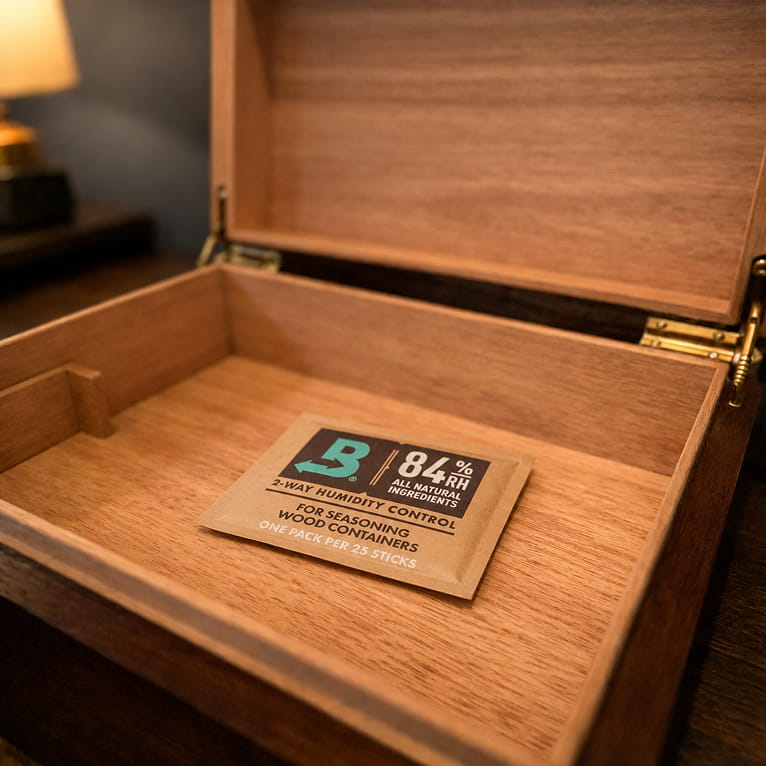
The simplest route is a purpose-made seasoning pack, of which Boveda’s 84 percent version is the standard. Boveda tested seasoning packs from 95 percent down to 32 percent before settling on 84 as the level that fills the wood in a fortnight without soaking it; a lower humidity could take up to eight weeks. The method asks almost nothing of you.
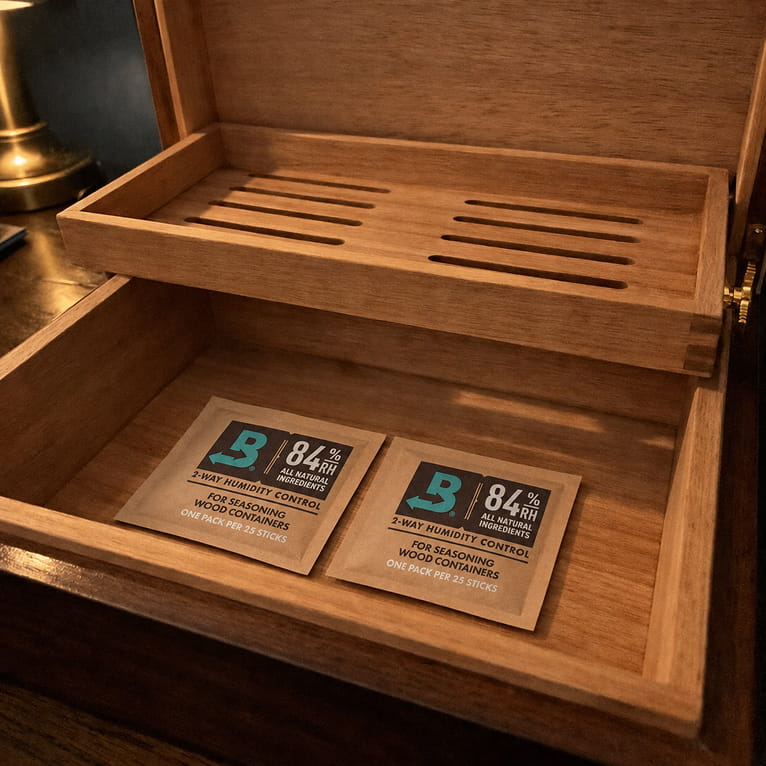
- Empty the humidor completely: no cigars, no humidification device. Leave the cedar trays and dividers inside so they season with the box, and fit any adhesive or magnetic hygrometer mount now, since nothing sticks to damp wood.
- Put your cigars somewhere safe for the fortnight: a sealed food container or a zip bag with one 69 or 72 percent pack. Boveda’s own suggestion is a humidor bag; a lidded container works just as well. Do not leave them loose in the open air for two weeks.
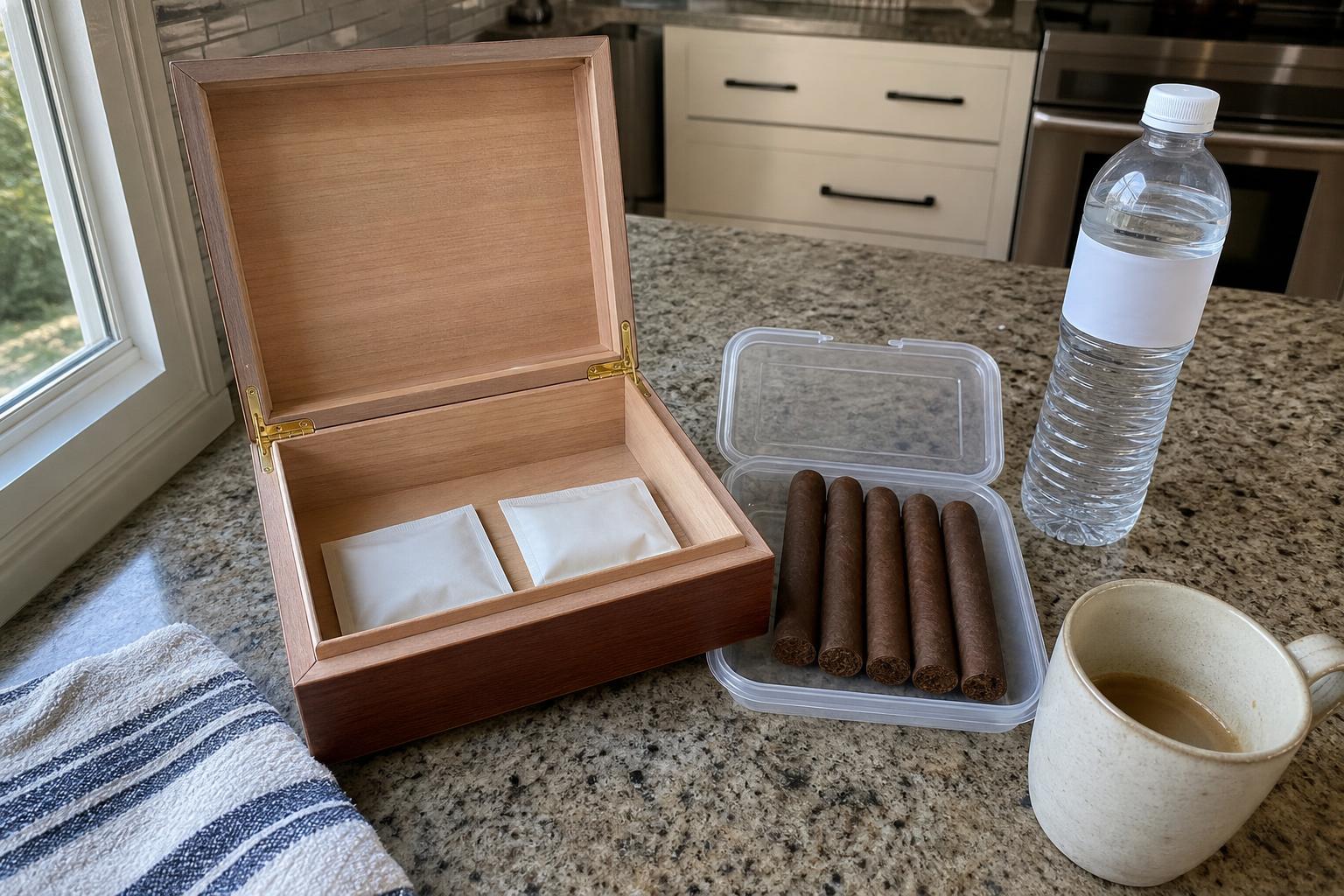
- Work out the pack count from the table below. Remove the clear plastic overwrap from each pack (the pack itself stays sealed) and lay them flat on the cedar floor. In a cabinet or wineador, spread them across every shelf. The hygrometer stays out; it has a job to do elsewhere, below.
- Close the lid and leave it closed for 14 days, somewhere steady, out of sunlight and away from radiators, ideally 18 to 21 degrees Celsius. Fourteen is the number, and a quick look on day six undoes more than it tells you: most of the water vapour releases in the first week, and the second week is the wood slowly drinking it in, so an open lid lets that moisture escape before the cedar has finished absorbing it. While you wait, calibrate the hygrometer using the salt test in the readiness section; Boveda suggests day 12.
- On day 14, discard the seasoning packs. They will feel stiff or crisp, which means they have given up their water. Do not reuse them and do not leave them in with the cigars.
- Put the calibrated hygrometer in, mid-box and away from the packs, load the cigars and add maintenance packs at your chosen storage humidity. The foam humidifier that came in the box can go in a drawer; packs do the job better. If you would rather use it, fill it with distilled water, and the propylene glycol comparison covers the rest. Expect the hygrometer to read high on the first day, often in the 80s, and drift down toward your pack’s figure over the following week. That drift is the box settling, not a fault.
The whole exercise costs about the price of a decent robusto and demands none of your attention, which is rather the point.
How many seasoning packs you need
Boveda publishes the arithmetic behind its own method. A 100-count wooden humidor needs on the order of a hundred grams of water in the wood, and each Size 60 seasoning packet releases about thirty-five grams. Three would just cover it; four is the rule for a 100-count box, the margin is for a dry room, and the same ratio runs upward. Halfwheel, which tests humidors by weighing them and metering the wood before and after a fortnight of packs, follows Boveda’s volume guidance instead: one 60-gram pack per 200 cubic inches, rounded up to the next 200.
| Humidor capacity | Interior volume, rough estimate | Size 60 packs (84 percent) | Or Size 320 packs |
|---|---|---|---|
| 25 cigars | 150 to 250 cubic inches | 1 to 2 | 1 |
| 50 cigars | 300 to 400 cubic inches | 2 | 1 |
| 100 cigars | 600 to 800 cubic inches | 4 | 1 |
| 150 cigars | About 1,000 cubic inches | 6 | 1 |
| 250 cigars (a small wineador) | 1,500 to 2,000 cubic inches | 10 | 2 |
| 400 cigars (cabinet) | 2,500 cubic inches and up | 16 | 3 |
Boveda rates one Size 320 seasoning pack per 150 cigars. The two rules will not always hand you the same number. Where they disagree, err upward. The packs regulate to a fixed humidity whatever their quantity, so an extra one simply means the wood finishes drinking sooner. Too few, and the box is still short on day fourteen with nothing left to give it. Boveda’s line is that you cannot use too many of its packs.
Method 2: the wipe-down (the traditional route)
The older method uses distilled water and a clean cloth, and it is faster, at the price of being less forgiving. Two points before you start. First, the wipe itself does very little of the seasoning: Boveda estimates that a wiped lining takes on only two or three grams of water against the hundred or so the box needs, so the sponge or dish you leave inside afterwards is what actually does the work. Second, read the paperwork that came with the humidor. Some manufacturers process their cedar in ways that do not take kindly to direct contact with water, and a few makers of the more expensive boxes, Elie Bleu among them, advise against wiping altogether. If yours does, believe them and use packs.
- Empty the box and house the cigars as in Method 1.
- Dampen a clean, unscented cloth or a new sponge with distilled water and wring it out until it is barely moist.
- Run it over the interior cedar with a light hand: floor, walls, the underside of the lid, any trays and dividers. You are aiming to darken the wood slightly, not to soak it. Puddles, drips or a visibly wet surface mean you have overdone it, and overdoing it carries real risk: saturated cedar can warp, lift at the seams or raise at the grain.
- Set a clean sponge or a shallow dish of distilled water on a plastic bag or saucer inside the box so the water never touches the wood directly. Fill your humidification device with distilled water and put it in too.
- Close the lid and leave it for 48 to 72 hours, topping up the sponge or dish each day if it has dried.
- Remove the sponge or dish, put the calibrated hygrometer in, and run the readiness test below. If the reading will not hold, give it another day with the water source; a second wipe adds risk and little water.
The shot-glass variation, a glass of distilled water left in the centre of the box with no wipe, is the same idea with less water on the move. It works on small boxes over three to five days, and it is kinder to the wood than wiping. It is also the slowest of the water routes and the easiest to under-do, which is why Boveda, who would rather sell you a pack, calls it unreliable. If you use it, the readiness test earns its keep here more than anywhere.

How long it takes and what changes it
Ask five people how long seasoning takes and you will get five numbers, each delivered with complete confidence. The spread tracks the method, the size of the box, and how much wood is actually in it.
| Method | Typical time | What it suits |
|---|---|---|
| Seasoning packs at 84 percent | 14 days, lid closed | Every wooden box. Nothing to manage after day one, and no water goes near the cedar. |
| Wipe-down plus a sponge or dish | 2 to 3 days | The quickest route, and the least forgiving of a heavy hand. |
| Sponge, dish or shot glass on a barrier, no wipe | 3 to 5 days, often longer | Desktop boxes, if you would rather keep water off the wood. Check the water daily. |
| Cabinets, wineadors, anything with shelves | 14 days, packs scaled to volume | Large interiors holding far more wood than one small water source can supply at once. |
The published guides differ mostly on how long is long enough, and agree on what is happening in the wood. Capacity the pack table handles. Two other things stretch the tail. Wood thickness is one: most humidors are a composite core with a thin Spanish cedar veneer, while a few use solid boards several times thicker, and solid-wood interiors take a little longer to come up. The room is the other. A humidor seasoning in a heated winter house, or at altitude, is negotiating with the air around it the entire time, and the same dry conditions that bring re-seasoning forward will have the first seasoning asking for the long end of the range. If you are setting a new box up in January somewhere dry, plan for it.
How to tell when it is ready
With seasoning packs, the fourteen days is the test: Boveda’s method does not rely on the hygrometer at all, and the gauge will read high for a week after the packs come out while the box settles. With the wipe-down and shot-glass routes there is no fixed clock, so the hygrometer decides, and that means a hygrometer you can trust.
Calibrate the hygrometer first (the salt test)
A new digital hygrometer can be off by several points out of the box, so calibrate it before you believe it. The salt test costs nothing and takes an evening.
- Put a tablespoon of ordinary table salt in a bottle cap or egg cup and add a few drops of distilled water until it is the consistency of wet sand. No standing water.
- Seal the cap and the hygrometer together in a small zip bag or a lidded food container, with the hygrometer’s display readable through the side.
- Leave it for eight to twelve hours at room temperature. Saturated salt holds the air in a sealed space at 75 percent relative humidity.
- Read the hygrometer. If it says 75, it is accurate. If it says 72, it reads three points low; if it says 79, four points high. Write the offset on a piece of tape on the back, or adjust it if it has a calibration button.
A packaged calibration kit does the same thing with a pre-mixed 75 percent sachet and is easier to seal. Repeat the test every six months.
The readiness test
Put the calibrated hygrometer inside, add your normal humidification device or maintenance packs, close the lid, and watch for a steady reading. When the box holds somewhere between 65 and 72 percent for a full day without drifting, the cedar has stopped taking and the humidor is ready for residents. If the number keeps sagging, the wood is still thirsty. Give it another day rather than another splash.
The published figures disagree about what a freshly seasoned box should read because they read it at different moments. Boveda says a box settles to around 65 percent once the packs are out and the storage packs are in; Holt’s expects the lower to mid eighties straight after a fortnight of packs, and 75 to 80 percent after the sponge route; Cigar Advisor reports mid to high eighties before the box settles back toward 70. Watch the trend across a week and ignore any single number. And when in doubt, wait. A cigar that spends an extra two days in its container loses nothing. A collection loaded into half-seasoned cedar pays for the impatience, and the bill arrives in the first few cigars you light.
Loading the cigars
It is normal for the humidity to drop when you add cigars, and cigars that arrive dry will take a disproportionate share and pull the whole box down with them. If a box turns up under-humidified, bring it back separately in a sealed bag with a pack before it joins the collection. If the collection is large, load it in two or three batches a day apart. I keep about a fifth of the box empty so air can move, and if the humidor is less than half full I add an extra pack; a sparsely filled box has more air per cigar to hold steady. How to organise a humidor covers where everything goes once it is in.
Re-seasoning and second-hand boxes
A seasoned humidor does not stay seasoned forever. Boveda’s guidance is that most boxes want re-seasoning once or twice a year, and it names the signs: the box can no longer hold its humidity, or the maintenance packs go hard well inside the two to three months they normally last. JR Cigars suggests a lighter touch every four to six months, timed with rotating the cigars. A humidor that needs re-seasoning more often than that is leaking, and the lid is the first place to look.
To re-season, run Method 1 again. A box that has merely drifted will come back in less than the fortnight, but the fortnight costs you nothing.
A second-hand, inherited or long-forgotten humidor needs a little more. Empty it and vacuum out every crumb of old tobacco. If the cedar is stained, grey or carries a smell that is not cedar, sand the interior lightly with fine paper (120 to 180 grit), vacuum again, and leave the lid open in a ventilated room for two or three days to air. Check the lid seal with the tests in the troubleshooting section, since dried-out wood shrinks away from its own closure. Then season it exactly as you would a new box. If it smells musty after all that, the mould section below is where you go next.
When seasoning goes wrong (and how to put it right)
Most seasoning failures are quiet ones. The box behaves oddly and its owner spends three months blaming the hygrometer. Most of it comes down to too much water, mould, or a lid that has stopped sealing, and each is recognisable long before it becomes expensive.
Over-seasoning: the box that will not dry out
The signs are consistent. The hygrometer sits above 72 percent and stays there days after you removed the water source. The cedar still looks dark and feels cool against the back of a finger. Cigars that were sound going in now light reluctantly and burn crookedly. Cigar Advisor treats anything above 72 percent as a signal to act and calls a reading of 81 percent an emergency, on the grounds that mould becomes a live prospect at that level. A cigar held too wet is hard to light, burns faster at the edges than through the middle, and can crack or come unwrapped while you are smoking it.
The correction is gradual, never sudden. Take the humidification device out for a day or two and record the readings as they fall. If you are above 80 percent, Holt’s advice is to prop the lid with a pen or a pencil so it stands open by a sliver, again for a day or two. Do not throw the lid wide. A fast swing shocks the wood and the cigars alike, so a cracked lid is a remedy for a specific fault and never a habit. If you would rather not open anything at all, the cedar sheets that come between the rows in a box of cigars will absorb the excess quietly, which is reason enough to keep a few.
Mould, and the thing that is not mould
Before anything else, establish which of the two you are looking at. Bloom, also called plume, is white or grey, powdery, spread fairly evenly across the wrapper, brushes away with a soft cloth and carries no particular smell. Mould is blue-green or white and fuzzy, clings rather than brushes, arrives in patches rather than as a film, stains the wrapper beneath it and smells musty. What is plume on a cigar goes through the wipe test in detail.
Cigar Journal attributes mould in a humidor to two things: excessive humidity sustained over an extended period, and water leaking out of the humidifier. Its remedy is more thorough than most. Wipe the box out with a damp cloth, sand the affected wood with 120 grit paper, remove every trace of dust, then dry the interior with a hairdryer at no less than 50 degrees Celsius. It is blunt about the folk remedies too, noting that wiping down with vinegar or alcohol is entirely ineffective. Discard any cigars carrying mould, and then season the box again from the beginning as though it had just arrived.
A lid that no longer sits flush
A warped lid is the quiet version of the same problem. Excess moisture, or moisture delivered unevenly, is one route to it, which is why Cigar Aficionado’s own guidance for a dried-out box is a water-filled sponge sitting in an open plastic tub, left in for a day, rather than a cloth on the wood. Cheap construction is the other route, and a box allowed to dry out will shrink away from its own seal.
Start with the quickest test. Drop the lid closed from a few inches up: a sound seal absorbs the impact with a faint whoosh, while a compromised one slams like a door. Shut a crisp banknote in the lid with an inch protruding and pull, and you should feel resistance. Set a small torch inside, switch it on, close the lid, kill the lights in the room, and look for escaping light along the joints.
Then work through the fixes from cheapest upward, hardware first. Loosen the hinge screws and retighten them with the lid held closed; a surprising number of gaps are the hinge, not the box. If the wood has dried and shrunk away instead, re-seasoning will swell it back and re-engage the seal without further intervention. If a gap survives both, run a bead of clear, food-grade silicone along the interior lip, leave the lid open for three full days to cure, then season the box again before any cigars go back in. And know when to stop. A badly warped budget humidor is not a restoration project.
The first ninety days (the settling-in period)
Seasoning has an end date. Settling in does not, quite. On the day you pull the packs and load the cigars, the box has reached an accommodation with itself and with nothing else. Over the weeks that follow it has to come to terms with the cigars, the humidification device and the room. Expect the readings to wander more in that stretch than they ever will again, and expect that to be ordinary rather than a fault. Refills produce a bump too; the reading climbs after you recharge the device and then falls back. A fair benchmark: a well-made humidor, serviced regularly, holds the number you want to within four or five percentage points. Judge the box on that band rather than on any one morning’s reading.
A new box also smells emphatically of itself, and heavily finished boxes carry a little of the finish alongside the cedar at first. Both mellow as the humidor comes into use. What should not happen is the smell turning musty rather than mellow; if it does, go back a section and start with the hygrometer. If your first ninety days run through a heated winter, the box will ask for more than it will in June. Heating strips moisture out of a room as efficiently as air conditioning does, and a humidor that drinks through packs in February and coasts through August is living in two climates.
A routine worth keeping: read the hygrometer at the same hour each day for the first fortnight, then weekly. Rotate the cigars top to bottom every week or two so the same sticks are not permanently nearest the humidification source. And write the numbers down. A fortnight of readings tells you what no single reading can, which is whether the box is settling or sliding. If you are already logging your cigars in Cigarro, the same habit costs you nothing to extend to the box they live in.
Seasoning questions answered
How long does it take to season a humidor?
Fourteen days with 84 percent seasoning packs, lid closed. Two to three days with a wipe-down and a water source, or three to five with a sponge or shot glass alone. Large cabinets and solid-wood boxes sit at the long end of each range.
Can I open the lid while it seasons?
Not with packs. The fourteen-day figure assumes a closed lid, and every peek lets vapour out before the cedar has absorbed it. With the wipe-down method you open it once a day to top up the water source, briefly.
What should the hygrometer read during seasoning?
Ignore it. A hygrometer reads the air, not the wood, and the air will sit in the 80s while the cedar is still dry inside. Calibrate it during the fortnight and trust it only once the packs are out and the box is loaded.
Can I use 69 or 72 percent Boveda packs to season a humidor?
No. They hold the air at storage humidity but carry far too little water to fill the wood in a reasonable time. Season with 84 percent packs, then switch to 65, 69 or 72 for storage.
Do I need to season an acrylic or glass humidor?
An acrylic humidor, no: there is no wood to season. A glass-top wooden humidor, yes: season the cedar as normal.
How often should I re-season my humidor?
Once or twice a year for most boxes, or whenever it stops holding humidity or empties maintenance packs inside three months. Dry climates, altitude and winter heating bring it forward.
How do I know the seasoning worked?
With a calibrated hygrometer inside and your maintenance packs in place, the box holds between 65 and 72 percent for a full day without drifting, and the first cigars you load neither dry out nor turn spongy over the following fortnight.
Season once, store for years
Fourteen days now buys a box that holds 69 percent through a December with the heating on. If you are setting up a box for the first time, my guide to organising a humidor covers what to do once the cigars move in, storing cigars well covers the wider practice, and if you are weighing what belongs in the humidification device itself, I have compared propylene glycol and distilled water separately. Log the cigars as they go in with Cigarro and you will know exactly what is resting where, and for how long.