By Hugh Ashby · Updated September 2026
Cigar etiquette is a small set of courtesies that make a shared hour pleasant: leave the band on until the burn nears it, cut and light your own cigar, let the ash grow before you tap it, keep your smoke away from the person next to you, and when you are finished, set the cigar down and let it go out on its own. Almost everything else people call a rule is a preference wearing a good suit.
I want to be clear about the spirit of the thing before we start. Etiquette in this hobby is not a membership test, and the people who use it as one are usually the least pleasant company in the room. It exists for the same reason table manners exist: so that nobody has to think about the mechanics and everyone can get on with the conversation. What follows is the working code as I have found it in lounges, on porches and at other people’s dinner tables. Where a point is genuinely settled, I say so. Where it is taste dressed as law, I say that too.
The Offer and the Gift
If you open your case in company, offer one. Not to the room, necessarily, but to whoever is sitting with you. The offer costs you a cigar and buys you an hour of better conversation, and refusing to make it is the single most reliably noticed failure of manners in this hobby.
The corollary is that you should accept graciously or decline gracefully, and never audibly price what you have been handed. If someone gives you a cigar, the correct response is thank you, and then to smoke it. Not to put it in your pocket for a better occasion, which everyone can see, and not to say what you would have chosen instead.
Giving cigars as a gift follows the same logic. Give something you have smoked yourself and can vouch for, in a size the recipient has time for, and skip the ceremony of explaining how much it cost. If you do not know their taste, a medium-bodied classic in a robusto is the safest ground in the world. And if you are handed something you would never buy, smoke it anyway. Palates are gifts too.
The Band Question
The band is the small piece of paper around the cigar, and whether to remove it is the most reliably overheated argument in the hobby. The received English position, going back a century or so, was that leaving the band on was a vulgar display of brand. The received American position was that it was nobody’s business. Both survived; neither won.
The practical answer settles it better than the social one. Band adhesive is loosened by heat, so if you want the band off, wait until the burn is an inch or two below it and it will lift away cleanly. Tearing it off a cold cigar risks taking wrapper leaf with it, because the same glue may be sitting on the wrapper seam. That is not etiquette, that is physics, and physics is on the side of patience.
So: leave it on, take it off when it is warm, or leave it on all the way down. Nobody sensible will comment. If somebody does comment, you have learned something useful about them at no cost.
Cutting and Lighting in Company
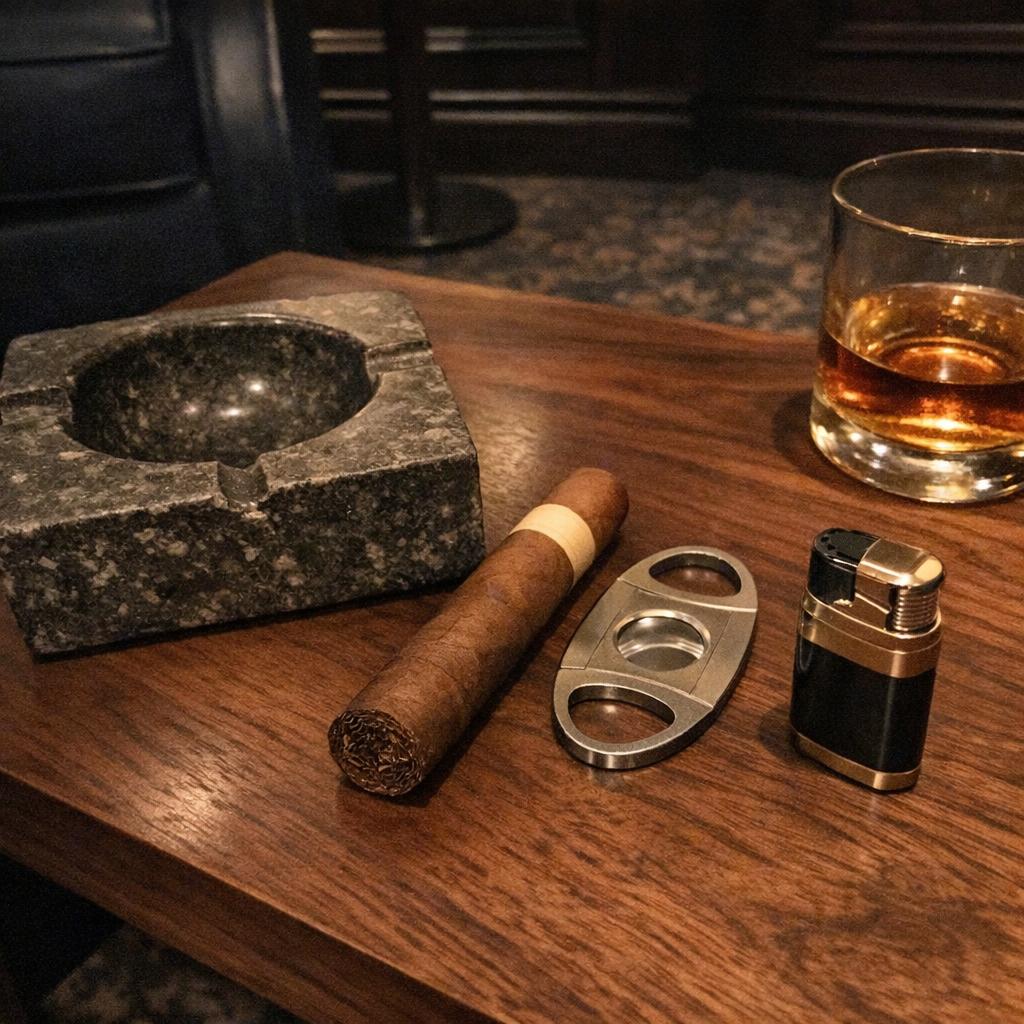
Cut your own cigar. If a shop or a host offers to cut it for you, that is a service and you may accept it, but reaching across a table to cut somebody else’s cigar uninvited is the equivalent of salting their food. Take a small cut rather than a brave one: you can always remove more, and you cannot put it back. Our guide to cutting a cigar covers the straight, punch and V options properly.
Lighting is where most of the visible clumsiness happens, and almost all of it comes from hurry. Toast the foot at a distance until it glows evenly, then draw gently while turning. Do not roast it like a marshmallow, do not hold the flame against the leaf, and do not blow on the foot. The full method is in our guide to lighting a cigar.
Two small courtesies. Offer your lighter to the person beside you before you use it on yourself, the way you would with a match. And if you are using a torch, angle it away from the table, because a triple flame at close range is an alarming thing to have waved near one’s sleeve.
Pace and the Relight
The single most useful thing anyone ever told me about smoking cigars in company is to slow down. Roughly thirty seconds between draws is the conventional guidance, and the reason is not decorum, it is flavour: a cigar pushed hard runs hot and turns bitter and sharp. The trade press has said this consistently for decades. A cigar smoked at the pace of a conversation tastes better than the same cigar smoked at the pace of a train.
A cigar that goes out is not a failure and not an embarrassment. It is what happens when you were talking. Occasional relighting is entirely normal, and a warm cigar relights faster than a cold one. The only caution is repetition: relighting the same cigar over and over introduces char and carbon into what you are tasting, which is why a cigar you have abandoned for twenty minutes is often better left abandoned. Our guide to relighting a cigar has the method.
What you should never do is apologise for it. Nobody at the table is keeping score, and the one person who might be is not worth the anxiety.
The Ash and Where It Goes
Let the ash grow. A firm ash sits on the foot as a small insulating cap, keeping the burning tobacco cooler and the flavour steadier, which is the practical case for patience. The theatrical case, that a long ash proves good construction, is only half true, but it is half true, and there is a quiet pleasure in an inch and a half of grey holding together while you make a point.
Know when to stop being brave. Once the ash is long enough that any real movement would drop it, you have crossed from confident to inconsiderate, and the person whose lap it lands in will remember. The graceful method is the gentle roll: rest the edge of the ash against the ashtray and turn the cigar slowly until it separates. No tapping, no flicking, no percussion.
Ash into an ashtray, never into a plant pot, a drink, a fireplace or the grass. This sounds obvious until you have watched a man do all four in one evening.
Smoke and Other People
Smoke goes where the air takes it, and the whole of this section is about being aware of that before somebody has to tell you. Hold the cigar down and away when you are talking to someone. Direct your exhale up or over your shoulder rather than across the table. If you are sitting outdoors, take the seat downwind of the group rather than the comfortable one.
Ask before you light in any space that is not obviously for smoking. Somebody’s garden, somebody’s balcony, the terrace of a restaurant, a friend’s car: ask, plainly, and accept the answer without negotiation. Asking costs one sentence. Not asking costs you the invitation next time.
Indoors and in company, the answer is almost always no unless the room is built for it. That is not a hardship. A cigar is an outdoor and a lounge pleasure by nature, and the hour on a cold porch with a coat on is, in my experience, better than the hour indoors would have been. Take the cold. It is part of the arrangement.
The Lounge
A cigar lounge is somebody’s business, and the etiquette follows from that. Buy your cigar there. If the lounge sells cigars and you smoke one you brought, you are using their chairs, their ventilation and their staff for nothing, and most lounges charge a cutting fee precisely to make that awkward. Where a lounge is happy for you to bring your own, they will say so, and you should still buy a drink.
Order something. Tip where tipping is customary in your country, and tip the person who kept the ashtray clean and remembered what you were drinking, because that job is more work than it looks. In North America the usual restaurant convention applies; in much of Europe it does not, and a rounded-up bill is plenty.
Phones on silent, calls taken outside, and no speakerphone under any circumstance. Take the empty chair rather than the one in the middle of a group that is clearly mid-conversation, and if you want to join a conversation, ask what they are smoking. It has never once failed. Above all, do not lecture. The lounge does not need your opinion on another man’s choice of cigar, his cutter, or the fact that he bought a bundle.
The Pairing at a Dinner
A cigar after dinner is a matter of timing more than of drinks. Wait until the plates have gone and the table has settled, ask the host, and if there is any doubt at all, move the whole business outside and invite whoever wants to come. A cigar lit over other people’s dessert is not a pairing, it is an ambush.
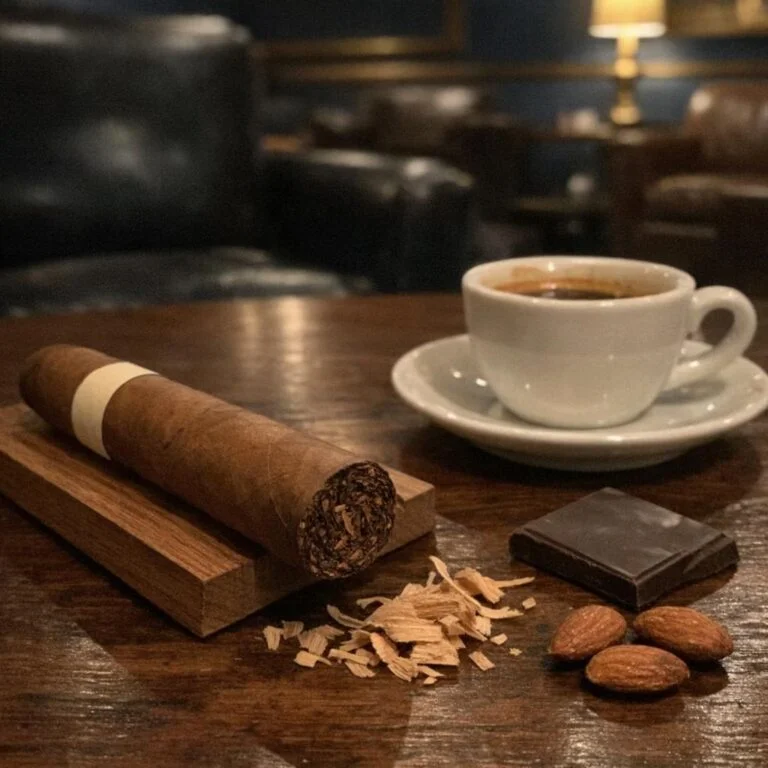
When you do pair, match weight to weight. A gentle cigar beside a heavy spirit disappears, and a full-bodied Nicaraguan beside a delicate white wine simply flattens it. The classic partnerships hold because they are balanced: something dark and sweet beside something dark and sweet. Our guide to pairing cigars with whiskey works through the specifics.
One quiet courtesy that costs nothing: choose a shorter cigar for a dinner. A robusto or a corona finishes in the natural life of an evening. A double corona commits everyone else to your schedule, and it is remarkable how often the man smoking it is the last to notice.
When to Put It Down
A cigar is finished when it stops being good, and that point arrives at a different place every time. Most people put a cigar down somewhere in the last third, when the smoke turns hot and the flavours flatten and the thing starts to taste of itself rather than of tobacco. Smoking to the band, or past it, out of a sense of duty to the money is the most common mistake in the hobby.
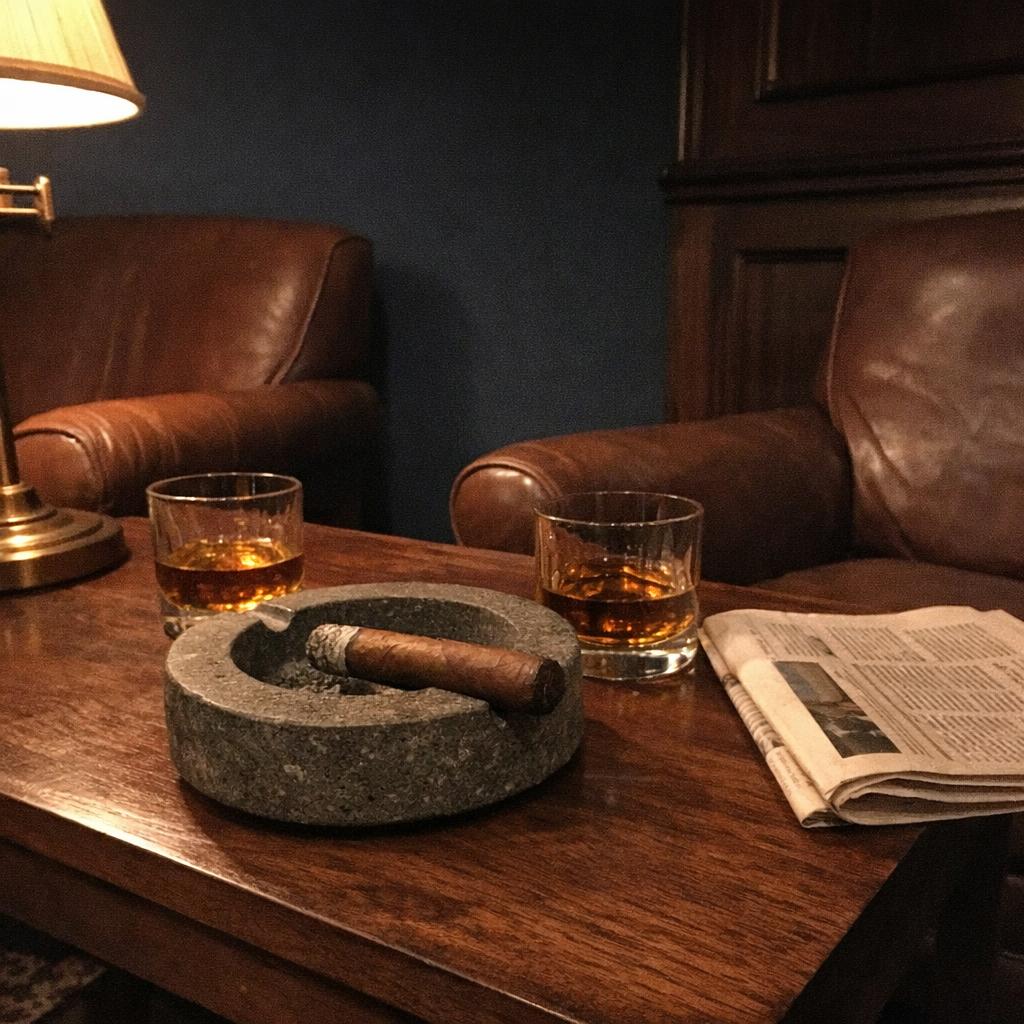
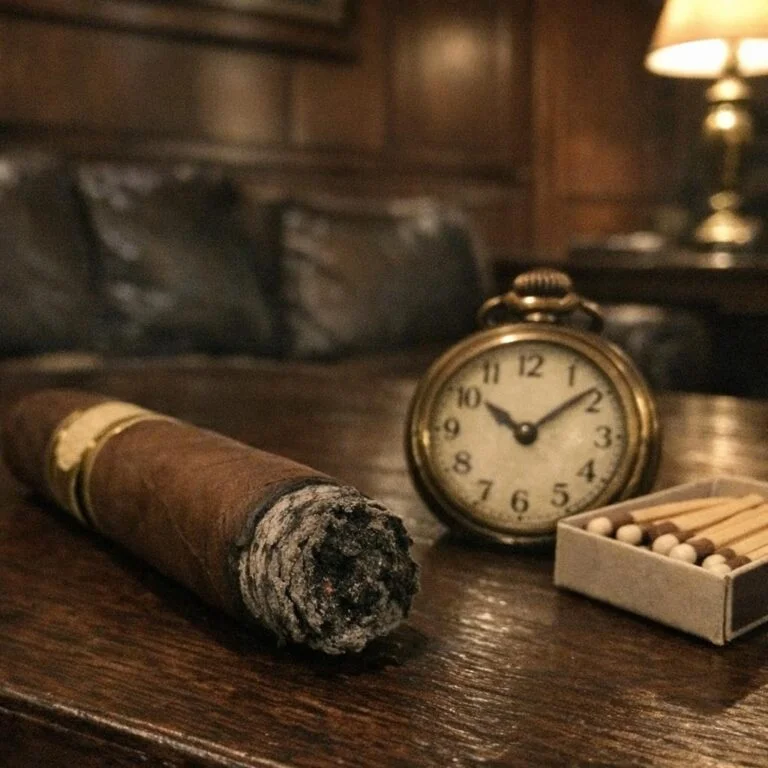
When you are done, set it in the ashtray and leave it. Do not stub it out like a cigarette. Crushing the head splits the binder, releases a great deal of unpleasant smoke into the room, and leaves a mangled thing sitting in front of everyone for the rest of the evening. Laid flat and left alone, a cigar goes out on its own within a minute or two and does so quietly.
If you have to leave early with a good third still in hand, that is fine too. Set it down, say your goodbyes, and let it go. Carrying a lit cigar out to the car is how upholstery gets ruined and how you become a story.
What Nobody Should Do
A short list, offered without heat. Do not relight another man’s cigar. It is his, he is watching it, and taking a torch to it while he is talking is closer to touching his plate than most people realise. Offer the lighter instead.
Do not wet the head. Chewing the cap or soaking it before you cut turns the wrapper soft, ruins the draw and looks precisely as unappealing as it sounds. A cigar needs a clean cut and a dry mouth on it, nothing more. Related, and firmly: do not dip the head in your drink. It does not add flavour worth having, it makes the leaf soggy, and it treats a hand-rolled cigar like a biscuit.
Do not blow smoke rings at people, do not remove someone else’s band, do not ask what a stranger’s cigar cost, and do not tell a man he is smoking it wrong. That last one covers most of the ground. The whole code, if you want it in a sentence, is this: mind your own cigar, mind the air around you, and be pleasant to whoever is holding the ashtray.
Common Questions
Should you take the band off a cigar?
It is entirely your choice and no serious smoker will comment either way. If you want it off, wait until the burn is an inch or two below the band: the heat loosens the adhesive and it lifts away cleanly. Removing it from a cold cigar risks pulling wrapper leaf with it, because the same glue can sit on the wrapper seam.
Is it rude to let a cigar go out?
No. A cigar going out mid-conversation is normal and relighting it is entirely acceptable. The only caution is doing it repeatedly, which introduces char and carbon into the flavour. A cigar you abandoned twenty minutes ago is usually better left alone.
How do you ash a cigar politely?
Let the ash build, then roll rather than tap. Rest the edge of the ash against the ashtray and turn the cigar slowly until it separates cleanly. Tapping and flicking scatter ash and are the usual reason someone ends up brushing their trousers.
Do you tip at a cigar lounge?
Where tipping is customary in your country, yes, and on the same basis as any bar: the person clearing your ashtray and keeping your glass filled is doing more work than it appears. In North America the usual restaurant convention applies. In much of Europe rounding up the bill is plenty.
Can you bring your own cigars to a cigar lounge?
Sometimes, and you should ask rather than assume. Many lounges charge a cutting fee for cigars bought elsewhere, which is a polite way of saying they would rather you bought theirs. If you do bring your own where it is permitted, buy a drink and tip properly.
How far down should you smoke a cigar?
Until it stops being enjoyable, which for most people is somewhere in the final third when the smoke turns hot and the flavours flatten. There is no obligation to smoke to the band. When you are finished, lay the cigar in the ashtray and let it go out on its own rather than stubbing it.
Manners, Worn Lightly
Every rule above exists to make one hour easier for the people sharing it with you, and any of them can be waived by a host who says so. That is the whole architecture. The man who knows the code and wears it lightly is good company; the man who knows the code and polices it is the reason people stop inviting the cigar smoker. Etiquette is hospitality pointed outward, and hospitality is the entire point of handing somebody a cigar in the first place.
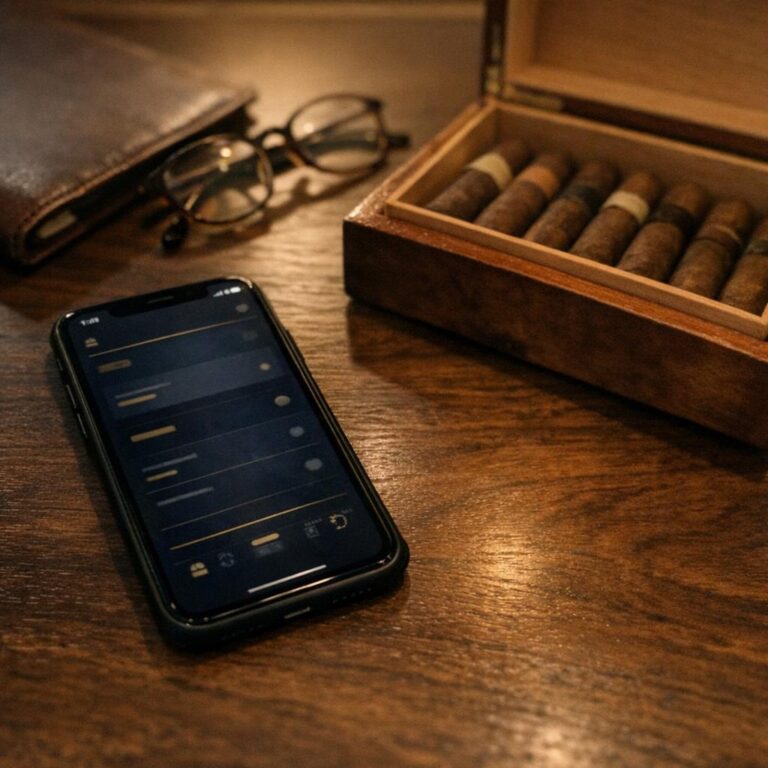
Keep notes on the ones you were given as well as the ones you bought, in Cigarro or in a paper notebook, because a cigar remembered alongside the evening it belonged to is worth two smoked alone. And if you want a framework for the noticing itself, the Cigarro Method will give you one that leaves plenty of room for the conversation. So will simply putting the phone down and letting the cigar rest as long as it needs to.