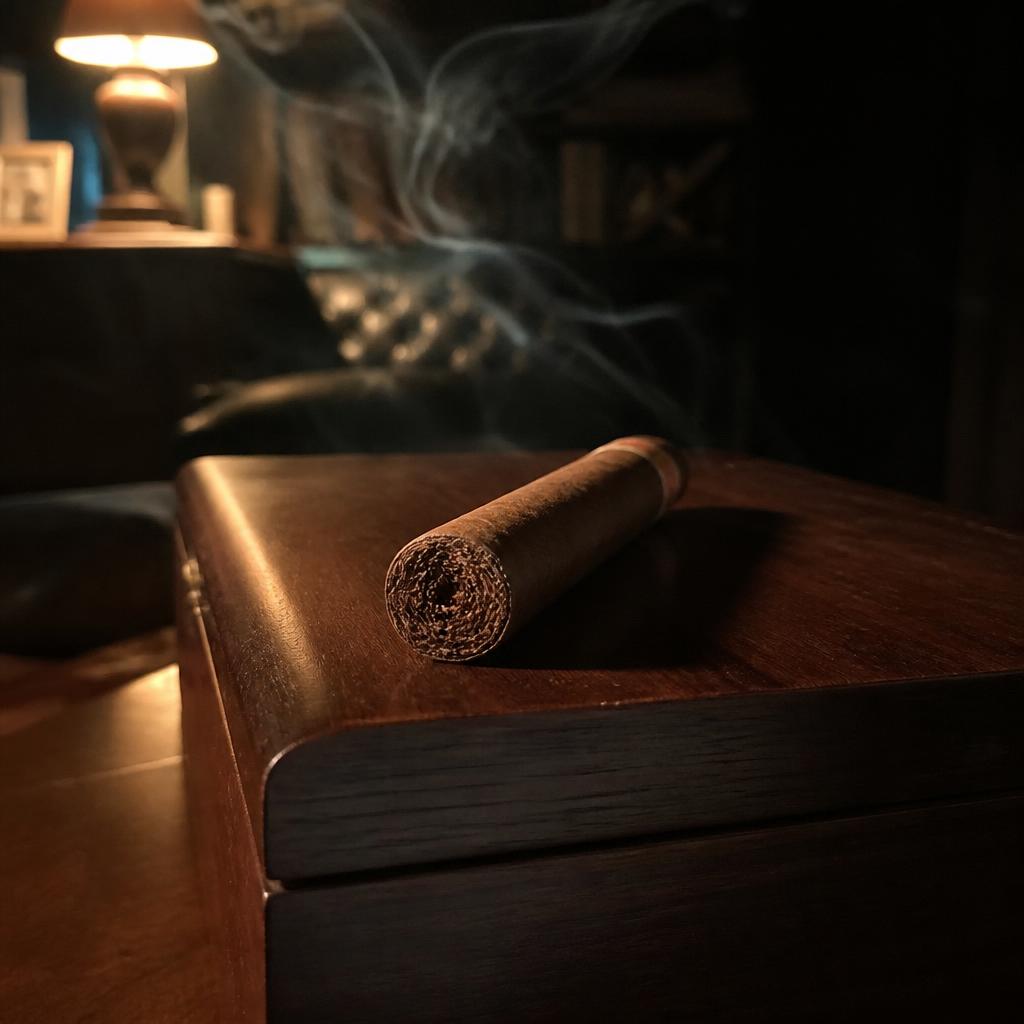
No. You do not inhale a cigar. Cigar smoke is drawn into the mouth, held there for a moment while the palate reads it, and let go, and at no point does it travel to the lungs. That is the whole answer, and it is the one rule in cigar smoking with no exceptions, no regional variations and no advanced version for old hands. Cigar Aficionado’s glossary defines “inhale” in seven words: what you don’t do with cigar smoke.
The question comes up because almost everyone arrives at their first cigar with a picture of smoking borrowed from cigarettes or from films, and the picture is wrong for this. A premium cigar is a hand-rolled bundle of fermented tobacco leaf, and it is built to be tasted rather than breathed. Retrohaling is the technique of pushing a little smoke out through the nose, and it is not inhaling either. Below is why beginners get this wrong, what to do with the smoke instead, how retrohaling works, and what actually happens on the evening you inhale by mistake.
The short answer, and why it goes wrong
The instruction is simple, and the reason it goes wrong is instinct rather than ignorance. If you have ever smoked anything else, or watched enough people do it on screen, the reflex to draw smoke downward is already wired in. A cigar asks you to override that reflex every time, and on a first evening, with a lighter in one hand and a slightly nervous host across the table, the reflex usually wins for a puff or two.
The second reason is the draw itself. A cigar is drawn like a straw, with the cheeks, and a newcomer who is not getting much smoke tends to pull harder, from the chest. Harder is exactly wrong. If the smoke is thin, the answer is a gentler draw over a longer moment, or a look at whether the cigar was cut and lit properly, never a deeper one. Our guide to lighting a cigar covers the toasting routine that prevents a stubborn draw in the first place.
The third reason is that nobody says it out loud at the counter. Cigar Aficionado lists inhaling among the ten things you should never do as a cigar smoker, and the reasoning is plain: taste buds are in your tongue, not your lungs. Smoke that goes to the lungs is smoke the palate never got to read. To my mind that is the only argument anyone needs. You paid for the flavour. Inhaling throws most of it away.
What to do instead: the mouth-first draw
Draw the smoke into your mouth with a slow, steady pull, the way you would take the first sip of a coffee you suspect is too hot. A two-second draw is plenty. Then close your lips, let the smoke sit against the tongue and the roof of the mouth for a second or two, and let it out. Holt’s puts it in one line: gently draw the smoke into your palate, absorb its flavour for a moment, then release it from your mouth. That is the entire mechanic, and it does not change between the first cigar and the thousandth.
Two habits make it work. The first is pace. Cigar Aficionado’s rule is at least thirty seconds between puffs; Cigar Advisor stretches it to thirty to sixty. Overpuffing overheats the foot, overheating turns the smoke bitter, and a bitter mouthful is what tempts a beginner to pull harder, which makes it worse. Slow and cool, as Cigar Aficionado says, is the rule.
The second habit is to treat the mouth as an instrument rather than a corridor. Move the smoke around a little. Notice what sits on the tip of the tongue, what arrives at the back, and what is left after it has gone, because the finish is where the interesting things happen. Our guide to tasting a cigar gives that noticing a structure, and the review-by-thirds framework turns it into a record you can compare against next month.
If you are choosing a first cigar to practise on, choose mild. The best cigars for beginners are mild for exactly this reason: a gentle Connecticut lets you concentrate on the draw without the smoke fighting you.
Retrohaling, explained simply
Once the mouth-first draw feels ordinary, there is one more technique, and it is the one that separates “tastes of cigar” from “cedar, a little cocoa, and white pepper on the finish.” It is called retrohaling, and it is not inhaling.
The word is a contraction of retronasal olfaction and exhale, coined in 2007 by David “Doc” Diaz, the certified master tobacconist who writes for Famous Smoke’s Cigar Advisor. The idea behind it is that most of what we call flavour is aroma, and aroma is read by receptors in the nose rather than on the tongue. Smoke that leaves through the lips never meets them. Smoke pushed up and out through the nose does, and Doc Diaz quotes one cigar company president as saying that until you have done it, you have never really tasted the cigar.
The mechanics, in Cigar Advisor’s own description: draw the smoke into your mouth and close your lips. Hold your breath. Then open the back of the throat and let the pressure of the breath you are already holding push the smoke up through the nasal passage and out. Holt’s says the same thing more briefly: mouth closed, push the smoke out through the nose with pressure from the chest, and never draw it further down. The smoke rises. It does not descend.
Start small. Doc Diaz suggests letting seventy or eighty percent of the mouthful out through the lips first and retrohaling only what is left, and Holt’s notes that you need not retrohale every draw. Learn it on a mild or medium cigar; a full-bodied one retrohaled whole stings like wasabi in the nose, in Cigar Advisor’s phrase, and teaches you nothing. The effect varies by person too. For some smokers it transforms a cigar, for others the difference is subtle. Either is fine. The point is to find out, and our short FAQ on retrohaling is there when you want the one-paragraph reminder.
What happens if you do inhale
You will know within a second. There is far more smoke in a single cigar draw than most newcomers expect, and a lungful of it produces a cough that is hard to disguise, a burn at the back of the throat and, fairly quickly, a light head. Cigar Aficionado’s warning is blunt: it could make you sick to your stomach or light-headed. Cigar Advisor names inhaling alongside smoking too fast and smoking too much as a cause of what enthusiasts call being nic-sick, the nausea, sweating and dizziness of too much nicotine at once.
This is worth saying plainly because it is how people give up on cigars after one evening. They inhale, feel dreadful, and conclude the cigar was the problem. Usually the technique was. The same cigar, drawn into the mouth and let go at a puff a minute, is an entirely different object.
Nicotine does not need your lungs to reach you, either. Cigar Advisor lists smoking too fast, smoking too much and smoking on an empty stomach as causes of the same queasiness, none of which involves a single lungful, and Holt’s makes the point from the other direction: smoking slowly keeps the nicotine from surging. So pace matters even when your technique is perfect.
If it happens to you, stop smoking the cigar. Cigar Advisor is emphatic that pressing on only makes it worse. Their remedy is sugar: a packet dissolved on the tongue, a sweet drink or a square of chocolate, chased with water. Holt’s gives the same advice. Fresh air helps, and the feeling passes, usually inside the hour. Next time, eat first, choose something mild, and keep the smoke where it belongs. The full routine from cut to last third is in our walkthrough on how to smoke a cigar properly.
Taste it, then write it down
None of this is etiquette. It is the design of the thing. A cigar is blended in layers to be read on the palate over an hour, and the lungs have no part in that reading. Draw it into the mouth, give it a second, let it go, and once that feels ordinary, send a little of it out through the nose and see what the blender hid in there. Then write down what you found. The habit of noticing is most of what separates the smoker who enjoys cigars from the one who merely gets through them, and it starts with keeping the smoke in the right place. Cigarro keeps the record for you, one third at a time.