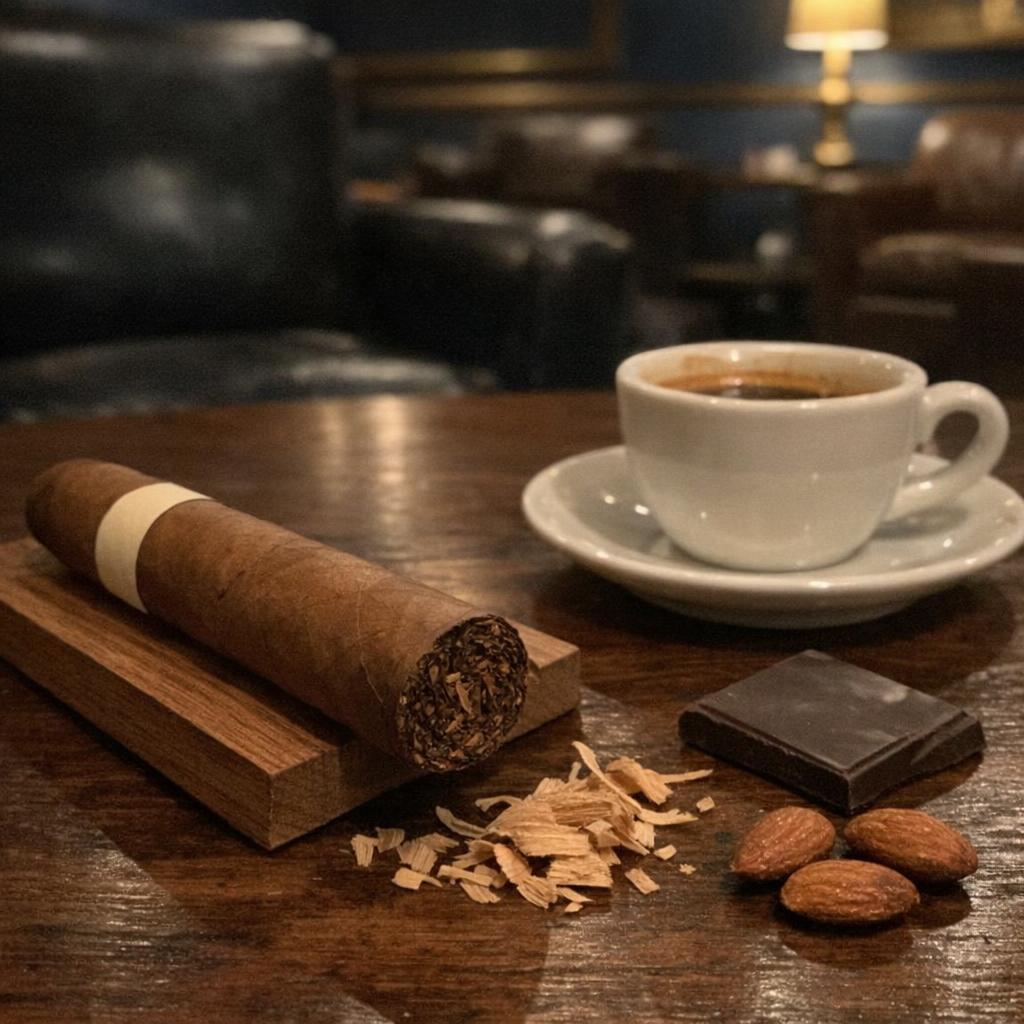
A cigar flavour wheel is a vocabulary, drawn in a circle. Americans spell it flavor wheel and the tool is the same one: a set of broad families arranged around the rim, each broken into the specific words that sit inside it, so that a smoker who can only say “woody” has somewhere to go next. Cedar or oak. Charred wood or pine. The wheel does not tell you what a cigar tastes of. It gives you the words to say what you already noticed and could not name.
That is the whole trick, and it is worth stating plainly because the wheel is often mistaken for a scoring instrument. Nobody is grading your palate. The families are prompts, and a good session with one produces three or four honest words rather than fourteen impressive ones.
What follows is the practical version. The families and the descriptors under each, the off-notes that mean something is wrong rather than something is interesting, how retrohaling opens a set of notes the mouth alone never reaches, why the wheel is read once per third rather than once per cigar, and a ten-minute exercise for a first attempt. The families named here are the ones in Cigarro’s own flavour picker, because a wheel you can actually record into is more useful than one printed on a poster.
What a Wheel Is Actually For
Wheels of this kind were borrowed from wine and coffee, where the problem was identical: tasters could tell two things apart but could not describe the difference to each other in words that meant the same thing twice. Arranging descriptors in families, general at the centre and specific at the rim, solved it. You start with the family you are confident about and work outward only as far as your honesty allows.
The point is repeatability rather than eloquence. If you write “nice and woody” tonight and “kind of oaky” in six weeks, you cannot tell whether the cigar changed or your mood did. If you write “cedar” both times, you have data. A wheel is the agreement you make with your future self about which word you will use.
It also protects you from the opposite failure, which is borrowing someone else’s notes. Reading that a cigar shows leather and espresso before you smoke it very nearly guarantees you will find leather and espresso. Come to the wheel after the draw, not before it, and you will be surprised how often you land somewhere the reviews did not.
The Families
Thirteen families, and every one of them earns its place because cigars genuinely go there. Read the middle column when you know roughly where you are and cannot get closer than that.
| Family | Descriptors inside it | Where it usually turns up |
|---|---|---|
| Toasted | Toasted bread, sourdough, rye bread, brioche, biscuit, graham cracker, gingerbread, cereal grains, burnt toast | The first third of almost anything, and the backbone of Connecticut-wrapped cigars |
| Nutty notes | Almonds, cashews, hazelnut, walnuts, chestnuts, peanuts, nut butter, popcorn | Mild and mild-to-medium blends, often alongside cream |
| Sweet | Cocoa, dark chocolate, milk chocolate, caramel, butterscotch, molasses, honey, brown sugar, maple syrup, marshmallow, sweet cream | Maduro wrappers, where long fermentation has done the sweetening |
| Fruit | Raisins, dried fruit, plum, cherry, apricot, peach, berries, apple, orange, lemon, lime, grapefruit | Aged tobacco and well-rested cigars, usually in the second third |
| Florals | Flowers, tea leaves, bergamot, lavender, vanilla | Delicate blends, and far more often on the retrohale than in the mouth |
| Spices | Bakers spice, cinnamon, clove, nutmeg, allspice, cardamom, anise, black licorice, ginger | Nicaraguan and Dominican blends, warm rather than sharp |
| Pepper | Black pepper, white pepper, red pepper, cayenne, chili pepper, bell peppers | Kept apart from spice on purpose, because pepper is a sensation as much as a taste |
| Animal | Leather, cream, milk, butter, beef jerky, red meat, barnyard, sharp cheese | Leather and cream both live here, which surprises people until they think about it |
| Natural and earthy | Minerals, chalk, salt, dirt, moss, peat, mushroom, musty basement | Cuban and Cuban-seed tobacco, where earth and mineral are the signature |
| Wood | Cedar, oak, burnt oak, charred wood, burnt cedar, hickory, pine, campfire | Everywhere, and the family most worth splitting finely |
| Coffee notes | Espresso, dark roast coffee, light roast coffee, cafe au lait | The final third of medium and fuller cigars |
| Herbal | Hay, fresh cut grass, wet leaves, dead leaves, vegetables, herbal medicine, potpourri, soap, ammonia | Young tobacco, and the family where the off-notes start appearing |
| Other | Tar, sulfur, cardboard, fermented hay, pharmaceutical, blood | Mostly faults, occasionally a genuine character note in a very full cigar |
Two of those groupings tend to raise an eyebrow. Leather sits under animal rather than under wood, which is correct once you consider that leather is a hide and smells like one. Cream, milk and butter sit there for the same reason, so the dairy notes people reach for on a mild Connecticut are one family across from the barnyard notes on a young Cuban. And minerals, chalk and salt live under natural and earthy rather than being scattered, which keeps the whole mineral character of Cuban-seed tobacco in one place where you can see it.
Wood is the family worth being fussy about, because “woody” is the laziest word in cigar tasting. Cedar is sweet and dry and lifts. Oak is broader and rounder. Charred wood and burnt cedar are what you get when a cigar has been smoked too hot, which is information about your pace rather than the blend. If you split nothing else finely, split wood.
The Off-Notes and What They Mean
A handful of descriptors are not flavours to enjoy but signals to read, and knowing them saves you from blaming yourself for a cigar’s condition.
Ammonia is the loudest of them. Tobacco throws off ammonia as it ferments and continues to shed it slowly as it ages, so a sharp ammoniac note usually means the cigar is young, or that it has been sealed somewhere airless for too long. It is a matter of time rather than a fault in the blend, and the answer is the same either way: put it down, leave it alone for a few months and try again. Our note on how long a cigar should rest covers the arithmetic.
Sulphur is the second, and it tends to come from the light rather than the leaf. Short match heads carry sulphur, and if the flame reaches the foot before the striking chemicals have burnt off, that is what you taste for the first few draws. Long wooden matches struck and allowed to settle solve it.
Bitterness and tar are the ones you cause yourself. Both arrive when a cigar has been smoked too quickly and run hot, which concentrates everything harsh in the smoke and, at the far end, leaves a genuine tarry note at the head. Slowing the draw to about once a minute fixes it more reliably than any tool. Cardboard, meanwhile, generally means the cigar has been kept too dry and has lost its oils to the air, and unlike the others that one rarely comes back.
Retrohaling Changes What You Find
The tongue registers a small number of basic tastes. Everything else people call flavour is smell, arriving at the olfactory receptors through the back of the nose. Which is why a wheel used with the mouth alone leaves most of itself unread.
Retrohaling, pushing a little smoke gently out through the nose rather than the lips, routes the smoke past those receptors and the effect is not subtle. Spice and pepper sharpen and locate themselves, so what read as vague warmth on the palate becomes clearly black pepper or clearly cinnamon. Florals appear almost exclusively here: bergamot, tea leaf and vanilla are barely present in the mouth and obvious through the nose. Sweetness separates into its parts, so the general impression of sweet resolves into cocoa, or caramel, or dried fruit. And the off-notes announce themselves earlier, which is genuinely useful, since ammonia is detectable on a retrohale a good while before it becomes unpleasant on the palate.
Do it gently and do it with a small volume of smoke, because a full lungful up the nose is unpleasant and teaches you nothing except caution. Our short explainer on what retrohaling is covers the mechanics. For the purposes of a wheel, the rule is simply that half the families on it are only really reachable this way.
Read the Wheel Per Third
A cigar is not one flavour held for an hour. It is a sequence, and a single set of notes written at the end averages the sequence away.
The first third is usually the brightest and the least settled. Toast, cedar and a peppery edge are common, partly because the cigar is still finding its temperature and partly because the wrapper is doing proportionally more of the talking while the burn is narrow. The second third is where blends tend to show what they are. Sweetness arrives, the wood rounds out, and the notes that reviewers remember usually come from here. The final third concentrates. Coffee, cocoa and earth strengthen as the smoke has less cigar to travel through, and if you have been hurrying, this is where bitterness and tar turn up to say so.
Read the wheel three times and you get a shape instead of a verdict. Two cigars that both finish on espresso and leather are entirely different objects if one opened on cream and almond and the other opened on pepper, and only per-third notes preserve the difference. That is the reasoning behind the Cigarro Method, and it is the same reasoning that keeps strength, body and flavour on separate scales rather than collapsed into one word.
How Cigarro Records It
A wheel printed on card is a reference. A wheel you can tap is a record, and the difference shows up about six months later when you want to know what you actually liked.
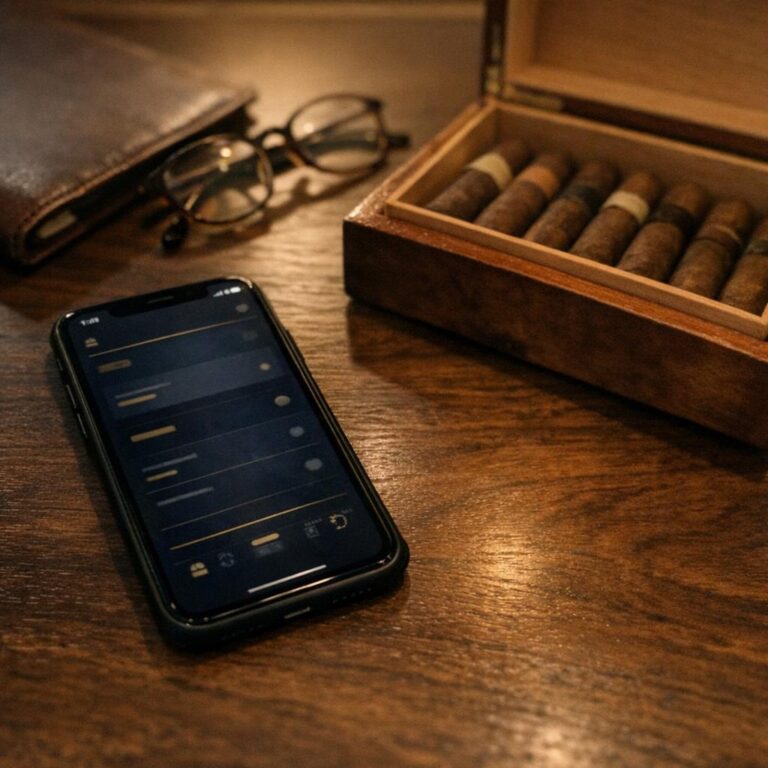
Cigarro’s review form carries a flavour picker at each third. The families are the thirteen in the table above, each holding its own list of descriptors, and you tap the ones you found. If the word you want is not on the list, you can add your own to whichever family it belongs in, which matters more than it sounds: palates are personal and nobody’s vocabulary is fully covered by anyone else’s list. Alongside the flavours, each third records the measured things separately, strength, body, retrohale, mouthfeel, sweetness, bitterness, spice and the rest, plus free text if you have something to say that no list will hold.
When the review is finished, the flavours you chose are drawn as a wheel on the review itself, so a cigar’s character is legible at a glance rather than buried in prose. Your own reviews can then be filtered by flavour, which is the feature that quietly answers the question people actually have: not “what did this cigar taste of” but “which of the cigars I have smoked had cocoa in the second third, because I would like another one of those”.
A Ten-Minute Exercise
Try this once, on a cigar you have smoked before and a mild one for preference, since a loud cigar shouts over the exercise. Ten minutes of the first third is enough.
Put three things on the table beside you: a cup of black coffee, a square of dark chocolate and, if you have a cigar box to hand, a strip of the cedar from inside it. These are references, not pairings, and you are not going to consume them. Smell each one before you light, so your nose has something recent to compare against.
Then take four draws, slowly, about a minute apart. After the second, name one family and only one. Not a descriptor, a family: wood, or sweet, or nut, or pepper. After the third draw, retrohale a small amount and name a second family, which will very likely be a different one from the first. After the fourth, go back to the family you named first and try to choose the descriptor inside it. Cedar rather than wood. Cocoa rather than sweet.
Three words is a complete answer for a first attempt, and two is respectable. If you find yourself writing seven, you are almost certainly reporting what you expected rather than what you found. Write down whatever you landed on, close the notebook, and repeat the exercise on the same cigar a fortnight later. The words will be steadier the second time, and that steadiness is the entire skill. Our fuller walk through how to taste a cigar takes it from here.
Questions Readers Ask
What is a cigar flavour wheel?
It is a vocabulary arranged in a circle. Broad families such as wood, sweet, spice and earth sit around the rim, and each opens into the specific descriptors that belong to it, so cedar and oak live under wood while cocoa and caramel live under sweet. The wheel does not measure anything and it does not grade your palate. It exists so that a smoker who can only say the smoke tasted woody has somewhere sensible to go next, and so that the word chosen tonight means the same thing in six months.
What are the main cigar flavour families?
Cigarro’s picker uses thirteen: toasted, nutty, sweet, fruit, floral, spice, pepper, animal, natural and earthy, wood, coffee, herbal, and a catch-all for everything else. Leather, cream and butter sit under animal, which surprises people until they consider what leather is. Minerals, chalk and salt sit under natural and earthy, which keeps the whole mineral character of Cuban-seed tobacco in one place. Pepper is kept apart from spice deliberately, because pepper is as much a sensation as a taste.
How do you actually use a flavour wheel while smoking?
Start at the family and work inward only as far as you honestly can. Take a slow draw, name one family rather than a descriptor, then on a later draw try to choose the word inside it. Two or three words per third is a complete answer, and seven usually means you are reporting what you read somewhere rather than what you found. Consult the wheel after the draw rather than before it, because reading that a cigar shows leather and espresso all but guarantees you will find leather and espresso.
Does retrohaling change the flavours you can detect?
Considerably. Most of what people call flavour is smell, reaching the receptors at the back of the nose, so smoke held in the mouth alone leaves much of a wheel unread. A gentle retrohale sharpens spice and pepper into specific notes, reveals florals such as bergamot and tea leaf that are barely present on the palate, and separates a general sweetness into cocoa or caramel or dried fruit. It also warns you about ammonia earlier than the mouth does. Use a small volume of smoke and be gentle.
What does ammonia in a cigar mean?
Usually that the cigar is young, or that it has been kept somewhere airless. Tobacco releases ammonia as it ferments and keeps shedding it slowly as it ages, so a sharp ammoniac note is a matter of time rather than a fault in the blend. Set the cigar aside, give it a few months of proper rest and try again. Sulphur is a different matter and generally comes from a short match head lit too close to the foot, while bitterness and tar usually mean the cigar has simply been smoked too fast and run hot.
Do flavour notes change through the cigar?
Almost always, which is why one set of notes for a whole cigar throws away the most interesting information in it. The first third is typically bright and unsettled, with toast, cedar and a peppery edge. The second third is where a blend shows its character and sweetness tends to arrive. The final third concentrates, and coffee, cocoa and earth strengthen. Two cigars that both finish on espresso are entirely different if one opened on cream and the other on pepper, and only notes taken a third at a time preserve that.
Name It, Then Move On
The wheel is scaffolding. It holds the shape of a description while you are still learning to build one, and like all scaffolding it comes down eventually. Smokers who have kept notes for a few years rarely consult a wheel at all, not because they have transcended it but because the words are theirs now and arrive without prompting.
Until then, be modest with it. Two honest words beat six borrowed ones, a family named confidently beats a descriptor guessed at, and the only note that is genuinely wrong is the one you did not mean. Write down what the cigar did, third by third, in whatever words you can stand behind. The Cigarro Method gives that a shape, the app is free to start, and a wrapper such as maduro stops being a colour on a box and starts being a set of notes you recognise.