The man on the Havana side street is not selling you a cigar. He is selling you a story about a cousin who works at the Partagás factory, and the cigars are the receipt. It is a very old routine, it is performed daily in a dozen cities, and it works because the buyer is on holiday, slightly flattered and entirely unequipped.
Counterfeit Havanas are not a marginal problem. Cohiba is among the most faked consumer goods on earth, and Montecristo and Romeo y Julieta are not far behind. The good news is that Cuban cigars carry more layered authentication than almost any other product in this trade, and most of it can be checked in under a minute by anyone who knows the order to check it in.
What follows is that order: the box first, then the stamps underneath it, then the band, then the cigars, then the price. No app is required and none is recommended. This is a reference guide, not a sales pitch, and the honest headline is that the single most effective anti-counterfeit measure available to you is buying from a Habanos Specialist or a La Casa del Habano in the first place.
Why Fakes Exist at All
Three conditions have to be present for a counterfeit trade to thrive, and Cuban cigars satisfy all three unusually well.
The first is scarcity. Cuban production has fallen sharply since 2019, badly affected by the pandemic, by fuel and packaging shortages, by warehouse fires in 2022 and by Hurricane Ian, which tore through Pinar del Río in September of that year. By May 2022 most retail shelves were essentially bare, and boxes were changing hands on the secondary market at twice recommended retail or more. Habanos responded with a large general price increase, pegging Cohiba and Trinidad to Hong Kong pricing and raising everything else by thirty to fifty per cent, followed by another rise in early 2023. Scarcity plus a doubled price is an invitation.
The second is a buyer who cannot verify. A tourist in Havana, Cancún, Nassau or Cozumel has no reference box to compare against, no relationship with a shop and a departure time. That is the ideal customer for a counterfeiter and everyone in the trade knows it.
The third is a legend that does the selling for you. Because the United States has banned Cuban cigars for six decades, the object carries an aura of the forbidden that no Nicaraguan puro will ever have, however good the tobacco. That aura is worth more to a counterfeiter than the tobacco is. If you want the legal position untangled from the folklore, we have set it out country by country.
Where they cluster is therefore predictable: street vendors, hotel staff, taxi drivers, beach sellers, casual markets, unfamiliar websites offering deep discounts, and anybody at all who approaches you rather than waiting for you to approach them. A genuine Habanos Specialist does not need to find you in a car park.
The Box: Seal and Hologram
Start with the box, always, and start at the top left corner where the government warranty seal sits.
The warranty seal is the oldest of the protections. It was introduced by royal decree in 1889, redesigned by the independent Cuban government in 1912 into something close to the modern form, adjusted in 1931 and altered more substantially in 1999 with the addition of a red serial number and an emblem visible only under ultraviolet light. The version that matters today arrived in 2009, and it added two things: a hologram, and an individual bar code that tracks every box from production through to the exclusive distributor in its destination market.
Check the hologram first. It sits on the right-hand side of the seal, and the text within it should show a bi-colour effect that shifts as you tilt the box, reading in both two and three dimensions. A flat printed rectangle that does not move is the single most common tell on a cheap fake. Photographs of a hologram are not holograms.
Then check the bar code. The numbers beneath it can be entered into the official Habanos authenticity checker, which will confirm whether that box was produced and shipped. Two cautions on this. A code that returns nothing is a serious warning, but the checker has been known to be unreliable or offline, so a failed lookup on its own is not proof of a fake. A code that returns a result for a different marca or a different size than the one in front of you is a different matter entirely, and that is conclusive.
Finally, look at how the seal is applied. Genuine seals are laid on straight and wrap cleanly over the box edge. The paper is deliberately fragile: it is auto-destructive, designed to tear if anyone tries to lift it, so a seal that has clearly been peeled and reseated is telling you something. Crooked application, bubbling, visible glue and a seal that has been trimmed to fit are all bad signs.
Since 1994 there is a second seal to find: the Habanos Denominación de Origen Protegida seal, which marks the cigars’ protected designation of origin. No box leaves Cuba without it. Many markets add a third mark, an importer’s stamp applied by the local exclusive distributor, and those vary by country. If you are in the United Kingdom, Germany or Switzerland, ask your tobacconist what the local stamp should look like, because it is a defence a counterfeiter working for the tourist trade rarely bothers to replicate.
The Stamps Underneath
Turn the box over. This is where most of the useful information lives, and it is the part of the check that dishonest sellers least like you performing.
Since 1960 the underside of every Habanos box has been hot-stamped with the words “Hecho en Cuba”. Before that the phrase was often in English. Since 1994 a second hot stamp has been added, “Habanos s.a.”, which is the company that distributes Habanos worldwide. Between 1985 and 1994 that stamp read “Cubatabaco” instead, so a box carrying Cubatabaco is either genuinely old or wrong, and there is not usually much ambiguity about which.
Since 1989, boxes of long-filler Habanos have also carried a hot stamp reading “Totalmente a Mano”, meaning totally by hand. Short-filler boxes carry the same phrase plus an ink stamp reading “TC”, for Tripa Corta, added from 2002. Hot stamping is a heat process: the letters are pressed into the wood and you can feel them with a fingertip. Printed or ink-jetted lettering where a hot stamp should be is a straightforward fail.
Then there are two ink stamps, and this is the pair worth learning properly.
The first is the factory code. It is a deliberately opaque code that tells the industry which factory rolled the cigars, and Habanos rotates it. There is no permanently valid public key, so treat any website offering you a definitive factory-code table as out of date. Its usefulness to a buyer is limited: what matters is that a plausible code is present at all, in ink, in the right place.
The second is the boxing date, and it is not in code. The month is a three-letter Spanish abbreviation and the year is two digits, running from 00 for the year 2000 onward. The months are ENE for January, FEB, MAR, ABR for April, MAY, JUN, JUL, AGO for August, SEP, OCT, NOV and DIC for December.
A worked example. A box stamped ABR 24 was boxed in April 2024. One stamped AGO 19 was boxed in August 2019, which by the time you read this makes it a cigar with meaningful bottle age and a plausible reason to cost more. A box stamped with a month abbreviation that is not on that list, or with a four-digit year, or with a date printed in English, is not a Habanos box. So is a box whose stamped date is later than the day you are standing there.
The date stamp has a second life once the box is yours, because it is the only objective ageing reference you will ever have for those cigars. It is worth copying into your notes the day you buy them.
The Band
Cuban bands have been in use since around the 1870s, and since mid-2006 every Cuban cigar carries one. From roughly 2010 onward, newer band designs have added security features of their own: holograms, microprinting, serial numbers and elements that fluoresce under ultraviolet light. A Cohiba band in particular is a dense piece of print engineering, and it is where cheap fakes fall apart fastest.
Four things to look at, in order.
Print registration. Genuine bands are printed with the colours in exact alignment. Look closely at where gold meets red or white meets black: any bleed, halo or fractional offset is a printing failure that Havana does not ship. Under a phone camera zoomed in, a fake band usually looks slightly soft, as though it had been photocopied, because in effect it has.
Embossing. Most Cuban bands carry raised elements you can feel: the dot pattern on a Cohiba, the crest on a Montecristo, the raised lettering on a Partagás. Run a fingernail across it. A perfectly flat band that should be embossed is a fake, and this is the fastest single check on the list.
Colour. Marca colours are consistent to a fault. Cohiba’s yellow is a specific yellow and its black is properly black rather than charcoal. Montecristo’s brown and red should look deep rather than orange. Romeo y Julieta’s gold should be metallic, not mustard. If you have any genuine example to hand, compare directly; if not, compare against the brand’s own imagery rather than a search result, because the internet is now substantially populated with photographs of counterfeits.
Alignment on the cigar. Every band in a genuine box faces the same way and sits at the same height. Bands applied at different heights, at different angles, or with the seam in different positions from cigar to cigar are a sign of a hand other than a Havana roller’s. On the shape of the band itself and what each part of it is telling you, our guide to reading a cigar band covers the vocabulary in full.
The three most-faked marcas deserve a specific note. Cohiba fakes are usually too yellow and the dot pattern is printed rather than embossed. Montecristo fakes get the fleur-de-lis crest slightly wrong, most often by simplifying it. Romeo y Julieta fakes tend to have the two portraits in the medallion rendered as an indistinct smudge, because reproducing fine intaglio-style print at that scale is genuinely difficult.
The Cigars Themselves
If the box and the bands survive the inspection, look at what is inside, because a competent counterfeiter can buy convincing packaging far more easily than they can roll a convincing cigar.
Uniformity. Open a genuine box and the cigars look as though they came from one bunch, because they did. Colour varies only slightly across the layer, and the shades are arranged deliberately, darkest to lightest, left to right. Obvious variation in colour, length or ring gauge within a single box is close to conclusive.
The cap. Cuban cigars are finished with a triple cap, a small trio of overlapping wrapper pieces applied at the head, which reads as a distinct pigtail-free swirl with two faint seams visible under good light. A single flat disc of wrapper stuck on the end is the mark of a different tradition and, in this context, a different origin.
The wrapper. It should be smooth, with fine veins lying flat and a matte to lightly lustrous sheen. Coarse raised veins, a papery texture, blotchy patches or a plastic-looking surface all point away from Cuba. Fine white spots that brush off are usually mould, not the plume of legend, and are a reason to walk away from that box regardless of authenticity.
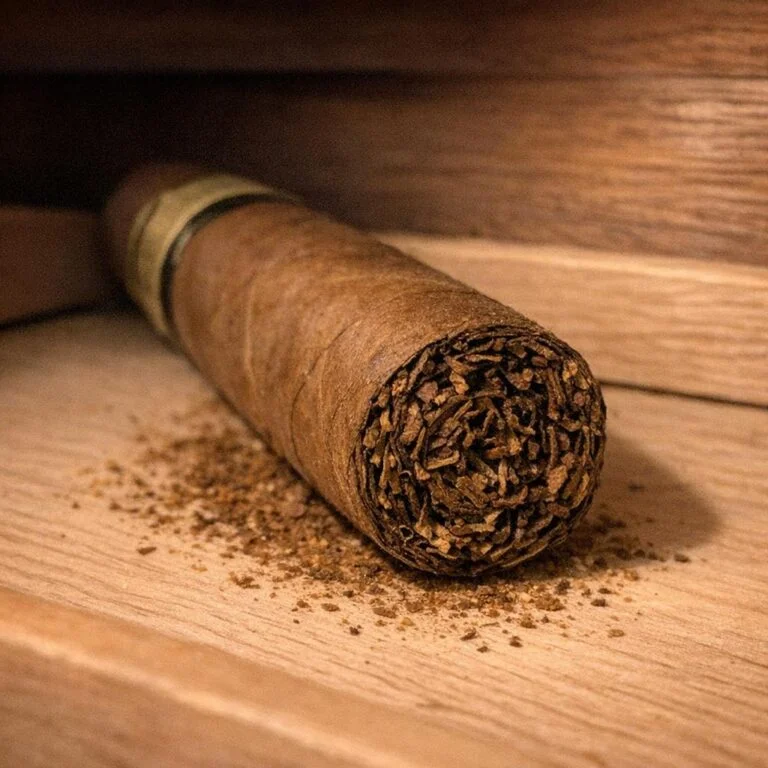
The feel. Roll one gently between finger and thumb. It should be firm and evenly packed the whole length, with a slight give. Hard spots, soft spots and any crackle are construction faults. Squeeze the foot lightly: you should see a tight spiral of whole leaves rather than chopped fragments, which is the difference between long filler and short filler. Every marca in the Habanos range is long filler apart from José L. Piedra, Quintero and La Flor de Cano, plus one or two individual sizes elsewhere, so chopped filler inside a Cohiba is not a Cohiba.
The smell. A box of real Havanas smells of cedar, hay, cocoa and something faintly barnyard. Ammonia, damp cardboard or a chemical sweetness are all wrong. Trust this one; it is a surprisingly reliable instrument.
Packaging Red Flags
Some fakes are betrayed by the container before anyone opens it.
Glass-topped boxes. Habanos does not sell its regular range in glass-lidded boxes. Clear-topped presentation boxes are overwhelmingly a tourist-market device, designed so a vendor can display product without letting a buyer handle it, and they are one of the strongest single signals in this whole guide. Treat a glass top as a fail unless you are certain of a specific and unusual release.
Cellophane on the cigars. Cuban cigars have not generally been cellophane-sleeved since about 1992, and machine-made production ended around 2002. Today cellophane is used only for machine-made small cigars made under licence by Internacional Cubana de Tabacos. A cellophane-sleeved Cohiba is not a Cohiba.
Loose bundles. Cellophane-wrapped bundles of twenty-five exist in the Cuban range, but they are restricted to cheap short-filler cigars. A bundle presented as a premium marca is wrong.
Box construction. Genuine dress boxes have tight corners, an even lid fit and clean printed paper without bubbling. Slide-lid boxes slide without forcing. Rough joinery, staples where there should be none, misaligned artwork and a lid that does not close flush all suggest a workshop rather than a factory.
The count. Habanos boxes come in standard counts, most commonly ten, twelve, fifteen, twenty and twenty-five depending on the size. An unusual count is worth a question.
The Price Test
This is the check people skip, and it catches more fakes than any of the others.
Cuban cigars are expensive, and they got very substantially more expensive from 2022. A box of twenty-five Cohiba is a four-figure sum in most markets. If someone is offering you one for the price of a decent dinner, the arithmetic has already answered the question, and no amount of hologram inspection is required.
Work out the local retail price before you travel or before you buy. Habanos operates a recommended retail structure, prices vary considerably by market because of local duty, and any Habanos Specialist will tell you what a given box costs in their market without being asked twice. Then apply a simple rule: a discount of ten or fifteen per cent from a legitimate shop having a quiet month is plausible. A discount of seventy per cent from a man in a doorway is not a bargain, it is a description of the product.
The corollary is worth stating too, because it catches people in the other direction. A high price proves nothing at all. Counterfeiters in tourist markets have long since worked out that pricing a fake box at eighty per cent of retail makes it more convincing, not less. Price is a good negative test and a useless positive one.
If You Already Have One
Suppose you are reading this holding a box you now suspect. What follows is the sensible order of operations.
Do not smoke the whole box to find out. Smoke one. A counterfeit usually declares itself within the first third: a harsh, sharp, ashy character, an uneven burn that wanders and needs constant correction, a draw that is either plugged or hollow, and a flavour that goes flat rather than developing. If the cigar is unpleasant in a way that seems structural rather than a matter of taste, you have your answer.
Check the box code and the seal properly, at home, in good light. Away from a vendor’s patter this is a much easier exercise. Run the bar code through the official checker. Compare the band against the brand’s own published imagery.
If you bought from a legitimate retailer, go back to them. Authorised Habanos Specialists take counterfeits seriously, because the counterfeit is competing with them. A reputable shop will look at the box and, if something is genuinely wrong with product they sold you, resolve it.
If you bought it from a stranger in a market, accept the tuition fee. There is no recourse, and pursuing it is neither safe nor productive. Note where it happened, do not go back, and treat the box as an educational reference: it is genuinely useful to have a known fake to compare against, which is more than most people own.
Do not resell it. Passing a counterfeit on, even at cost, even with a caveat, is how these boxes stay in circulation.
Questions Readers Ask
How do you tell if a Cuban cigar is real?
Work through the layers in order. On the box, check that the warranty seal’s hologram genuinely shifts as you tilt it and that its bar code verifies through the official Habanos checker; confirm the Denominación de Origen Protegida seal, present on every box since 1994. Underneath, look for the hot-stamped “Hecho en Cuba” and “Habanos s.a.” lettering you can feel with a fingertip, plus a factory code and a boxing date in Spanish month abbreviations. On the cigars, look for uniform colour and size across the box, a triple cap, whole-leaf filler at the foot and consistent band placement. Then apply the price test. The most reliable measure of all is buying from a Habanos Specialist.
How do I read a Cuban cigar box code?
There are two ink stamps on the underside. One is a rotating factory code that Habanos keeps deliberately opaque, so no public lookup table stays accurate for long. The other is the boxing date, which is not coded: a three-letter Spanish month abbreviation followed by a two-digit year, with the year system starting at 00 in 2000. ABR 24 means April 2024. The month codes are ENE, FEB, MAR, ABR, MAY, JUN, JUL, AGO, SEP, OCT, NOV and DIC.
Does the Habanos hologram guarantee a box is genuine?
It is strong evidence, not a guarantee. The 2009 seal carries a bi-colour hologram that shifts in two and three dimensions plus an individual bar code, and the seal paper is auto-destructive so it tears if lifted. Most counterfeits fail this test outright with a flat printed rectangle. The better ones copy the appearance, which is why the hologram should be checked together with the bar code lookup, the stamps underneath and the cigars themselves rather than on its own.
Are cigars sold on the street in Havana ever real?
Occasionally, in the sense that genuine cigars are sometimes diverted from factories. Overwhelmingly, no. Cuba requires an official purchase receipt from an authorised store to export more than fifty cigars, precisely because the state wants a paper trail that street sales cannot produce. Treat any approach from a vendor, taxi driver or hotel employee as a sales tactic rather than a stroke of luck.
Are glass-topped boxes of Cuban cigars fake?
Almost always. Habanos does not sell its regular production range in glass-lidded boxes, and clear-topped presentation boxes are a fixture of tourist markets rather than of Habanos Specialists. Combined with a low price, a glass top is about as clear a signal as this subject offers.
Should a Cuban cigar be in cellophane?
No, with one narrow exception. Cellophane sleeving of Cuban cigars was largely discontinued around 1992 and now applies only to machine-made small cigars produced under licence outside the main Habanos range. A cellophane-wrapped cigar presented as a premium Havana marca is wrong.
What is a triple cap and why does it matter?
It is the way the head of a Cuban cigar is finished, with three small overlapping pieces of wrapper laid on in sequence rather than a single disc. Under good light you can see the faint seams. It is not unique to Cuba, but its absence on a cigar claiming Cuban origin is a meaningful signal, because it is a rolling technique rather than a printing one and therefore much harder to counterfeit convincingly. It sits alongside the other construction points in the anatomy of a cigar.
Which Cuban brands are faked most?
Cohiba by a very wide margin, followed by Montecristo and Romeo y Julieta. They are the most recognisable names, which is exactly what a counterfeiter needs. The corollary is that the less famous marcas in the Habanos portfolio are faked far less often, and several of them are better value in any case, which is one of the arguments we make in our guide to the full Habanos brand list.
Eight Checks, Ninety Seconds
None of this is difficult. Hologram, bar code, hot stamps, date, band, cap, filler, price: eight checks, perhaps ninety seconds, and the overwhelming majority of counterfeits fail at least three of them. What defeats people is not the difficulty of the test but the circumstances in which they are asked to perform it, standing in the sun, being hurried, wanting the story to be true.
So the practical advice is unglamorous. Buy from a shop that will still be there next year. Take a photograph of the underside of the box before it goes into the humidor, because that boxing date is the only objective record you will ever have of how long those cigars have been resting. Then log what you smoke, marca, vitola and box code together, in the same format each time, and the pattern that emerges will teach you more about what a real Havana does than any checklist can. The Cigarro Method is built for exactly that, and it is free to start.