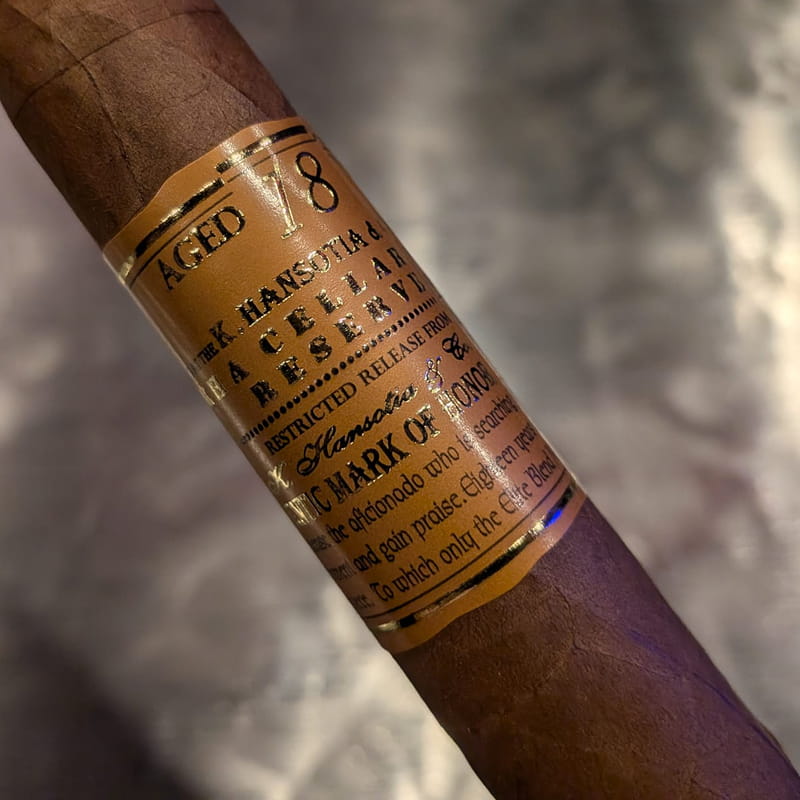
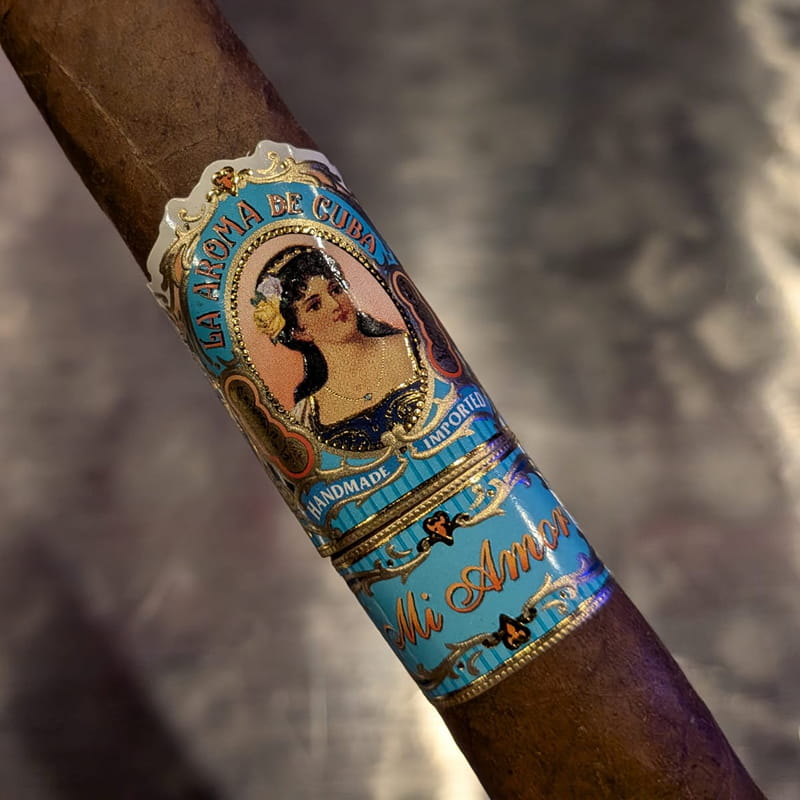
A cigar band is the paper ring wrapped around a cigar, usually an inch or so below the head. Most people remove it without a glance, or leave it on without a thought, and in both cases a small printed document goes unread. The band was invented in Havana in the 1830s by a cigar maker named Gustave Bock, and it has carried the same job ever since. It tells you who made the cigar, what line it belongs to, and often where it came from. A band is the cigar’s identity card, printed in miniature and gummed to the leaf.
Read properly, the band is a good deal more than decoration. It records the maker’s name, the blend’s family, the country of origin, whether the cigar is a standard production or a limited release, and, on the better Cuban marques, a set of security marks meant to prove that the thing in your hand is genuine. None of it is hidden. It is simply printed small and ignored often.
What follows is how to read all of it: the history that explains why the band exists at all, the difference between the maker’s mark and the line, how to find the country of origin and what the handmade markings mean, how to recognise a limited edition or a regional release, and how to use the band as the trust signal it was always meant to be. Cigarro sits at the end, as the place to record what the band tells you, so that a year from now you know exactly what you smoked.
A Paper Ring, With a Purpose
There is a charming story that the cigar band was invented for Catherine the Great, who is said to have ordered her cigars wrapped in silk so the tobacco would not stain her royal fingers, after which the fashion spread through her court. There is another that credits the English dandies of the nineteenth century, too fastidious to risk a soiled white glove. There is a third, less flattering, that says the band exists to hold a badly rolled cigar together. All three are wrong, and the cigar historians of Havana have spent a fair amount of energy saying so.
The Catherine story is dismissed by the Cuban collector-historian Angel Pereira Reyes as a fairy tale for children; the man who first told it seems to have confused the band with the coloured silk ribbons once used to tie cigars into wheels, then added a queen. The white-gloves theory fares no better. Abdon Gonzales of Havana’s Instituto de Investigaciones del Tabaco calls it an old wives’ tale, and points out that a properly rolled cigar does not stain the fingers in the first place, quite apart from the fact that the English of the period smoked far more pipe tobacco than cigars. The notion that a band holds a poor cigar together is the one that would get you laughed out of Havana: the banding instructions at the Partagás factory have always insisted that a band must not constrict the cigar, since it is meant to be removed before smoking. You do not trust a cigar’s structure to a ring designed to slip off.
The real reason is duller and more convincing, and it is the one accountants would predict. Gustave Bock, a European immigrant who owned a factory in Havana, was familiar with the sharp practices of Old World merchants, and in the 1830s he ordered a paper ring bearing his signature to be placed on every cigar he sent to Europe. Counterfeiting of Cuban cigars was rampant. German factories around Bremen turned out cheap cigars by the ton and sold a great many of them under borrowed Cuban names. Don Francisco Cabañas, who made a prestigious Havana cigar of his own, reckoned that for every two million genuine Cuban cigars he shipped to Europe, six million counterfeits were sold there. Bock’s band was a maker’s mark and nothing more romantic than that: a way of saying this one is really mine.
It worked, and it spread. Cuban archives show that by 1855 virtually every Cuban maker with an export trade was banding cigars, registering the design with the government, and urging buyers to insist on a banded cigar. The band was, from its first day, a certificate of authenticity dressed up as decoration. Everything else it has come to carry was built on that single original purpose, and the purpose still holds.
Maker, Line, and the Vitola
Most bands carry two pieces of information and imply a third. The first and largest is the marca, the maker’s mark, printed to be read across a room: Partagás, Padrón, Davidoff, Arturo Fuente. This is the house that made the cigar, and on a simple band it may be all that is printed.
The second is the línea, the line or series within that house. A maker may run a dozen lines at different strengths, wrappers, and prices, and the line is how you tell them apart. Romeo y Julieta is the marca; 1875 or Reserva Real is the línea. Sometimes the line shares the main band as a second word; often it earns a band of its own, which is part of why second bands have multiplied over the years.
The third thing people expect to find on the band, and usually do not, is the vitola: the cigar’s shape and size. This is the most common misreading of a band. The vitola name lives on the box far more often than on the band itself. Take the Cuban Montecristo No. 2. The band carries the famous Montecristo design and the marca, and that is essentially all it carries; the band does not tell you that you are holding a pirámide, a tapered torpedo of six and an eighth inches and a fifty-two ring gauge, aged two years before it was sold. That No. 2 is the vitola, and you learn it from the box and the price list and the shape in your hand, not from the ring of paper around it. The band names the maker. The box names the format.
None of this is a flaw in the band. It is simply the division of labour between the band and the box, and knowing it saves you from the beginner’s mistake of hunting the band for a size that was never printed there. When a New World maker does put the line, or even a size indicator, on a second band, that is a deliberate choice, and the extra ring is worth reading for exactly that reason.
At a Glance
The Marks and Where They Live
| Mark | Where it lives | What it tells you |
|---|---|---|
| Maker’s mark (marca) | Main band, largest type | Who made the cigar |
| Line or series (línea) | Main band, or a second band | Which blend within the maker’s range |
| Vitola (size name) | Usually the box, sometimes a second band | The shape and dimensions |
| Country of origin | Box, sometimes the band | Where it was made |
| Handmade marking | Box | Totalmente a mano, hecho a mano, or machine made |
| Edition mark | Second band | Standard, limited, or regional release |
Knowing a House on Sight
Spend enough evenings near a well-stocked humidor and you stop reading the marca and begin to recognise it, the way you know a friend by their gait before they are close enough to greet. Each house keeps to its own livery, and the colours do as much work as the words. Padrón runs gold lettering on white. Arturo Fuente wears a red and gold crest. Davidoff keeps to a restrained green and gold. La Aurora flies its bird. Cohiba holds to the yellow, black, and white check it has carried for decades, the same livery whether you are holding a Behike or a Siglo VI.
The point of learning the liveries is not display but speed. A glance along a shelf tells you which houses are present before you have read a single word, and the secondary band, where there is one, narrows a familiar marca to the particular line in your hand. Recognition of this kind asks nothing of you beyond attention, and it arrives on its own: a row of small flags resolving, over a season or two, into names you know on sight.
Where It Was Made, and By Whose Hands
Origin is the next thing to look for, and the band will sometimes give it to you directly. A Cuban band or box says Habana or Hecho en Cuba. New World makers print Hecho a mano en Nicaragua, en República Dominicana, en Honduras. Origin behaves much like the vitola. The box is the more dependable place to find it, though a serious cigar will name it somewhere, and a careful smoker goes looking. Whether you may carry that particular box home is a separate question entirely, and we answer it country by country in our guide to where Cuban cigars are legal.
More useful than the country is the phrase that usually travels beside it, because that phrase tells you how the cigar was made. There are three to know, in descending order of care. Totalmente a mano means totally by hand: the filler, the binder, and the wrapper all assembled by hand, which is the designation a serious long-filler cigar earns and the one to look for. Hecho a mano means made by hand, but only in part; usually the bunch is formed by machine and the wrapper applied by hand. Hecho a máquina, or the box stamp Mecanizado, means made by machine, generally from chopped or homogenised tobacco, which is the mass-market cigar.
The distinction matters because the words are chosen with care and mean specific things. Hecho a mano sounds like handmade to an English ear, and a buyer who does not know the gradation can pay a fully handmade price for a half-handmade cigar. The phrase to trust, on a Cuban box or a serious New World one, is totalmente a mano. The rest is marketing standing close to the truth and hoping to be mistaken for it.
A word on who actually applies the band, because it tells you something about the house. Traditionally the work was done by hand, almost always by women, with a dab of plant-based glue applied on the tip of a finger. The band has to sit at the same height on every cigar in the box, and the glue must not ooze onto the wrapper, where it would tear the leaf when the band came off. The care a factory takes over a small paper ring is a fair indication of the care it takes over everything else.
- Totalmente a mano. Totally by hand. Filler, binder, and wrapper all assembled by hand. The mark of a serious long-filler cigar, and the one to look for.
- Hecho a mano. Made by hand, in part. Usually a machine-formed bunch finished with a hand-applied wrapper.
- Hecho a máquina, or the box stamp Mecanizado. Made by machine, generally from chopped or homogenised tobacco. The mass-market cigar.
- Hecho en [country]. The country of origin: Cuba, Nicaragua, the Dominican Republic, Honduras.
Second Bands and Limited Editions
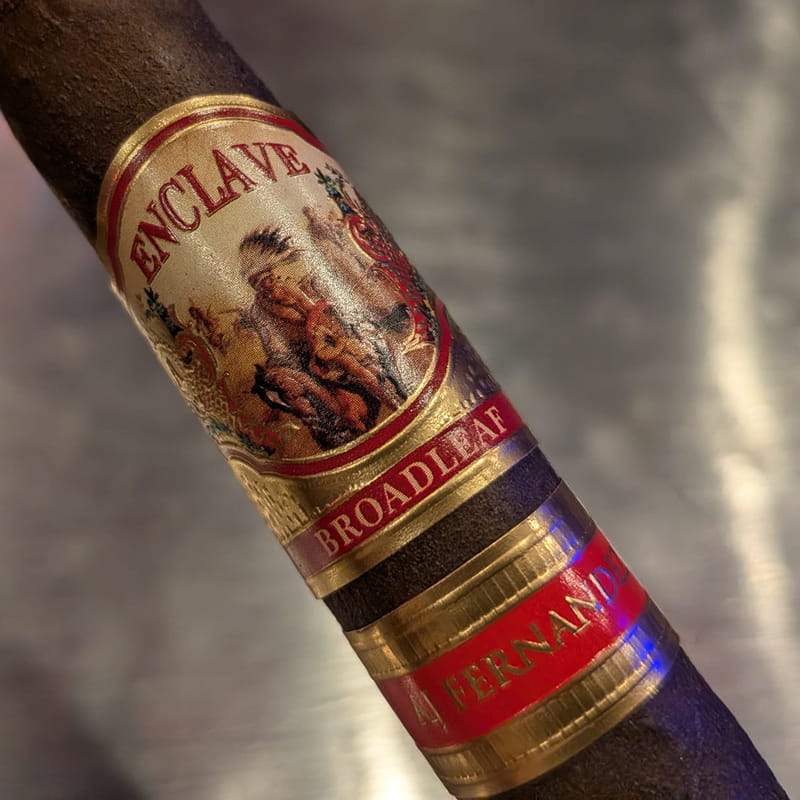
Somewhere in the last twenty-five years the cigar acquired a second band, and then sometimes a third, and a foot band around the bottom besides. A second band is a smaller ring sitting just below the main one, and it carries the news the main band has no room for: a limited edition, a particular wrapper, an anniversary, a release year.
Cuba codified the practice. In 2000, Habanos introduced the Edición Limitada, marked by a distinctive black-and-gold second band reading Edición Limitada; from 2001, that band also carries the year of release. The cigars are made with specially aged tobacco, usually a darker and older wrapper, for a single production run that is not repeated. The black-and-gold ring is the tell, and on the secondary market it is the difference between an ordinary box and a sought-after one.
In 2005 came the Edición Regional, made in limited quantity for a single market or distributor rather than for the world. Its second band names the region with the word Exclusivo, as in Exclusivo Suiza or Exclusivo Reino Unido, and wears its own colour scheme. A Cuban cigar whose second band names a country is almost always a Regional Edition produced for that country’s importer, which is a useful thing to recognise when one turns up in a trade.
The New World plays the same game with more freedom and less regulation. Drew Estate’s Liga Privada, the various My Father lines, and a long list of others use secondary bands and foot bands as identity and marketing as much as information. A foot band, the little ring around the bottom of the cigar, is largely decorative and comes off before you light up. The lesson holds across all of it: when a cigar wears more than one band, the extra rings are telling you this particular cigar is special in some specific way, and they are worth reading to learn how.
Cuban Second Bands
Limitada versus Regional
Edición Limitada Introduced 2000. Black-and-gold second band reading “Edición Limitada”. Release year on the band from 2001. Specially aged tobacco, usually a darker, older wrapper. One production run, not repeated. | Edición Regional Introduced 2005. Second band names a single market with “Exclusivo” (for example Exclusivo Suiza). Its own colour scheme. Made in limited quantity for that region’s distributor. |
The Band as a Trust Mark
All of which returns to the band’s first purpose. Bock’s ring was an anti-counterfeiting device, and the most valuable cigars in the world still lean on the band, and on its companion the box seal, to prove they are real.
The Cuban system is the most elaborate in the trade. Every box of Habanos carries a warranty seal, a green-and-white government guarantee whose lineage runs back to an 1889 royal decree and a 1912 Cuban law. In 2009 the seal was redesigned with a hologram and an individual barcode that tracks each box from the factory to an authorised distributor. It is printed on auto-destructive paper that tears apart if you try to lift it, and more recent issues have added microdots and an NFC chip for verification by phone. Note that this seal lives on the box rather than the band, which is one reason a loose Cuban cigar with no box is so difficult to authenticate.
The band itself can carry security as well. Since 2014 the Cohiba Behike has worn a holographic band built specifically to defeat fakes: a holographic Taíno head with a smaller head set inside it, the head within a head, alongside repeating Cohiba and Behike logos in gold foil and nine rows of small white squares running to a solid gold line, every square meant to be complete even at the edges. Counterfeiters can reproduce the artwork; they struggle with the hologram and the squares. Cigar Aficionado’s own guides to spotting a fake Behike turn on exactly these details.
For everything else, the band is a quieter tell. A genuine band is printed crisply, embossed where it should be, registered so the gold sits exactly on the design, and gummed cleanly. A counterfeit tends to betray itself in the small things: a fuzzy edge, a colour slightly off, a typeface a half-weight wrong, a band that sits askew on the cigar. You will not authenticate every cigar by its band alone, but a band that looks cheap is telling you something, and it is usually the truth.
- Registration. On a genuine band the gold sits exactly on the design. Printing that drifts off the artwork is a warning.
- Print quality. Crisp edges and clean colour are the rule. A fuzzy line or a colour slightly off suggests a copy.
- The hologram. On a Cohiba Behike, the Taíno head holds a smaller head inside it. No head within a head, no genuine band.
- The white squares. Nine rows of small white squares run to a solid gold line, complete even at the edges. Broken or partial squares fail.
- Fit and finish. A real band sits straight and is gummed cleanly. A band askew or badly glued is telling on itself.
On or Off the Cigar
No discussion of bands survives long without the oldest argument in the room, which is whether you smoke with the band on or take it off. The English settled it for themselves in the nineteenth century, and not kindly. The etiquette guides of the day held that only the lower classes left the band on, while allowing that one might turn the face of a sufficiently impressive band toward one’s companions. To leave the band on was to advertise, and to advertise was vulgar.
That snobbery has softened into preference. American tobacconists will tell you it is entirely your choice, while noting that something like seven in ten smokers still take the band off out of habit. The writer G. Cabrera Infante insisted in Holy Smoke that the band, though it goes on last, must always come off first. Others leave it on and think nothing of it. The argument is no longer about class. It is about taste, and taste is allowed to vary.
There is, however, one piece of advice that nearly everyone serious agrees on, and it is practical rather than social. Do not pull the band off a cold cigar. Wait until the cigar has been lit and smoked for a few minutes; the warmth softens the gum beneath the band and lets it slide off without lifting the wrapper with it. Modern wrappers are thinner and more delicate than they once were, and a band torn off in haste will take a strip of leaf with it. Davidoff removed his bands only once the cigar was running, and the advice is as sound now as it was then.
A band torn from a cold cigar takes the wrapper with it. Wait until the cigar is running, and it comes away clean.
For what it is worth, I leave the band on through the first third and take it off when the cigar tells me it is ready, which is usually the moment it would have come away cleanly in any case. But that is preference, not law. The only firm rule is the one about the wrapper. Everything else is yours to decide, and anyone who tells you otherwise is selling you their taste as though it were a fact.
Keeping the Record
The band is the most reliable record a cigar carries of its own identity, and it is worth keeping rather than discarding. Long after the smoke is a memory, the band still says who made the cigar, which line it belonged to, whether it was a limited run, and what year it was released. That is precisely the information you want on hand when you review a cigar or set one down to rest, and it is the information most likely to evaporate if you do not write it down.
So before you remove a band, read it in order, and then photograph it. A photograph kept with your notes settles any later question about what you actually smoked, which matters more than it sounds, because memory tends to round a cigar up.
The Order
How to Read a Band, in Order
In Cigarro, the band is where a cigar’s record begins. Photograph it and the entry takes shape around what the band tells you: the maker, the line, the origin, whether it is a standard or a limited release. That record then carries your tasting notes, your rest dates, and your scores, so that a year on you can set your June note beside your December note on the same blend and see what your palate has done in between. The band that began as Gustave Bock’s signature becomes, in the app, the first line of your own record of the cigar.
On Reading a Cigar Band
Should I take the band off before smoking?
It is your choice. If you do remove it, wait until the cigar has been lit for a few minutes so the heat softens the gum; a band pulled from a cold cigar will often take a strip of the wrapper with it. The only firm rule is to protect the wrapper.
Does the cigar band tell me the size?
Usually not. The band carries the maker and often the line, while the vitola, the size and shape, almost always lives on the box. A Montecristo No. 2 wears a Montecristo band, but the “No. 2” and the pirámide shape come from the box and the cigar itself.
Why do some cigars have two or three bands?
The main band names the maker and line. A second band carries what the first has no room for: a limited edition, a particular wrapper, an anniversary, or a year. A foot band around the bottom is mostly decorative and comes off before you light up.
What does "Totalmente a mano" mean?
Totally by hand. Filler, binder, and wrapper were all assembled by hand, which is the mark of a serious long-filler cigar. “Hecho a mano” means only partly by hand, usually a machine-formed bunch with a hand-applied wrapper. “Hecho a máquina” or “Mecanizado” means machine made.
How can a band help me spot a fake?
On Cuban cigars, the box carries a holographic warranty seal, and a Cohiba Behike carries a holographic band with a Taíno head set inside a larger head. Beyond those, a genuine band is printed crisply, registered cleanly, and sits straight. A fuzzy, faded, or crooked band is often the first sign of a counterfeit.
A Signature in Miniature
For a scrap of printed paper that most smokers throw away without a glance, the band carries a remarkable amount. It is the maker’s signature first of all, and with it the line, the origin, and a guarantee against fraud; for a long stretch of the last century it was also a collecting craze in its own right, redeemed by the thousand for baseball gloves and, if you saved enough of them, a baby grand piano. Read it well and you know a great deal about a cigar before you ever light it.
Bock printed his name on a paper ring because he wanted you to know whose work you were smoking. Nearly two centuries later, that is still what the band is for. The first attention a good cigar deserves is to read the ring around it. The second is to remember what it said.