
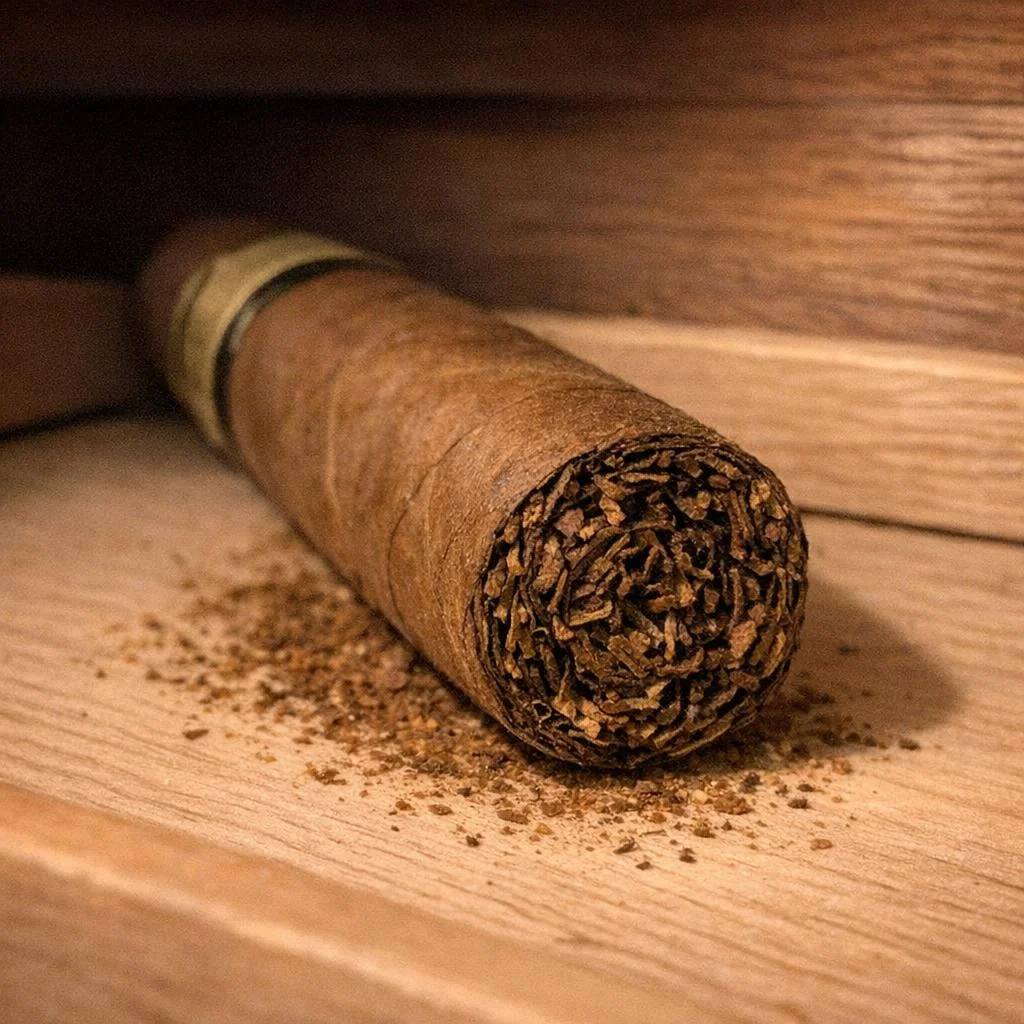
The cigarette beetle is the one pest every humidor owner should know by sight, or rather by the evidence it leaves behind. Lasioderma serricorne, called the tobacco beetle or cigar beetle in the trade, is an insect about two to three millimetres long whose larvae eat tobacco from the inside out. Almost nobody sees the beetle. What you see is a neat round pinhole in a wrapper and a little drift of tobacco dust on the cedar beneath it, and by then the damage has started.
The reassuring part is that prevention is almost entirely a matter of temperature. The eggs arrive already inside the tobacco, they hatch only when a humidor runs warm and wet, and a collection kept cool and inspected now and then is very unlikely to ever host a hatch. This piece covers what an infestation looks like, where the beetles actually come from, the habits that keep them dormant, and what to do on the day you find a hole.
What an infestation actually looks like
The first sign is nearly always a single cigar with a small, perfectly circular hole in the wrapper, about the diameter of a pin. It may sit on the side of the cigar or near the foot, and it is often accompanied by fine powdery tobacco that has shaken loose into the cellophane sleeve or settled on the shelf below. Holt’s describes this dust as the tell that most people notice first, because it shows up against the cedar even when the hole itself is hidden under a band.
The beetles themselves are rarely seen. Cigar Aficionado’s account of one collector who opened a thousand-cigar humidor to find beetles crawling over the lot, with little heaps of brown dust in the corners, is the dramatic exception. In most cases the larvae do their eating inside the cigar, and the hole is the only evidence.
Speed is the alarming part. A bad outbreak can work through every cigar in a humidor, or a whole box, within about forty-eight hours. That is why a single pinhole is treated as a humidor problem rather than a cigar problem, and why the response below starts with removing everything, not just the damaged stick.
A cigar with beetle holes is finished. It will not burn properly, the filler has been tunnelled, and no amount of aging will restore it. Bin it without sentiment. If a cigar shows only the smallest suspected mark and you are not sure, treat it as infested anyway. The cost of being wrong in the other direction is the rest of the shelf.
Where they come from
Beetles do not wander into a humidor from the garden. They arrive in the tobacco. Female cigarette beetles lay their eggs on tobacco leaf, often while it is still in the field or the curing barn, and the eggs are small enough to survive every sorting and rolling step that follows. Every reputable factory fights them, with fumigation, oxygen-depleted rooms and in some cases freezing, and the great majority of eggs are killed. Some are not. Holt’s puts it plainly: it is common for finished cigars to carry beetle eggs, and the eggs are harmless until conditions let them hatch.
Those conditions are heat and damp together. The trade’s rule of thumb, as Cigar Aficionado puts it, is that larvae begin to hatch when the humidor climbs above about 72 degrees Fahrenheit, roughly 22 Celsius, and above 72 percent relative humidity; Famous Smoke’s Cigar Advisor draws the same line at 72 percent. A 2021 laboratory life-table study found the beetle develops fastest between 30 and 37 Celsius and fails to complete development at all around 17 Celsius, which is the science behind the rule: cold does not merely slow them, it stops them.
Once hatched, the life cycle runs somewhere between forty and ninety days depending on warmth and food. A female lays anywhere from ten to a hundred eggs, larvae emerge in about a week, and they feed for five to ten weeks before pupating. The adult beetle does not eat tobacco at all. All of the damage is done by the larvae, which is why the pinhole is the exit and the tunnelling is already behind it.
The practical lesson is that a beetle problem is a storage problem, not a bad-luck problem. The eggs may well be in your humidor right now, as they are in most humidors, and they will stay dormant for as long as you keep the box cool.
Prevention: cool, dry enough, and watched
Keep the temperature down. This is the single most important habit. Holt’s recommends never letting a humidor exceed 70 Fahrenheit, about 21 Celsius, and most experienced collectors aim lower. The humidor should sit away from direct sunlight, radiators, heating vents and the top of any appliance that runs warm. A south-facing windowsill in July is the classic mistake. If your home runs hot in summer, move the humidor to the coolest room in the house for the season, or into a cabinet on an interior wall.
Run the humidity in the mid sixties. The old 70/70 standard sits uncomfortably close to the hatching zone. Cigar Advisor suggests keeping the humidor under 70 percent and ideally between 65 and 67 percent, and that is the range I keep my own at. The full case for a lower setting, and how to choose between 65, 69 and 72, is in our cigar humidity guide. A digital hygrometer and thermometer, checked rather than trusted, tells you where you actually are.
Quarantine new arrivals. A cigar bought on holiday from a beach vendor, a box that spent a week in a hot delivery van, a handful of singles from a shop whose walk-in felt warm: any of these can carry a hatch that has already begun. Keep new purchases in a separate bag or a small travel humidor for two to three weeks and inspect them before they join the main collection. Cigars that need a rest after shipping benefit from the pause anyway; how long to rest a cigar covers the timing.
Look, regularly. Holt’s advice is to open the lid a couple of times a week, rotate the cigars and check for holes and dust. It takes a minute. Rotation also evens out the humidity across the shelves, and it is a natural moment to update your log. If you track your humidor in Cigarro, note the temperature and humidity reading at each check; a run of warm readings is the early warning that matters more than any single one.
Never reach for chemicals. No insecticide, spray or fumigant belongs anywhere near a humidor. It ruins the cedar, taints every cigar in the box and is not safe on anything you intend to smoke. The only treatment the trade uses at home is cold.
If you find one: the freezer, done properly
Act the day you see the hole. Take every cigar out of the humidor, not just the damaged ones, because one visible pinhole means the rest are at risk. Throw away any cigar showing holes or leaking dust. Then bag the rest in sealed freezer bags, keeping cigars from the same box as the damaged one in a bag of their own, and if you want to be thorough, bag them individually.
The cold sequence matters as much as the cold. Cigars taken straight from a freezer to a warm room can swell and split their wrappers, so the trade moves them in stages. The consensus from Cigar Aficionado and Holt’s is three days in the freezer, then a full day in the refrigerator, then back to the humidor. Cigar Advisor prefers a gentler entry as well, with a few hours in the fridge before the freezer. Both work; the point is that no step is sudden. The full method, with temperatures and timings, is laid out in our guide to freezing cigars, and it is the same method whichever source you follow.
While the cigars are away, deal with the box. Empty it completely, shake or vacuum out every trace of dust, and wipe the interior with a cloth dampened with distilled water. No cleaner, no disinfectant, no scent of any kind; Cigar Aficionado’s warning is that these ruin the wood and leave a smell the cigars will pick up. Inspect the humidification device and replace it if there is any chance it is harbouring larvae. Cigar Aficionado suggests adding a few spare strips of cedar when the cigars go back in, to absorb any excess moisture.
Then fix the cause. The beetles hatched because the humidor ran warm or wet, or both, and putting the cigars back into the same conditions invites a repeat. Check the reading, move the box if it needs moving, and if the humidification system is a cheap sponge or a homemade device, this is the moment to replace it with something that holds a stable level. A well-set-up humidor is covered in our humidor organisation guide.
Log every check, catch it early
A beetle outbreak feels like a catastrophe and is nearly always avoidable. The eggs are already in the tobacco; the hatch is up to you. Keep the humidor cool, keep the humidity in the mid sixties, look inside twice a week, and treat any new arrival with a fortnight of polite suspicion before it joins the shelf. Do that and the beetle stays what it should be for most collectors: something you have read about, checked for, and never met.