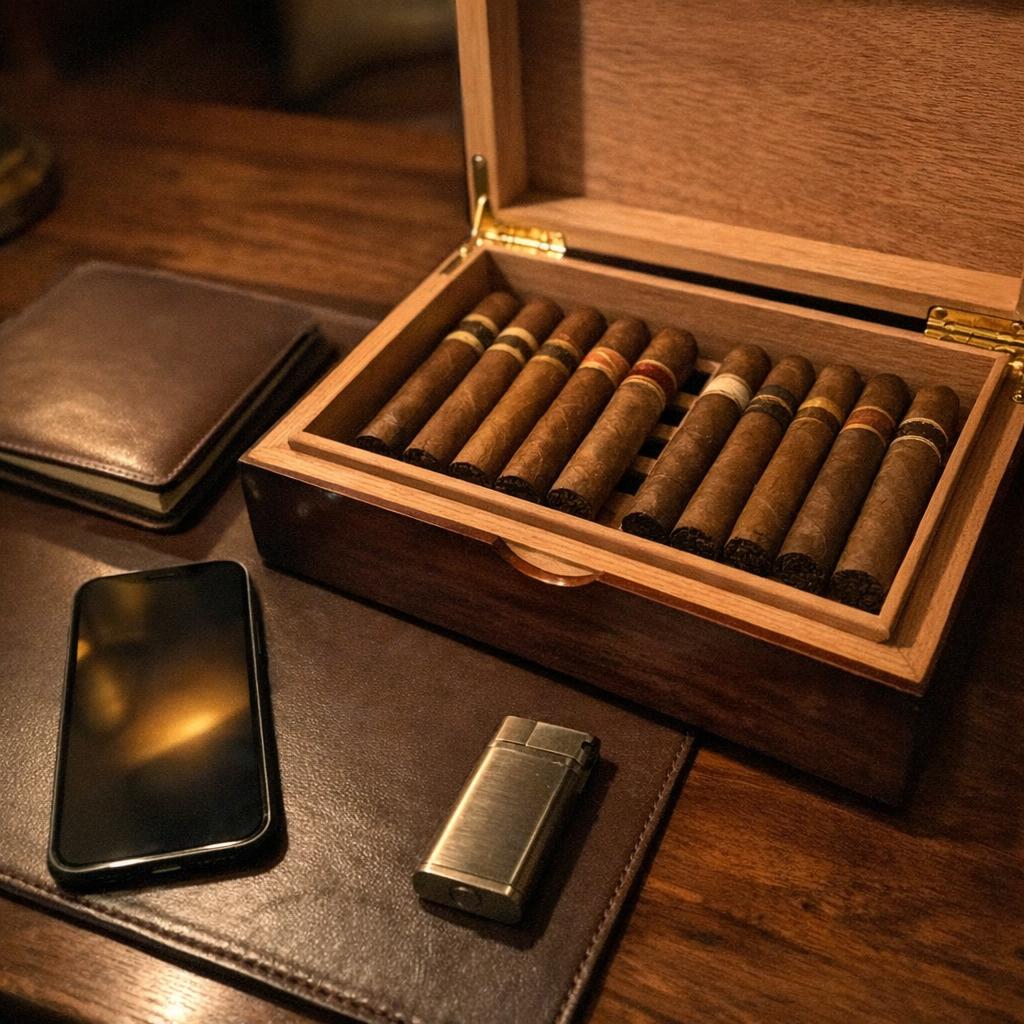
There is a particular kind of quiet disappointment that comes from opening a humidor, finding a cigar you forgot you owned, and realising it sat there a year past the evening you meant to smoke it. A digital humidor app exists to spare you that moment. It is software that keeps a record of the cigars you own, what you paid, when they arrived, and how long they have rested, so that your collection lives somewhere more reliable than memory.
The phrase covers more ground than most people expect. To one enthusiast, a digital humidor app is the thing that pings their phone when the humidity drifts. To another, it is the catalogue that tells them they are three Padróns short of needing another box. Those are two genuinely different tools wearing one name, and choosing well begins with knowing which one you actually want.
What follows is a concierge’s view of the category as it stands in 2026: what these apps do, what a good one earns its place by doing, what a poor one quietly fails to do, and how Cigarro fits among them.
Two Tools, One Name
Ask ten cigar enthusiasts what a digital humidor app does and you will get two answers, neither of them wrong. The confusion is worth clearing up before you spend a penny or a Sunday afternoon on one.
The first kind reads the air. It pairs with a small Bluetooth or wi-fi sensor that sits inside your humidor and reports the temperature and relative humidity to your phone. It charts how those numbers move through the day, warns you when they drift, and lets you watch a season turn from across the room. Cigar Aficionado’s coverage of the Boveda Smart Sensor describes exactly this: a device that transmits humidor data to an app, keeps a running history, and alerts you to changes. This is an instrument. It tells you about the conditions your cigars are living in.
The second kind reads the collection. It is a catalogue, a structured record of every cigar you own, what you paid, when it arrived, how long it has rested, and what you thought of the last one. It does not know or care what your hygrometer says. Its job is memory, not measurement. A virtual humidor, in other words.
Most enthusiasts who go looking for a digital humidor app want one of these two things specifically, and a surprising number end up disappointed because they bought the other. A sensor app will never tell you that you are down to your last Padrón 1964. A catalogue app will never tell you the humidor crept to seventy-two percent while you were away for the weekend.
The honest answer, for a serious collection, is that you want both, and they are usually two separate purchases. Knowing that going in saves you the irritation of expecting one tool to do the other’s work. The rest of this guide treats the catalogue as the centre of gravity, because that is where the real day-to-day value of a humidor tracking app lives, and notes the sensor where it belongs.
What a Good One Does
A catalogue app earns its place the moment it tells you something your memory could not. The bar is higher than a row of cigar names, and the better tools clear it in a few specific ways.
It records the things that actually matter later. Brand and blend are the easy part. A good app also captures the vitola, the wrapper, the box or purchase date, and the price per stick, because those are the fields you will want to sort and search by when the collection grows past the point you can hold in your head. The ability to sort a humidor by wrapper shade, by age, or by price per cigar is the difference between a list and a tool.
It tracks rest and age honestly. Cigars change in the box. Most benefit from a settling period after they arrive, and many reward longer patience. An app that timestamps when a cigar entered your humidor lets you answer the only question that matters on a given evening: has this one had long enough. Storage is a separate craft, and worth reading up on properly, but the app’s role is simply to remember the date so you do not have to.
It connects to your reviews. This is where a catalogue stops being a spreadsheet. If the record of a cigar is tied to what you thought of it last time, structured rather than scrawled, then your collection becomes a palate history you can actually consult. The Cigarro Method, our review-by-thirds framework, exists for precisely this reason: notes you can compare are worth far more than notes you cannot. If the journal side is what you care about most, our cigar journal app comparison weighs the dedicated options side by side.
It keeps your data yours. A collection logged over years is worth protecting. A good app syncs, backs up, and lets you export. An app that locks your history inside itself, or quietly disappears when the developer loses interest, is a liability dressed as a convenience.
None of this is exotic. It is the difference between software built by someone who tracks their own cigars and software built to fill a category. You can usually tell which is which within five minutes of opening it.
What a Poor One Does
The simplest test for a weak digital humidor app is to ask what it does that a notes app on your phone does not. If the honest answer is very little, you have your verdict.
The common failures rhyme. A thin database that does not recognise the cigars you actually smoke, so every entry becomes a manual chore. No structured review, only a star rating, which tells you a cigar was a four last March and nothing about why. No way to search or sort, so the catalogue becomes a scroll. No export, so your years of logging are hostage to one company’s survival.
Then there is the clutter. An app stuffed with advertising, or one that pesters you to buy through its own shop on every screen, has confused your collection with its revenue. There is nothing wrong with a business model, but the moment the app works harder for the retailer than for you, the data suffers.
The last warning sign is silence. Cigar apps have a habit of launching brightly and then going untended, the reviews souring as the operating system moves on beneath them. Before you commit a collection to one, look at when it was last updated and whether anyone is still answering. A humidor you can trust is built on consistency, and the same is true of the software that keeps its ledger.
A poor app is not usually a scandal. It is a notebook with a worse interface than the notebook you already own, and it asks for an account and a password besides. Hold any candidate to the notes-app test and most of the field thins out quickly.
The Main Entrants
The category sorts into three rough camps, and it helps to see who lives where.
The environmental monitors. These are the air-readers. The CI Smart Sensor, which revives the hardware Cigar Aficionado first reviewed as the Boveda Smart Sensor, pairs a Bluetooth sensor with an app that charts humidity and temperature, stores the history, and sends alerts when the numbers move; it can watch several humidors at once and even reorder humidity packs. We set that approach against ours in Cigarro compared with the Boveda app. Standalone sensors, including the wi-fi-gateway models, go further for the travelling collector, letting you check on a humidor from another country. What none of them do is tell you what is inside the box. They are instruments, and good ones, but they are not catalogues.
The social and inventory apps. Here sit the community-flavoured tools, where a virtual humidor comes bundled with reviews, ratings, and a feed of other enthusiasts. Boxpressd is the familiar name in this camp, offering a virtual humidor alongside its social and review features. The appeal is the company; the trade-off, often, is that the catalogue and the review tools are built to serve a feed as much as a filing system, which tends to make them broad rather than deep.
The dedicated managers. A newer wave of apps treats inventory as the main event, with cleaner humidor management and less social noise. Humidor Companion is one of the more recent of these. They tend to do the cataloguing competently and leave the air-reading and the community to others.
No single one of these is the right answer for everyone, and that is rather the point. A collector whose only worry is humidity wants a sensor and can ignore the catalogues entirely. An enthusiast who wants to remember, compare, and improve wants a catalogue, and the depth of that catalogue is what separates a passing curiosity from a tool worth keeping. We keep an up-to-date view of the wider field in our ranking of the best cigar apps, which is worth a read if you want the full comparison rather than the categories. If you arrived here looking for a similarly named product, Cigarro and Cigaro are not the same thing.
Where Cigarro Sits
Disclosure, said plainly: Cigarro is our app. Read this entry as the maker’s case; the rest of the guide judges the field on its own terms.
Cigarro is a catalogue, firmly, and an unapologetically review-first one. It is a web app, which means there is nothing to install and nothing to update; you open it in a browser on any device and your collection is there.
The humidor is the structured kind. Every cigar carries the fields that matter, and the collection sorts by wrapper shade, by age, by ring gauge, and by price per stick, a depth of filtering we have not found matched elsewhere. The free Pocket tier holds thirty cigars, the full review-by-thirds tool, and the news feed, which is enough to decide whether the discipline suits you before you pay anything. And the record is yours to keep: an existing collection imports from a spreadsheet when you arrive, and the whole archive exports to CSV in one tap from your profile. Your humidor is yours.
The review is the centre of it. The Cigarro Method asks you to record a cigar in three parts, the first third, the second, and the final third, because that is how a cigar actually changes in the hand. Tie those notes to the catalogue entry and your humidor stops being a list of what you own and becomes a record of what you have learned. That is the part a notes app cannot give you, and the part most apps treat as an afterthought.
What Cigarro does not do is read your air. It has no sensor and makes no pretence of one. If humidity is your concern, pair it with one of the monitors above; the two jobs are different and we would rather do ours well than do both poorly. That is the concierge’s restraint, and it is deliberate.
The result is narrow by design. Cigarro is for the enthusiast who wants to remember every cigar properly, compare one evening to another, and watch their own palate sharpen over a year. If that is the collection you keep, it is built for you. If you simply want a humidity alarm, you want something else, and we will happily point you to it.
Choosing the One You Need
Strip the category down and the choice is almost simple.
If your anxiety is the air, that your cigars might dry out or swell while your back is turned, buy a sensor. A monitor that charts humidity and warns you when it drifts will earn its keep in a single saved box. Set your target where you prefer it; the traditional seventy-percent figure is a fine start, though many experienced aficionados now sit their humidors a touch lower, around sixty-five to sixty-nine percent, for a firmer feel and a cooler, more even burn. Our guide to the right humidity for a humidor sets out where that range came from and when it is worth sitting outside it. What matters more than the exact number is that it holds steady, and a sensor is how you know it does. A sensor will flag the drift, but it will not tell you which humidor solution to use to correct it.
If your anxiety is forgetting, that good cigars go unsmoked or unremembered, buy a catalogue, and choose one with a real review tool rather than a star and a shrug. The value compounds. A year of structured notes is a portrait of your own taste that no shop assistant can give you.
And if you take the collection seriously, you will most likely want both, because they answer different questions. The sensor tells you the conditions are right. The catalogue tells you what to do about it. Neither replaces the other, and any app that claims to be all of it at once is usually thin at everything. Decide which question keeps you up at night, and start there.
Why the Record Matters
A humidor is a small act of faith. You buy cigars now for an evening that has not arrived, trusting that they will be there, in good order, when the moment comes. The whole point of keeping a record, whether of the air or of the contents, is to make that faith less of a gamble.
The right digital humidor app does not change the cigars. It changes your relationship to them: fewer forgotten boxes, fewer cigars smoked a year too late, a clearer sense of what you actually enjoy rather than what you assumed you did. That is a modest promise, and a real one.
Choose the tool that answers your question, keep the record honestly, and let it quietly sharpen your palate over time. The cigars, after all, are doing their part in the dark. The least we can do is keep proper track.
The least we can do is keep proper track.