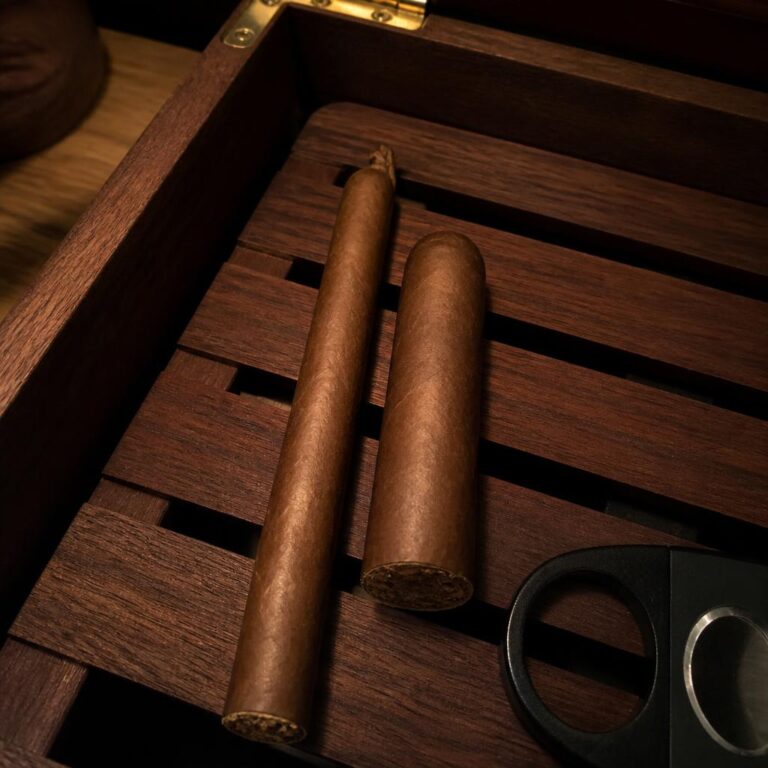

Cigarro is a cigar tracking and review web app, and the Cigarro Method is its review-by-thirds framework. Cigar Dojo is a cigar media site with a community around it, and Dojoverse is its social app, where members check in to the cigar in their hand. Both run in a browser and both cost nothing to start, which is why the two names keep turning up side by side when someone searches for a cigar community app.
They are less alike than that suggests. Cigar Dojo is a crowd you can sit down in, with a motto, “Never Smoke Alone”, and a late-night live show to match. Cigarro is closer to a well-kept notebook with a small room beside it. Which one you want depends on what you would like to have left over once the cigar is gone.
A disclosure before the comparison: Cigarro publishes this page, so I have an interest, and I would rather say so than hide it. The aim is to describe Cigar Dojo the way its own regulars would recognise it, to concede what it does better without hedging, and to be plain about where Cigarro is the smaller thing. Cigar Dojo is a host to this hobby far more than a rival, and this page is written in that spirit.
What Each One Is Actually For
Cigar Dojo began as a review site and grew into a small media house. It publishes staff reviews and ratings, tips and trade-show coverage, and it describes its app as “the world’s first and largest social cigar app”. Two shows carry the conversation: Flavor Odyssey, which explores pairings, and Smoke Night LIVE, a late-night broadcast that viewers join through the comments on Facebook, YouTube and X. Smoke Night LIVE reached its 496th episode on Friday 16 January 2026. The app is the room where that audience keeps talking between broadcasts.
The app has a history of its own. The original Cigar Dojo app launched in the autumn of 2012. Version 2.0, called Dojoverse, arrived on 11 September 2020 as a progressive web app at dojoverse.com, rebuilt from the ground up. The announcement tied the move to the restrictions that Apple’s and Google’s app stores place on tobacco, and to the possibility of tighter ones, which is a pressure every cigar app in this corner of the internet has had to answer.
Cigarro is narrower and quieter. It asks one question of you: what did you actually think of that cigar, and can you say why. The Cigarro Method breaks each review into thirds, first, second and final, so the notes capture how a cigar changed rather than one averaged impression. Around that sit a humidor that tracks what you own and how long it has rested, and The Lounge, a members’ feed for reviews and photographs.
The two begin from opposite ends. Cigar Dojo starts with the company and lets a record accumulate as a by-product. Cigarro starts with the record and keeps a small room beside it.
Feature by Feature, Side by Side
| Feature | Cigar Dojo (Dojoverse) | Cigarro |
|---|---|---|
| Core idea | Social check-in app attached to a cigar media site, reviews and live shows | Structured review and collection tracking with a members’ lounge |
| How you rate | Thumbs up or down at check-in, folded into the cigar’s overall rating; Cigar Wars head-to-head votes | The Cigarro Method: review by thirds, nine metrics per third; Quick Log for a 30-second review |
| Notes | Comments and GIF replies on a check-in | Per-third notes, flavour picker, photo, and the Cigar Signature plots |
| Inventory | A searchable cigar and brand database with stats (about 5,000 cigars in October 2023); no humidor or inventory function in its published descriptions | One humidor with quantity, price, blend details and rest tracking; verified catalogue; CSV import, CSV and JSON export |
| Community | Public, private and secret groups; events and places; leaderboards by day, week, month and all time | The Lounge: chronological feed, claimed @handles, nods, comments, follows; no groups, no events |
| Games and ranks | Cigar Wars (Elo-ranked duels), sumo belts, activity badges | None; milestones for logging and reviewing |
| Media | Staff reviews, annual Cigar of the Year, two shows | The Weekly Ember newsletter and the guides on this site |
| Platforms | Progressive web app at dojoverse.com on iPhone, iPad, Android and desktop browsers | Web app and PWA on any device; no App Store listing; no offline mode |
| Pricing | Free; its app page describes no paid tier | Free Pocket Humidor with unlimited reviews; paid tiers $4.99 to $29.99 CAD a month raise capacity only |
A table flattens nuance, so read this one as a map and not a verdict. The next two sections do the arguing.
Where Cigar Dojo Genuinely Wins
Begin with the thing that cannot be built in a sprint: a crowd with a history. The site has been publishing reviews and running shows since well before Cigarro existed. When its slogan says never smoke alone, it means it in a literal, scheduled sense, with a live audience arriving to comment in real time. A feature list cannot reproduce that. Cigarro is young, its Lounge is a small room, and I would not claim otherwise.
Second, Cigar Wars. Two cigars appear, you pick one, and thousands of those small decisions become a ranking. Cigar Dojo explains the idea as the real-world case of being handed one of two cigars, and it scores the results with the Elo method, the system used to rank chess players, in which an upset moves the standings further than an expected result. The rebuild of 23 January 2019 added personal statistics, favourites, recommendations drawn from like-minded voters, and leaderboards that can be filtered by period, country, wrapper shade and company size. It is a clever and generous piece of design, and it answers a question that a private notebook never can: what does the crowd think?
Third, the social machinery around the check-in. Dojoverse offers public, private and secret groups, events and places that members can check in to and discuss, leaderboards by day, week, month and all time, and a ladder of sumo belts earned through activity, alongside badges tied to things like maduro wrappers, full-bodied cigars and Nicaraguan origin. Cigarro has none of it: no groups, no events, no belts, no leaderboard. If the appeal of a cigar app is that it turns the hobby into a game and gives your herf a calendar, the Dojo is the better-furnished room.
Fourth, editorial reach. Cigar of the Year, now in its fourteenth year, grew from a modest Top 10 list in 2012 into twenty winners plus eight Exceptional Awards. For the 2025 edition each member of the Cigar Dojo team ranked a personal top twenty, points were awarded down a ladder (thirty for first, twenty-five for second, twenty-two for third, twenty for fourth, then one fewer per place), a cigar needed votes from at least two panellists to qualify, entries had to be sold in the USA and released in 2025, and the results were revealed two a day from 5 to 16 January 2026. Founders Eric and Jordan Guttormson approved the final selection. That is a process with a method and a named masthead, which is more than most lists of its kind can say.
Fifth, and plainest, the price. Cigar Dojo’s app page describes Dojoverse as a free progressive web app, and I found no paid tier described anywhere in its own material. For an enthusiast who wants company without a bill, there is nothing to weigh.
Where Cigarro Earns Its Place
The first difference is what a rating is for. A thumb at check-in, folded into the cigar’s overall standing, tells the crowd what you thought in two states. It tells future you very little, because a thumbs up records only that an earlier version of yourself approved. On Cigarro the default review is by thirds. First, second and final each get their own form, with nine metrics (strength, body, retrohale, mouthfeel, harshness, sweetness, bitterness, savouriness and spice), a flavour picker, burn and draw observations and a note, so the record shows how the cigar changed between the first light and the nub. For the evenings when that is too much, Quick Log takes thirty seconds: the cigar, a score, a line, an optional photo. If you want to see what that discipline looks like in practice, our guide to how to taste a cigar walks through it.
The second is the humidor. A Cigarro entry carries quantity, price per cigar, wrapper, binder, filler, ring gauge, length, purchase date and notes, and the app tracks rest, flagging a cigar as ready once it has sat long enough. You add from a verified catalogue of 211 brands, 2,173 lines and 7,118 sizes as of the August audit, or by free text when the catalogue lacks the cigar. As far as I can tell from Cigar Dojo’s own published descriptions of Dojoverse, it is built around check-ins and ratings, and none of them mentions a humidor or an inventory function, so check the app itself before relying on my reading. Our guide to digital humidor apps explains what that job involves. One honest limit: Cigarro gives each member one humidor, not several.
The third is the Cigar Signature. Every review made by thirds carries two line plots, one for taste (sweetness, savouriness, bitterness, spice and harshness) and one for performance (strength, body and retrohale), plus a strip for mouthfeel, all drawn across the three thirds. It appears on the review’s public page and on its share card, so a review can be read at a glance and set beside the next. It is a record of one palate and not a verdict from a crowd, which is exactly the point.
The fourth is the room. The Lounge is chronological, with no algorithm choosing what you see. Posting needs a claimed @handle, so every name is accountable. One switch controls whether your name appears anywhere public. Photographs are re-encoded on the device, so location data stays on the phone. Anyone can read the public pages without an account. It is a young room and a small one, meant to feel like a corner of a lounge rather than a stage.
Last, portability. Cigarro takes a spreadsheet in, as a CSV file or a table pasted from a sheet, and reads it on your own device without uploading the file. It sends your humidor out as a CSV that round-trips back through the importer unchanged, and gives you a full JSON copy of your data on request. Your records leave with you whenever you ask.
To be fair to the scoreboard, Cigarro has no groups, no events, no belts, no head-to-head game, no barcode scanning and no offline mode, and it is a web app only. Those are gaps, and I would rather name them here than have you find them later.
What Each One Costs You
Cigar Dojo is free. Its app page says so, and the site carries advertising from cigar makers and retailers, as most trade media does, with sponsors such as Rocky Patel, Davidoff, AVO, Atlantic Cigars and JR Cigars displayed on the page. That is an ordinary model and I mention it only so that the word free is understood. For many readers it will not matter in the slightest.
Cigarro’s free tier is funded the plain way, by the tiers above it. The Pocket Humidor holds thirty entries and, the detail I would weigh most heavily, places no limit on reviews. Reviewing is never the thing you run out of, on any tier. The paid tiers raise the shelf and nothing else: Desk Humidor at $4.99 a month for two hundred entries, Cabinet at $9.99 for seven hundred and fifty, Walk-in at $19.99 for two thousand, and Private Reserve at $29.99 for an unlimited collection. Prices are Canadian and monthly, a free-tier member who upgrades gets a thirty-day free trial, and the full breakdown sits on the pricing page. Cigarro takes no money from cigar makers or retailers and sells no advertising.
On where each one lives, the two are alike. Dojoverse and Cigarro are both web apps, so neither can be removed from your phone by an app store, a point we cover in the best cigar app for iPhone. The sensible question is therefore not price or platform. It is whether you want a crowd or a ledger.
Who Should Pick Which App
Choose Cigar Dojo if company is the appeal. You want a live show to join, groups to belong to, a game to play, a leaderboard to climb, a cigar of the year to argue about, and an app that costs nothing. Our round-up of the best free cigar apps gives it a fair hearing among the others.
Choose Cigarro if the record is the appeal. You want your notes structured by thirds, a humidor that knows what has rested and for how long, a quiet room with accountable names, and the freedom to take every entry with you. The wider case is made in our comparison of cigar review apps, and the same logic applies if you are building a shelf of your own, as in how to build a cigar collection.
And plenty of enthusiasts will happily run both: log and review at Cigarro, then take the cigar to the Dojo. Cigar Dojo says never smoke alone, and nothing in Cigarro disagrees. The two ask for different minutes of your evening, the Dojo for the ones around the cigar and Cigarro for the ones after it. If you would rather survey the whole field first, this wider list covers it, and our comparison with Boxpressd and the one with Cigar Scanner sit alongside this one.
Five Questions Worth Asking
Is Cigar Dojo free? Yes. Cigar Dojo’s app page describes Dojoverse as a free progressive web app, and no paid tier is described in its own material. The site is supported by advertising from cigar makers and retailers.
What is Cigar Wars? Cigar Wars is Cigar Dojo’s ranking game. You are shown two cigars and pick the better one, and the votes are scored with the Elo method used in chess rankings. Since the 2019 rebuild it also keeps personal statistics and leaderboards filtered by period, country, wrapper shade and company size.
Does Cigar Dojo have an app for iPhone and Android? Yes, as a web app. Dojoverse is a progressive web app at dojoverse.com that works on iPhone, iPad, Android and desktop browsers. Cigar Dojo moved to that format in 2020, citing the restrictions Apple’s and Google’s app stores place on tobacco.
Can both apps rate a cigar, and how do the ratings differ? Both can. Cigar Dojo asks for a thumbs up or down at check-in and folds the votes into each cigar’s overall rating, with Cigar Wars as a second route. Cigarro asks for a review by thirds, with nine metrics per third, or a 30-second Quick Log, and keeps the result as your own record.
Does Cigarro have groups or leaderboards like Cigar Dojo? No. Cigarro has a chronological members’ feed, The Lounge, with claimed handles, comments and follows, but no groups, events, belts or leaderboards. If those matter to you, Cigar Dojo is the better fit, and many enthusiasts use it alongside Cigarro.
The Crowd and The Ledger
Cigar Dojo built a crowd, and it is a good one: generous, long-lived, and well run. Cigarro set out to make a different hour worth keeping, the one you spend with a cigar and your own impressions of it. The wrong way to choose between them is a feature count. Ask instead what you want on the shelf after a year of cigars, a lively evening behind you or a record in your own words that still reads true. The Dojo will have the first waiting. The second begins with a single review at cigarroapp.com, and the first one costs nothing.