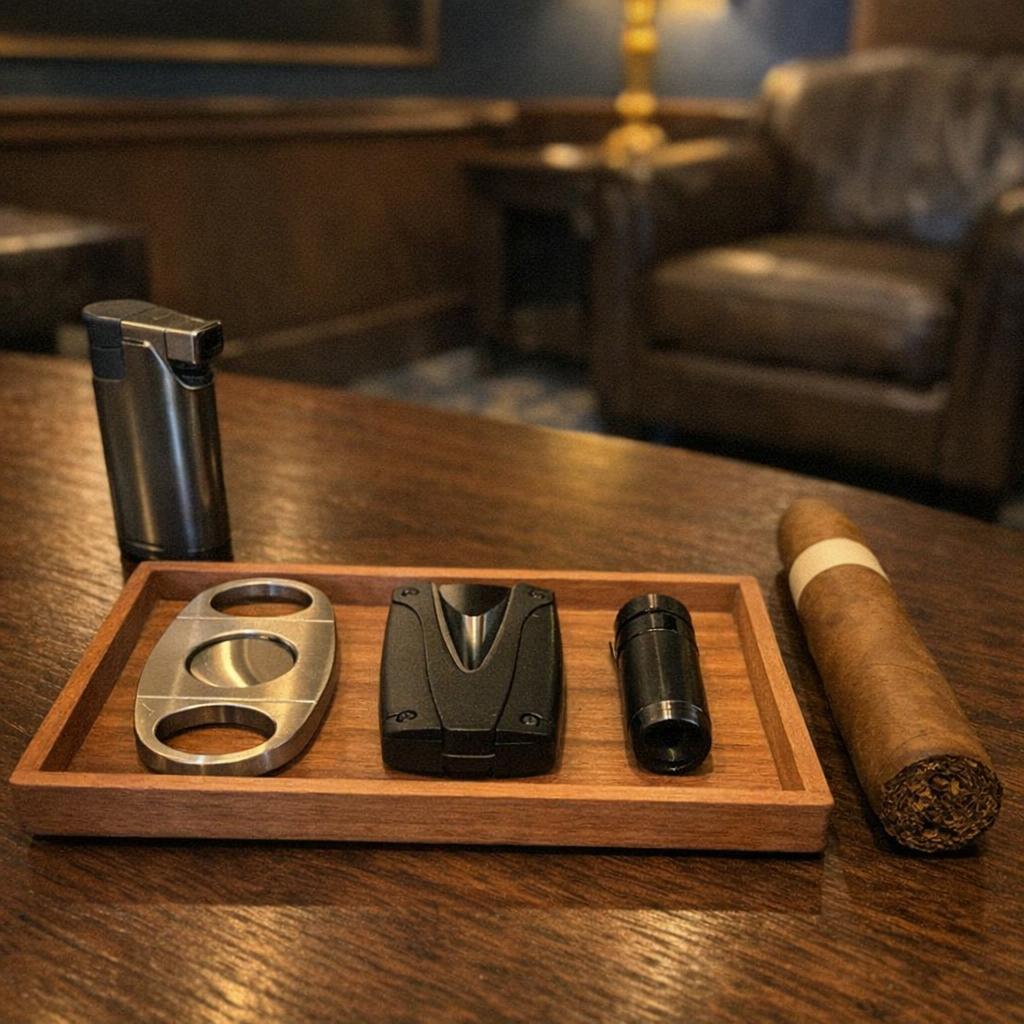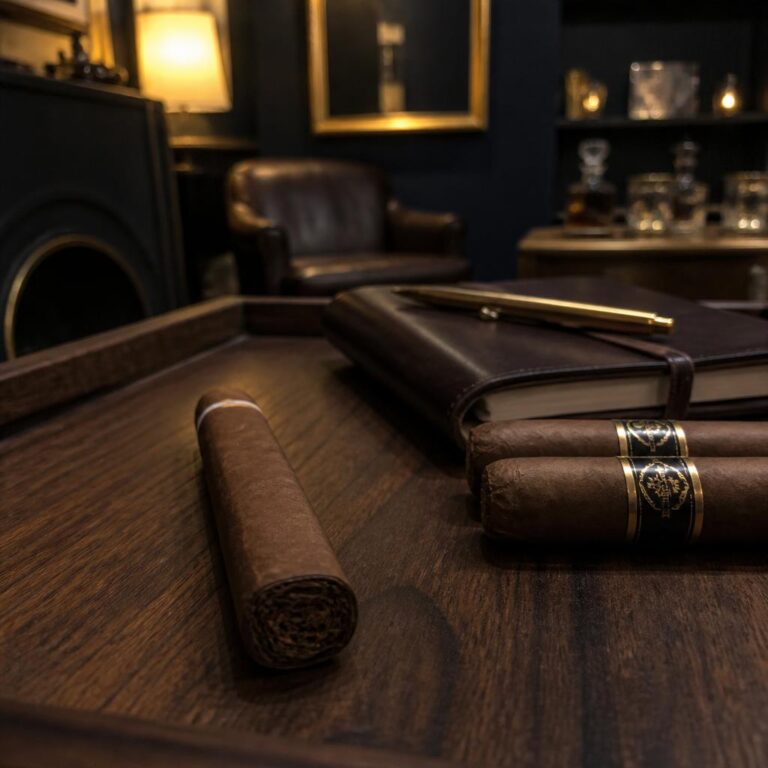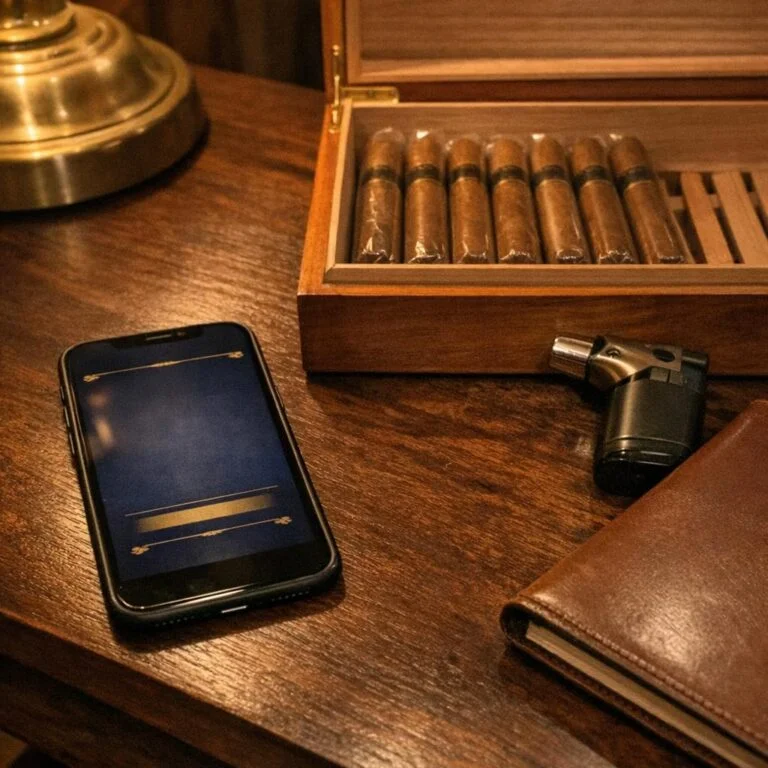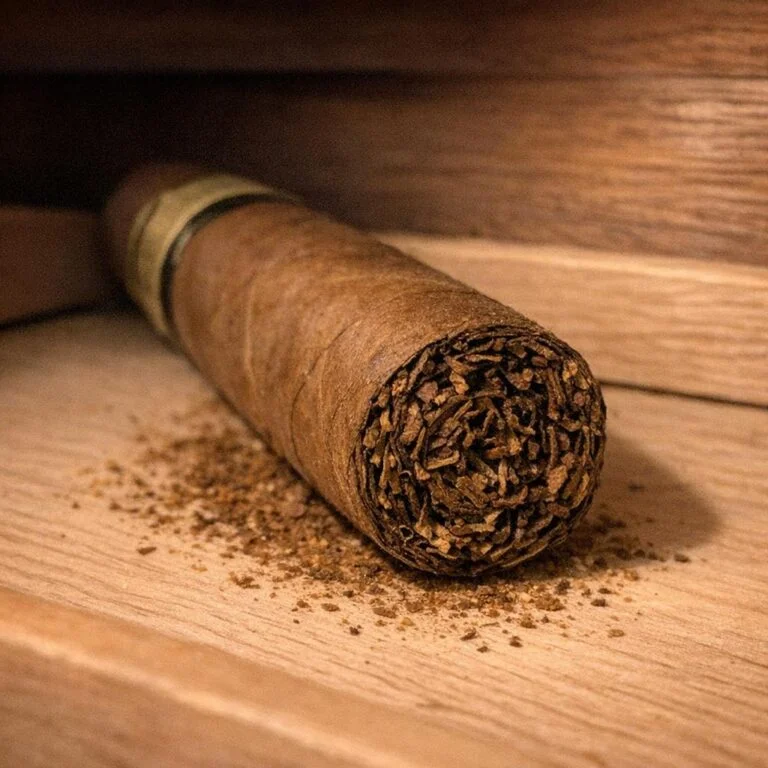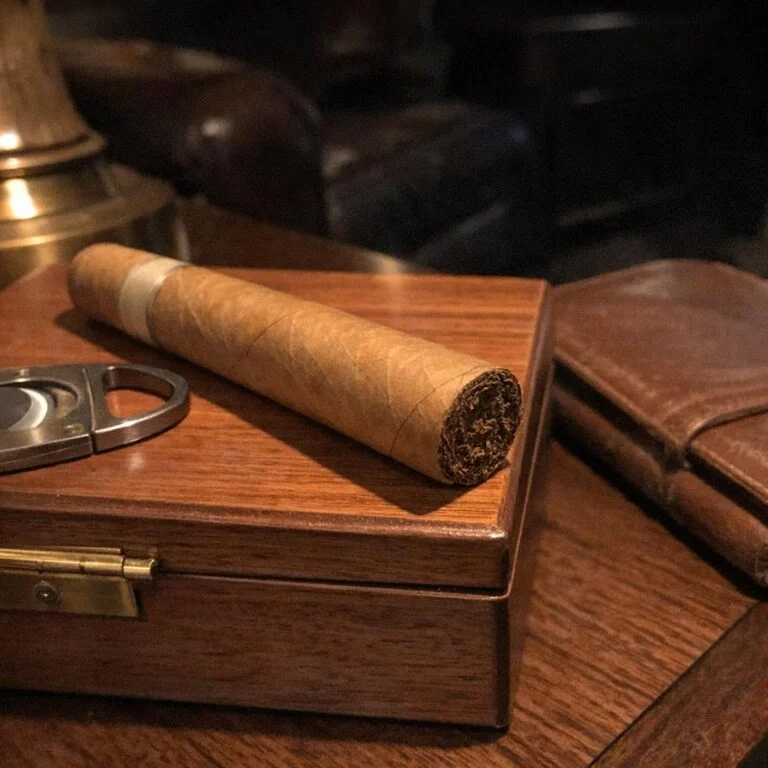
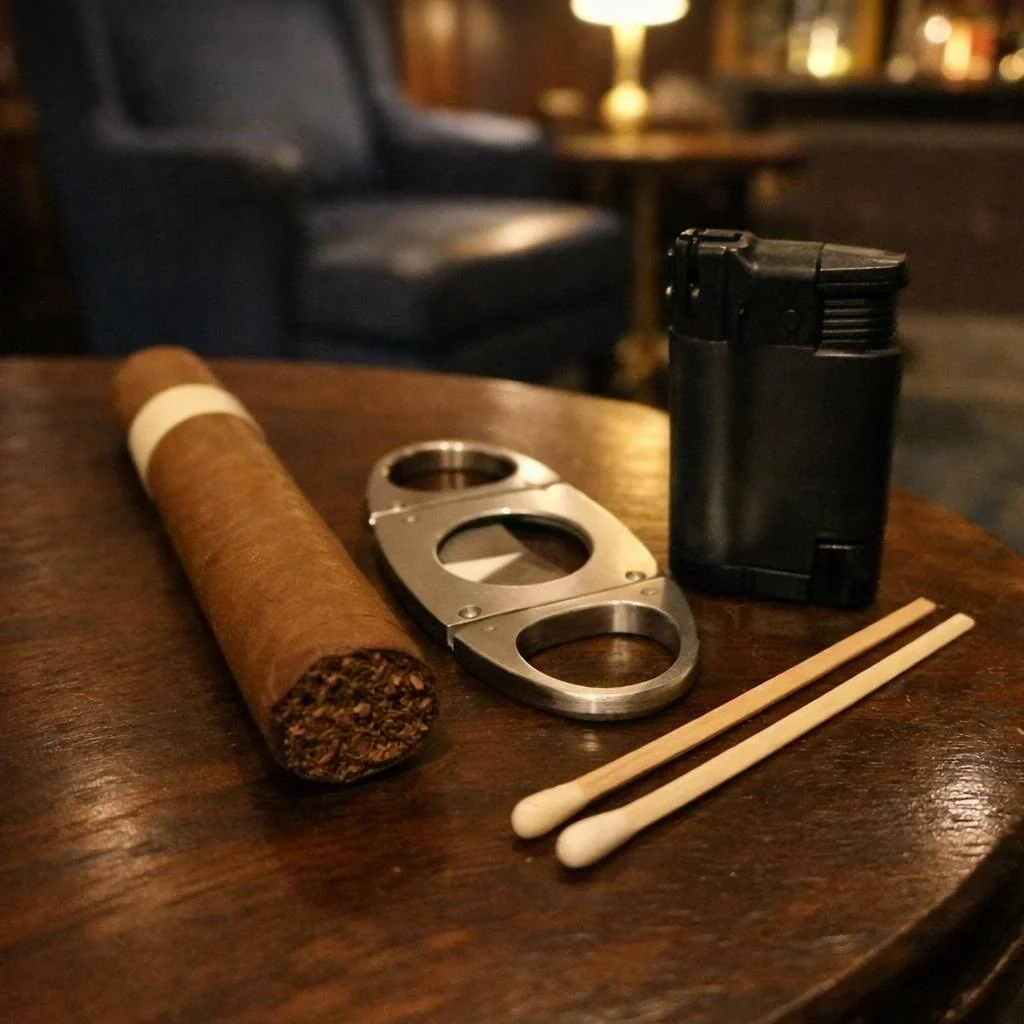
A cigar cutter and a lighter are the whole of the kit. Everything else in the accessory cabinet is comfort, storage or vanity. The cutter opens the cap so the smoke comes through cleanly, the lighter lays an even flame across the foot, and when those two jobs are done properly nothing else about the evening needs rescuing.
The difficulty is that both are sold as jewellery. Walk into a good shop and you will be shown a case of cutters priced anywhere from twelve dollars to three hundred, all of which cut, and a wall of lighters that all light. The differences are real, but they are narrower than the price ladder implies, and they come down to three things: blade quality, ring gauge capacity, and whether a flame survives a breeze on a terrace.
What follows is the plain version. Which of the three cuts suits which head, what separates a good double-blade guillotine from a bad one, when a punch is the wrong tool entirely, why butane and never lighter fluid, how to refill without ruining the jets, and what is worth buying at three honest budgets. Cigarro takes no money from manufacturers or retailers, so there are no sponsored gear or cigars anywhere in this guide and no shopping links below.
Two Tools, One Job
A cigar has to be opened and it has to be lit. That is the entire brief. The cutter removes just enough of the cap to let smoke through without unravelling the wrapper, and the flame toasts the foot evenly so the burn starts square rather than running up one side.
Both jobs are unforgiving of bad tools in the same way. A blunt cutter tears rather than slices, and a torn head sheds tobacco into your mouth for the next hour. A weak or dirty flame chars unevenly, and an uneven start tends to stay uneven right through the cigar. Neither failure is dramatic. They simply make an hour slightly worse, every time, for years.
Which is why the honest advice is to buy sensibly once rather than cheaply three times. A decent cutter at forty dollars and a decent butane torch at the same will see you through a decade if you keep them clean. Everything above that price is finish, weight in the hand and the pleasure of owning a nicely made object, all of which are legitimate reasons to spend more and none of which improve the cut. If you have not yet read our guide to cutting a cigar, start there and come back for the hardware.
The Three Cuts
Three cuts are in common use, and the choice is decided by the shape of the head more than by anyone’s preference.
The straight cut, made with a guillotine or scissors, takes a clean disc off the cap and opens the largest draw of the three. It suits nearly every parejo, which is to say nearly every cigar with a flat, rounded head, and it is the cut to learn first because it is the one that goes wrong least often.
The V-cut, sometimes called a cat’s eye, presses a wedge-shaped notch into the cap rather than removing it. The wrapper stays intact around the sides of the head, which is why it appeals on larger ring gauges where a straight cut can feel cavernous, and it concentrates the smoke across the middle of the tongue. It works on tapered heads too, so a torpedo can take a V.
The punch bores a small round hole through the centre of the cap. It is the tidiest cut of the three, the hardest to botch, and the most restrictive on draw. It also has a hard limit: it needs a flat cap to bite into, so it is the wrong tool for a torpedo, a belicoso or any other figurado. If you are unsure what those words mean, our note on the torpedo shape explains the head that defeats a punch.
Inside a Double Guillotine
A single-blade cutter pushes the cigar sideways as it closes, and the cap goes with it. Two blades closing simultaneously from opposite sides hold the head still and shear it. That is the whole argument for the double-blade guillotine, and it is why almost every cutter worth buying has two blades.
What separates a good one from a poor one is narrower than the marketing suggests. Blade steel matters because the edge has to stay keen through several thousand cuts on a material that is dry, fibrous and slightly abrasive. Softer stainless dulls quickly and starts crushing instead of slicing, and a crushed cap is the usual cause of a wrapper cracking at the shoulder. The second thing is the tolerance between the two blades. They should pass each other with no perceptible gap, because a gap is where the wrapper gets caught and dragged.
The third is the aperture, and it is the specification most people ignore until it bites them. Cutters are sold by ring gauge. A common enthusiast cutter takes a 54 ring gauge and will manage up to about 60 or 64 at a push, which covers the great majority of what is sold. Larger models open to 68 or 70, and a handful stretch to 80. If your shelf runs to gordos, check the number before you buy, because a cutter that will not close around the head is an expensive paperweight.
The V-Cut and the Punch
A V-cutter is judged by its bowl and its depth. The bowl is the cradle the head sits in, and a bowl sized for a 64 ring gauge will hold a broad head steady while the blade travels. Depth is the part nobody agrees on. Too shallow and the notch barely opens the draw, too deep and you have cut past the cap into the bunch, which loosens the wrapper and lets the filler shift. There is no published specification for the right depth, so treat any figure you read, including this one, as a rule of thumb: the notch should look like a shallow trough across the crown of the head, not a trench down into it.
The better V-cutters draw the blade inward through the cap rather than pushing outward against it, which keeps the wrapper from splitting at the edge of the notch. If you are choosing between two at the same price, that mechanism is the thing to ask about.
Punches come in a small number of sizes and the sizes are the whole decision. Seven and nine millimetres cover coronas, robustos and toros comfortably, and eleven or twelve millimetres exists for the sixty-plus ring gauges where a smaller hole would strangle the draw. Some bodies carry two or three punches in one housing, which is genuinely useful if your shelf is mixed. A punch is also the gentlest cut on a fragile or slightly dry wrapper, since nothing is being sheared off at all.
Scissors for the Traditionalist
Cigar scissors are the oldest answer and still the most satisfying to use. The jaws are ground with a keen edge and open wide enough to take any ring gauge, which means one pair handles the whole shelf, and because you control the closing speed you can take a shallow disc off a tapered head with a precision no guillotine offers.
They must be cigar scissors and not the pair from the kitchen drawer. Household scissors are ground to shear paper and fabric, they crush a cap rather than slicing it, and they will tear a wrapper the first time you try. A folding scissor cutter that lives in a pocket exists at around sixty dollars, and a bench pair in the shape people picture when they hear the word starts higher.
The honest caveat is that scissors reward practice. They are the one tool on this list where technique matters more than the tool, which is exactly why the people who use them tend to be evangelical about it. If you enjoy the ritual of cigars, this is the part of the ritual worth learning. If you want the cut done in a second with no thought at all, buy the guillotine and be happy.
The Lighter Question
Start with the rule that decides everything else. Fuel with a smell of its own puts that smell into the first third. Naphtha, the fluid in a Zippo-style wick lighter, is a petroleum distillate that reeks of solvent, and holding a cigar over it transfers exactly what you would expect. Cigar Aficionado is unambiguous on the point: lighter fluid belongs nowhere near a cigar, which leaves butane or a sulphur-free match. Butane burns clean and odourless, so nothing is added to the leaf.
Within butane there are two temperaments. A torch, or jet lighter, forces gas through a nozzle and burns hot, blue and directional. It lights a foot in seconds, it holds its shape in wind, and it is the sensible choice for anyone who smokes outdoors. The count of jets is a question of ring gauge and patience rather than status. A single jet lights anything if you are willing to rotate the foot; a double is the comfortable everyday choice; a triple or quad covers a sixty ring gauge in one pass and drains the tank correspondingly faster. Table lighters with three or four jets exist for the same reason a decanter exists, which is to say they are pleasant and unnecessary.
A soft flame butane lighter burns cooler and yellow, and it is the connoisseur’s preference precisely because it is gentler. Less heat means less risk of scorching the wrapper edge, and the toast happens slowly enough to be enjoyable. It is also useless in a breeze, which is the whole trade.
Cedar matches and cedar spills sit at the far end of that spectrum. A long match lets the sulphur burn off before the flame reaches the foot, and a spill, a thin strip of cedar lit from a candle or another flame, is the quietest and most old-fashioned way to light a cigar. Both are slow and both are lovely. Neither works on a windy terrace, which is why most people who own a spill also own a torch. The mechanics of the toast itself are covered in our guide to lighting a cigar, and the etiquette of borrowing someone else’s flame is in the etiquette notes.
Refilling and Purging
Almost every dead torch lighter is a clogged torch lighter, and almost every clog is cheap butane. Supermarket gas carries paraffin waxes and heavier oils that do nothing in a cigarette lighter’s wide flame and everything in a jet nozzle measured in fractions of a millimetre. The residue builds, the flame goes yellow and lazy, and eventually nothing comes out at all. Buy refined butane, the sort sold at five times refined or better, and the problem largely disappears.
The refill itself has one step people skip and it is the important one. Purge the lighter first. Hold it upside down in a ventilated room away from any flame and press the fill valve with a small screwdriver or the tip of the can until the hissing stops. That releases the air that has worked its way into the tank alongside the old gas, and air in the tank is why a half-full lighter sometimes will not light at all.
Then turn the flame adjuster down to its lowest setting, hold both can and lighter inverted, seat the nozzle squarely on the valve and press for a few seconds at a time. Do not overfill. Now leave it alone. The gas comes out of the can cold and the tank needs several minutes to come back to room temperature before it will light properly, which is why a freshly filled lighter that refuses to spark is usually just impatient rather than broken. Reset the flame height afterwards, and expect the first ignition to be enthusiastic.
Altitude, Wind and Cold
Thin air changes the ratio of fuel to oxygen a jet is burning, which is why a lighter that behaves impeccably at sea level can sputter on a mountain terrace. The flame adjuster is the remedy, and the direction to turn it is genuinely disputed between otherwise sensible sources, so the practical instruction is to move it a little, try, and move it back if that made things worse. Cold compounds the problem, since a chilled tank drops its pressure, and the fix there is simply to keep the lighter in a trouser pocket rather than a coat.
The more useful thing to know before buying is that several manufacturers altitude-test their lighters and publish the figure. Ratings from around seven thousand feet up to fourteen thousand appear on individual models, and if you live somewhere high or ski with a cigar in your jacket, that number is worth more than the finish on the case.
Wind is simpler. A jet flame is directional and largely indifferent to a breeze; a soft flame is not, and a match is at the mercy of the weather. If most of your smoking happens outdoors, own a torch and treat the soft flame as the indoor pleasure it is. And if the wind wins anyway, the recovery is covered in our note on relighting, which is a normal part of smoking outdoors rather than a failure.
A Starter Set by Budget
Three bands, three honest answers. The models below are named because their prices could be read off the maker’s own site or a major specialist retailer on the day this was written, which is a duller criterion than editorial preference but a more useful one. Prices are approximate street figures in US dollars and they move. Nobody has paid to appear here.
| Band | Cutter | Lighter | What you give up |
|---|---|---|---|
| Entry about 50 to 80 for the pair | Colibri Firebird Nighthawk double guillotine, low teens, 60 ring. Xikar X8, about 37, cuts to 70. A keychain punch sits around 15 | Xikar Stratosphere or Astral single jet, about 40, both altitude rated in five figures of feet | Finish, weight in the hand, and in the cheapest cutters the edge retention. Everything here cuts and lights properly on the day you buy it |
| Mid about 110 to 200 for the pair | Xikar Xi2 double guillotine, 50 to 55, 54 ring cutting to 60. Xikar VX or VX2 V-cut, from 55. Xikar MTX folding scissors, 60. Xikar 9mm pull-out punch, 60 | Xikar Allume 2 double jet, 70. Xikar ELX double jet with a fold-out 9mm punch, 75. Xikar HP3 triple jet, 100 | Nothing that affects the cut or the light. This is the band most people should buy in and then stop thinking about |
| Heirloom 300 and upward | Xikar Xi3 in the premium finishes, 120 to 220. Les Fines Lames Le Petit cutter-knife, roughly 160 to 220. Davidoff double blade, around 330 | Xikar Volta quad jet table lighter, 180. S.T. Dupont Ligne 2 soft flame, four figures and a lifetime of servicing | Money, and nothing else. These are better objects rather than better tools, which is a perfectly good reason to want one |
If you want a single recommendation rather than a table: a mid-band double-blade guillotine and a double-jet torch, bought together for somewhere near a hundred and twenty dollars, is the set that ends the question. Add a punch later if you find yourself wanting a tighter draw on a robusto, and add a soft flame or a box of cedar matches when you discover you enjoy the slow start. Neither addition is urgent.
Care and Travel
Cutters ask almost nothing. Keep the blades dry, blow the tobacco dust out of the mechanism now and then, and resist the urge to oil them, since oil collects dust and dust dulls edges. If a cutter starts crushing rather than slicing, the blades are done and no amount of sharpening at home will bring back the factory geometry. Good makers will replace or service a cutter under warranty, which is one of the quiet arguments for the mid band.
Lighters ask for clean butane, an occasional purge, and a soft brush across the jets when the flame goes ragged. Store them upright if you can. A lighter left in a hot car will vent, which is by design and not a fault.
Travel is the one place where the rules are not yours to interpret. In the United States the aviation authority is explicit that torch lighters, the blue jet flame sort, are not permitted in the cabin or in checked baggage, while an ordinary butane or absorbed-fuel lighter may travel on your person or in carry-on, one per passenger. Rules differ by country and by airline, and they change. Pack the cutter in checked baggage rather than carry-on for the same reason, and buy a cheap lighter at your destination.
What to Skip
Skip the fluid-fuel lighter, whatever its heritage. It is a fine object and the wrong fuel, and the first third of the cigar will tell you so.
Skip the single-blade cutter that comes free in a gift box. It pushes the cap rather than shearing it and it is the reason a great many people believe their wrapper is fragile.
Skip the novelty multi-tool that folds a cutter, a punch, a torch, a bottle opener and a spike into one housing. Each function is compromised by the others, the whole thing is heavy, and the jet is always the first part to fail.
Skip the gift set assembled around a matching case unless you actually want the case, since the case is usually where the money went. Skip the electric or battery-powered lighter, which does not put enough heat across a foot to toast it evenly. And skip the second and third cutter until the first one dulls, which is a piece of advice nobody follows, including the person writing it.
What is genuinely worth adding once the basics are settled is nothing you fire or sharpen at all. It is the habit of writing down what a cigar did, which is what the Cigarro Method is for.
Questions Readers Ask
What cigar cutter should a beginner buy first?
A double-blade guillotine rated for at least a 54 ring gauge. Two blades closing from opposite sides hold the head still and shear the cap, where a single blade pushes the cigar sideways and tends to crush it. Around fifty dollars buys one that will still be cutting cleanly in ten years. Check the ring gauge the cutter opens to before you buy, because a cutter that will not close around a sixty ring gordo is no use to you at all.
Guillotine, V-cut or punch: which is best?
The head decides more than you do. A straight cut from a guillotine opens the widest draw and suits nearly every flat-headed cigar, which makes it the sensible first cutter. A V-cut presses a wedge into the cap, leaves the wrapper intact around the sides and concentrates the smoke, which many people prefer on larger ring gauges. A punch bores a small hole and is the tidiest and most restrictive of the three, but it needs a flat cap, so it cannot be used on a torpedo or any other tapered head.
Why should you not light a cigar with a Zippo?
Because the fuel has a smell and the cigar will take it. Naphtha lighter fluid is a petroleum distillate, and holding a cigar foot over that flame carries solvent notes straight into the first third. Butane burns clean and odourless, which is why torch and soft-flame butane lighters are the standard, and a long sulphur-free match or a cedar spill is the traditional alternative. This is not snobbery, it is simply that the fuel is doing something you can taste.
Is a torch lighter or a soft flame better for cigars?
They are answers to different conditions. A torch burns hot, blue and directional, lights a foot in seconds and holds its shape in wind, which makes it the practical choice outdoors and the one to buy first. A soft flame burns cooler and yellow, is gentler on the wrapper edge and makes the toast slower and more pleasant, but it is defeated by any breeze. Most people who smoke regularly end up owning both and reaching for whichever the weather allows.
How do you refill a butane cigar lighter properly?
Purge it first. Hold the lighter upside down away from any flame and press the fill valve until the hissing stops, which releases the air that has collected in the tank. Turn the flame adjuster to its lowest setting, invert both can and lighter, seat the nozzle squarely and fill in short bursts without overfilling. Then wait several minutes before igniting, because the gas enters cold and the tank needs to reach room temperature. Use butane refined at least five times, since cheap gas is what clogs the jets.
Can you take a cigar lighter or cutter on a plane?
Rules vary by country and airline and they change, so check before you travel. In the United States the aviation authority is clear that torch or jet-flame lighters are not permitted in the cabin or in checked baggage, while one ordinary butane or absorbed-fuel lighter may be carried on your person or in hand luggage. Cutters carry blades, so they belong in checked baggage. The simplest habit is to travel with neither and buy an inexpensive lighter when you arrive.
Buy Once, Then Forget It
The pleasant thing about this corner of the hobby is that it ends. A cutter and a lighter are a solved problem, and once solved they sit in a drawer and do their work for years without asking anything further of you. There is no upgrade path worth chasing, no annual model, nothing that will make a cigar taste better than a clean cut and an even toast already do.
What does keep improving is your reading of what happens after the flame comes off the foot. That is the part worth spending attention on, and the only equipment it requires is somewhere to put the notes. The Cigarro Method records a cigar third by third, the app is free to start, and unlike a cutter it gets more useful the longer you own it.