There is a particular disappointment in opening an app three weeks after a fine cigar and finding only a number. Four and a half stars, no words. You recall that you liked it. You cannot recall why, nor what it tasted of in the final third, nor whether you would buy it again. The rating survived. The cigar did not.
A cigar review app is software for recording structured tasting notes on the cigars you smoke. Cigarro is a cigar tracking and review web app built for that purpose, and the Cigarro Method is the review-by-thirds framework at its centre. The better tools in this category turn a pleasant hour into something you can return to months later. The lesser ones turn it into a tally.
What follows is a comparison of the apps a serious enthusiast might reach for in 2026, judged on a single question: when you sit down to write, what does the app actually ask of you? That question separates the apps that rate from the apps that let you review, and it matters more than the size of any catalogue.
Said plainly before the judging begins: Cigarro is our app, and this comparison is written from our desk. We have kept it honest, and where a competitor does something better, we say so.
Rate and review are different verbs
To rate a cigar is to deliver a verdict. To review one is to show your working. The two get muddled because most apps let you tap a score and call it done, but a score with no evidence behind it is a souvenir, not a record. You will not learn anything from it, and neither will anyone reading over your shoulder.
Cigar Dojo is the clearest case of rating done well. It is widely regarded as the most community-driven app in the category, and its mechanics reflect that. You check a cigar in with a thumbs up or thumbs down, and your vote folds into that cigar’s overall standing. Its best-known feature, Cigar Wars, sets two cigars against each other and asks you to pick the better of the pair, building a crowd-sourced Battle Rating from thousands of these head-to-head votes. It is good fun and a genuinely useful read on consensus. What it is not is a record of your own palate. A thumbs up tells you that a past version of yourself approved. It does not tell you what the cigar did in the second third, or why you reached for it again.
This is the line I care about. A rating is a gesture toward the crowd. A review is a note to your future self. The apps worth your time are the ones that make the second one easy, and most of them make it surprisingly hard.
What the apps actually ask you
Sit down to log a cigar in each of the main tools and you will notice how differently they treat the blank page.
Cigar Dojo opens to a check-in. You can add a comment and a photo, but the structure pushes you toward the vote rather than the writeup. Cigar Scanner opens to its camera. Its real strength is identification: point it at a band or a strip of cellophane and it will usually tell you what you are holding, drawing on a catalogue of more than thirteen thousand cigars. You can then post a picture and a short review, leaning on a list of frequently used descriptors. It is excellent at answering “what is this” and lighter, to my eye, on helping you say anything lasting about it. Independent reviewers have made the same observation: the inventory side is strong, the review side thin.
Boxpressd is the most complete review tool of the three. Its Smoke Sessions are proper journal entries, with a rating, written notes, flavour tags, a drink pairing, and photos or video. Its paid Aficionado tier, offered as a one-time purchase rather than a subscription, adds timeline sessions that let you capture observations for each third of the cigar, along with several rating scales and collection analytics. If you want depth and you will pay once for it, Boxpressd repays the effort. We put the two side by side in Cigarro compared with Boxpressd, and the Dojo gets the same treatment in Cigarro compared with Cigar Dojo.
Cigarro takes the depth as the starting point rather than the upgrade. The review form is built around thirds by default, so the structure does the prompting for you. Here is how the four compare on the things that actually matter when you write.
| App | Primary rating mechanic | Written review fields | Notes captured per third | Free to start |
|---|---|---|---|---|
| Cigar Dojo | Thumbs up or down check-in; Cigar Wars head-to-head votes | Optional comment and photo | No | Yes |
| Cigar Scanner | Posted review using common descriptors | Descriptor-led, light | No | Yes |
| Boxpressd | Rating within a Smoke Session; more scales on paid Aficionado | Flavour notes, drink pairing, photos, video | Yes, in paid Aficionado timeline sessions | Yes |
| Cigarro | Review by thirds | Per-third flavour, construction, draw, finish | Yes, by default | Yes |
None of these is a bad app. They are built for different readers. The question is whether you want to record a preference or build a memory, and the form you are handed largely decides that for you.
Cigar review, scanning and inventory apps, compared
Three different questions get bundled into “which cigar app should I use,” and each deserves its own answer. Identifying what is actually in your hand is one job. Keeping a running shelf of what you own is another. Writing down what happened once you lit it is a third. Cigar Dojo, Cigar Scanner and Boxpressd each lean toward a different one of those jobs, and Cigarro leans deliberately toward the third. None of the four does all three equally well, which is worth knowing before a whole collection gets typed into any single app.
Set side by side on scanning and inventory, the picture sharpens. Cigar Scanner earns its name: point the camera at a band or a strip of cellophane and it checks the shot against a catalogue of more than thirteen thousand cigars, then files it into a journal, favourites or a wish list. Boxpressd, rebuilt this year around its Limitada tier, pairs a working barcode scanner with unlimited virtual humidors that hold full boxes and samplers, not just single sticks; band recognition is still listed as in development. Cigar Dojo skips inventory altogether in favour of the check-in and the Cigar Wars vote. Cigarro skips scanning altogether, asking you to type in what you are smoking and putting the saved effort into the review itself.
Here is how the four compare once scanning, inventory and price join the table.
| App | What it does | Review depth | Scanning | Inventory | Price |
|---|---|---|---|---|---|
| Cigar Dojo | Social check-ins and Cigar Wars head-to-head voting | Light: thumbs up or down, optional comment and photo | No | No humidor or collection tracker | Free |
| Cigar Scanner | Identifies a cigar from a photo or barcode | Light: descriptor-led posted review | Yes, photo and barcode against a 13,000+ cigar catalogue | Yes: Journal, Favourites and Wish List | Free |
| Boxpressd | Tracking, discovery and social app with Smoke Sessions | Deep: ratings, flavour notes and pairings; per-third timeline on paid Limitada tier | Barcode yes; band recognition in development | Yes: unlimited virtual humidors, full boxes and samplers | Free to start; Limitada one-time $4.99, was $9.99 (Aug 2026) |
| Cigarro | Structured review by thirds, free to start | Deep by default: per-third flavour, construction, draw and finish | No, manual entry | Yes: humidor capacity scales by tier | Free for 30 cigars, up to $29.99 CAD monthly for an unlimited humidor |
Which gap matters most depends on how you already smoke. Reach for Cigar Scanner when the question is simply what you are holding; identification is the one job it does better than anything else here. Reach for Boxpressd when you want the shelf and the session log living in the same place, and you are content to pay once for the deeper tools. Cigarro’s shelf grows with the plan you choose, from thirty cigars on the free Pocket Humidor up to an unlimited Private Reserve, but the review itself is never metered: every tier, including the free one, carries no limit on how many you can write. For a longer look at Cigarro set directly against a scanning-first app, see our comparison with Cigar Scanner.
Reviewing by thirds
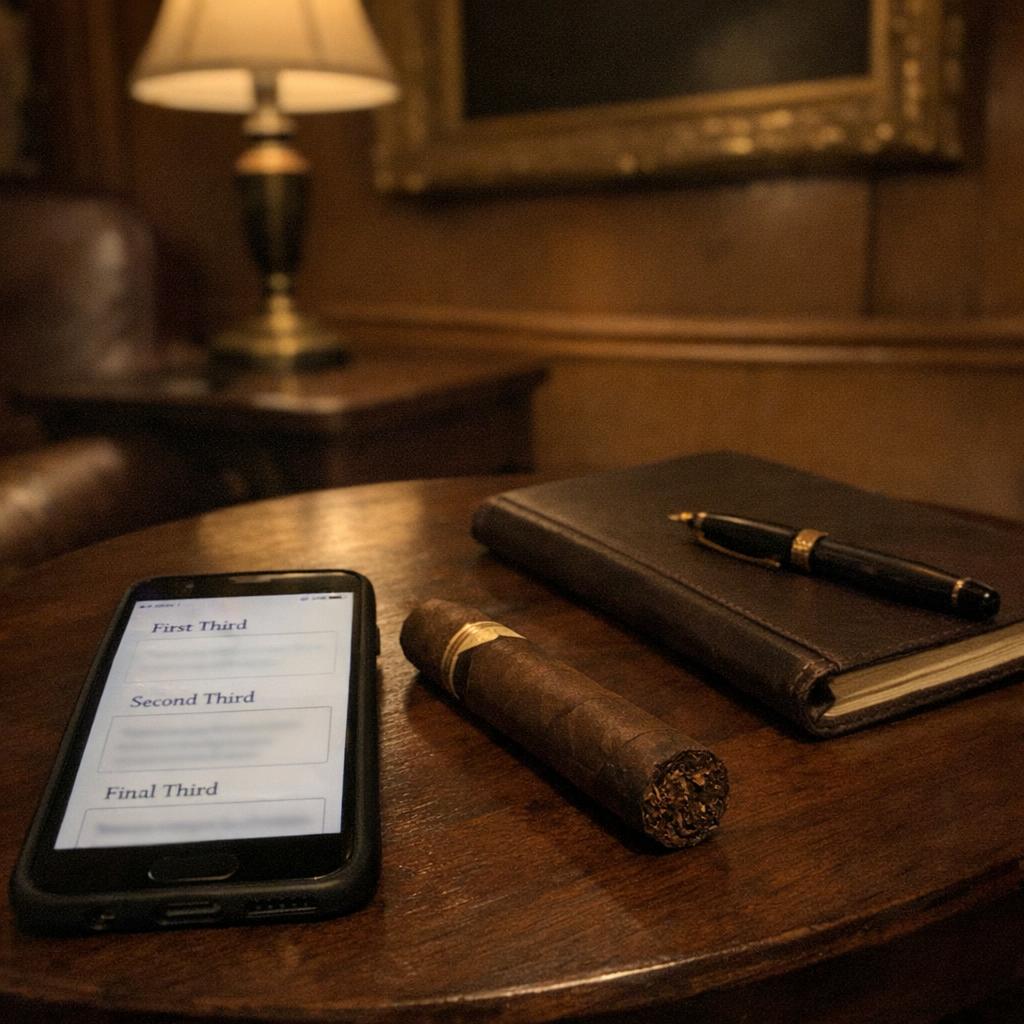
A cigar is not one thing. It is three, roughly, and the good ones tell a different story in each. The first third is the opening, often cooler and brighter, where the wrapper has most to say. The second third is where a blend settles and shows its real character. The final third is where construction and patience are exposed, where a rushed cigar turns hot and harsh and a well-made one deepens. Score the whole hour with a single impression and you flatten all of that into an average that describes none of it.
Reviewing by thirds is the habit of writing a few honest lines at each of those stages while the cigar is still in your hand. It is the spine of the Cigarro Method, and it is the single most useful discipline I can recommend to anyone who wants their notes to be worth rereading. You do not need a sommelier’s vocabulary. You need to notice that the pepper faded after twenty minutes, that the draw tightened, that the finish turned to cocoa. Three small observations beat one grand verdict every time.
To be fair to the field, Cigarro is not alone in supporting this. Boxpressd’s timeline Smoke Sessions capture notes for each third, and they do it well. The difference is one of posture. On Boxpressd, per-third reviewing sits inside the paid Aficionado tier as an advanced mode you opt into. On Cigarro, it is the default shape of every review, free, with the framework named and taught so the structure carries you rather than waiting to be discovered. When the easy path is also the disciplined one, you actually keep the habit.
Notes you can actually use later
Structure is not pedantry for its own sake. It is what makes your notes searchable a year from now. This is the quiet advantage a review app holds over the notebook most people start with, and the reason a plain notes file eventually fails the serious smoker.
Write fifty cigars into a notebook and you have fifty pages you will never cross-reference. Write fifty structured reviews into an app and you have a map of your own palate. You can see that you keep returning to Ecuadorian Habano wrappers and talking yourself into Connecticut Broadleaf you do not actually enjoy. You can filter by strength before a long evening, or pull up everything you smoked with coffee. Boxpressd does this filtering particularly well, letting you sort a virtual humidor by rating, brand, wrapper, strength, and country. The point is general: data you entered with structure is data you can question later. Data you scrawled in prose is just a diary.
This is where a review app earns its place. A rating tells you what you thought. A body of structured reviews tells you who you are as a smoker, which cigars deserve a repurchase, and which were a one-night curiosity. Cigarro keeps your reviews in exactly that queryable shape, and the Lounge, its social feed, lets you share a single review as a clean public page when you want to, without turning your private record into a performance.
What it costs to begin
Most of these apps are free to start, which is the right instinct for a hobby you are still feeling out. The differences sit in what the free tier withholds.
Cigar Dojo is free, and its community features come with it; the app is not trying to sell you a journal because the journal is not really the point. Cigar Scanner is free for identification and basic logging. Boxpressd offers a generous free tier, with Smoke Sessions, a virtual humidor, discovery, and its social layer, and reserves timeline thirds, extra rating scales, and analytics for the one-time Aficionado purchase.
Cigarro’s free tier, the Pocket Humidor, holds thirty cigars and places no limit at all on reviews. That last detail is the one I would weigh most heavily. On Cigarro, reviewing is never the thing you run out of. The cap is how many cigars you keep on the digital shelf, not how many you write up, and the paid tiers exist to raise that shelf: Desk Humidor at 4.99 dollars a month for two hundred, Cabinet at 9.99 for seven hundred and fifty, Walk-in at 19.99 for two thousand, and Private Reserve at 29.99 for an unlimited collection. All prices are Canadian, billed monthly, with no annual lock-in. You can read the full breakdown on Cigarro’s pricing page, but the principle is simple: the discipline is free, and you only pay when your collection outgrows the cupboard.
Who this is actually for
The honest answer is that not everyone needs a review app, and pretending otherwise does the reader no favours.
If you smoke socially and mostly want to check in, share a photo, and see what the crowd rates highly, Cigar Dojo is the natural home and a review app would be overkill. If your problem is mainly “what is this cigar a friend handed me,” Cigar Scanner’s catalogue solves it faster than anything else. If you are a committed collector who wants depth, analytics, and per-third detail, and you are happy to pay once for it, Boxpressd’s Aficionado tier is a serious tool that rewards the investment.
Cigarro is for the enthusiast who wants the reviewing itself to be the habit: who would rather build a body of structured, searchable notes than a wall of stars, who likes that the discipline is free and lives on the web with nothing to install, and who finds that a framework keeps them honest in a way a blank box never does. If your aim is to develop a palate rather than merely log a collection, that is the camp to join. For the wider field, including the apps that lean more toward inventory than review, our ranking of the best cigar apps covers the ground in detail, alongside companion guides to cigar journal apps and digital humidor apps.
Common questions about reviewing cigars
What is the best app to review cigars?
It depends on what you mean by review. For a quick communal rating, Cigar Dojo is hard to beat. For deep, paid-once journaling with analytics, Boxpressd Aficionado is the most capable. For a free, web-based tool built around a structured review-by-thirds discipline, Cigarro is the one I would point a new reviewer toward.
Is there a free cigar review app?
Yes, several. Cigar Dojo, Cigar Scanner, and Boxpressd all have free tiers, and Cigarro’s free Pocket Humidor places no limit on the number of reviews you can write. The free tiers differ mostly in how much depth they give you before asking for payment.
What is the difference between rating and reviewing a cigar?
A rating is a single score or a thumbs up. A review is a written record of what the cigar did: its flavours, how the draw and burn behaved, and how it changed from the first third to the last. Ratings are useful for crowd consensus; reviews are useful for your own memory.
Can I review a cigar in thirds?
Yes. Cigarro builds every review around thirds by default, and Boxpressd’s paid timeline Smoke Sessions let you capture notes for each third as well. Reviewing in thirds is the most reliable way to record how a cigar develops rather than averaging the whole cigar into one impression.
What is the difference between a scanning app and a review app?
A scanning app answers one question: what is this cigar. Point a camera or a barcode reader at it and the app checks the result against a catalogue, the way Cigar Scanner and Boxpressd’s barcode tool both do. A review app answers a different question: what did this cigar actually do, and it asks you to write that down yourself, third by third. Most enthusiasts end up wanting both.
What should I look for in a cigar app in 2026?
Start with what you actually want the app to remember. Strong inventory and a wish list help if the goal is tracking what is sitting in the humidor. A scanning or check-in app is enough if the goal is quick identification. Written structure, fields for each third rather than a single score, matters most if the goal is remembering what a cigar was actually like to smoke. On Cigarro, the paid tiers only ever buy more shelf space; the review itself stays free and unlimited on every plan.
Begin with a single review
Return to that opening app, three weeks on, and picture a different screen. Where the lonely four and a half stars used to sit, three short paragraphs: the bright cedar of the first third, the leather that arrived in the middle, the cocoa finish that made you reach for a second. That is the whole difference between the tools in this comparison, and it costs you nothing but the few minutes you were going to spend with the cigar anyway.
Pick the app that suits how you actually smoke. If that is Cigarro, you are welcome at any time, and the only thing asked of you is a few honest lines, written in three movements, while the cigar is still lit.