There is a particular small defeat every cigar enthusiast meets eventually. You are standing in front of the walk-in at your local shop, a familiar band catches your eye, and you cannot for the life of you remember whether the last one was a quiet triumph or a forgettable half hour you abandoned in the ashtray. You bought it once. You smoked it once. And the verdict has evaporated.
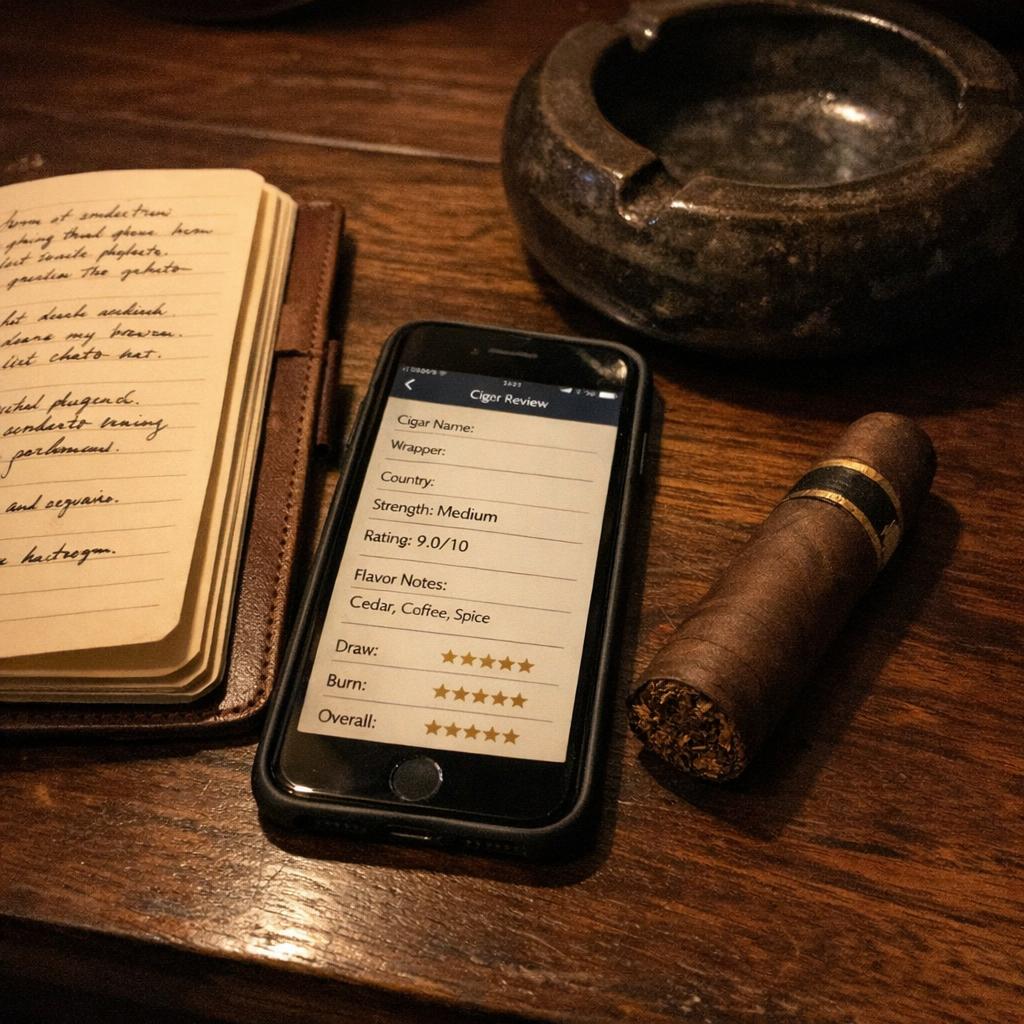
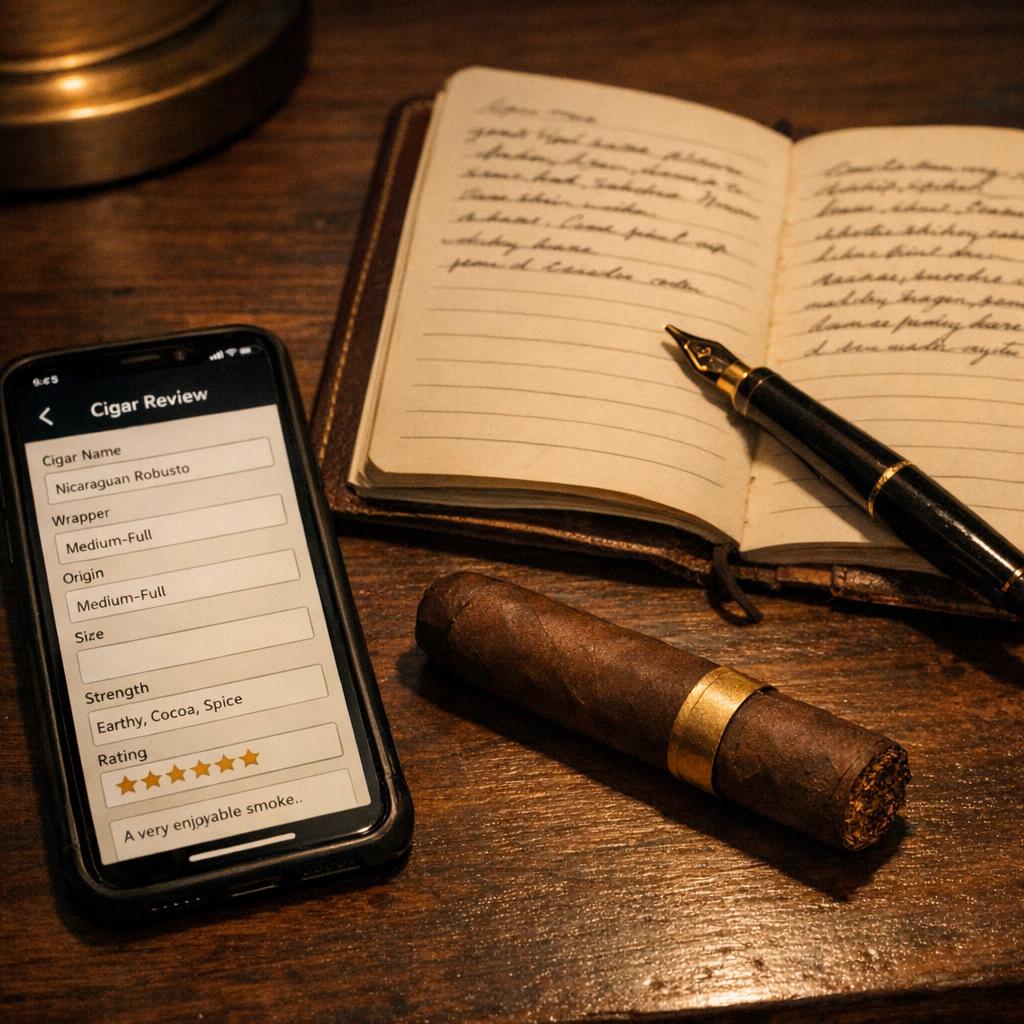
A cigar journal app exists to close that gap. It is a tool for recording the cigars you smoke, what you made of them, and how to find that thought again a year later. Cigarro is one such app, a cigar tracking and review tool built around the Cigarro Method, a review-by-thirds framework that gives every entry the same backbone. There are a dozen others, and they range from genuinely useful to a notes app wearing a humidor as a hat.
This is a guide to telling them apart.
What a cigar journal is actually for
Plenty of enthusiasts kept a cigar journal long before any app existed, usually a record of the cigars they had smoked and what they made of them, so that a favourite could be found again and a disappointment avoided twice. That is the whole of it at the start: a historical account of your own shelf.
The habit earns its keep in quieter ways. There is memory, first. A palate is not a filing cabinet, and the difference between the second third of a Padrón 1964 and the second third of an Oliva Serie V blurs within a week if you never wrote either down. There is pattern, which takes longer to appear. Once you have thirty or forty entries, you start to see what you actually reach for, and it is rarely what you tell people you like. And there is the matter of getting better. Tasting sharpens when you know you will have to put words to it, the way you read a book more closely if you know you must describe it afterwards.
This is where the review-by-thirds framework at the heart of the Cigarro Method does its work. Smoking a cigar in three acts, first third, second third, final third, gives you something to write at each stage rather than a single verdict scrawled at the end, when the ashtray is full and your impressions have run together. A journal is only as good as the prompts it gives you. Left to a blank page, most of us write “nice, a bit peppery” and put the pen down.
Why a notes app is not enough
The honest objection to all of this is that you do not need an app at all. A notebook works. So does the notes app already on your phone. For a while both are better than nothing, and I would never talk a man out of a leather pocket notebook if that is what gets him writing.
The trouble arrives at scale. A note is a flat thing. You can write “Montecristo No. 2, lovely, a bit of cedar” into your phone in ten seconds, and you can never do anything with that sentence again except read it. You cannot ask your notebook to show you every Connecticut-shade cigar you rated above eighty. You cannot sort a stack of paper by ring gauge, or by the month you smoked it, or by price. You cannot search two hundred entries for the word “ammonia” to confirm a suspicion that the young ones from a particular box needed more rest. The words are all there, and none of them are working for you.
Structure is the thing a real journal app adds, and it is the only thing worth paying for. Fields instead of a blank box, so every entry captures the same details and can be set against every other. A search that reaches inside your own history. A clean separation between the cigars you own and the cigars you have smoked, which a notes app collapses into one undifferentiated list. Strip those away and a journal app is indeed just your notes app with a cigar drawn on the icon. Keep them, and it becomes the memory you could never hold in your head.
What the dedicated apps actually do
A handful of apps have been built specifically for this, and they are not interchangeable. We rank the wider field in full elsewhere; here the concern is narrower, which of them is actually a journal and which only behaves like one.
Boxpressd is the most established of the social journals. Its core idea is the Smoke Session, an entry that gathers a photo, a rating, flavour notes and a drink pairing, and its better feature lets you add notes through the stages of a single cigar rather than only at the end. It runs as a web app across phone, tablet and desktop, with a free tier and a paid Aficionado upgrade for deeper analytics. The catch is that Boxpressd is built around its feed. Every entry wants to be a photograph for other people to admire, and the private record can feel like a by-product of the social one. For the two set against each other in detail, see how Cigarro and Boxpressd differ as journals.
Cigar Dojo is the community itself rather than a filing system. It is free, it is busy, and its Cigar Wars ranking game and belt system have kept a large crowd engaged for years. You can log and review there, but the logging sits second to the conversation. If you want company while you smoke, the Dojo has more of it than anywhere else. If you want a quiet, sortable archive of your own palate, that is not what it was built to be.
A newer crop lives in the App Store and leans on convenience. My Humidor pairs a large cigar database with quick logging and will remove a stick from your inventory the moment you review it. Puro adds an AI-driven band scanner that fills in brand, vitola and wrapper from a photograph, plus a flavour wheel for rating draw, construction and aroma. Cigar Vault folds journal, humidor and discovery into one. Dedicated identifiers go further still, and our comparison with Cigar Scanner covers that lane. Each is competent. Two things tend to unite them: they are tied to a single phone platform, and they assume you came mainly to count what you own rather than to write down what you thought.
The questions to ask before you commit
Rather than rank these by stars, it is more useful to carry a short list of questions into the decision. The right app is the one that answers them in your favour.
Does it survive a change of phone? An app tied to a single platform holds your years of notes hostage to that platform. A web app that installs to the home screen travels with you regardless of what you buy next, which matters more than it sounds once the archive is a decade deep.
Can you search your own history? This is the one feature that separates a journal from a diary. If you cannot pull up every cigar you have ever marked “too young”, the record is decoration.
Does it prompt you, or abandon you to a blank box? The apps that produce the best notes are the ones that ask the same questions every time. A structure such as review-by-thirds is worth more than the prettiest empty page.
Does it keep what you own apart from what you have smoked? A humidor and a journal are different objects with different jobs, which is the line between a journal and a digital humidor app. Conflating the two is the most common design fault in the category.
And does it cost anything to find out? Most of the serious options have a free tier, so there is no reason to pay before you know the habit will stick. Cigarro’s own Pocket tier is free and tracks thirty cigars, which is enough to learn whether you are the journal-keeping sort before a penny changes hands.
Where Cigarro sits and the Cigarro Journal
It would be coy to write all of this and pretend Cigarro has no stake in the answer. It does, so here is the honest placement.
Cigarro was built review-first. The review-by-thirds framework of the Cigarro Method is not a feature bolted to the side; it is the shape of every entry, which means the notes come out structured whether you are feeling articulate that evening or not. It runs as a web app that installs to your home screen, so the archive is not the property of an App Store, and the humidor sorts by wrapper shade, age, ring gauge or price rather than sitting in one long scroll. Nor is it the property of Cigarro: the whole archive exports to CSV in one tap from your profile, and an existing collection imports just as easily. Where it is honestly no different from the others is the basics of logging and rating, which everyone in the category now does competently.
The Cigarro Journal is the part that turns the archive back into something you can hold. Once a year it gathers your reviews into a single digital document, a PDF record of everything you smoked and thought, the modern descendant of the leather notebook this whole habit started in. It is a keepsake rather than a feature, and it is the better for being one.
None of this makes Cigarro the right answer for everyone. If you mainly want a crowd to smoke alongside, the Dojo will serve you better. If you live entirely inside one phone and never intend to leave it, a native app will feel more familiar. Cigarro is for the enthusiast who wants the discipline to outlast the device.
Who needs one, and who honestly does not
Not everyone needs any of this, and a guide that pretends otherwise is selling something.
If you smoke a cigar on the occasional Sunday, buy the same three you have always liked, and feel no urge to know why, the notes app on your phone is plenty. You will remember what matters because there is little to remember. There is no virtue in logging for its own sake.
The case changes the moment you start paying attention. If you are building a palate and want to watch it move, if you have begun comparing the same vitola across two countries, if your collection has crept past the point where you can hold it in your head, a structured journal earns its place quickly and saves you money and memory both. The enthusiast who keeps one tends to buy better, waste less, and taste more, because the record makes the next decision an informed one rather than a hopeful one.
Keep the habit, not just the app
In the end the app is the smaller half of the equation. A cigar journal is really a decision to pay attention, to treat each cigar as something worth a sentence or two rather than a pleasant hour that vanishes the moment it ends. You can make that decision with a notebook, with the notes app you already own, or with a tool built for the job. What the better tools do is take the friction away, so that on the evening you are tired and the cigar is good and you would rather just sit, writing it down costs you almost nothing and gives you back a great deal.
Pick the one that gets out of your way. Then smoke something worth recording, and record it.