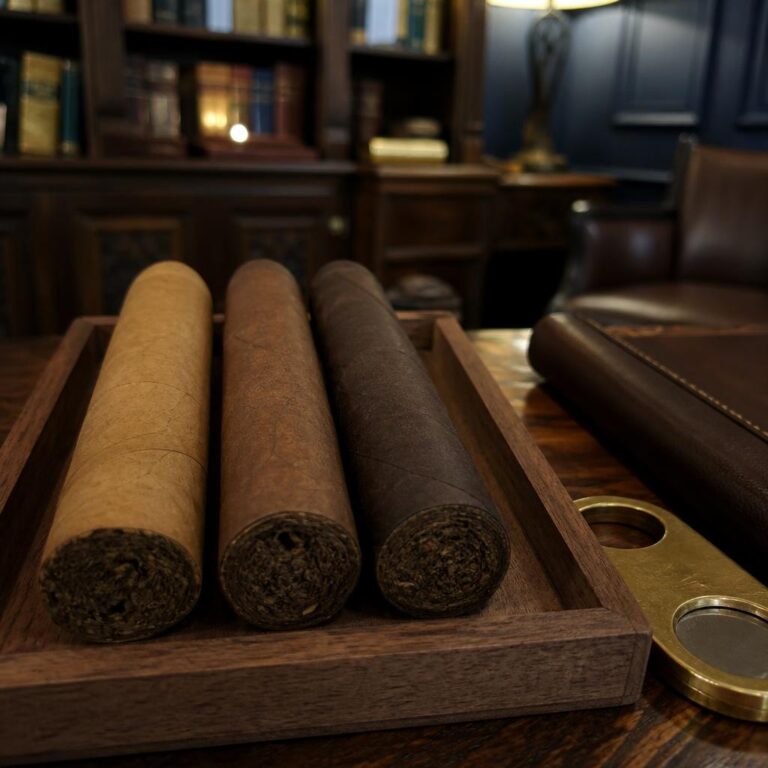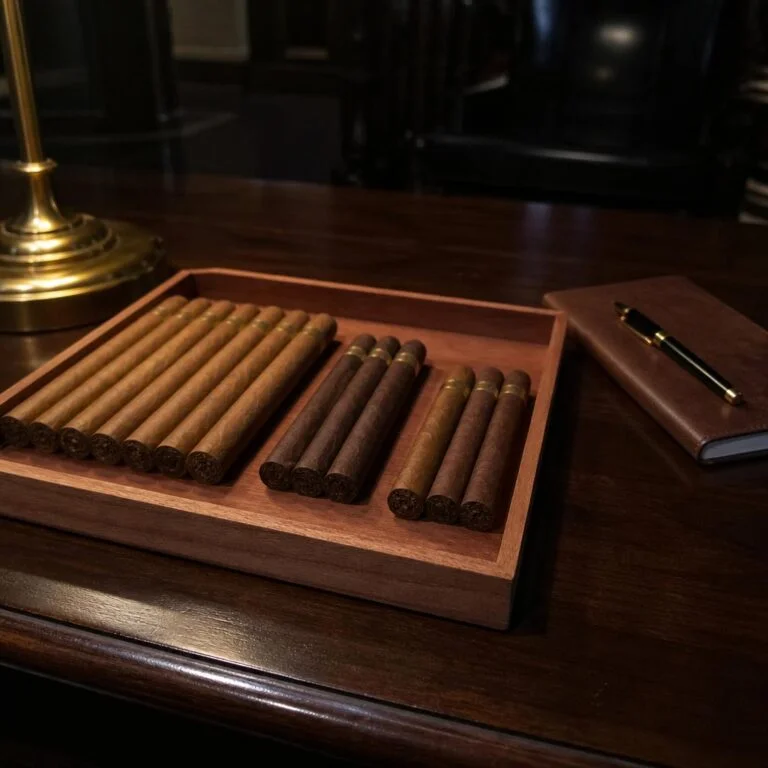
Somewhere in Cuba there are warehouses where finished cigars sleep for five to eight years before anyone is allowed to buy them. Habanos S.A. started selling them in 2015 as the Añejados, a second identifying band on each cigar and the roll and inspection dates stamped on each box, and the premise of the whole programme fits in one sentence: a cigar that has been rolled, boxed, and then left alone for years is a different and often better cigar than the one that went in. The house that sells the most famous cigars on earth holds stock back for five years and more on purpose, a bet placed on slow chemistry rather than on sentiment.
Aging is the practice of making the same bet at home. To age a cigar is to hold it deliberately, at controlled conditions, for a year or more past the point where it is merely ready to smoke. Rest is recovery; aging is transformation. A rested cigar tastes the way its blender intended, and an aged cigar tastes of what the years have quietly done since. The two get confused constantly, usually by people selling something, and separating them is where this guide begins.
What follows separates resting from aging, sets out what actually changes inside the leaf as the years pass and what never will, and names the cigars that reward the wait. From there it covers the conditions an aging shelf wants, the practical questions of boxes, singles, cellophane and the white dust that starts arguments, and how to run an aging experiment properly, one box and one stick at a time. It ends with the record, because none of it counts unless you write it down.
Two Jobs on Two Clocks
In the resting guide I set out three words that get used interchangeably and should not be: acclimatisation, rest, and age. Acclimatisation is days, the cigar adjusting to your humidor after its journey. Rest is weeks to a few months, the components settling back into agreement so the cigar smokes the way it was blended to smoke. Aging is the year mark and beyond, where the leaf stops recovering and starts changing. Acclimatisation fixes location. Rest fixes condition. Aging changes character.
The distinction matters because the two long clocks answer different questions. Rest asks: is this cigar ready? It has a finish line, the point where the moisture has evened out, the travel shock has faded, and the blend reads clean. Aging asks something more speculative: what might this cigar become? There is no finish line, only a long curve, and the honest answer at the start is that you do not fully know. That uncertainty is part of the bargain, and learning to sit comfortably with it is most of what the practice asks.
No bell rings when rest ends and aging begins. A cigar that has sat a year has finished resting and started aging without ever being moved, and the first months of what collectors call age are really the tail of the settling process. The one-year mark is a convention, not a chemical threshold, but it is a useful one: below it you are mostly waiting for the cigar you bought, and beyond it you are waiting for a cigar that does not exist yet.
Say it plainly: none of this is required. A cigar smoked young, rested and nothing more, is not a mistake, and some blends are at their best exactly there. Aging is an optional discipline for the curious, the patient, and the slightly obsessive. If that is you, the rewards are real, and they are measurable in your own tasting notes rather than in anyone else’s mythology.
Get the words right
Three Words, Kept Apart
Acclimatisation. Days. Fixes location: the cigar adjusts to your humidor after its journey.
Rest. Weeks to a few months. Fixes condition: the blend settles back into agreement.
Aging. A year and beyond. Changes character: the leaf stops recovering and starts becoming something else.
What Time Actually Changes
The first thing the years do is finish a job fermentation started. Tobacco is fermented before rolling in stacks that heat up under their own weight, and one by-product of that process is ammonia, which continues to leave the cigar slowly for a long time after it is rolled. This is the sick period the trade press describes: a stretch early in a cigar’s life when the ammonia is still loud enough to mute everything else. Most of it is gone by the end of the first year, and it is essentially gone by the second. If you have ever nosed a fresh cigar and felt that small clench inside the nostril I described in the resting guide, you have met the thing that year one quietly removes.
The second change is the marriage. A cigar is several tobaccos rolled into one object, wrapper and binder and filler from different primings, farms, and sometimes countries. Held together at stable humidity, they exchange oils and aromas until the seams disappear. A young cigar can taste like a committee, cocoa here, pepper there, something vegetal underneath taking its turn. The same cigar three years on tends to speak with one voice. Nothing new has entered the cigar in the interval, and what sounds like a change of blend is really the original tobaccos settling into agreement.
The third change is the slow rounding of edges. As the compounds in the leaf continue to break down, harshness softens, acidity drops, pepper moves from the tip of the tongue to the back of the throat, and sweeter notes that were buried come forward. The trade press sketches the stages with numbers: a green stage across years one to three, an aged stage from three to five, and a mature stage from six onward, where flavours grow more nuanced still. Past fifteen or twenty years the road forks: some palates find the cigar has hollowed, others find a beauty in what is left.
Be clear-eyed about the trade. Aging exchanges intensity for refinement. Strength fades, body slims, and the loud opening act of a young full-bodied cigar becomes something quieter and more articulate. If what you love about a blend is its volume, age will not improve it for you, and there is no shame in that preference. Aging clarifies a cigar; it does not transmute one. A rough, cheaply made cigar with five years on it is a rough, cheaply made cigar that has calmed down.
Aging clarifies a cigar; it does not transmute one.
Which Cigars Reward the Years
The cigars that age well share two traits: enough strength and structure in the leaf to spend some of it gracefully, and construction good enough to hold together while it happens. A full-bodied blend built on ligero, the strong sun-fed leaf from the top of the plant, has somewhere to go as it softens. A mild blend is already where it is going. This is why mild, mass-market, short-filler tobacco does not become a Padrón 1964 after five years on your shelf. It becomes the same cigar with slightly fewer rough edges.
The names I trust with years are the ones I keep returning to. Padrón’s 1964 Anniversary line, rolled from tobaccos the family has already aged four years before they touch a rolling table, and the Serie 1926, whose leaf gets five. Fuente’s OpusX. Davidoff‘s Millennium and Aniversario. The Cohiba Behike. The regional and limited Habanos releases. These are cigars whose makers expect them to be held, and whose leaf and workmanship justify the expectation. They are not the only candidates, but they are the proof that the category exists.
The strongest evidence comes from the makers themselves. Habanos S.A. sells factory-aged cigars under the Añejados band, released from 2015 onward after five to eight years of sleep in their boxes in Cuba. The detail worth noticing is what gets aged: the finished, rolled cigar, not the leaf. The Limited Editions use leaf aged before rolling; the Añejados age after. Both exist because both work, and the second is precisely what your shelf at home can do. Nothing about it requires a warehouse in Havana. It requires conditions and patience.
Wrapper matters at the margin. A dark maduro, fermented hard and long, tends to carry more residual youth and rewards a long sleep with real sweetness. A delicate Connecticut shade wrapper has less in reserve and more to lose, and a blend built for creamy mildness is usually best enjoyed inside its first couple of years. And one principle above all: age what you already love young. An aged cigar you never liked is an old cigar you never liked. The years deepen a cigar’s character. They do not perform a rescue.
The proof the category exists
Cigars That Reward the Years
- Padrón 1964 Anniversary. Tobaccos aged four years before rolling.
- Padrón Serie 1926. The leaf gets five.
- Arturo Fuente OpusX. Strength and structure held in reserve.
- Davidoff Millennium and Aniversario. Built for the long hold.
- Cohiba Behike. The rare medio tiempo leaf in the blend, with somewhere to go.
- Regional and limited Habanos releases. Check the box date when buying.
Two traditions
Aged Before vs Aged After
Before rolling
Leaf aged in bales and barrels before it ever meets a roller; the Ediciones Limitadas; Padrón’s pre-roll years.
After rolling
Finished cigars boxed and held; the Añejados, five to eight years asleep in Cuba.
The second is the one your shelf can replicate.
The Aging Environment
An aging shelf wants the same numbers as a good humidor, held with far less interference: the setpoints stay put while the traffic drops, the light goes, and the placement moves to the coolest spot the house can offer. The Cuban guideline for aging finished cigars, sixty-five to seventy percent relative humidity at sixteen to eighteen degrees Celsius, is a sensible anchor, and most careful cellars I know lean to the bottom of it for the long haul.
My own aging cabinet sits at sixty-five percent and sixty-five degrees Fahrenheit, the same numbers I keep for everyday storage, and some run as low as sixty-two percent for cigars they intend to hold for a decade. Running drier and cooler slows the clock, and slower is what you want: the changes it delays are the ones worth waiting for, and the ones it prevents are the ones that ruin boxes.
Cool matters as much as dry. Warmth accelerates the wrong things: the volatile aromatics you are waiting years for evaporate faster, wrapper leaf dries and lifts at the seams, and any moisture problem compounds. Warmth is also what wakes the cigarette beetle: its eggs lie dormant in the leaf until heat brings them on, and activity rises above roughly seventy-three degrees Fahrenheit; a hatch inside a sleeping box is the ugliest surprise in this hobby.
The belt-and-braces answer for a box bound for years of sleep is a few days in a sealed bag in the freezer before it goes down, then a day in the fridge on the way out; cool storage is the everyday defence. A cool corner of the house, away from radiators, sunlight, and exterior walls that swing with the seasons, is doing more for your aging stock than any accessory you can buy.
Dark and undisturbed complete the list. Light and heat degrade wrapper leaf, which is why serious cellars are closed boxes in shaded rooms rather than display cases in bright ones. And stability, as ever, beats perfection.
The worst thing for an aging cigar is not sixty-three percent instead of sixty-five; it is bouncing between sixty and seventy-two with the seasons. A shelf that holds one honest number year round will out-age a shelf that chases the perfect number and misses.
The practical shape of all this: separate your aging stock from your working humidor. The box you open three times a week lives at smoking conditions and suffers the traffic. The aging shelf is a different address, opened a few times a year, ideally in a cooler room, with its own humidity source and its own hygrometer. If the same cabinet must do both jobs, keep the aging boxes on the lowest shelf, where the air is coolest and your hands go least.
At a glance
The Aging Shelf at a Glance
Cuban guideline. 65 to 70 percent relative humidity at 16 to 18 degrees Celsius.
A sound home setting. 65 percent at 65 degrees Fahrenheit.
Decade holds. Careful cellars run as low as 62 percent.
The beetle line. Keep it below roughly 73 degrees Fahrenheit.
Dark and undisturbed. Light and heat degrade wrapper leaf.
Stability beats perfection. One honest number held year round.
A separate address. Keep aging stock apart from the working humidor.
Boxes, Singles and Cellophane
Age in boxes when you can. A sealed cedar box is a small climate of its own, buffering the swings of the cabinet around it, and the cigars inside it are aging in company: twenty examples of the same blend, exchanging aromas through the same cedar, arriving at the same place together. Not every box breathes alike: a varnished dress box passes less air than a plain slide-lid cabinet box, which is part of why the old cabinet selections age the way they do. The great aged Habanos are box-aged almost by definition, and the Añejados programme ages cigars in their boxes for the same reason. A box also gives you something singles cannot, which is a controlled experiment, and we will come to that.
Singles age perfectly well too; they simply age socially. Loose sticks in a cedar-lined space share their aromas with their neighbours, which is fine when the neighbours are congenial and less fine when a heavily maduro shelf is seasoning your delicate Connecticuts. If you age singles, give them a corner, a tray, or a bag of their own, and expect a little more drift than a closed box would allow.
Then there is cellophane, the most relitigated square inch in the hobby. The facts are undramatic: cellophane is breathable, humidity passes through it, and a cigar sleeved in cello ages, just more slowly and in more isolation than a naked one. The case for leaving it on is protection, since cigars that get handled survive handling, and a tidy uniformity, each cigar aging in its own weather. The case for stripping it is fuller contact with the cedar and the neighbours, the marriage conducted at full volume. Retailers will tell you both work, and they are right.
My own practice, offered as a preference and nothing more: cello off for boxes going to the aging shelf for years, cello on for anything in the working humidor that gets touched, travelled, or shared. The one mistake available here is agonising over it. The variable is small, and the cigar cares far less than the forums do.
At a glance
Boxes, Singles and Cellophane
| Mode | Marriage | Protection | Drift risk | Best for |
|---|---|---|---|---|
| Sealed cedar box | Full, in company | High | Lowest | Multi-year holds and the controlled experiment |
| Naked singles | Full, social | Low | Highest, neighbours season each other | Congenial mixed shelves and shorter holds |
| Cello-on singles | Slower, isolated | High | Low | The working humidor, and sticks that travel or get handled |
The Trouble with Plume
Sooner or later an aged cigar shows you something white, and you will want it to be plume. Plume, the story goes, is the crystallised bloom of a cigar’s own oils rising to the wrapper over years of proper storage, a fine dry dust, evenly spread, that brushes away clean and marks the cigar as well kept. It is the hobby’s merit badge, and people photograph it the way anglers photograph fish.
Hold the celebration. The identification rules are worth knowing exactly because the stakes of getting them wrong are a ruined box. True to the descriptions, plume is powder-fine, white to grey, dry, odourless, and even, like the faintest dusting of icing sugar. Mould is none of those things: it grows in patches rather than films, it fuzzes and hairs, it runs to blue, green, or grey-white with texture, it can smell musty, and it roots, leaving a mark when wiped where plume lifts away entirely. Anything on the foot, in the open tobacco, is mould. Anything fuzzy is mould. Anything patchy is mould.
I will admit to being a sceptic in the modern style: among serious collectors the fashionable view, which I share, is that most of what gets celebrated as plume is mould photographed charitably, and that genuine plume, if you ever meet it, is rarer than the forums suggest. You lose nothing by assuming the worst. A cigar wearing white gets treated as a suspect first and a trophy never: isolate it, check the hygrometer, and inspect its boxmates. Light surface mould on a wrapper can be brushed off outdoors and the cigar watched; anything that returns, roots, or reaches the foot has cost you a cigar, and better one than the shelf.
The consolation is that the cause is almost always legible. Mould is a report card on your conditions, too warm, too wet, too still, and the drier, cooler aging shelf described above is precisely the environment that starves it. Keep sixty-five percent honest and the white dust question mostly stays theoretical.
The design
How to Age Cigars, in Order
| 01 | Buy a box of a blend you already know and admire. Two, if the budget allows: one to sleep, one to smoke down as the control. |
| 02 | Rest it properly on arrival. |
| 03 | Smoke one and write the baseline: draw, burn, and the flavour map by thirds. |
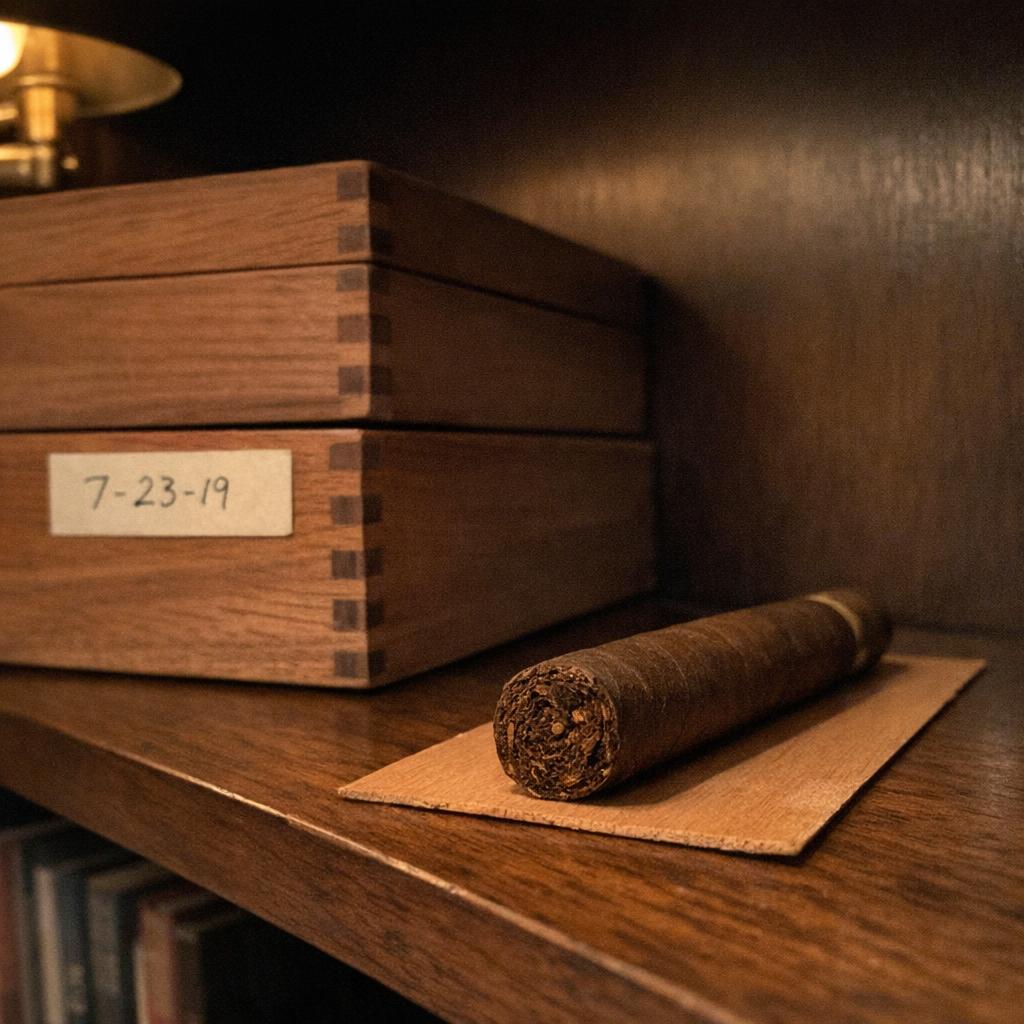
| 04 | Date the lid and put the box to sleep at your aging numbers. |
| 05 | Smoke one stick a quarter, same shelf, same hour, notes every time. |
| 06 | Smoke the control box down in parallel while its twin sleeps. |
| 07 | Read the curve at years two and three against your own notes. |
Running the Long Experiment
Aging goes wrong in one way more than any other: a box goes to sleep, years pass, and at the end its owner has a vague sense the cigars are better and no idea whether that is true. The fix is to run the thing as an experiment, and the full design is old and simple: two boxes of a blend you already know and admire, one to sleep for the years and one to smoke down fresh as the control. The one-box version is the budget cut of the same design, trading the control for a single written baseline, and it still answers the question worth asking. Either way, rest the box properly on arrival. Smoke one, and write down what it was: the draw, the burn, where the flavours sat, what the first third promised and the last third kept. Then put the box away and smoke one stick a quarter, notes each time, and let the box tell you what it is becoming.
Pick the subject like a scientist with a budget. It should be full enough to have somewhere to go, well made enough to get there, and affordable enough that twenty of them sleeping for three years does not sting. An Oliva Serie V is my standing example: an Ecuadorian-grown Sumatra-seed wrapper over Nicaraguan leaf, with the strong Jalapa Valley ligero at its core, a cigar with genuine reserves that costs box money rather than trophy money. Young, to my palate, it leads with pepper and dark earth and a slightly insistent edge. The interesting question, the one the experiment exists to answer, is what that edge becomes at one year, at two, at three.
Hold the discipline steady and the experiment stays clean. One variable, time. Same shelf, same conditions, same humidity source, and ideally the same hour of the day and state of palate when you smoke the quarterly stick, because a cigar after breakfast and a cigar after dinner are two different cigars. Resist the urge to raid the box in a good week; the sticks are data points, and a box plundered to five examples by month eight answers nothing. If you are running the full design, smoke the control box down while its twin sleeps. It is the same principle I gave for six-month rests, stretched to years: the fresh box teaches you the blend, and the sleeping box teaches you time.
Expect the reward on a delay. The quarterly notes will bore you for the first year, which is the ammonia leaving and the marriage settling, slow work with little to report. Somewhere in the second year the notes start disagreeing with the early ones, and that disagreement, written in your own hand, is the entire payoff: proof of what time did, to this blend, on your shelf, at your numbers. Nobody can hand you that conclusion, because it only exists once you have smoked your way to it, one quarter at a time.
Suspect first
Plume or Mould
| Sign | Plume | Mould |
|---|---|---|
| Colour | White to grey | Blue, green, or grey-white |
| Texture | Powder-fine and dry | Fuzzy and hairy |
| Spread | An even film | Patches |
| Smell | Odourless | Can be musty |
| Wipe test | Lifts away clean | Smears or leaves a rooted mark |
| Location | Wrapper only | Anywhere, including the foot |
| Verdict | Rare and benign; keep watching | Isolate it, check the hygrometer, inspect the boxmates |
Age Is Part of the Record
Every part of the experiment leans on the least glamorous tool in the hobby: the record. Memory is a flattering narrator, and over the spans aging works on, it is a useless one. Nobody remembers in 2029 what a cigar’s first third promised in 2026, what the box cost, when it arrived, or what the hygrometer read through the winter. The difference between aging cigars and merely owning old cigars is a written trail.
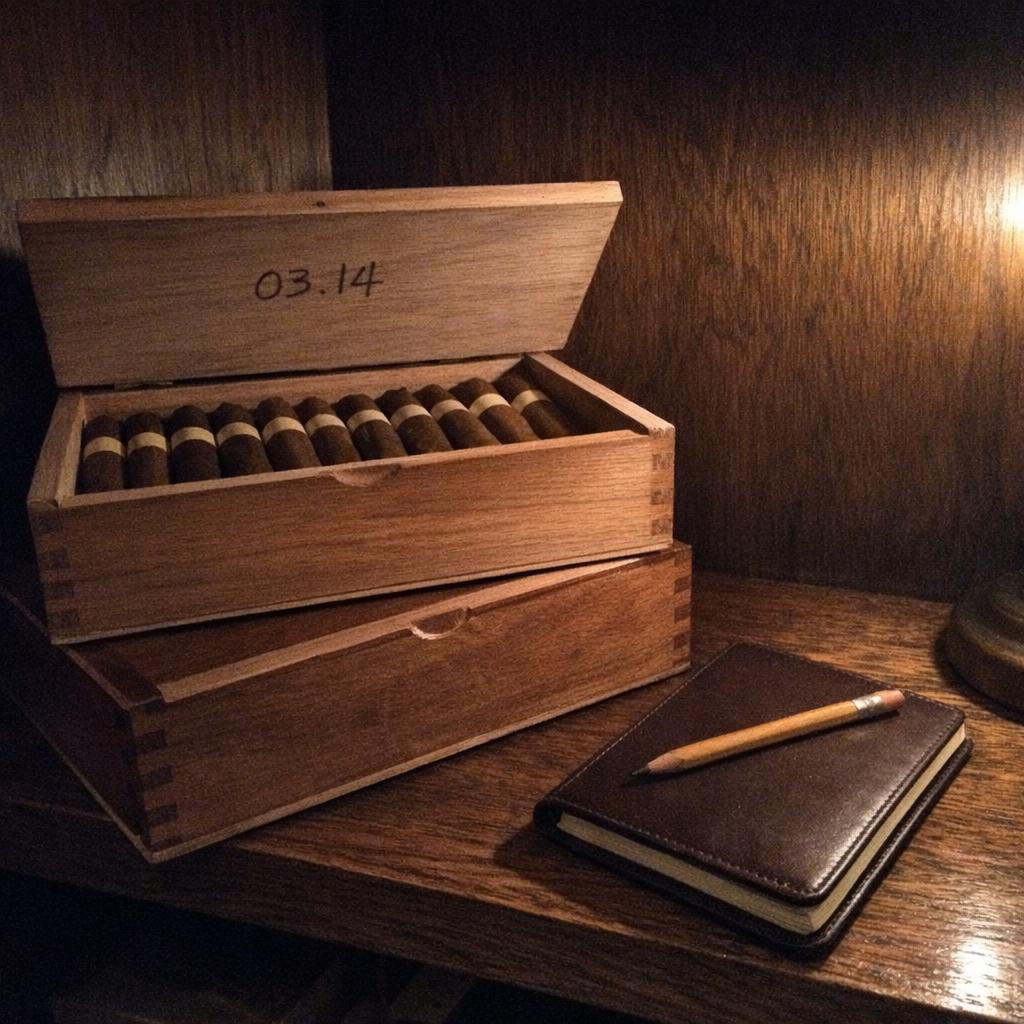
The trail needs five things per box, and the first is the one most people skip: the factory box date or code where one exists, with the purchase date standing as proxy where it does not. Arrival date is not age, and for Habanos the box code is the first thing a serious ager reads. After that: when it arrived and where it came from, what it cost, what conditions it slept at, and what each smoked stick was like, dated. A pencilled date on the box lid and a notebook will do it, and have done it for a century of patient smokers. The failure mode is not the tools; it is the consistency, which is exactly the part I am bad at, and why mine lives in Cigarro. The same rest timer that counts a new arrival’s first thirty days simply keeps counting, so a box’s age is a fact on the screen rather than an argument with my own memory. Each box groups its cigars, each smoked stick takes its review by thirds, and the humidity log sits beside the dates, so a three-year-old note is evidence rather than nostalgia.
However you keep it, keep it. The review-by-thirds discipline of the Cigarro Method turns out to be built for this job, because a framework applied the same way every time is what makes notes from different years comparable at all. Aging is a conversation between you and a box of tobacco that lasts years, and the record is the only transcript. The cigars will do their slow work either way. Whether you get to understand what they did is entirely up to what you wrote down.
Write it down
The Record, Per Box
- The factory box date or code, with the purchase date as proxy where none exists.
- Arrival date and source.
- What it cost.
- The conditions it held: setpoint and log.
- Every smoked stick, dated, with its review by thirds.
Questions worth answering
Questions on Aging
Aging proper begins around the one-year mark, once acclimatisation and rest have done their work. The trade press stages it as green across years one to three, aged from three to five, and mature from six onward, with opinion dividing past fifteen or twenty. In my own experiments the notes usually start disagreeing with the baseline somewhere in the second year, which is the first real evidence that time is working.
The right ones do. Time carries off the last of the ammonia, marries the tobaccos into one voice, and rounds harshness into something quieter and more articulate, which is why Habanos S.A. holds Añejados stock back for five to eight years before selling it. The trade runs one way, though: intensity fades as refinement arrives.
The Cuban guideline for aging finished cigars is 65 to 70 percent relative humidity at 16 to 18 degrees Celsius, and most careful cellars lean to the bottom of it. My own shelf holds 65 percent at 65 degrees Fahrenheit, kept dark, undisturbed, and cool, because beetle activity rises above roughly 73 degrees Fahrenheit. Stability matters more than the precise number; one steady figure held year round out-ages a perfect figure missed.
Both work. Cellophane is breathable, so humidity passes through it and the cigar ages either way, just more slowly and in more isolation with the cello on. My own practice is cello off for boxes bound for the aging shelf and cello on for anything in the working humidor that gets handled or travelled, offered as a preference rather than a ruling. It is the smallest variable on this page, and the cigar cares less than the forums do.
Assume mould first. True plume is a powder-fine, dry, odourless film, spread evenly across the wrapper, that lifts away clean; mould grows in fuzzy patches, runs to blue, green, or grey-white, can smell musty, and leaves a mark when wiped. Anything on the foot is mould, and anything fuzzy or patchy is mould. Isolate the suspect, check the hygrometer, and inspect its boxmates before celebrating anything.
No. The years deepen character that is already in the leaf, and a mild, short-filler cigar has nowhere to go; five years on, it is the same modest cigar, marginally smoother. Age blends with enough strength and structure to spend some of it gracefully, and only ones you already love young. An aged cigar you never liked is an old cigar you never liked.
The Long Game
Aging cigars is a long argument with your own impatience, and winning it slowly is part of the reward. Even age can be bought; the Añejados prove it. What cannot be bought is the witnessing: time on your own shelf, at your own numbers, in your own notes. That time accrues at exactly one day per day, to everyone equally, which makes an aged box one of the few genuinely democratic possessions in a hobby that loves its hierarchies.
Start smaller than feels significant. One box of something you love, a date on the lid, a stick a quarter, and the patience to leave the rest alone. In three years you will own cigars nobody can sell you, and, better, you will know precisely what the years did to them, because you were there, taking notes, the whole quiet time.