Plume is the most argued-about dust in the cigar world. The classical definition is tidy enough: plume, also called bloom, is a fine white powder of crystallised oils that appears on a cigar’s wrapper after years of patient aging. Mould is a living fungus that thrives in a damp humidor and ruins cigars outright. One is harmless and rather lovely. The other spreads. The trouble is that the two look similar at arm’s length, and the white dust collectors proudly photograph as a badge of honour is, more often than anyone would like, a problem in progress.
This guide covers the classical definition, the sixty-second test that separates plume from mould, an honest look at the evidence, and exactly what to do when white spots turn up in your humidor.
What plume actually is
Start with the textbook. Cigar Aficionado’s glossary defines plume as a fine white powder that forms when the oils in a well-aged cigar work their way to the surface and crystallise on the wrapper. It sits flat against the leaf, feels dry under a fingertip, and brushes away without leaving a mark. On the classical account it is entirely harmless, changes nothing about how the cigar smokes, and signals that the stick has rested undisturbed in stable conditions for a very long time.
Note the character of the thing: dust, not growth. Plume has no height and no texture. It does not cluster in fuzzy patches, and it does not creep across the foot of the cigar. If what you are looking at does any of that, you are not looking at plume.
The word bloom means the same thing. Older books tend to prefer it; the trade uses the two interchangeably, and your tobacconist will understand either.
The sixty-second test
White spots on a wrapper deserve a calm inspection, not a panic. Four checks settle it.
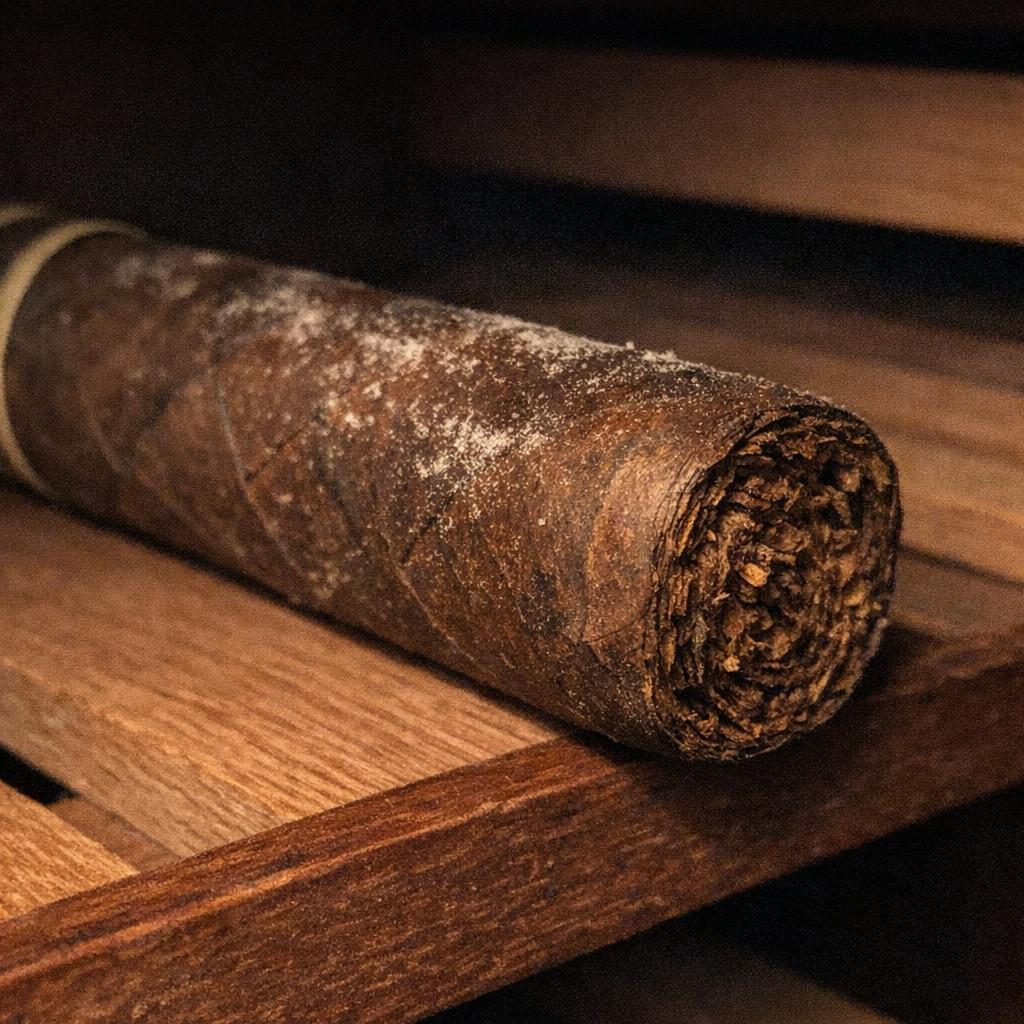
Look. Plume is even and powdery, like the faintest dusting of icing sugar lying flat against the wrapper. Mould is patchy and raised. It often starts white and turns blue or green as it matures, and under a bright light it shows fuzz rather than shimmer.
Touch. Wipe the spot gently with a dry fingertip. Plume comes away cleanly and leaves the wrapper unmarked. Mould smears, clings to the leaf, or reappears within days, because its roots are in the tobacco rather than on it.
Location. This is the most reliable check of the lot. Plume, where it occurs, occurs on the wrapper. Mould loves the foot, where the filler is exposed and moisture lingers. Anything growing on the foot of a cigar is mould. There is no second opinion to seek.
Smell. A mouldy cigar smells like a damp cellar. If the barnyard sweetness of aged tobacco has turned musty, trust your nose over your hopes.
An honest word on the evidence
Here is the part most guides skip. Nearly every time cigars believed to be carrying plume have been put under a microscope, the verdict has come back mould. The most widely cited effort was organised by members of the Friends of Habanos community, who sent a batch of supposed plume specimens to an Australian laboratory for analysis. Every sample came back identified as a common mould. Crowd wisdom on this subject has a poor record in the lab.
That does not make plume a fairy tale. The trade’s reference glossaries still describe it, and experienced collectors continue to report the genuine article on decades-old cigars. What it does mean is that plume is rare, far rarer than humidor folklore suggests, and that the sensible default when you find white spots is suspicion. Treat the growth as guilty until the sixty-second test proves otherwise.
There is a practical upside to the scepticism. Mould has a cause you can fix: humidity sitting above roughly 72 percent, warm temperatures, or a wet patch left by an over-enthusiastic humidification device. Plume, whatever your view of it, asks nothing of you. Chasing it is not a storage strategy.
What to do when white spots appear
First, isolate the cigar. Whatever the spots turn out to be, you lose nothing by moving the stick away from its neighbours while you inspect it, and if it is mould you may well save the rest of the box.
Then run the test. If the spots sit on the foot, or they fuzz, smear or smell musty, the cigar goes in the bin. That feels brutal with an aged stick, but a mouldy cigar is not salvageable, and smoking one is a poor idea.
If the spots pass every check, wipe the wrapper gently with a dry cloth and return the cigar to its shelf. Congratulations are cautiously in order.
Either way, inspect the humidor itself. Check the reading against the 65 to 70 percent range covered in our cigar humidity guide, look for condensation or a soaked humidification device, and make sure the box was seasoned properly in the first place. If you run a solution-based humidifier, our propylene glycol versus distilled water explainer covers the discipline that keeps moisture stable. A note in your Cigarro humidor log each time you inspect makes patterns visible over months, and cigars that rest quietly at 65 percent, as our guide to resting cigars recommends, tend to age without drama.
Track every cigar worth aging
Plume makes a better story than it makes a habit. By all means hope for it on the box you are sitting on for a decade, but let the hoping stop at the humidor lid. Inspect monthly, keep the humidity honest, and treat every white spot as a suspect with an alibi to prove. Your cigars will age beautifully either way, and if a genuine dusting of crystallised oils ever does appear, you will know exactly how to greet it: with a dry fingertip and a quiet sense of occasion.