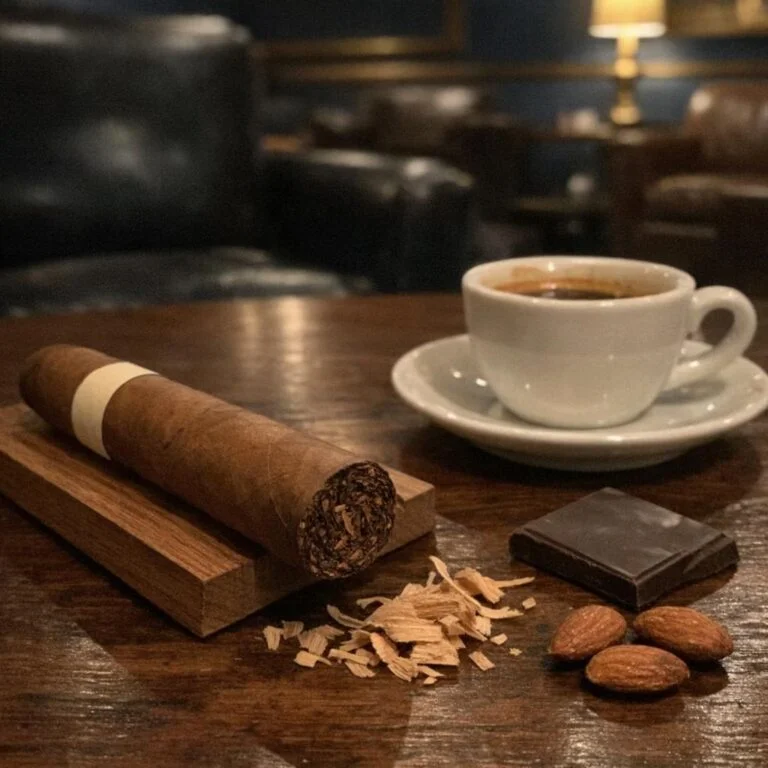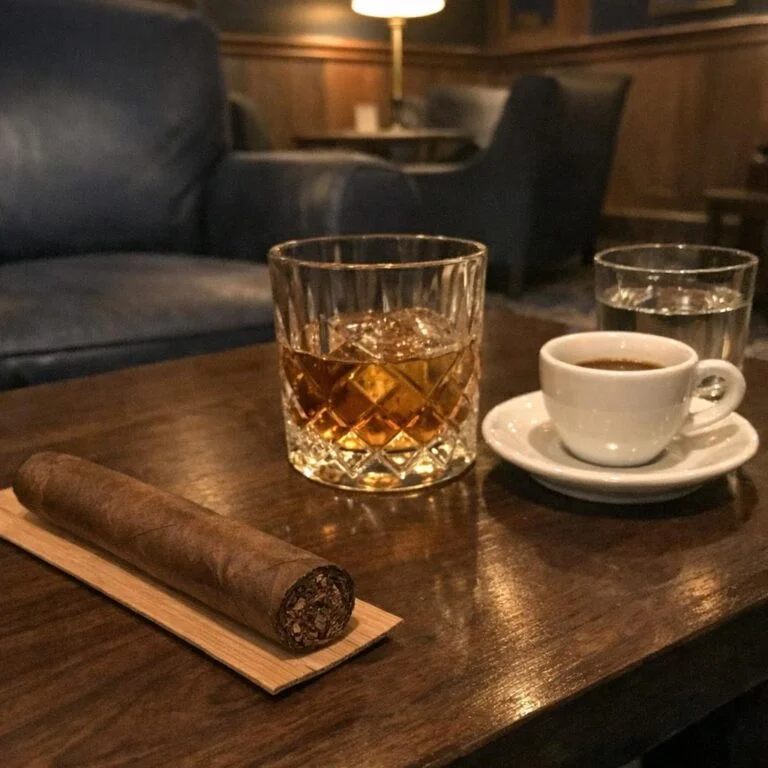
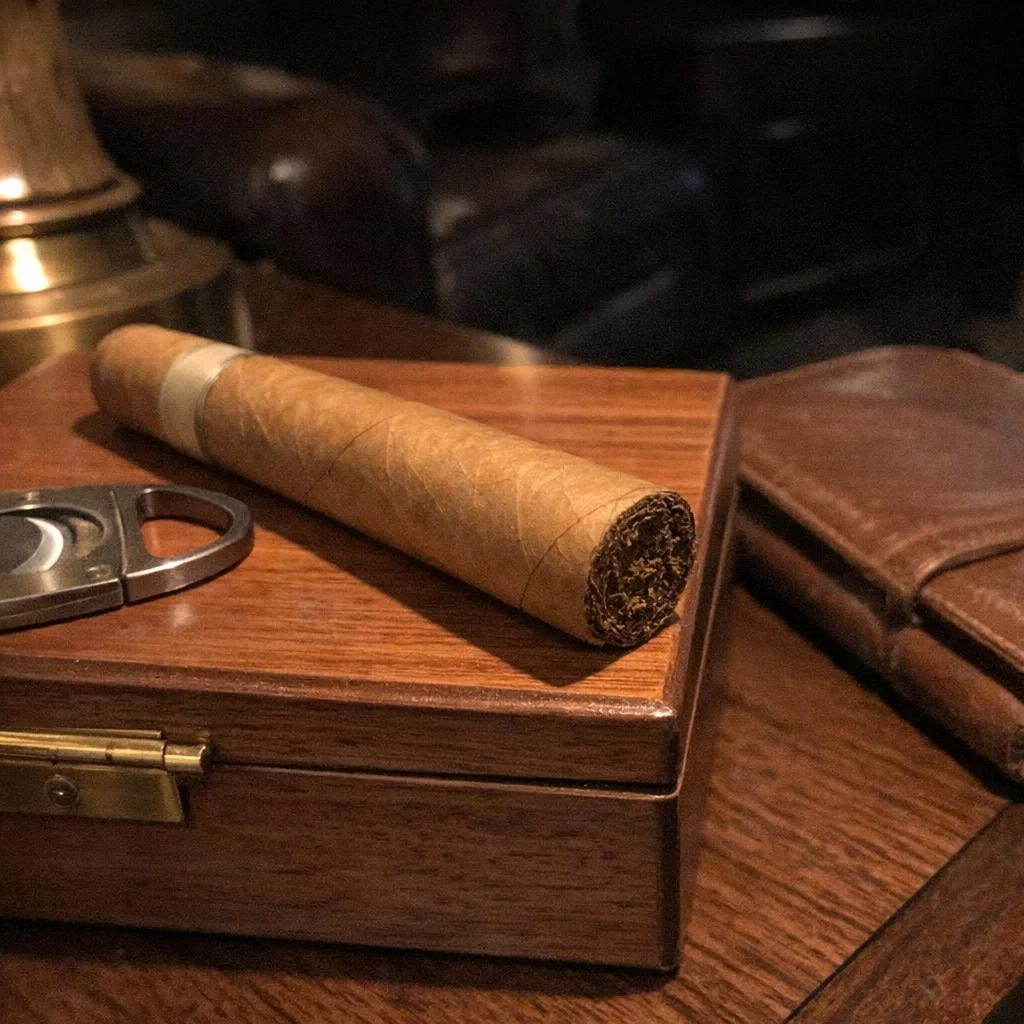
Smoking a cigar properly is a slow, unhurried business, and almost every mistake a newcomer makes comes from treating it as a fast one. A premium cigar is a hand-rolled bundle of fermented tobacco leaf. Cigar smoke is tasted in the mouth and never inhaled. The pace is one draw a minute, give or take, with the smoke held on the palate for a moment and let go, and an hour or so in which nothing else is required of you.
I have watched a good many first cigars go wrong across a counter, and the failures are always the same three. The cigar is smoked like a cigarette, quickly and with the lungs. The ash is tapped away every thirty seconds out of nerves. And at the end it is crushed into the tray, which forces a plume of acrid smoke out of the tobacco and is the reason rooms smell the way people who dislike cigars imagine all rooms with cigars smell. None of those is a character flaw. Nobody explained the rhythm.
This is that explanation, in one place. Choosing, cutting, lighting and tasting each have their own deep guides on this site, and I will point you to them where they earn the detour. Here, the aim is the whole arc from unlit stick to a cigar left to go out on its own, with enough specificity that you can sit down tonight and get it right. It is the guide we hand to every new Cigarro member first, and it is written for a first evening, not a lecture hall.
The Whole Arc, Briefly
- Choose a cigar that suits the hour and your palate.
- Cut the cap, not the wrapper.
- Toast the foot, then light it.
- Draw once a minute, into the mouth and no further.
- Stop when it stops tasting good, and let it go out on its own.
A cigar smoked well moves through five acts, and only two of them ask for any dexterity. You choose, you cut, you light, you smoke at a pace the tobacco can keep up with, and you let it go out when it stops tasting good. Everything else in this hobby is a refinement of one of those five.
Choosing is its own subject and I will not repeat the full guide to choosing a cigar here, but the short version for a first outing is this: go mild, go modest in size, and go with a Connecticut Shade wrapper. Cigar Advisor’s first-timer list leads with exactly that profile, and their pick of the Macanudo Café Hyde Park is a sound one. It measures 5.5 inches by a 49 ring gauge, wears a Connecticut Shade wrapper over Dominican tobaccos, and sits at the mild end of the scale; Cigar Aficionado rated it 90 and called it a perfect starter cigar when it placed in their Top 25 back in 2005, and it has not changed its manners since. I will use it as the worked example through the rest of this piece, because a cigar like the Hyde Park forgives the small errors a first evening will inevitably contain.
Timing matters more than most guides admit. Do not smoke on an empty stomach; nicotine on nothing, taken too fast, is the quickest route to feeling green, and a proper meal beforehand is the simplest insurance. Allow the cigar the time it actually needs. How long that is depends on your pace, and the published figures disagree more than you would expect, so I give them their own section below. For now: plan on the better part of an hour for a Robusto-sized stick and be pleasantly surprised if it runs shorter. If you have twenty minutes before the taxi arrives, this is not the evening.
The kit is short. A proper cutter. A butane flame, torch or soft, or a box of long cedar matches; not a petrol lighter, because the fuel gets into the smoke and stays there. Somewhere to rest the cigar between draws, which is what an ashtray is actually for. A glass of water alongside whatever else you are drinking. And something sweet within reach, for reasons that will become clear. One more thing worth knowing before you start: a cigar straight from a good shop’s humidor is ready to smoke, cellophane or not, while one that has spent a week in a glovebox or a jacket pocket is not, and the difference will show in the burn. If you are buying more than one, the storage guide covers how to keep the rest of them honest.
Before you sit down
Eat first. Allow a full hour. Have a cutter, a butane flame or long cedar matches, somewhere to rest the cigar, a glass of water, and something with sugar in it within reach. No fluid-fuel lighter, and no twenty-minute window.
01 · The cut
Open the Cap
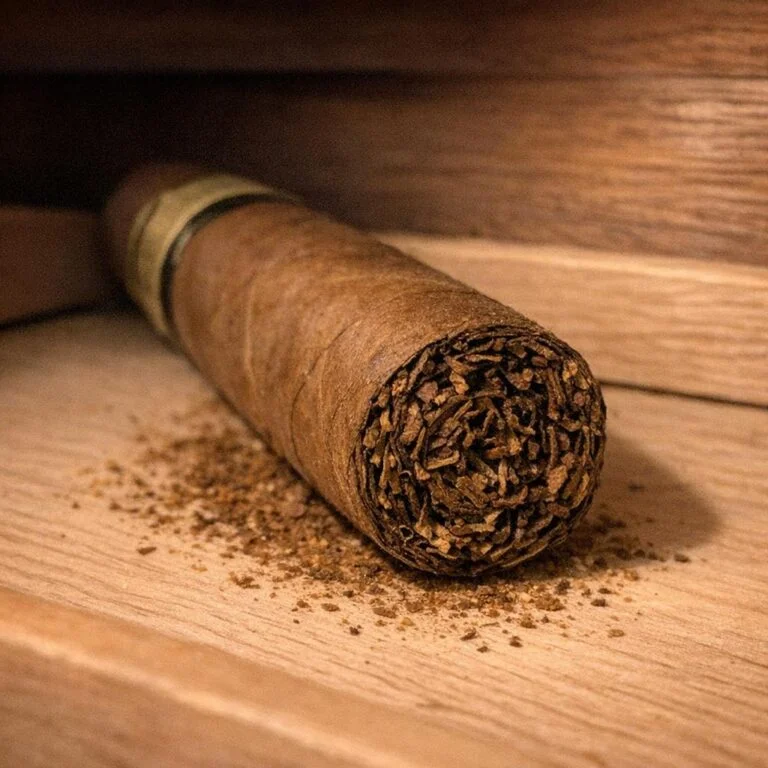
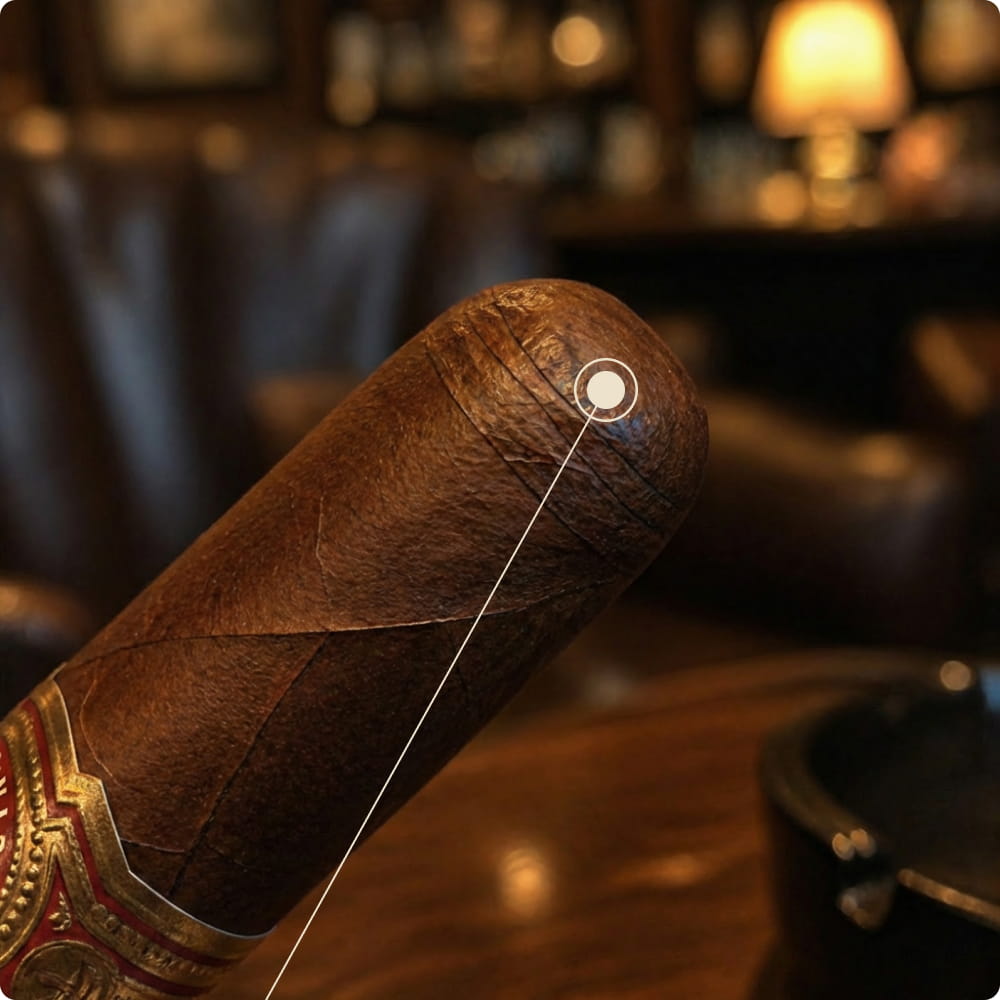
The head of a cigar, the end you draw from, is sealed with a small round of leaf called the cap. Your only job with the cutter is to open that cap without disturbing the wrapper beneath it. Cigar Aficionado’s rule is the one I was taught: cut at the shoulder, the place where the curved end of the cigar starts to straighten out. In practice that removes a sliver a couple of millimetres thick, about the thickness of a coin’s edge, and no more. Take more than that and the wrapper, which is a single leaf wound under tension, can begin to unravel in your fingers.
A double-blade guillotine is the honest default and the one I hand to newcomers. Rest the head in the opening, close the blades until they just touch the cap, and then cut in one decisive motion. A V-cutter and a punch are both fine alternatives with their own habits, and the full guide to cutting a cigar walks through all three with the particular cases where each one wins.
Test the draw before you light. Put the cigar to your lips and pull air through it cold. You want gentle resistance, something like sipping a thick milkshake through a straw. A firm draw is fine and often a sign of a well-packed cigar. A plug is different: nothing moves at all, or barely. Do not reach for a deeper cut first. Cigar Advisor’s sequence is the right one: roll the cigar gently between thumb and forefinger along its length, feeling for the hard knot in the bunch, and retest; if it is still stuck, run a draw tool or a slim piercer down the centre from the head, no more than an inch or so, and retest; only then consider a slightly deeper cut, and only on a cigar whose cap has room for it.
The opposite problem, air rushing through with no resistance at all, is one I have met behind a counter more often than a plug. Usually the cigar is under-filled; sometimes the cut went well below the shoulder; occasionally the stick has simply dried out. None of the three can be mended tonight. A dry cigar can be brought back, but slowly: Holt’s protocol steps the humidity up in stages, from the low sixties to 65 and then 69 percent at intervals of two to three weeks, because tobacco loses moisture far faster than it can safely regain it and a cigar dropped straight into a working humidor swells its filler faster than the wrapper and splits the leaf. A loose cigar smokes hot, so slow your pace further than you think you need to and make a note for next time.
On the Hyde Park, with its 49 ring gauge, a standard guillotine opens the cap in one motion and the cold draw is easy and faintly sweet. If yours is not, look again at where you cut.
- Find the shoulder: the line where the curve of the cap straightens into the body of the cigar.
- Rest the head in the guillotine with the blades a sliver above that line, no more than a couple of millimetres.
- Close until the blades just touch the cap, then cut in one motion. Hesitation crushes; commitment slices.
- Look at the cut face. You want the filler bunch showing with a clean rim of wrapper intact all the way round.
- Test the cold draw: gentle resistance, like a thick milkshake through a straw.
| Cutter | What it does | Best for | Watch out for |
|---|---|---|---|
| Double-blade guillotine | Removes a flat disc from the cap | Almost any straight-sided cigar and every newcomer | Crushes if you hesitate mid-cut |
| V-cut | Cuts a wedge into the cap | Larger ring gauges and anyone wanting a concentrated draw | Goes too deep on a small ring gauge |
| Punch | Bores a round hole in the cap | Keeping the cap intact; firm, tidy draws | No use on a torpedo or any pointed head |
02 · The light
Toast, then Draw
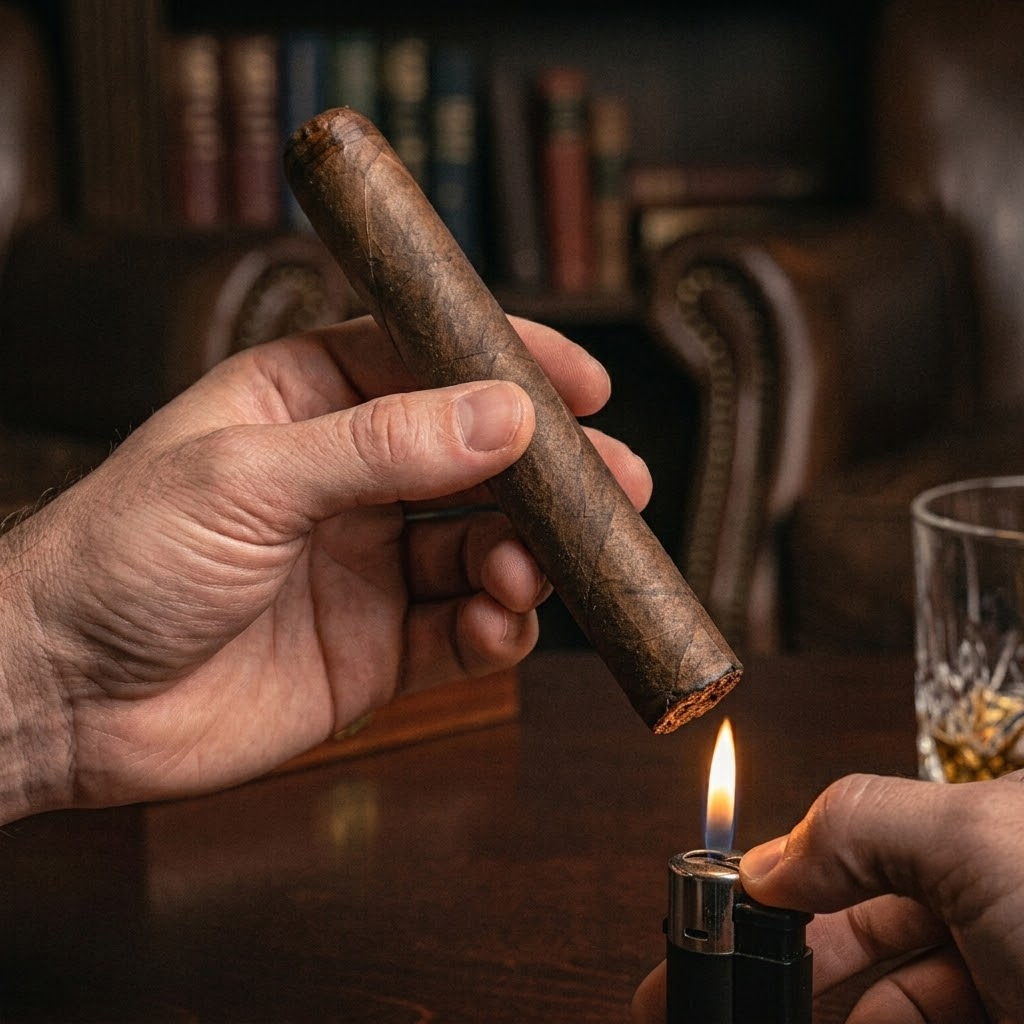
Lighting is done in two stages, and the first stage does not involve your mouth. Hold the cigar at a slight downward angle and bring the flame close beneath the foot without letting the two touch. Rotate the cigar slowly so the whole face of the foot darkens evenly. This is toasting, and it does the real work: it dries and chars the outer ring of tobacco so that when you finally draw, the whole foot catches at once rather than one side racing ahead.
Only then put the cigar to your lips. Draw gently with the flame still held just off the foot and keep turning. A few slow draws are enough. Take the cigar out of your mouth and look at the foot. You are after an even glowing ring all the way round. If one section is dark and cold, bring the flame back to that side for a moment. A soft blow across the foot will show you where the glow is and where it is not.
The choice of flame matters more than the choice of lighter. Butane burns clean. A torch is the quickest and the most forgiving outdoors; a soft flame is gentler and harder to overdo. Long cedar matches or a cedar spill, lit and used as a taper, are the traditional route and a pleasure in their own right. What you do not want is any fluid-fuelled lighter. The fuel taints the foot and the first several draws with it, and no amount of purging gets it out.
A Connecticut wrapper like the Hyde Park’s is thin and pale and shows scorching immediately, so keep the flame further off than instinct suggests. Blackened wrapper at the foot is the tell of an impatient light. The full guide to lighting a cigar covers torch versus soft flame, wind, and the recovery when a light goes lopsided.
- Hold the cigar at a slight downward angle with the flame just beneath the foot, not touching it.
- Rotate slowly until the whole face of the foot has darkened evenly. This is the toast, and it does the real work.
- Now put the cigar to your lips. Draw gently, flame still held just off the foot, and keep turning.
- Take it out and look. You want an even ring of glow all the way round.
- If one section is dark and cold, bring the flame back to that side for a moment. A soft blow across the foot shows you where the glow is.
Butane or cedar, never petrol
Fluid fuel taints the foot and the first several draws with it, and no amount of purging gets it out. A butane torch, a soft-flame butane lighter, or long cedar matches are the only flames worth bringing to a cigar.
03 · The pace
A Draw a Minute
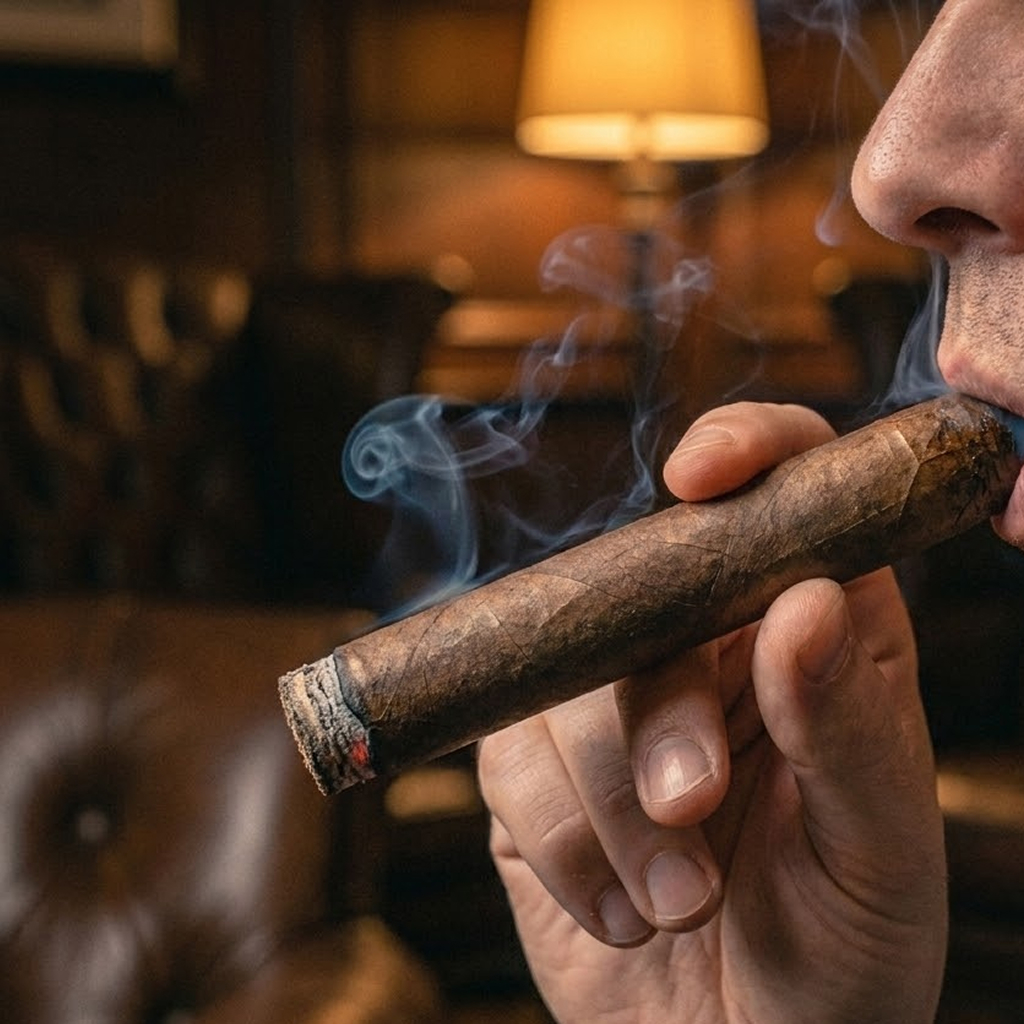
One draw a minute. Three or four seconds, into the mouth and no further.
Here is the rule that fixes most first cigars: one draw a minute. Holt’s puts the acceptable range at one or two puffs a minute with a rest of thirty to sixty seconds between them, and I have never found a reason to argue with it. The draw itself is slow and unhurried, three or four seconds, pulling smoke into the mouth and no further. Hold it there for a moment, notice what it is doing on your tongue, and let it out.
The reason is heat. A cigar is a slow combustion. Draw too often and the coal runs hot; the tobacco begins to scorch rather than smoulder, and the tar and moisture that should be carried away as smoke instead build up in the last inches of the stick. The result is the bitter, acrid, tongue-scalding cigar that convinces people they dislike cigars. In nearly every case, they simply smoked it too quickly.
The draw-a-minute rhythm also protects the second third, which is where a well-made cigar usually does its best work. The Cigarro Method reads a cigar in thirds precisely because the character changes as it burns down, and a first third smoked in a hurry arrives at the second already hot and out of sorts. Slow down early and the middle of the cigar rewards you.
Draw too seldom and the cigar goes out, which is a lesser sin and an easy one to correct. A cigar left alone will not keep burning beyond a couple of minutes. If you have been talking, or the spirit has been particularly good, give it a gentle draw before the coal fades entirely. If it has gone out, we will come to that.
Cigar Aficionado’s tasting note on the Hyde Park is vanilla, bread and sweet spice, and at a draw a minute that is roughly what I get too, with the bread turning a little toastier through the middle. Smoked at twice the pace, on the evenings I have hurried one, the same cigar has gone papery and sharp by the halfway mark, with none of that sweetness left to find.

04 · The retrohale
Never Inhale, Retrohale
The one rule with no exceptions
Cigar smoke is never inhaled. Into the mouth, held a moment, released. Inhale it as you would a cigarette and you will cough, feel dizzy quickly, and taste nothing the blender intended. More in our FAQ on whether you inhale cigars.
Cigar smoke is not inhaled. This is not etiquette, it is the whole design of the thing. A cigar is fermented tobacco with a great deal of nicotine and body in the smoke, and it is built to be tasted on the palate and released, not drawn into the lungs. Inhale a cigar as you would a cigarette and you will cough, feel dizzy in short order, and taste none of what the blender intended. We answer the question at more length in our FAQ on whether you inhale cigars, but the answer is no, and it is the one rule in this piece with no exceptions.
Not inhaling does not mean no nicotine. Nicotine is absorbed through the lining of the mouth, more slowly than through the lungs but very much for real, which is why a cigar can leave you queasy without a single lungful. Cigar Advisor’s piece on what enthusiasts call being nic-sick describes it plainly: too much nicotine reaching the bloodstream, nausea, dizziness, a headache. It is also the whole reason the advice to eat first and to keep something sweet nearby keeps appearing in this guide. Pace is the prevention; sugar is the cure.
Draw the smoke into your mouth, let it sit for a second or two, and let it out. That is the entire mechanic. The tongue does a little of the tasting. Most of what we call flavour is actually aroma, picked up by the nose, and that is where the retrohale comes in.
Retrohaling means sending a little of the smoke out through the nose instead of the mouth. Cigar Advisor describes the mechanics best: draw the smoke into your mouth and close your lips; hold your breath; then open the back of your throat and let the breath you are already holding push the smoke up and out through the nose. The smoke never goes down. It rises through the nasal passage, where the olfactory receptors that do the fine work of tasting sit, and they light up in a way the tongue cannot. It is the difference between “tastes of cigar” and “there is cedar and a little white pepper on the finish.”
Start small. Retrohale a fraction of the mouthful, not the whole thing, and do it on a mild cigar first. A full-bodied Nicaraguan retrohaled in its entirety will make your eyes water and teach you nothing. On something like the Hyde Park the retrohale is gentle, faintly sweet, and rather pleasant, which is exactly why a Connecticut is the right cigar to learn on. The practice deepens considerably in the full guide to tasting a cigar, where the retrohale becomes one of the tools of the trade rather than a party trick.
Ash, Band and Touch-ups
Leave the ash alone. The instinct from cigarettes is to tap constantly, and it is precisely wrong for a cigar. Let the ash build to roughly an inch, and up to two on a well-made stick, before gently rolling or tapping it off against the edge of the tray. A column of ash insulates the coal and holds its temperature steady, which keeps the burn even and the smoke cool. Flick it away every few draws and the exposed coal runs hotter and the burn wanders.
Two things about ash worth separating, because the counter folklore runs them together. A long, firm ash that holds an inch without complaint is a fair sign of good construction; the bunch was packed evenly and the roller knew the trade. The colour of the ash is a different story and it is a story about soil, not skill. Cigar Aficionado’s glossary puts it plainly: a bright white ash indicates tobacco grown in soil with ample magnesium, while a black ash may point to soil short of nutrients. A pale ash tells you where the leaf grew. It does not tell you the cigar is good, and some of the finest cigars I have smoked left an ash the colour of a rain cloud.
The band stays on until the cigar is well under way. The reason is practical rather than ceremonial: the band is glued to the wrapper, and on a cold cigar the glue can take a shred of leaf with it. Once the cigar has burned for a while the warmth softens the adhesive and the band slides off cleanly. The usual guidance is to wait until the ash is within an inch or so of the band, or simply until past the halfway point; either works. Slide, do not peel. If it resists, leave it another ten minutes.
Burns go uneven. It happens to good cigars in good hands, and the corrections are quick. If one side of the foot is burning faster than the other, the cigar is “canoeing.” Rotate so the lagging side sits uppermost and give it a minute or two; if that does not level the burn line, touch the flame briefly to the slow edge. Cigar Advisor also offers the old counter trick of dabbing the fast-burning edge with a fingertip of saliva to hold it back while the slow side catches up; it works better than it sounds, and if the idea does not appeal, the lighter does the same job a little less elegantly. If instead the filler burns ahead of the wrapper and leaves a hollow at the centre, that is “tunnelling.” The wrapper is refusing to burn, and Cigar Advisor lists the usual reasons: a wrapper holding more moisture than the filler, a gap between wrapper and binder from the roll, too much binder, or a pace so slow that the long ash insulates the core while the wrapper goes cold. A slightly brisker pace for a few minutes and a touch-up around the rim of the foot will usually bring the wrapper back into line. Behind all of it, the single best prevention is the toasting stage earlier, which is why it deserves the patience it asks for.
One more tool, rarely explained: the purge. If a cigar has turned harsh or bitter mid-way, take it from your mouth and blow gently outward through it, from head to foot, a few times. This clears the stale smoke and accumulated tar sitting in the last inches and often restores the flavour entirely. It is also the first step before any relight, and a small habit that rescues a surprising number of evenings.
| What you are seeing | Why | What to do |
|---|---|---|
| One side of the foot burning ahead (canoeing) | A poor initial light, or uneven density in the bunch | Rotate so the lagging side sits uppermost; if it does not catch up in a minute or two, touch the flame to the slow edge for two or three seconds, or dab the fast edge with a fingertip of saliva to hold it back |
| Filler burning ahead of the wrapper, a hollow at the centre (tunnelling) | The wrapper is damper than the core, a gap in the roll, or the pace has dropped so low the wrapper stops burning | Pick the pace up for a few minutes and touch the flame around the rim of the foot |
| Smoke gone harsh or bitter mid-cigar | Stale smoke and tar collecting behind the coal | Purge: blow gently outward through the cigar, head to foot, two or three times, then slow down |
| Band will not shift | The adhesive is still cold | Leave it another ten minutes. Slide, never peel |
Going Out, Relighting, Letting Go
Cigars go out. Conversation runs long, the wind picks up, the draw was one minute too lazy. It is not a failure and there is no need to hurry. Knock off any loose ash, purge the cigar with two or three gentle outward blows, and then toast and light the foot exactly as you did the first time, turning it to get the ring glowing evenly. The first draw or two after a relight can taste a little flat; the third is usually back to itself. The full guide to relighting a cigar covers the fine points, including what to do when the foot has gone ragged.
There is a limit, and it is time. A cigar relit within the same sitting is fine. A cigar put down half-finished and picked up the next day is a different and worse thing: the stale smoke and tar left in it overnight make the relit half taste stale, as Holt’s puts it, and the last inches were already the least generous part of the cigar. If you cannot finish it tonight, let it go. The Hyde Park is not a costly cigar, and the lesson is cheaper than the evening you would spend forcing it down.
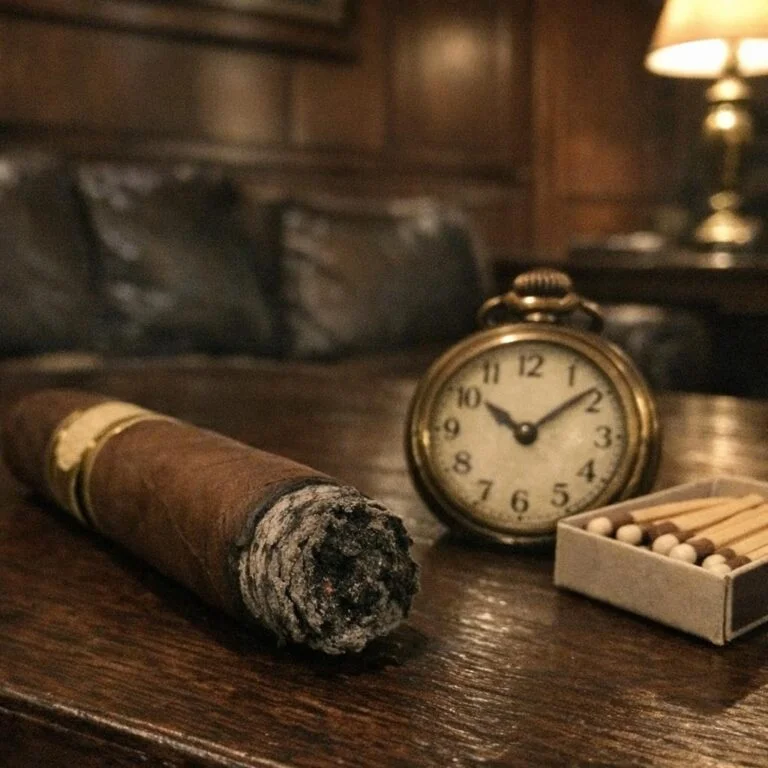
When you are finished, do not stub it out. This is the last habit borrowed from cigarettes and the most unpleasant one. Crushing a cigar in the tray forces a plume of acrid smoke out of the tobacco and fills the room with it. Set the cigar down in the tray and leave it. Without a draw, it will go out on its own within a couple of minutes.
As for when to stop, the honest answer is: when it stops being good. There is no rule that obliges you to smoke to the nub, and none that forbids it. Cigar Aficionado’s guidance is that flavour commonly turns with roughly a third of the cigar remaining, as moisture and tar collect near the head and the smoke grows hot and bitter, though plenty of cigars stay generous well past that point. The moment the cigar turns hot or harsh on the tongue is the moment to set it down, and it is nobody’s business but yours how much was left.
- Knock off any loose ash, so you are lighting tobacco rather than ash.
- Purge: blow gently outward through the cigar, head to foot, two or three times, to clear the stale smoke sitting behind the coal.
- Toast the foot again exactly as you did the first time, flame just off, turning slowly until the face darkens evenly.
- Draw gently, still turning, until the ring glows all the way round.
The first draw or two may taste flat; the third is usually back to itself. None of this applies to a cigar left overnight.
How Long It Takes
The question every first-timer asks, and rarely aloud, is how long they are committing to. The honest answer is that it depends on pace far more than on size, and the published figures prove it by disagreeing with each other. Holt’s, assuming an unhurried cadence, gives a 5 by 50 Robusto 45 to 50 minutes, a 6 by 52 Toro 55 minutes to an hour, a 7 by 49 Churchill about an hour, and a 7.5 by 52 Double Corona 75 minutes and upward. Cigar Aficionado’s glossary, working from a brisker draw, puts the same Robusto at 20 to 30 minutes and a 7.5 by 50 Double Corona at a little over an hour. Neither is wrong. They are describing different evenings.
| Vitola | Typical size | Holt’s figure | Cigar Aficionado figure | Plan on |
|---|---|---|---|---|
| Corona | 5.5 to 6 in x 42 to 44 | not given | not given | 40 to 50 minutes at a draw a minute |
| Robusto | 4.75 to 5.5 in x 48 to 52 | 45 to 50 minutes (5 x 50) | 20 to 30 minutes (5 x 50) | 45 to 60 minutes |
| Toro | 5.625 to 6 in x 46 to 50 | 55 to 60 minutes (6 x 52) | not given | an hour |
| Churchill | 7 in x 47 | about an hour (7 x 49) | not given | 90 minutes and often longer at a draw a minute |
| Double Corona | 7.5 in, as sized by each source below | 75 minutes and upward (7.5 x 52) | over an hour (7.5 x 50) | 90 minutes to two hours |
Corona, Robusto, Toro and Churchill sizes are Cigar Aficionado’s ranges; the Double Corona dimensions are those quoted by each timing source. The two published columns assume different cadences, which is why they disagree; the “plan on” column is my own count at one draw a minute and is an extrapolation, not a published figure.
At a strict draw a minute, my own count sits closer to Holt’s on the small sizes and well past both on the large ones. A Churchill, the classic 7 inches by 47 in Cigar Aficionado’s sizing, is a 90-minute cigar for me and often longer, and I would not plan a Churchill around anything less. The reason a strict cadence stretches a Churchill more than a Robusto is simple arithmetic: at a draw a minute every extra inch of tobacco is another twenty or so draws, and a Churchill carries two inches more than a Robusto. For the Hyde Park’s 5.5 by 49, sitting between the Robusto and Toro figures, call it 50 minutes to an hour, and treat that as an extrapolation rather than a published number.
A faster pace shortens the clock and worsens the cigar; a slower pace lengthens it and improves it, right up to the point where the thing goes out. If you want the deeper answer, with the arithmetic of ring gauge and the reasons a fat short cigar can outlast a thin long one, our FAQ on how long it takes to smoke a cigar has it.
First-Time Nerves
Every experienced person in the lounge has had a first cigar, and most of us made at least two of the mistakes above on the same evening. Nobody is watching you, and the ones who are will be glad you came. The short list follows, in the order you will need it.
- Eat first.
- Sit down and give it an hour.
- Choose something mild and no larger than a Robusto.
- Cut a sliver at the shoulder, not a slab.
- Toast the foot before you draw.
- Draw once a minute, into the mouth, never the lungs.
- Let the ash grow to an inch before you touch it.
- Leave the band on until the cigar is warm.
- If it goes out, purge and relight.
- If it turns harsh, purge; if it stays harsh, set it down.
- When you are done, leave it in the tray and let it go out on its own.
Keep a sweet drink within reach. The counter wisdom I was taught is the same advice Holt’s gives on nicotine queasiness: sugar, whether a cube in a coffee, a square of chocolate or a soft drink, brings you back quickly, and the surest prevention is having eaten. Water alongside whatever else you drink keeps the palate fresh and the pace honest.
And take a note. Not a review, not yet. Just the cigar, the date, and one sentence on what it did. The second cigar is better than the first almost entirely because you remember the first.
Questions From the Counter
Keeping the Record
That note is where Cigarro comes in, quietly. Cigarro keeps your humidor and your smoking log in one place: which cigars you own, when they went in, and what each one was like when it came out. Log the Hyde Park tonight with a line or two, and the next time you stand at a counter you will know whether Connecticut Shade is your lane or a stepping stone to something with more body.
When you are ready to go beyond a sentence, The Cigarro Method is our review-by-thirds framework: one reading in each third, construction and draw in the first, the transition and the retrohale in the second, the finish and the verdict in the third. It maps directly onto the rhythm described in this piece, which is no accident. Smoke a cigar properly and you have already done most of the work of reviewing it. All that remains is to write it down.
Tonight's note
The cigar, the date, and one sentence on what it did. Log it in Cigarro and the next one starts from memory rather than from scratch.
Take Your Time
There is nothing in any of this that requires talent. The cut is one motion, the light is two, and the rest is a matter of doing less than you think you should: drawing less often, tapping less, fussing less, and leaving the cigar to burn at the speed it was built for. Do that with a mild Connecticut on a full stomach and an hour to spare, and the first one will go well enough that you will want a second.