Every skill in this hobby sits downstream of one unglamorous habit. Cutting well, lighting well, tasting well, resting with intent: all of it assumes the cigar you pick up is the cigar the roller handed over, and that assumption is bought with storage. Storing cigars is the business of holding two numbers steady and keeping the box dark. The numbers are humidity and temperature; the discipline that joins them is stability. A cigar kept between 65 and 72 percent relative humidity, below about 21 degrees Celsius, and away from sunlight will wait for you for years.
The same cigar left on a desk in an air-conditioned room can begin drying within the hour. That asymmetry is the whole argument for taking storage seriously before anything else. Nothing you learn from The Cigarro Method survives contact with a stick that has spent a fortnight on a bookshelf.
What follows is the whole of it: the targets that matter, the honest ladder of storage options from sandwich box to cabinet, what to do in the first thirty days, how to hold cigars safely when there is no humidor in sight, and the familiar mistakes that quietly ruin more cigars than any beetle ever has.
Why Storage Comes First
A premium cigar is a piece of agriculture, not a manufactured good. The wrapper, binder and filler were grown, fermented and rolled at a particular moisture level, and everything a blender intended, the draw, the burn line, the way the flavours open across the thirds, depends on the cigar staying near that level until you light it.
Tobacco gives up its moisture readily. Gary Korb at Cigar Advisor puts the timeline bluntly: in a warm or air-conditioned room, an unprotected cigar can begin drying out in as little as an hour, and will only hold its condition for the better part of a day. Not weeks. Not a few days on the sideboard while you decide on an occasion. Hours.
What drying costs you is not subtle. To my palate a dried-out cigar smokes hot and short, and the delicate top notes go first, leaving the bitterness behind. The physical damage is just as real. Wrapper leaf expands and contracts as conditions swing, and the thin, supple leaves prized on elegant cigars, Connecticut Shade above all, split rather than stretch. A cracked wrapper is not a cosmetic problem; the draw goes loose and ragged as air sneaks in through the split, the burn wanders after it, and the wrapper unravels in the hand.
The good news is that storage is the cheapest skill in the hobby to get right. A twenty-dollar setup done properly beats a two-hundred-dollar humidor done carelessly, and the habit, once built, costs you a glance a week.
Two Numbers and One Habit
Humidity. The counter wisdom for decades was the 70/70 rule: 70 percent relative humidity at 70 degrees Fahrenheit. It remains the most commonly quoted protocol, and it works. Most experienced smokers I trust have drifted lower. Boveda, who make the two-way packs half the hobby relies on, put the acceptable band at 65 to 72 percent and call 69 the most preferred point for premium cigars, with 65 suiting those who like a drier, quicker-burning smoke or who are aging boxes long term. Where you settle inside that band is taste. Outside it, you are gambling. The full picture of what relative humidity does to tobacco lives in our cigar humidity guide.
Temperature. Cooler than you think, and never hot. Keep the box below 21 degrees Celsius, 70 Fahrenheit. This is less about flavour than about what heat awakens: the tobacco beetle. Eggs laid in the leaf can hatch when the temperature inside a humidor climbs past 72 Fahrenheit, per Cigar Aficionado. A beetle outbreak announces itself as neat pinholes through your best sticks. If you ever find them, the collection is not lost. Holt’s protocol works: bin the visibly damaged cigars, seal the rest in bags, give them three days in the freezer to kill eggs and larvae, then a day in the fridge on the way back out so the warming is gradual, and inspect every neighbour before anything returns to the shelf. Better, though, to let a cool room make the whole question academic.
Stability. The quiet third variable, and the one that separates careful storage from anxious storage. Cigars respond badly to fluctuation. Each swing in humidity or temperature makes the tobacco expand and contract, and enough cycles will crack a wrapper that a steady environment would have preserved for a decade. A shelf that holds 66 percent all year is better than one that oscillates between 64 and 72. Pick a point in the band, hold it, and stop fiddling. And give the whole arrangement darkness; sunlight is the one hazard you remove entirely by choosing the right shelf on day one.
The targets, at a glance
Humidity: 65 to 72 percent RH, 69 the sweet spot, 65 for drier smokes and long aging.
Temperature: below 21 C (70 F); beetle risk climbs past 22 C.
Stability: pick one point in the band and hold it all year.
Light: dark storage, always; direct sun fades and cracks wrappers.
01 · The honest start
The Tupperdor
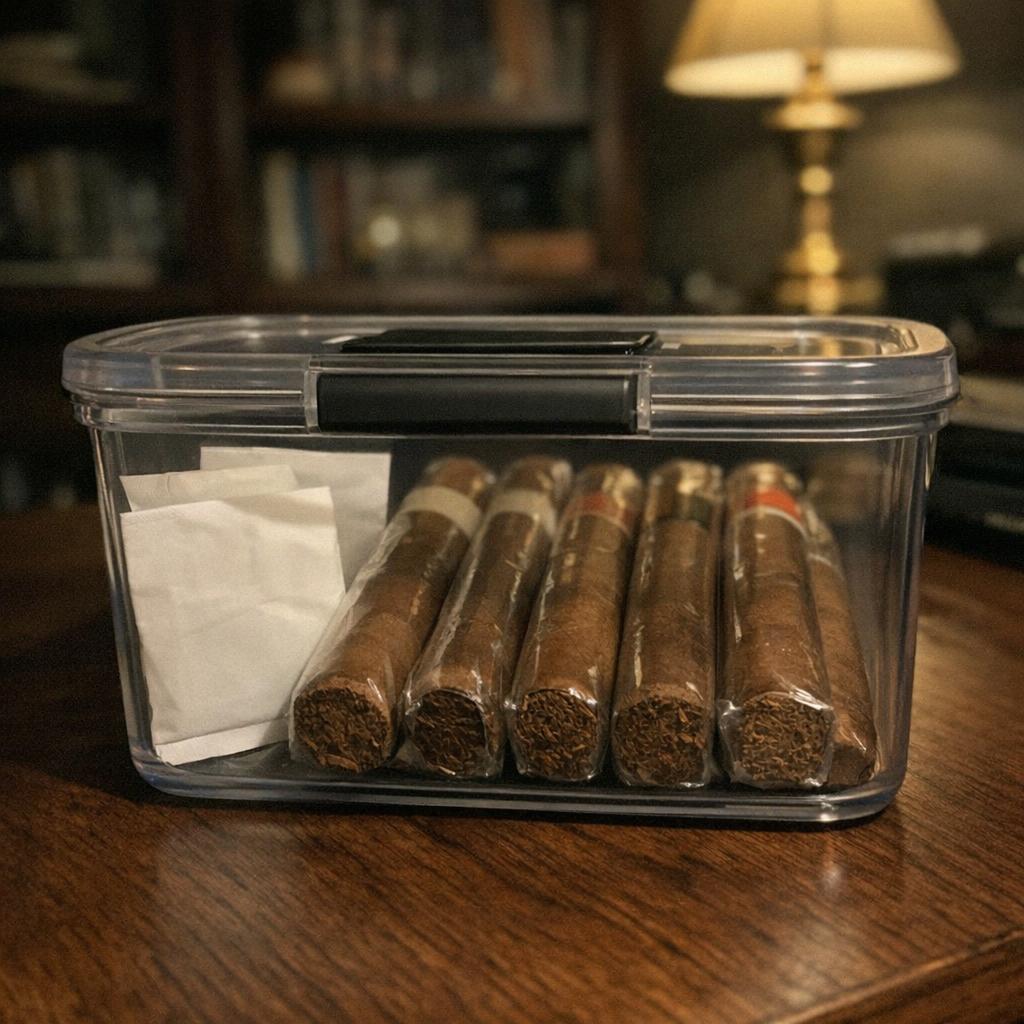
A food-grade container with an airtight lid, two-way humidity packs sized to the count, and your cigars still in their cellophane. That is the entire build, it costs less than twenty dollars, and it is not a compromise to apologise for. The American tobacconist Holt’s recommends the tupperdor without a blush.
Sizing is Boveda’s own arithmetic: one large 60-gram pack for every 25 cigars the container could hold, rounding up, and never a mix of different humidity ratings in the same box. Running more packs than the minimum does no harm; they share the work and last longer.
The physics are on your side. Two-way packs hold a printed humidity level by releasing moisture when the air is dry and absorbing it when the air is damp, and they work best in exactly this setting: a sealed environment with no leaks to fight. Boveda packs last longer in an airtight tub than they do in any wooden box. There is no seasoning, no calibration, no learning curve. Fill it, close it, put it somewhere cool and dark.
The trade-offs are aesthetic and social rather than functional. A plastic tub brings none of the cedar aroma that a proper humidor slowly lends its residents, and nobody has ever felt a small thrill lifting the lid of a sandwich box. But your cigars do not know the difference, and a tupperdor that holds 69 percent is better storage than a handsome humidor that cannot hold anything at all.
Plastic is not cedar; it does not breathe at all. So follow Holt’s advice and unseal the lid every few weeks to let the cigars air briefly, then close it and leave it alone.
- Step 1. Choose a food-grade container with a genuinely airtight lid; wash with mild soap, dry fully, let the plastic smell air off.
- Step 2. Add 69 percent two-way packs, one 60-gram pack per 25 cigars of capacity, rounding up; never mix humidity ratings in one container.
- Step 3. Load the cigars with cellophane left on.
- Step 4. Seal the lid and place the tub somewhere cool and dark.
- Step 5. Unseal for a brief airing every few weeks, then reseal and leave it alone.
02 · The desk upgrade
The Desktop Humidor
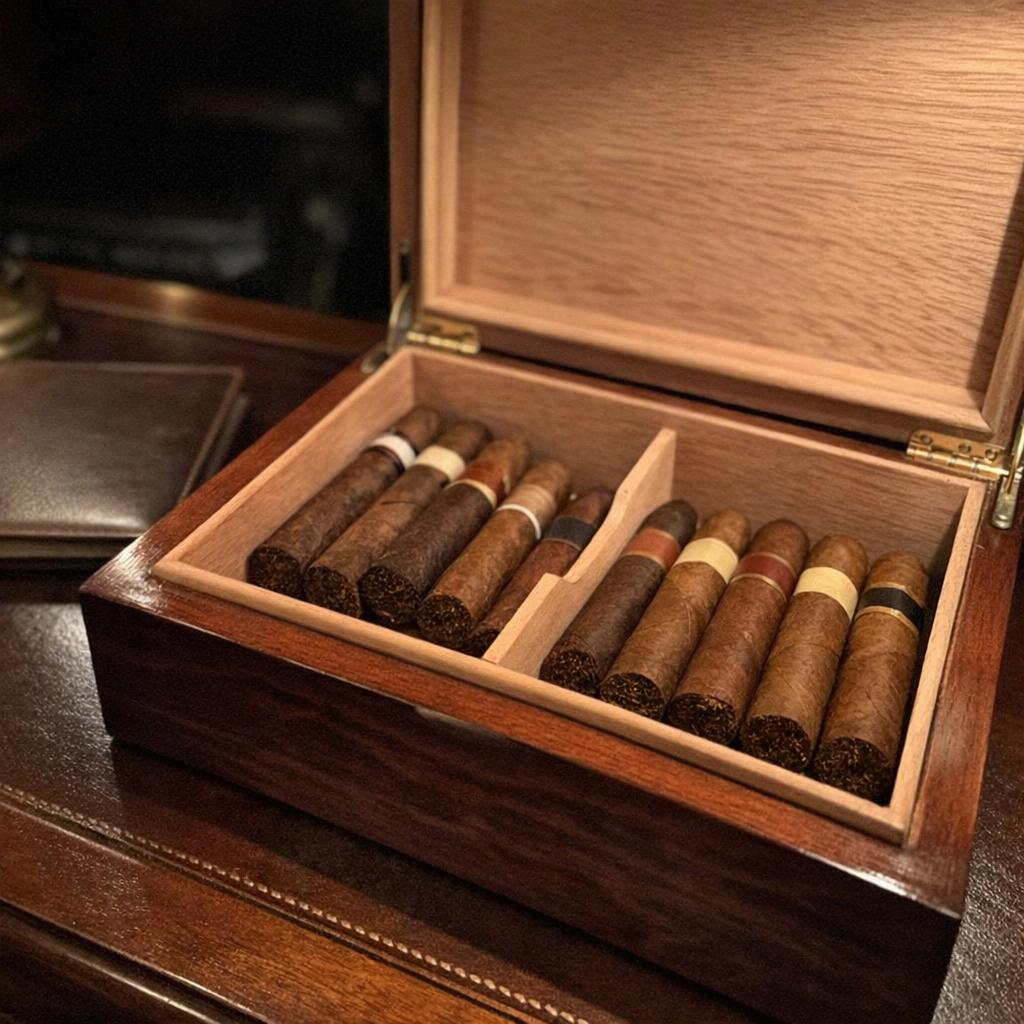
The classic wooden box, usually holding somewhere between 25 and 100 cigars, and the point where storage starts to feel like part of the pleasure rather than a chore. The wood that matters is inside: Spanish cedar, the traditional lining, absorbs and releases moisture through its porous grain, buffering the interior against the small daily swings that plastic cannot soften. It lends a gentle aroma the hobby has long prized, and it carries an old reputation, passed down rather than proven, for discouraging tobacco beetles.
The catch is that a wooden humidor arrives dry, and dry cedar is thirsty. Load cigars into an unseasoned box and the wood will pull moisture out of them for weeks. Seasoning fixes this: high-humidity 84 percent packs sit in the closed, empty box for a full fourteen days while the cedar drinks its fill. Resist the folk advice about wiping the interior with distilled water; Boveda warns it can warp and crack the wood and invites mould. The patient method, and the full walkthrough, lives in our guide to seasoning a humidor.
What keeps the box humid day to day is the part the brochure glosses over. The sponge-style puck fitted inside most humidor lids is the weakest component in the package; my own practice is to retire it on day one, run the same two-way packs inside the seasoned box, sized to the count exactly as in the tupperdor, and let the cedar handle the buffering.
Be equally unsentimental about measurement. The analogue dials fitted to most humidors drift, and Holt’s puts the common error at ten percent, wider than the entire acceptable band. A small digital hygrometer is the more accurate instrument, and either way, calibrate against a known reference, the old salt test or a purpose-made 75 percent kit, before you trust a single reading.
03 · The long game
The Cabinet
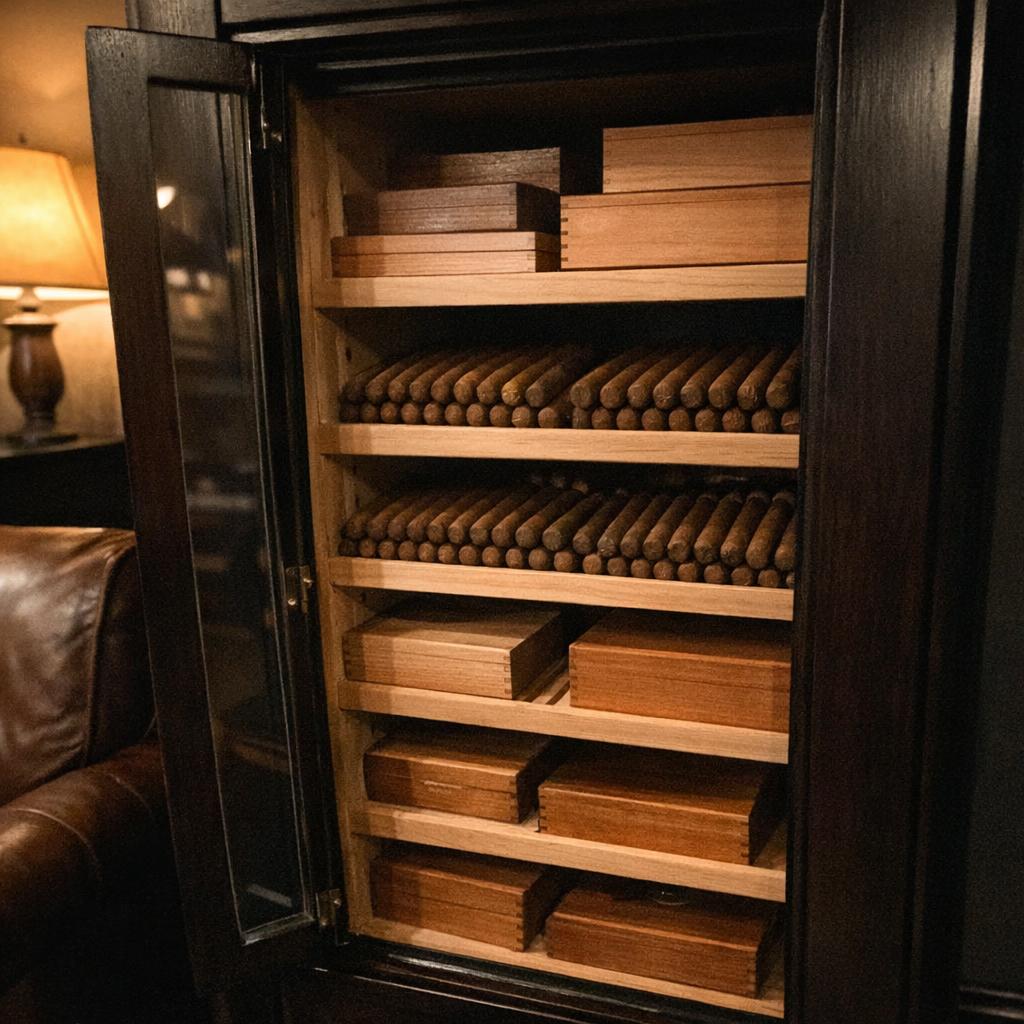
Sooner or later a collection outgrows its desk. The signs are familiar: boxes stacked on top of the humidor rather than inside it, singles wedged at diagonals, the lid closing with a press rather than a sigh. The answer at scale is the cabinet, a piece of furniture with cedar shelving and room for whole boxes, or its unglamorous cousin the coolerdor, a large insulated cooler run on the same airtight logic as the tupperdor, several rungs up in volume.
Scale changes the job. A cabinet holds more air, more wood and more tobacco, so it moves slowly; it takes longer to season, longer to recover after the door has been open, and longer to drift out of range when something goes wrong. Slow is good. Slow is stability by construction, and it is what serious aging programmes want: a box resting undisturbed at the back of a stable cabinet is as close to ideal conditions as most of us will manage outside a factory aging room.
Two pieces of hardware earn their keep at this rung. Passive packs still work, but a cabinet’s volume favours an electronic humidifier that pushes conditioned air around the shelves rather than waiting for it to wander. And if the room itself runs warm, the answer is the cooling cabinet, a thermoelectric case built for cigars that holds the temperature below the beetle line whatever the season is doing outside the glass.
At this size, storage becomes curation. Whole boxes rest sealed on the lower shelves while the working rotation sits at eye level, and knowing what is where stops being a memory exercise. Our system for organising a humidor scales to a cabinet without modification; the shelves simply get roomier.
| Rung | Capacity | Prep before the first cigar | Routine upkeep | Best suited to |
|---|---|---|---|---|
| Tupperdor | 25 to 75 cigars | wash, dry, add sized packs | brief airing every few weeks, packs swapped when they stiffen | first boxes and overflow |
| Coolerdor | 150 plus | wash, air out, add sized packs | seasonal pack swaps | bulk resting on a budget |
| Desktop humidor | 25 to 100 | fourteen-day seasoning plus a calibrated digital hygrometer | a glance a week, packs when they stiffen | the working rotation |
| Cabinet | whole boxes by the shelf | long seasoning, placement out of the sun | monthly checks, electronic humidification | aging programmes and deep collections |
The First Thirty Days
However far up the ladder you start, the first month follows the same shape: prepare the environment, introduce the cigars, then leave everything alone.
For a wooden box, preparation means the full fourteen-day seasoning and a calibrated hygrometer before a single cigar goes in. For a tupperdor it means nothing more than the right packs. Either way, new arrivals have had a rough week: shipped through changing climates, rattled in vans, walked home through winter air or summer heat. They need time to settle at your humidity before they show you their best. That settling period is called resting, it is the difference between a good first impression and a false one, and it has a guide of its own.
Your only job in these weeks is a light touch. Check the reading when you pass, note the trend rather than the moment, and resist the urge to open the lid daily to admire your discipline; every opening lets the equilibrium out. By the end of the first month a well-set-up shelf will have found its level and will hold it with almost no help from you. If it has not, the culprit is one of three things, and after enough counter conversations I check them in this order: the gauge, which lies more often than anything else in the hobby; the seal; and only then the seasoning.
- Day 0: season the box (or size the packs) and verify the gauge against a salt test or calibration kit.
- Day 1: load the cigars and log each one.
- Weeks 1 and 2: read the gauge in passing; the lid stays shut.
- Weeks 3 and 4: confirm the shelf holds one point inside the band.
- Still drifting: check the gauge first, then the seal, then the seasoning.
Caught Without a Humidor
Every enthusiast is eventually handed cigars with nowhere proper to put them. A wedding favour, a generous friend, a shop visit that ran ahead of the storage at home. The short-term answer is a zip-seal freezer bag, the sturdiest you can find, with a 69 percent two-way pack inside. Squeeze the excess air out, seal it, and put the bag somewhere cool and dark, a drawer or a wardrobe shelf well away from sun and radiators. Done promptly, this holds cigars in honest condition for weeks, which is more than enough time to arrange something permanent.
Leave the cellophane on. Cello is not the vacuum seal it appears to be; the sleeve is porous, humidity passes through it, and it adds a layer of physical protection against the knocks that crack wrappers. There is no need to undress a cigar for storage, whatever the shop’s display shelf might suggest.
What the bag does not buy you is time to forget. The clock that matters is the one from earlier: an unprotected cigar starts giving up moisture within hours, so the bag needs to happen the day the cigars arrive, not at the weekend. And if the gap between purchase and proper storage is measured in a day or two, a closed bag in a cool drawer will carry them across it without drama, pack or no pack.
- A heavy zip-seal freezer bag.
- One 69 percent two-way pack inside.
- Excess air squeezed out, bag sealed.
- A cool dark drawer, away from sun and radiators.
- Done the day the cigars arrive, not at the weekend.
The Familiar Mistakes
The same handful of errors accounts for most of the cigars ruined in domestic storage, and every one of them is avoidable on the first day.
The windowsill humidor. A handsome box deserves to be seen, and the windowsill is where handsome things get put. It is the worst location in the house. Direct sunlight fades wrapper leaf, and the daily heat cycle behind glass swings the interior through exactly the expansion and contraction that cracks wrappers. Cigar Aficionado’s storage advice is blunt on the point: keep humidors out of the sun and away from temperature extremes. An interior shelf, a cupboard, a cool corner of the study; anywhere the light does not land.
The refrigerator. The most persistent myth in the hobby, presumably because it works for lettuce. A fridge runs at roughly 42 percent relative humidity, far below the 65 to 72 a cigar needs. The cold stalls the slow marrying of flavours that storage is meant to allow, and the air carries every odour in the crisper drawer straight into the tobacco. Holt’s verdict is the right one: cigars do not belong in the fridge, full stop.
The forgotten travel handful. Three sticks pulled for a golf weekend, zipped into a case pocket, remembered in October. The case protected them from crushing; it did nothing for moisture. Assume any cigar that has spent more than a day or two outside humidification is compromised, and give survivors a long rest at proper humidity before judging them.
The hot-room shelf. The loft office, the conservatory, the car boot in July. Anywhere that sits above 22 degrees Celsius for long is beetle territory, and no humidity pack can help with that. Cool first, then humid; the order of priorities is not negotiable.
The soaked sponge. Drowning is as real as drought. Push a shelf past 72 percent, usually by over-charging a humidifier or trusting a lying gauge, and Holt’s warning applies: the burn goes uneven, the draw tightens as the tobacco swells, and the door opens to mould. Blue-green fuzz at the foot or under the band is the confirmation. Isolate anything it touches, bin the visibly affected sticks, and dry the box gently back into the band before restocking. If a white dusting brushes off clean without a mark, you may be looking at rare and harmless plume; our guide to telling plume from mould gives you the sixty-second test, and until it passes, treat every spot as mould.
A Shelf You Can See
There is one more storage discipline worth building early, and it needs no cedar at all: knowing what you own. Every collection past its first dozen sticks starts generating questions. Which box has had six months of rest? Which singles were bought for aging and which for Friday? What did last winter’s damp spell actually touch? A physical shelf holds the cigars; it does not hold the answers.
A physical shelf holds the cigars; it does not hold the answers.
This is the gap Cigarro was built for. The digital humidor mirrors the physical one: each cigar logged with its dates, its resting time visible at a glance, notes attached to the stick rather than to your memory. When a box comes out of the cabinet a year on, the record of why it went in is waiting. The free Pocket Humidor tier holds thirty entries, which covers most desktop humidors with room to spare, and moving up from there costs less than a single decent robusto a month.
The habit takes seconds per cigar. Log it when it goes in, note it when it comes out, and the shelf becomes something better than tidy: it becomes legible.
Questions From the Counter
Kept Well
Storage is patience made physical. Nobody sees it done well; there is no ceremony in a closed lid holding 68 percent on a Tuesday, no applause for the cigar that did not crack. The reward arrives later, on the evening you finally reach for the stick you put away in spring and find it exactly as generous as you hoped, and rather more composed than you remembered. Get the shelf right and every cigar you ever buy inherits the favour.