By Hugh Ashby · Updated September 2026
If you want the short answer: under ten dollars, the Punch Gran Puro Santa Rita is the most cigar per coin on the shelf, the Baccarat Rothschild is the gentle everyday, and the Alec Bradley Prensado Robusto is a former Cigar of the Year that never left the bargain end. Between ten and twenty, the Oliva Serie V Melanio Robusto and the Padrón 1964 Anniversary Exclusivo are the two most people would still buy at twice the money.
Twelve picks follow, six in each band, every one of them a long-filler cigar currently in production. Prices are given as ranges in US dollars because that is the market with the deepest published pricing, and because a single figure would be a fiction. Prices vary by retailer, by state and by month. Canadian prices run materially higher: federal excise duty on cigars is charged at the greater of a per-cigar minimum or eighty-eight percent of the duty-paid value, and provincial tobacco tax and sales tax stack on top of that. A cigar that costs two and a half dollars in Florida can sit near nine at a Canadian counter for the same stick in the same size. Read the bands as relative, not as a quote.
| Cigar | Vitola | Band | Approx. price (USD) | Body | Best for |
|---|---|---|---|---|---|
| Quorum Shade | Robusto, 4.75 x 50 | Under $10 | $2.45 to $2.55 | Mild to medium | The bundle you leave by the door |
| Baccarat The Game | Rothschild, 5 x 50 | Under $10 | $5.00 to $7.00 | Mild | The gentle everyday |
| Punch Gran Puro | Santa Rita, 4.5 x 52 | Under $10 | $5.30 to $6.85 | Medium to full | Most cigar per coin |
| Charter Oak Habano | Rothschild, 4.5 x 50 | Under $10 | Around $6.50 | Medium | Boutique blending at bundle money |
| Rocky Patel The Edge Corojo | Toro, 6 x 52 | Under $10 | $7.50 to $8.00 | Full | A long, strong evening |
| Alec Bradley Prensado | Robusto, 5 x 50 | Under $10 | $9.00 to $9.20 | Medium to full | A former Cigar of the Year |
| Arturo Fuente Hemingway | Short Story, 4 x 49 perfecto | $10 to $20 | $8.00 to $12.50 | Medium | The forty-minute classic |
| Aging Room Quattro Nicaragua | Maestro, 6 x 52 box pressed | $10 to $20 | $10.65 to $10.95 | Full | Award pedigree at ten dollars |
| My Father Le Bijou 1922 | Torpedo, 6.125 x 52 box pressed | $10 to $20 | $10.50 to $13.00 | Full | Nicaraguan power, properly built |
| E.P. Carrillo Pledge | Prequel, 5 x 50 box pressed | $10 to $20 | $12.00 to $14.00 | Full | The modern benchmark |
| Oliva Serie V Melanio | Robusto, 5 x 52 | $10 to $20 | Around $15.00 | Medium to full | The one nobody argues with |
| Padrón 1964 Anniversary | Exclusivo, 5.5 x 50 box pressed | $10 to $20 | $16.40 to $18.00 | Full | The top of the band |
Typical single-cigar prices at large US online retailers in September 2026. Prices vary by market, and Canadian prices run higher because of duty and provincial tax.
What Twenty Dollars Actually Buys
Twenty dollars is a generous ceiling in 2026, and that is worth saying plainly because most price-point lists pretend otherwise. Under it sits nearly every cigar an enthusiast smokes on an ordinary Tuesday, including several that have won the trade’s biggest annual awards. Above it you are buying rarity, age, or a name, and sometimes all three. The cigars that live between ten and twenty dollars are not the compromise tier. They are the tier.
Ten dollars is the more interesting line. Below it the shelf thins, and thins honestly: fewer aged wrappers, fewer box presses, fewer of the small manufacturing courtesies that cost a factory real money. What survives is usually a house that owns its own tobacco, an older blend that has finished paying for its development, or a bundle built deliberately without the packaging. All three are good reasons for a cigar to be cheap. None is a reason for it to be bad.
Everything below is quoted in US dollars because that is the market with the deepest published single-stick pricing. If you buy in Canada, the UK, Australia or most of Europe, add duty and tax and expect a different number entirely. My own shelf is priced in Canadian dollars and I have made peace with it.
Long Filler, Short Filler
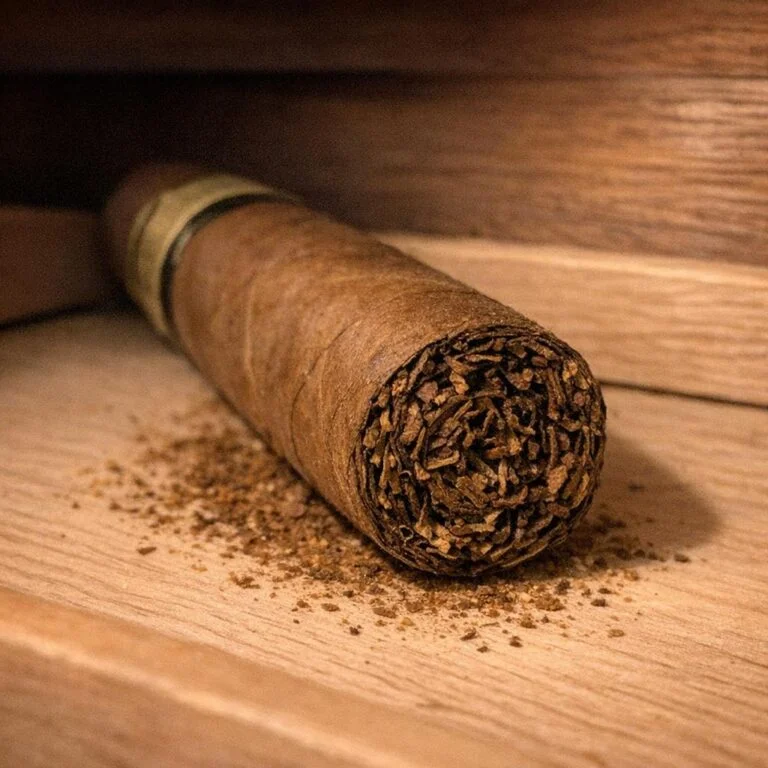
The single most useful distinction at this end of the shelf is filler. A long-filler cigar is built from whole leaves running the length of the cigar, cured, fermented and aged, then bunched by hand. A short-filler or mixed-filler cigar uses chopped tobacco, the offcuts and scrap the trade calls picadura. The trade press is direct about the consequence: short filler burns hotter and faster, draws less evenly, and is far cheaper to produce.
This matters because the sub-ten-dollar shelf is where the two categories sit side by side and the packaging rarely tells you which is which. Every one of the twelve cigars below is long filler. The Quorum Shade is a handmade long-filler bundle, which is a different animal from a machine-made bundle at the same price, even though they share a shelf and a plastic sleeve.
The test in the shop is simple. Ask. A shop that can answer will usually also tell you which of its cheap boxes the staff actually smoke, and that answer is worth more than any list, mine included.
The Under-Ten Shelf
Quorum Shade Robusto (4.75 x 50)
J.C. Newman makes Quorum in Nicaragua as a handmade long-filler bundle, and the Shade variety wears an Ecuadorian Connecticut wrapper over a Sumatra binder and Nicaraguan filler. Two and a half dollars buys cream, buttered toast and a whisper of white pepper, which at that money is close to unreasonable. It is not a cigar to study. It is the cigar you keep by the back door for the twenty minutes between finishing work and starting dinner, and the one you hand to a guest without doing sums. Mild to medium, and forgiving of a slightly rushed pace.
Baccarat The Game Rothschild (5 x 50)
Honduran long filler under a Connecticut wrapper with a Mexican binder, rolled at the Camacho factory in Danlí, and finished with the sweetened cap that has been Baccarat’s signature for decades. That cap divides people. I find it charming in the way a digestif is charming, which is to say it is doing something deliberate rather than covering something up. Cedar, cream and a soft sweetness for forty-odd minutes. If you want a gentle cigar you can buy by the box without thinking about it, this is the one, and it also earns its place on our best mild cigars shortlist.
Punch Gran Puro Santa Rita (4.5 x 52)
A Honduran puro: wrapper, binder and filler all grown in the same country, which is unusual at any price and remarkable at five dollars. The Santa Rita is short and thick, medium to full, and tastes of earth, coffee and dry wood with a leathery centre. It is the cigar I hand people who insist that cheap cigars are all mild and dull. Honduras has been quietly doing this for fifty years, a story told properly in our guide to Honduran cigars. Per dollar, nothing on this list carries more flavour.
Charter Oak Habano Rothschild (4.5 x 50)
Charter Oak is what happens when a blender of Nicholas Melillo’s standing builds something for the shelf rather than the shelf’s top row. Ecuadorian Habano over Nicaraguan binder and filler, medium bodied, with a bready sweetness and a clean cocoa finish. It arrives in a plain bundle and out-blends plenty of cigars in cedar boxes at twice the number. Retailers list the Rothschild at both 4.25 and 4.5 by 50, so check the sleeve.
Rocky Patel The Edge Corojo Toro (6 x 52)
The Edge was built to be a big, strong, slow cigar at a price that did not punish you for smoking it on a weeknight, and twenty years on it still is. Honduran Corojo wrapper, Mexican binder, Nicaraguan and Panamanian filler, and a full body that needs an hour and a half and something to eat beforehand. Pepper, cocoa and dark earth, with more nicotine than the price suggests. If your taste runs that way, our guide to the best full-bodied cigars maps the rest of the shelf above it.
Alec Bradley Prensado Robusto (5 x 50)
The Prensado took Cigar Aficionado’s top annual honour in 2011 and, unusually for a cigar that wins something, the price never chased the prize. A Honduran Corojo 2006 wrapper from the Trojes region sits over a Nicaraguan Jalapa binder with Nicaraguan and Honduran filler, and the result is medium to full, sweet-spiced and cedary, with a burn line most factories would envy. Nine dollars for a Cigar of the Year is the single best argument on this page that price and quality are only loosely related.
Ten to Twenty: The Sweet Spot
Arturo Fuente Hemingway Short Story (4 x 49 perfecto)
The Short Story sits on the line between the two bands and dips below ten as often as it climbs above twelve, which tells you something about how many people want one. A Cameroon wrapper over Dominican binder and filler, in a stubby perfecto that takes forty minutes and gives you cedar, sweet spice and a toasted nuttiness the whole way. Fuente has been rolling this shape since 1989 and has never been persuaded to make it bigger. That restraint is the point.
Aging Room Quattro Nicaragua Maestro (6 x 52)
A Nicaraguan puro in a firm box press, full bodied, and the cigar Cigar Aficionado named its number one of 2019. Ten dollars and sixty-five cents at the time of writing. It is dense, sweet and peppery with a cocoa spine, and it rewards a slow hand: push it and the sweetness turns sharp. Of everything here, this is the one whose price looks most like an oversight on the manufacturer’s part.
My Father Le Bijou 1922 Torpedo (6.125 x 52)
Named for José Pepín García’s father and blended as a Nicaraguan puro under a Habano Oscuro wrapper, the Le Bijou is full in every direction: body, strength, flavour. Espresso, black pepper, cocoa and a mineral edge underneath. The box press is properly firm and the construction is close to faultless, which is what a family that grows, rolls and boxes its own tobacco can do. Do not start your evening here unless you have eaten.
E.P. Carrillo Pledge Prequel (5 x 50)
Ernesto Perez-Carrillo’s Pledge was Cigar Aficionado’s number one of 2020, and the Prequel is its box-pressed robusto: a Connecticut Habano wrapper over an Ecuadorian binder and Nicaraguan filler, full bodied, with a dark cherry sweetness sitting under the pepper that is unlike anything else on this list. Twelve to fourteen dollars for a cigar of this pedigree is the current market working as it should.
Oliva Serie V Melanio Robusto (5 x 52)
The Melanio is the cigar I reach for when I want to stop having opinions. Ecuadorian Sumatra wrapper over Nicaraguan binder and filler, medium to full depending on the size in your hand, and a flavour set of dark chocolate, cedar, roasted nut and a clean sweetness that holds through the last third. The Figurado took Cigar Aficionado’s top annual honour in 2014 and the whole line has coasted on deserved goodwill since. Fifteen dollars, and nobody at the table will argue with it.
Padrón 1964 Anniversary Exclusivo (5.5 x 50)
The top of the band, and the reference point for what a full-bodied Nicaraguan cigar should be. Padrón ages the tobacco a minimum of four years before it is rolled, box presses the result, and puts a serial-numbered band on it. Cocoa, coffee, black pepper and a long, sweet finish, in Natural or the darker Maduro. At sixteen to eighteen dollars it is the most expensive cigar here and still, by a distance, the one I would take to a desert island with a decent lighter.
Where Value Actually Hides
Three places, consistently. The first is Honduras, which grows wrapper, binder and filler on its own soil, so a Honduran puro at five dollars is possible because nobody has to buy anything from anyone. Punch Gran Puro is the obvious example, and Camacho, Alec Bradley and the older Rocky Patel lines all lean on the same advantage.
The second is the Dominican house blend: a cigar made by a large factory under a name that is not the factory’s flagship. The development cost was paid years ago, the tobacco is already contracted, and the line exists to keep the rollers busy between the expensive runs. These cigars rarely get reviewed and frequently deserve to be.
The third is seconds. Factories reject cigars for cosmetic reasons: a wrapper whose colour does not match the rest of the box, a small blemish, a seam that sits wrong. The tobacco inside is unchanged. Reputable programmes exist, the Perdomo Factory Tour Blend being the best documented, and a bundle of seconds from a factory you already trust is the cheapest way to smoke well. The caution is that “seconds” is an unregulated word. If the shop cannot name the factory the bundle came from, it is not a second, it is a mystery.
The Box Maths
Boxes are cheaper per stick, and that is the entire argument for them, so it is worth doing the sum honestly. A twenty-count box typically saves between ten and twenty-five percent against twenty singles. On a six-dollar cigar that is roughly a dollar a stick, or twenty dollars across the box: real money, but not transformative. On an eighteen-dollar cigar the same percentage is three or four dollars a stick, which is where box buying starts to matter.
The counter-argument is that a box commits you to twenty of the same thing, and palates move. My rule is to buy a five-pack of anything I have not smoked at least three times, and a box only of the cigars I have already proven to myself in writing. If you cannot look up what you thought of a cigar the last four times you smoked it, you are buying a box on a feeling, and feelings about cigars are notoriously improved by shop lighting.
Bundles are the third option and the most sensible one at this end of the shelf. A bundle strips the cedar box, the ribbon and the tissue, and passes the saving on. Nobody has ever tasted packaging.
How to Log a Value Cigar
Cheap cigars are where a log earns its keep fastest, because the variance is higher and the sample size is bigger. You will smoke thirty of a six-dollar cigar in the time it takes to smoke three of an eighteen-dollar one, and thirty entries is enough to see a pattern that three never will.
The Cigarro Method is a review-by-thirds framework: score the first third, the second and the last separately, and note construction alongside flavour. On a value cigar the thirds usually diverge more sharply than on an expensive one, and that divergence is the useful information. A cigar that opens beautifully and turns harsh at the halfway mark is telling you to smoke a shorter vitola of the same blend.
Log the price you paid, too. Six months later the only question that matters is whether the ten-dollar cigar was twice the cigar the five-dollar one was. In my own notes, roughly a third of the time, it was not. If you are still working out what you like before you start scoring it, our guide to choosing a cigar is the better place to begin.
How This List Was Chosen
Twelve cigars, six per band, chosen for spread rather than for one style of cheap, across Nicaragua, Honduras, the Dominican Republic and one Ecuadorian-wrapped bundle. Every one is long filler, currently in production, and available from more than one large retailer. Blend facts, dimensions and body ratings are checked against the manufacturer’s published details or the trade press; where retailers disagree on a dimension, the disagreement is stated rather than smoothed over.
Prices are typical single-cigar prices at large US online retailers in September 2026, quoted as ranges, and they will drift. Non-US prices run higher, Canada considerably so. Cigarro accepts no samples, sponsorship or payment from any manufacturer or retailer, and there are no purchase links anywhere on this page. Where a reader is starting from zero rather than from a budget, our beginner shortlist is the gentler entry point.
Common Questions
What is the best cigar under $10?
For flavour per dollar, the Punch Gran Puro Santa Rita, a Honduran puro that usually sits between five and seven dollars. For something gentler, the Baccarat Rothschild. For the most decorated cigar in the band, the Alec Bradley Prensado Robusto took Cigar Aficionado’s top annual honour in 2011 and still sits around nine dollars.
Are cheap cigars actually any good?
Cheap long-filler cigars from established factories are frequently very good. What twenty dollars buys over six is aged wrapper leaf, tighter construction tolerances and rarer tobacco, none of which makes a well-made six-dollar cigar bad. The real dividing line is filler, not price: whole-leaf long filler behaves entirely differently from chopped short filler.
Why are cigars more expensive in Canada?
Tax. Canadian federal excise duty on cigars is charged at the greater of a per-cigar minimum or eighty-eight percent of the duty-paid value, with provincial tobacco tax and GST or HST on top. A cigar selling for two and a half US dollars can sit near nine Canadian dollars for the same stick in the same size.
Is it cheaper to buy cigars by the box?
Usually by ten to twenty-five percent against the same number of singles, which is small in absolute terms on a six-dollar cigar and meaningful on an eighteen-dollar one. Buy a five-pack of anything unfamiliar and a box only of a cigar you have already smoked several times and written notes about.
What are cigar seconds, and are they worth buying?
Seconds are cigars a factory pulled from a normal run for cosmetic reasons, most often a wrapper whose colour does not match the box. The blend is unchanged and they sell at a steep discount. Reputable programmes exist, the Perdomo Factory Tour Blend among the best documented. Buy seconds only where the shop can name the factory.
What is the difference between long filler and short filler?
Long filler is whole tobacco leaves running the length of the cigar. Short filler, sometimes called mixed filler, uses chopped offcuts, burns hotter and faster, draws less evenly and is much cheaper to produce. Every cigar on this list is long filler, including the bundle.
Value, Honestly Reckoned
There is a particular kind of pleasure in a cigar that costs less than the drink beside it and holds its own anyway. Twenty dollars is a comfortable ceiling and ten is a genuinely interesting one, and the shelf below both is deeper in 2026 than it has been in years, largely because the factories that own their own tobacco have got very good at making inexpensive cigars properly.
Buy a five-pack, smoke it slowly, and write down what happened in each third. Log the twelve above in Cigarro as you work through them and you will know, in your own handwriting, exactly where your personal ceiling sits. Mine turned out to be lower than my pride would have guessed.