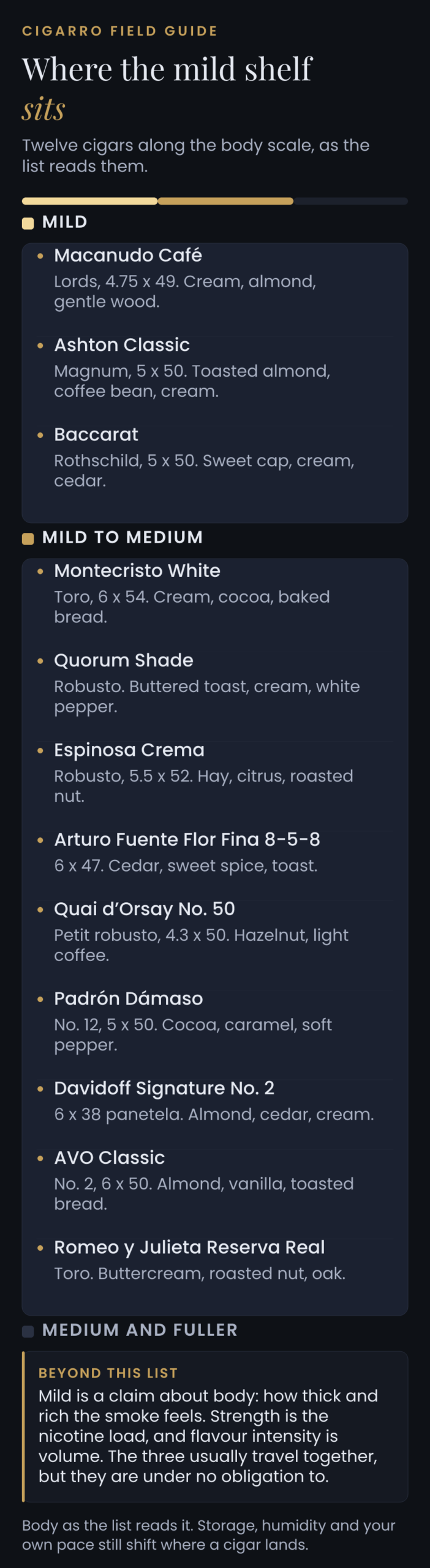
| Cigar | Vitola | Wrapper | Body | Core flavours | Price | Time | Best for |
|---|---|---|---|---|---|---|---|
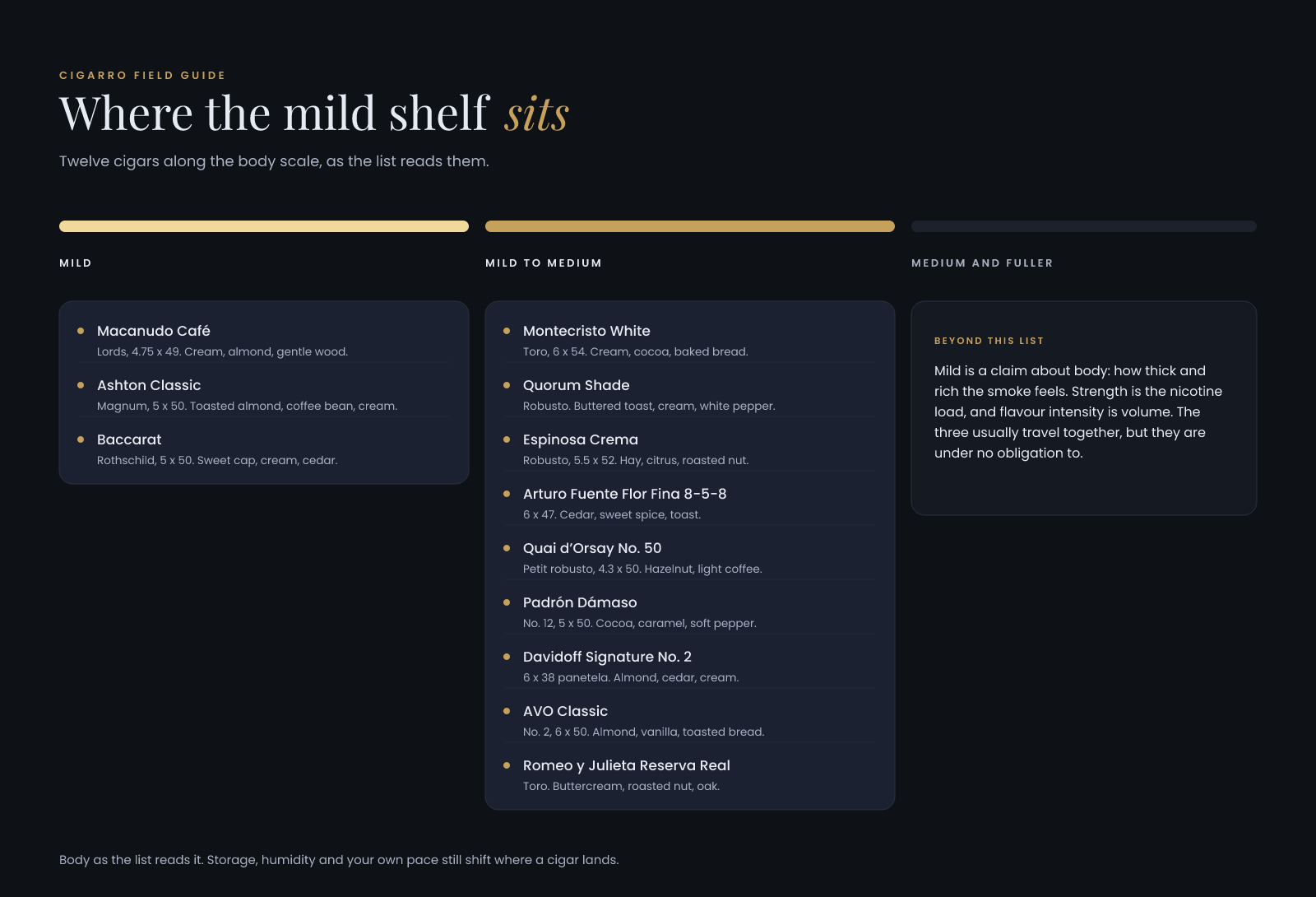
| Macanudo Café | Lords, 4.75 x 49 | USA (Connecticut Shade) | Mild | Cream, almond, gentle wood | $$ | 40 to 50 min | The textbook mild |
| Ashton Classic | Magnum, 5 x 50 | USA (Connecticut Shade) | Mild | Toasted almond, coffee bean, cream | $$ | 45 to 55 min | Dependability |
| Montecristo White | Toro, 6 x 54 | Ecuador (Connecticut) | Mild to medium | Cream, cocoa, baked bread | $$ | 60 to 75 min | The long afternoon |
| Baccarat | Rothschild, 5 x 50 | Connecticut over a Honduran core | Mild | Sweet cap, cream, cedar | $ | 40 to 50 min | The porch stack |
| Quorum Shade | Robusto | Ecuador (Connecticut) | Mild to medium | Buttered toast, cream, white pepper | $ | 45 to 55 min | The box you lend |
| Espinosa Crema | Robusto, 5.5 x 52 | Ecuador (Connecticut seed) | Mild to medium | Hay, citrus, roasted nut | $$ | 50 to 60 min | Boutique temperament |
| Arturo Fuente Flor Fina 8-5-8 | 6 x 47 | Cameroon | Mild to medium | Cedar, sweet spice, toast | $$ | 60 to 75 min | Mild beyond Connecticut |
| Quai d’Orsay No. 50 | Petit robusto, 4.3 x 50 | Cuba | Mild to medium | Hazelnut, light coffee | $$$ | 40 to 50 min | The Cuban argument |
| Padrón Dámaso | No. 12, 5 x 50 | Connecticut seed | Mild to medium | Cocoa, caramel, soft pepper | $$$ | 45 to 60 min | Padrón, quietly |
| Davidoff Signature No. 2 | 6 x 38 panetela | Ecuador (Connecticut) | Mild to medium | Almond, cedar, cream | $$$$ | 45 to 55 min | Precision |
| AVO Classic | No. 2, 6 x 50 | Ecuador (Connecticut) | Mild to medium | Almond, vanilla, toasted bread | $$ | 50 to 60 min | The composer’s hour |
| Romeo y Julieta Reserva Real | Toro | Ecuador (Connecticut Shade) | Mild to medium | Buttercream, roasted nut, oak | $$ | 60 to 70 min | The familiar name |
What Mild Actually Measures
The trade sorts cigars along three axes, and most disappointment in this hobby comes from muddling them. Body is texture: how thick and rich the smoke feels in the mouth, from watery to velvet. Strength is chemistry: the nicotine load, and what it does to a person who smoked too quickly on an empty stomach. Flavour intensity is volume: whether the notes murmur or announce themselves. The trade press explains the distinction at length, and the short version is that the three usually travel together but are under no obligation to. There are creamy cigars that carry surprising strength and dark, imposing cigars that turn out to be pussycats.
“Mild”, used properly, is a claim about body. A mild cigar produces smoke that sits lightly on the palate and asks for your attention rather than demanding it. It says nothing at all about quality, price, or how much skill went into the blend. It also says nothing about colour. The palest Connecticut leaf can sit over a filler blend with real muscle, and a dark maduro wrapper is fermented for sweetness, not strength, a point covered properly in our short primer on what maduro actually means.
The reason the vocabulary matters is practical. If you log a cigar as “mild” when what you mean is “quiet flavours”, or “weak” when what you mean is “thin smoke”, your own notes stop being useful to you within a month. The fix is learning to taste a cigar with the three axes separated, at which point the mild shelf stops looking like the shallow end and starts looking like what it is: a register.
Gentle Is a Choice, Not a Stepping Stone
The standing slander against mild cigars is that they are training wheels: something to be endured politely until your palate earns its dark wrappers. The market says otherwise. The most expensive cigar on this list is a mild one. Davidoff did not build its white-label reputation on ligero, and the Fuente family did not keep a Cameroon-wrapped corona grande in production for decades out of charity to novices. Blenders keep making refined gentle cigars because refined palates keep buying them.
There is a reason the beginner association exists, and it is a fair one: a forgiving body makes early mistakes cheaper, which is why our beginner shortlist leans gentle. But a door you entered through is not a room you must leave. Plenty of smokers with decades of notes behind them run a mild rotation on purpose: because they smoke in the morning, because they want three cigars a week rather than one heavyweight, or because they simply prefer conversation to volume.
The strongest evidence is historical. Quai d’Orsay, the Habanos marca you will meet further down, exists because the French market of the 1970s asked Cuba for a lighter Havana, on purpose, for pleasure. Nobody involved was a beginner. Gentle was the brief, not the compromise. Gentle is a decision a blender makes on purpose, not a compromise the tobacco forced on him.
The Benchmark Milds
Macanudo Café Lords (4.75 x 49)
Every category needs its north star. General Cigar grows the Connecticut Shade wrapper for this itself, sets it over a Mexican San Andrés binder and a Dominican piloto cubano core, and rolls the result in the Dominican Republic with a consistency that borders on stubborn. What comes out is cream, almond and gentle wood, nothing above conversation volume, cigar after cigar after cigar. The Lords, at 4.75 x 49, is the morning-length format: forty-odd minutes, done before the second coffee cools. It gets dismissed as the cigar your father-in-law smokes. Your father-in-law, as usual, was onto something.
Ashton Classic Magnum (5 x 50)
Rolled for Ashton at the Fuente family’s Dominican factory, with a golden shade wrapper over Dominican tobaccos aged three to four years before anyone rolls anything. The house’s own tasting card promises toasted almond and coffee bean against creamy spice, and for once the card undersells the polish. Yes, it also sits on our Connecticut list; a mild list that omitted it to seem original would be lying to you. The Magnum, a 5 x 50 robusto, is the proportion I keep returning to. If dependability were a flavour, Ashton would have trademarked it by now.
Montecristo White Toro (6 x 54)
The dressy one. An Ecuadorian Connecticut wrapper grown under that country’s permanent cloud ceiling, over a Nicaraguan binder and a Dominican and Nicaraguan filler, rolled at Tabacalera de García in La Romana. There is more middle here than the American-wrapped benchmarks offer: cocoa and baked bread underneath the cream, and a finish that stays tidy to the band. The Toro at 6 x 54 wants a free afternoon rather than a stolen half hour. Give it one.
The Value Shelf
Baccarat Rothschild (5 x 50)
Made at the Camacho factory in Danlí, Honduras: Honduran fillers, a Mexican binder, a Connecticut wrapper, and the famous sweetened cap that has been quietly converting porch smokers for generations. Purists mutter about the sugared finish. The Baccarat has never once pretended to be anything else, which is more honesty than some cigars twice its price can manage. Sweet, creamy, cedar-edged, and priced so you can keep a stack for guests without doing arithmetic. The Rothschild at 5 x 50 is the shape the brand is known by.
Quorum Shade Robusto
J.C. Newman‘s Nicaraguan-made bundle line, wearing an Ecuadorian Connecticut wrapper over a Sumatra binder and Nicaraguan fillers. Buttered toast, cream, a pinch of white pepper, and a burn line straighter than its price has any right to fund. It arrives in bundles rather than boxes, which tells you its intended role: this is the cigar you lend, gift and light on an unremarkable Tuesday. Every serious humidor needs one shelf nobody guards. Quorum Shade is what that shelf is for.
Espinosa Crema Robusto (5.5 x 52)
Erik Espinosa’s La Zona factory in Estelí spends most of its day rolling medium to full-bodied Nicaraguans, which is exactly what makes the Crema interesting: it is the house’s deliberate exhale. An Ecuadorian-grown Connecticut-seed wrapper over Nicaraguan binder and fillers, built, by Espinosa’s own account, as the gateway into the portfolio. Hay, citrus and roasted nut, with the native Estelí spice dialled down to polite. Boutique credentials, weekday temperament, and a Robusto at 5.5 x 52 that never overstays.
Milds That Wear a Different Coat
Arturo Fuente Flor Fina 8-5-8 (6 x 47)
The pale-wrapper monopoly on mild is a myth, and the 8-5-8 is exhibit one. Its wrapper is African Cameroon: toothy, reddish-brown, faintly sweet, and nothing like the blond leaf elsewhere on this list. Underneath sit aged Dominican tobaccos in a 6 x 47 corona grande that Fuente has kept in production for decades. Cedar, sweet spice, toast, and that particular Cameroon tang no Connecticut can imitate. It smokes at the far edge of mild and drifts toward medium in the final third, which makes it the right cigar for finding out exactly where your own border sits.
Quai d'Orsay No. 50 (petit robusto)
The only marca in the Habanos stable that was commissioned to be light. Quai d’Orsay was created in the 1970s for the French market, which wanted a Havana it could pair with lunch rather than recover from afterwards, and the modern No. 50 carries the brief faithfully: a 50 ring gauge petit robusto of Vuelta Abajo tobacco, all hazelnut and light coffee, finished inside an hour. It costs proper money, as Havanas do. But as proof that the most tradition-bound corner of the industry considers gentle a legitimate ambition, it has no equal.
Padrón Dámaso No. 12 (5 x 50)
Padrón built its reputation on Nicaraguan muscle, then built the Dámaso for the mornings. A Connecticut-seed wrapper over tobaccos from the family’s own farms, named for José Orlando Padrón’s grandfather, and blended gentler than anything else the house makes. Cigar Aficionado read it as mild to medium when it arrived, and my notes from the No. 12 agree, adding cocoa and a soft caramel line that no other cigar here quite matches. The box-pressed anniversary heavyweights collect the headlines. This one collects the eight a.m. slot.
The Deliberate Milds
Davidoff Signature No. 2 (6 x 38)
A 6 x 38 panetela in Ecuadorian Connecticut over aged Dominican tobaccos, and the steadiest argument I know that mild rewards attention. The narrow gauge raises the wrapper’s share of every draw, so the almond, cedar and cream arrive with unusual clarity, in order, like a well-run tasting menu. There is no drama anywhere in it; there is also not a single loose stitch. You pay Davidoff money for the privilege. Precision has always billed by the hour.
AVO Classic No. 2 (6 x 50)
Launched in 1988 by Avo Uvezian, a jazz composer who wanted a cigar worthy of his piano bar, and blended in the Dominican Republic under Hendrik Kelner, the master long associated with Davidoff’s Dominican production. Ecuadorian Connecticut over aged Dominican binder and filler; almond, vanilla and toasted bread, swinging gently for the better part of an hour in the No. 2’s 6 x 50 frame. It smokes the way a standard should be played: familiar, unhurried, and better than it needs to be.
Romeo y Julieta Reserva Real Toro
The friendliest label in the category. An Ecuadorian Connecticut Shade wrapper over a Nicaraguan binder with Nicaraguan and Dominican fillers, delivering buttercream, roasted nut and a line of oak that keeps the sweetness from going soft. It is the mild cigar for the evening your guests know cigars only by name, because the band does the introductions and the blend does not embarrass it. There are subtler choices on this list. There are few friendlier ones.
Morning, Midday and the Coffee Question
Mild cigars own the morning for a sensible reason: the palate is freshest before lunch, and a register built on small notes deserves the hours when you can still hear them. The trade’s pairing rule is to match intensity on both sides of the table, so the classic partnership is a mild, creamy cigar beside coffee with some cream in it, a cappuccino or a milky pour-over rather than a violent little espresso that flattens everything it meets. The 8-5-8’s sweet spice against a medium roast is my own standing Saturday arrangement, and I am not moved to renegotiate it.
Midday belongs to the shorter formats. The Macanudo Lords, the Baccarat Rothschild and the Quai d’Orsay No. 50 all finish inside fifty minutes, which is the honest length of most free afternoons. And the evening case for mild is underrated: after a rich meal, a Signature No. 2 or an AVO with something light in the glass lets the day end on a clear note rather than a heavy one. If your palate wants more weight as the light fades, the darker shelf is catalogued in the best maduro cigars, and the full smooth-side map, wrapper by wrapper, lives in our guides to Connecticut cigars and cigar wrapper types.
How This List Was Chosen
Twelve lines, chosen for breadth across the mild register rather than one style of gentle: two American-shade benchmarks, an Ecuadorian classic, three value picks, a Cameroon, a Cuban, and four deliberate milds from houses that could blend anything and chose this. Where an entry prints a size, that is the size my notes describe, verified against the maker’s or a major retailer’s published specification; where it does not, take the line reference and choose your length. Blend facts are checked against each manufacturer’s published details and the trade press, and the price tiers reflect typical single-cigar prices at large US online retailers in mid-2026, so read them as relative rather than gospel. If price rather than body is your organising principle, the companion guide to the best cigars under $20 and under $10 sorts the same shelf that way instead. Three of the twelve also appear in our Connecticut guide, because the benchmarks of mild and the benchmarks of shade overlap by nature; the other nine are this list’s own argument. Cigarro accepts no samples, sponsorship or payment from any manufacturer or retailer, so nothing here bought its place. Body and flavour still shift with storage, humidity and your own pace. Treat the table as a map, not a promise, and log your own verdicts as you go.
Gentle by Choice
A mild cigar is a small-print document: everything in it is legible, provided you actually read. The gap between a good mild and a great one is the width of an almond note, which is exactly why the gentle shelf is the best training ground reviewing has. Loud cigars talk over your notes. These let you hear yourself think. The Cigarro Method was built for that kind of listening: score the first third, the second, the last, and watch how much a quiet cigar turns out to be saying. Log whichever of the twelve you try in Cigarro and settle the question for yourself, in your own handwriting, whether gentle is a phase or a preference. Mine stopped being a phase around the time I stopped apologising for it.