A cigar collection is a shelf you can explain: what is on it, why it is there, and when each cigar is meant to be smoked. An accumulation is what you get when you buy well at every counter and never stop. The accumulator opens the humidor one spring, finds a two-year-old box behind the newer ones, and cannot say why it was bought. The collector can say, because each purchase had a job to do before it arrived. In my years behind the counter the two shelves were indistinguishable until that first spring clean-out.
This guide is the counter’s method for building a collection on purpose: sort the shelf into three roles, buy singles before boxes, set a budget by the month, size the humidor before the stock outgrows it, and keep a record of what you own. I call the split the 70/20/10 shelf. It is my own rule of thumb, not an industry standard, and it is meant to be bent. Cigarro is a web app for tracking and reviewing cigars. I use a thirty-cigar starter shelf as the worked example because it is a realistic first shelf, and I reconcile it with a real humidor further down. Cigarro’s free Pocket Humidor holds up to thirty unique cigars, which comfortably covers a shelf of that size.
Nobody needs a large humidor, a rare cigar or a full wallet to do any of this. By the definition I hold to, a twelve-cigar shelf where every stick has an evening is a better collection than a cabinet nobody can account for. Collectors also use the word for laid-down boxes, vintages and releases, and I come to those in the ageing section. They need the same ledger.
On this page
Collection Versus Accumulation
The method, in five moves
- 1. Sort the shelf into three roles: everyday, occasion and experiments, roughly 70, 20 and 10 percent by count.
- 2. Buy singles before boxes: three singles of the same cigar, smoked to the end on three different days, before any box.
- 3. Set a monthly budget at a desk, split it by spend across the three roles, and keep to it at the counter.
- 4. Size the humidor so the shelf fills it to about 75 or 80 percent, leaving a fifth empty for air.
- 5. Keep a ledger from the first cigar: source, price, date in, role, planned evening and verdict.
Accumulation is easy to recognise from the inside once you know the signs. There are boxes bought in a burst of enthusiasm after one good evening. There are singles from a trip that you were saving. There are three cigars from a friend’s gift bag with no note of who gave them, and a row at the back of the humidor you last touched in the spring. None of it was a mistake at the counter. Each purchase made sense on the day, and the sum of them makes no sense at all.
Collection or accumulation
| A collection | An accumulation | |
|---|---|---|
| Why each cigar is there | It has a job on the shelf | It looked right on a good day at the counter |
| When it will be smoked | A rough evening can be named | Some day |
| Record | A ledger with dates and prices | Memory |
| Humidor fill | 75 to 80 percent, with room to breathe | Packed, with the oldest at the back |
| Boxes | Earned by singles | Bought on enthusiasm |
A collection differs in one respect: every cigar on the shelf has a reason to be there and a rough idea of when it will be smoked. That is a lower bar than it sounds. A twelve-cigar shelf where you can name the evening for each stick is a collection. A two-hundred-cigar cabinet you cannot account for is a stockpile. The working shelf, the cigars you expect to smoke over the coming months, is the subject here. Plenty of people also collect boxes on purpose, to lay down for ageing or to keep a particular release or vintage, and that is a real and older sense of the word. I cover it in the ageing section below and in how to age cigars, and it needs the same ledger as everything else.
The trade’s own advice points the same way, if you read past the shopping. Famous Smoke’s Cigar Advisor reduces the task to three steps in its guide to building a collection: know what you like, set a budget, and buy for occasions. Holt’s guidance for new collectors is to sample a range of cigars before spending your budget on a full box, and to photograph bands and keep tasting notes as you go. Neither piece tells you which cigars to buy, which is the right instinct, because the right cigar is the one that fits a job you actually have.
Keep one test to hand: I will smoke this one when ___. The rest of this guide is about giving every cigar on the shelf a role that lets you finish it.
The one-sentence test
Pick any cigar in your humidor and finish this sentence: I will smoke this one when ___. If you can complete it for most of the shelf, you are collecting. If the honest answer is some day, the cigar is still waiting for a role.
The Shelf in Three Roles
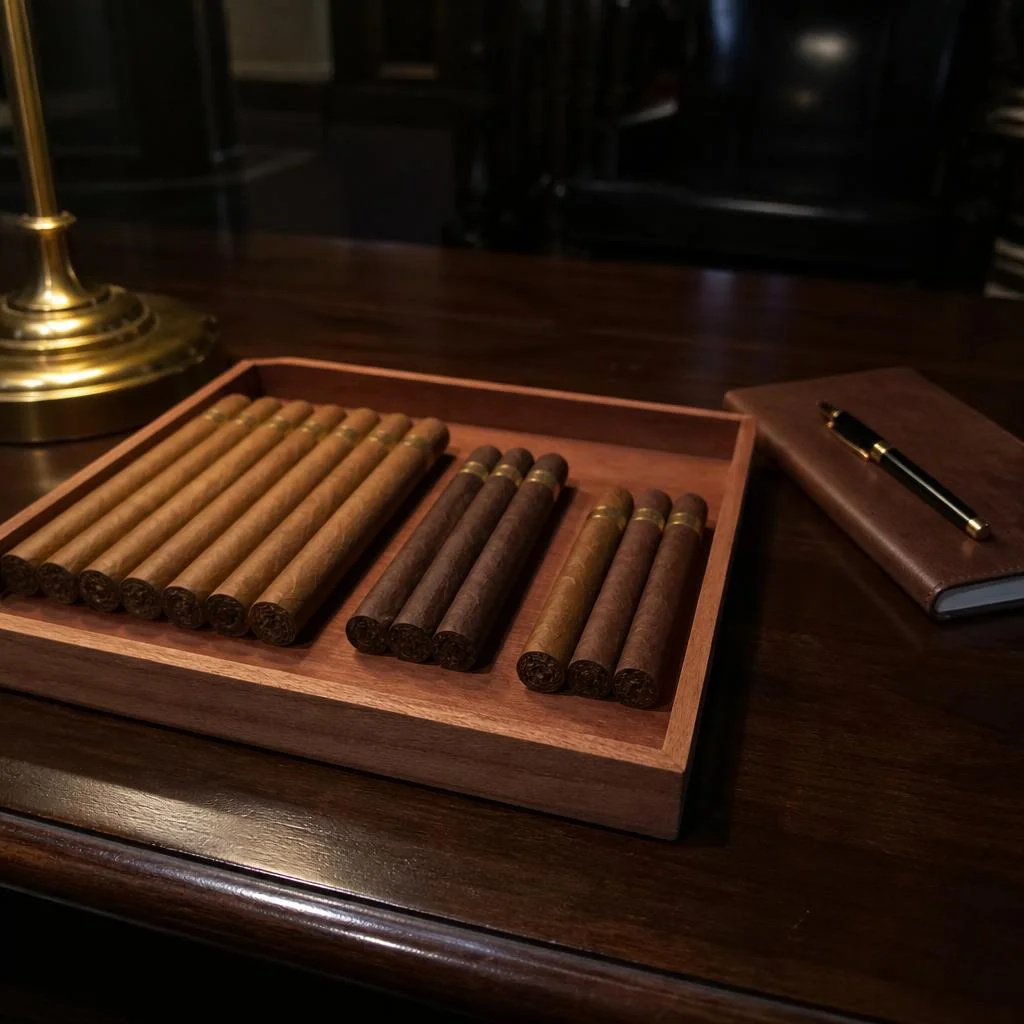
I divide a working shelf into three roles and give each a share. Seventy percent is everyday: cigars you have smoked before, like, and would happily smoke again on an ordinary Tuesday. Twenty percent is occasion: the cigars kept for a birthday, a closed deal, a friend visiting, an evening that deserves a long smoke. The last ten percent is experiments: singles you have never tried, bought to be wrong about. The split describes what sits on the shelf, counted in cigars. Spending follows a different shape, which the budget section sets out. As a starting proportion it keeps most of the shelf on cigars you know you enjoy and caps the number of cigars bought on a hunch.
The 70/20/10 split at three shelf sizes
| Role | Share | 12-cigar shelf | 30-cigar shelf | 50-cigar shelf |
|---|---|---|---|---|
| Everyday | 70 percent | 8 | 21 | 35 |
| Occasion | 20 percent | 3 | 6 | 10 |
| Experiments | 10 percent | 1 | 3 | 5 |
The 12-cigar column is rounded to keep the total at twelve (the raw figures are 8.4, 2.4 and 1.2). Counts are cigars on the shelf, not dollars spent.
Famous Smoke’s Cigar Advisor offers a finer-grained version: ten to twenty inexpensive working cigars under three dollars, ten to twenty to share, fifteen to twenty everyday cigars, five to ten mid-shelf treats and one to ten for special occasions, adjusted to your humidor space and the season. That comes to roughly forty to eighty cigars, and it suits a shelf that already exists. For a shelf still being built, five roles is more bookkeeping than the first fifty cigars need, so I fold them. The working and everyday cigars become my everyday; the shareable, mid-shelf and special-occasion cigars become my occasion; and the experiments are my own addition, since nothing in that scheme sets cigars aside for the purpose of being wrong. Folded this way, the scheme comes to about twenty-five to forty everyday cigars against sixteen to forty for occasions, which is nearer half and half than seventy and twenty. I weight the everyday role heavier because a first shelf should lean on cigars you already know.
How Famous Smoke's five roles fold into three
| Famous Smoke role (suggested count) | Folds into |
|---|---|
| Working cigars under 3 dollars (10 to 20) | Everyday |
| Everyday (15 to 20) | Everyday |
| Shareable (10 to 20) | Occasion |
| Mid-shelf treats (5 to 10) | Occasion |
| Special occasion (1 to 10) | Occasion |
| No equivalent | Experiments |
Folded, the source scheme gives about 25 to 40 everyday cigars and 16 to 40 occasion cigars, nearer half and half than 70/20. The 70/20/10 weighting is Hugh’s own.
The arithmetic on a thirty-cigar starter shelf is simple: twenty-one everyday cigars, six for occasions, three experiments. Variety lives in the ten percent and depth in the seventy. The split discourages a shelf of thirty different cigars, because you cannot learn a cigar from a single stick, and it discourages thirty of the same, because a collection with no experiments has stopped teaching you anything.
What follows is one worked example for each role, using real cigars. They illustrate the role and are not recommendations for your palate. Swap in whatever fills the job for you, and if you are still finding your feet, the beginner shortlist is a fair place to start.
01 · Everyday
The Cigars You Actually Smoke
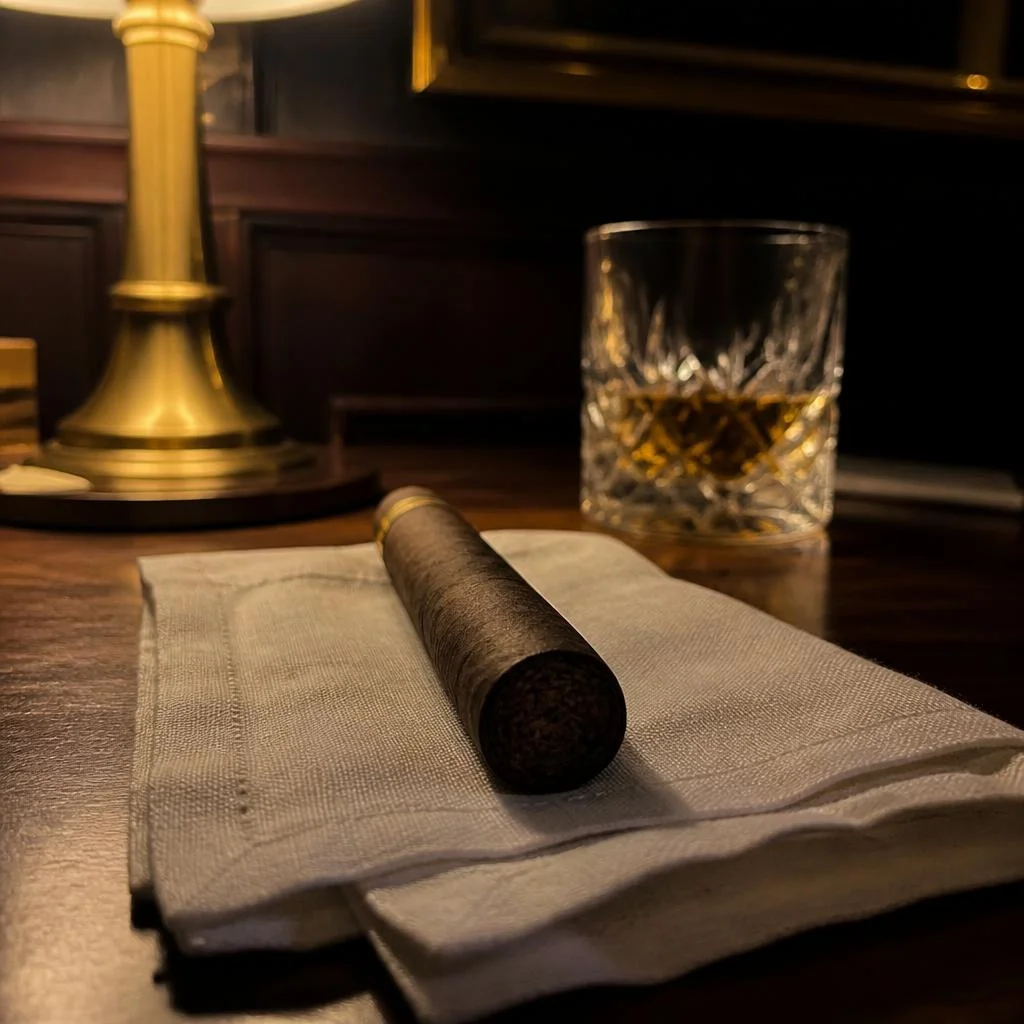
The everyday cigar has one job: to make an ordinary evening better without asking anything of you. It should be a cigar you have already smoked at least three times, in a size that fits the hour you usually have. My worked example is the Arturo Fuente Hemingway Short Story, a 4 by 48 Dominican perfecto in a Cameroon wrapper over a Dominican binder and filler, sold in cedar chests of twenty-five. Halfwheel carries an older review from its archive, undated on the page, that timed one at forty-seven minutes and scored it 90. That is one reviewer, one cigar and one sample from some years back, so I use it for the length and not the verdict. Forty-seven minutes suits the hour between supper and bed, which is the slot an everyday cigar has to fill. J-R Cigars’ listing in September 2026 put the chest of twenty-five at about 179 dollars, or roughly seven dollars a cigar. That is a per-stick price for a full box. Singles cost more, so check your own shop’s, and treat all of it as a band and not a promise.
Twenty-one everyday cigars is not a whole box of twenty-five. That box is 83 percent of a thirty-cigar shelf, and would be 70 percent only of a shelf holding about thirty-six. So on the starter shelf the everyday role is a five-pack or a bundle, or several cigars in rotation bought as singles, and the box waits until the shelf has grown to suit it. Once it has, everyday is the one role where a box earns its place, because you will get through it and you already know what is inside.
The three-singles rule
No box for the everyday seventy percent until three singles of the same cigar have been smoked to the end, on three different days. Log each one, and compare the three notes before you buy.
The rule in the box above needs one clarification: the three singles are three of the same cigar. You are testing consistency, not variety, and the first smoke is sometimes the exception. Log each one. Three notes side by side will tell you more than one vivid memory, and the guide to choosing a cigar covers how to shortlist the candidates.
02 · Occasion
Sticks With a Date on Them
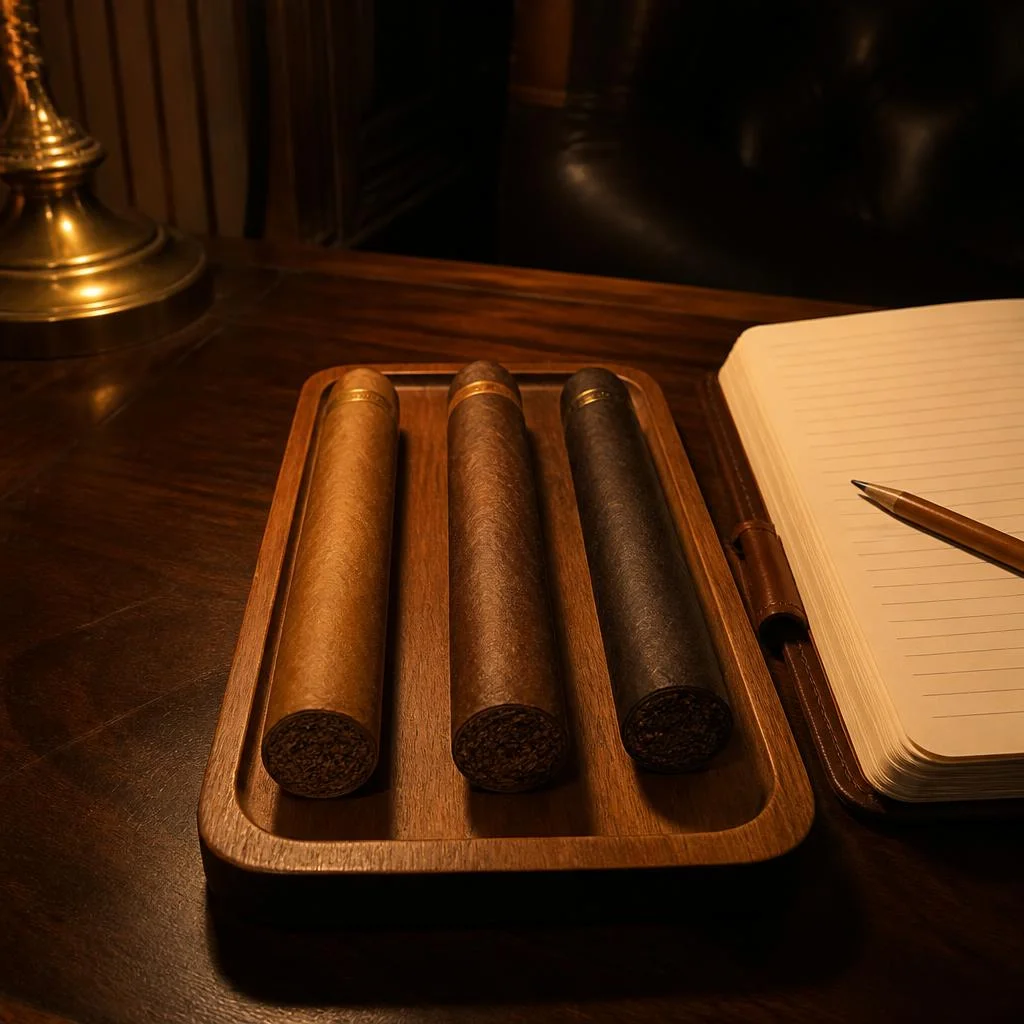
An occasion cigar is chosen for the evening it is meant to mark, and it is usually bigger, dearer, or both. Six on a thirty-cigar shelf is plenty, and the role loses its point if you smoke them casually. My worked example is the Padrón 1964 Anniversary Series Exclusivo, a 5.5 by 50 Nicaraguan cigar from a line Padrón introduced in 1994 for the company’s thirtieth anniversary. Padrón lists the series in formats from five-packs up to twenty-five-count boxes. The Exclusivo comes in a box of twenty-five, and J-R Cigars’ listing in September 2026 put that box at about 410 dollars, near sixteen dollars a cigar. Holt’s notes that premium boxes typically hold twenty or twenty-five cigars and can run to hundreds of dollars.
That price is why occasion cigars are bought as singles or five-packs, not boxes. You are paying for a specific evening, and six evenings do not need twenty-five cigars.
One practical point for the twenty percent. Occasion cigars are the ones most likely to sit and wait, which makes them the ones most in need of a note saying when they went in. More on that in the ledger section below, and how to rest a cigar explains why a cigar that has only just arrived is not yet ready for its evening.
03 · Experiments
A Tenth Set Aside for Being Wrong
The experiment tenth exists to be wrong cheaply. Three cigars on a thirty-cigar shelf, always singles, always ones you have not tried, and always followed by a written review before you decide anything about them. The discipline is in the buying, not the smoking: an experiment that turns into a box of fifty has stopped being an experiment. My ceiling for one is the top of Holt’s everyday range, about ten dollars a stick.
The rules for an experiment
- A single, never a box.
- A cigar you have not tried before.
- A written review before you decide anything about it.
- A price ceiling: no more than the top of the everyday range, about ten dollars a stick.
- It becomes a candidate for the shelf after a second smoke, and an everyday cigar only after a third.
The Illusione Rothchildes CT shows the trap. Halfwheel reviewed it in August 2016 as a 4.5 by 50 with an Ecuadorian Connecticut wrapper over a Nicaraguan binder and filler, at 5.50 dollars a cigar, sold in boxes of fifty, and gave it 89 points. That price is a decade-old MSRP, so check today’s, but the shape of the problem does not change. It is an entirely reasonable thing to try, and it is also fifty cigars. At the 2016 price that box is 275 dollars, which is more than two years of a ten-dollar monthly experiment slice. Buy one. Smoke it by the Cigarro Method, thirds and all, and write the verdict down while it is fresh. If it earns a second, it is a candidate for the shelf, and a third smoke makes it an everyday cigar. A cigar that suits one particular evening can take an occasion place instead, and either way the shelf has learned something.
Sooner or later an experiment will be a limited release, and here the ceiling does the thinking for you. Halfwheel reported that Padrón’s Family Reserve No. 95 was available only to retailers who ordered at the 2021 PCA Convention, in boxes of ten with an MSRP of 295 dollars. That is about 29.50 a cigar, roughly three times the ceiling, so it is an occasion cigar if it is anything, not an experiment. A limited release qualifies as an experiment only when you can buy one stick under the ceiling. Halfwheel also notes that Habanos does not disclose production numbers for its Edición Limitada releases, and that one 2020 release did not reach stores until 2022. Claims of scarcity are hard to check, which is one more reason to let the price, and not the story, decide.
The three worked examples, side by side
| Role | Cigar | Size | Wrapper and origin | Box count | Price basis and date |
|---|---|---|---|---|---|
| Everyday | Arturo Fuente Hemingway Short Story | 4 by 48 (perfecto) | Cameroon wrapper, Dominican binder and filler | 25 | About 179 dollars a box, about 7 a cigar, September 2026 listing |
| Occasion | Padrón 1964 Anniversary Series Exclusivo | 5.5 by 50 | Nicaraguan | 25 | About 410 dollars a box, about 16 a cigar, September 2026 listing |
| Experiment | Illusione Rothchildes CT | 4.5 by 50 | Ecuadorian Connecticut over Nicaraguan binder and filler | 50 | 5.50 dollars a cigar, August 2016 MSRP (a decade old) |
Depth Versus Breadth
Every collector eventually asks whether to buy the box. A box is a commitment to twenty or twenty-five evenings with one cigar, and you should make it only once you know how those evenings will go.
Holt’s advises smoking a range of cigars first, to find one that is well made and consistent before committing to a box. Consistency is the point. A single cigar can be excellent by luck, and a box is a bet that the roller, the leaf and the factory stay consistent across twenty-five. Three singles on three days is a cheap way to find out.
A single cigar can be excellent by luck, and a box is a bet that the roller, the leaf and the factory stay consistent across twenty-five.
Whether the box is cheaper than singles is a question for your own retailer’s price list. The retail gap varies by shop and by month, so I would not quote a figure. What Cigar Journal did publish, in its Spring 2011 edition, is a packaging cost, quoting J-R Cigars’ Lew Rothman: about eighteen cents a cigar for a standard twenty-five-count box, twenty-two and a half cents for a twenty-count, and eighty-five cents to a dollar for a premium box. Bundles, which skip the box, ran about twenty cents a cigar cheaper than the boxed version. Those are 2011 packaging costs and not shelf discounts, so do the per-stick arithmetic on the shelf tag.
Single, sampler, bundle or box
| Format | Best for | Role it fills | Watch for |
|---|---|---|---|
| Single | Trying one cigar | Experiments, occasion | Highest price per stick |
| Sampler (Holt’s names the Ashton 5-cigar and Oliva 8-cigar) | Trying several blends | Experiments | Mixed quality across the pack |
| Bundle (about 20 cents a cigar cheaper than boxed, per Lew Rothman, 2011) | A cigar you know, at lower cost | Everyday | No box, so less presentation |
| Box of 20 or 25 | A cigar you trust | Everyday, ageing | A commitment that can run to hundreds of dollars |
Samplers are the underused tool here. Holt’s names the Ashton five-cigar and Oliva eight-cigar samplers as ways to try different cigars without buying boxes, and a sampler is a tidy way to fill the experimental ten percent.
Depth and breadth map neatly onto the three roles. Depth is boxes of what you love, which is the seventy percent. Breadth is singles of what you are still learning, which is the ten. The twenty is the cigars you already know well enough to save for an evening.
Budgeting by the Month
Budget by the month, not by the visit. A shop visit is the worst time to decide, because everything on the counter looks like a good idea and the card in your hand makes any purchase feel small. A monthly figure, decided in advance at a desk, does the deciding for you.
The 70/20/10 counts cigars on the shelf, and spending takes a different shape, because an occasion cigar costs more than twice an everyday one. Price the starter shelf at the box-derived figures above: twenty-one everyday cigars at about seven dollars is roughly 147 dollars, six occasion cigars at about sixteen is about 96, and three experiments at my ten-dollar ceiling come to 30. That is about 270 dollars in all, and by spend the shelf splits close to 54, 35 and 11 percent. So I budget the money at roughly 55, 35 and 10, and let the shelf stay 70, 20 and 10 by count. On a hundred dollars a month, the starter shelf fills in about three months, the everyday role first. That is the best case, because these figures come from box prices and singles cost more, so rerun the sums with your own shop’s prices. The point is the shape: most of the shelf is cigars you already trust, a larger share of the money marks the evenings that matter, and a fixed sliver funds curiosity.
The monthly budget at three levels
| Monthly budget | Everyday (about 55 percent) | Occasion (about 35 percent) | Experiments (about 10 percent) |
|---|---|---|---|
| 50 dollars | 28 dollars, up to about four cigars | 17 dollars, up to about one cigar | 5 dollars, save two months for one single |
| 100 dollars | 55 dollars, up to about eight cigars | 35 dollars, up to about two cigars | 10 dollars, one single |
| 200 dollars | 110 dollars, up to about sixteen cigars | 70 dollars, up to about four cigars | 20 dollars, two singles |
| Your shop’s prices | Everyday dollars divided by your everyday single price | Occasion dollars divided by your occasion single price | Experiment dollars divided by your single price, at most about 10 dollars |
The counts are a best-case ceiling. They use per-cigar prices derived from September 2026 box listings (about 7 dollars an everyday cigar, about 16 an occasion cigar), and singles cost more, so the real counts will be lower. Use the last row with your own shop’s prices. Humidor, humidification, shipping and sales tax are extra.
Holt’s puts everyday cigars at five to ten dollars and limited editions at fifteen to twenty dollars or more, which is a useful reality check on your own shelf. If your everyday cigar costs what Holt’s calls a limited edition, the split is drifting.
The cigars are not the whole bill. The humidor, its humidification, shipping and sales tax sit outside these figures, so budget for them separately and do not let them come out of the cigar slice.
Two habits keep the number honest. Unspent money rolls into next month’s occasion budget, never into a box you did not plan for. That is my rule, and the reason is that occasion cigars cost the most per stick and are the role a monthly slice fills slowest. And when a shop offers the deal that expires today, remember that, for a regular-production cigar, sold out has usually meant back or replaced in my years at the counter, and the money will still be in your pocket.
Two habits
1. Fix the number at a desk, not at the counter.
2. Decide before the month starts where unspent money goes, and never let it go into a box you did not plan for.
Capacity, Ageing and the Second Box
Size the humidor before the stock outgrows it. Holt’s, in its guide to what makes a good humidor, says to leave about a fifth of the interior free so air can move around the cigars, and its maintenance guide puts a sensible fill at roughly seventy-five to eighty percent of stated capacity. Famous Smoke’s Cigar Advisor gives the same seventy-five percent rule of thumb and adds two cautions: cramming cigars in hurts even humidification and flavour, and a big humidor that stays mostly empty dries out its humidifier faster. Its advice for buyers is to size up from what you think you need, because collections outgrow consumption.
Those two cautions pull in opposite directions, so here is how I reconcile them: one size up from your current stock, not two. Thirty cigars at seventy-five percent asks for a humidor rated at forty at least. The nearest common size is the fifty-count, which Holt’s lists among the usual capacities, and which by the rule is full at about thirty-eight cigars. It holds the thirty now with room to grow, and it also holds the thirty-six-cigar shelf that suits a box of twenty-five. A seventy-five-count would leave the starter shelf forty percent full, which is where Famous Smoke’s dry-humidifier warning starts to bite.
How many cigars at 75 and 80 percent full
| Stated humidor count | Fill at 75 percent | Fill at 80 percent |
|---|---|---|
| 25 | about 19 | 20 |
| 50 | about 38 | 40 |
| 75 | about 56 | 60 |
| 100 | 75 | 80 |
Fill rules from Holt’s and Famous Smoke. The thirty-cigar starter shelf sits at 60 percent of a fifty-count, and the thirty-six-cigar shelf that suits a box of twenty-five at about 72 percent.
Treat any stated count as a headline figure and not a measurement. Holt’s says many humidors are rated by how many Toro-sized cigars they hold, and that the classic Toro is six inches by a 52 ring gauge. Thicker or longer cigars cut the real capacity. By cross-section alone (my own arithmetic, not a maker’s figure), a fifty-count rated on 52-ring Toros would hold nearer thirty-eight 60-ring cigars before length is counted. If your shelf runs to gordos and long Churchills, buy the next size up.
Crowding shows up first as uneven humidity, which Famous Smoke ties to poorer flavour, and the margin for error is narrow. Holt’s ideal is about seventy percent humidity and seventy degrees Fahrenheit, and Cigar Aficionado reports beetle larvae hatching only two points above both, so a crowded humidor is harder to hold inside the line. If your readings drift high, I would aim for the lower half of Holt’s acceptable range. The thresholds and the reasoning are set out below. The practical advice on holding a steady seventy and seventy is in how to store cigars, and how to lay the shelf out is in the guide to organising a humidor.
Conditions, at a glance
- Target about 70 percent RH and 70F; Holt's treats 65 to 72 as acceptable.
- Mould risk rises above 70 percent RH, and with warmth.
- Tobacco beetle larvae hatch above about 72F and 72 percent RH.
- Inspect every few days if you buy more than once a week or live somewhere hot or humid.
- Keep the humidor 20 to 25 percent empty.
Ageing is where a collection starts to repay patience, and where it starts to mislead. The sources disagree on how long, from six months to a year at the cautious end to five to ten years at the generous one, as the table shows. Cigar Aficionado’s glossary adds that full-flavoured, rich and robust cigars are the best candidates, that not every cigar improves, and that there is a point of diminishing returns. Treat the window as a range and test it.
How long to age: the sources disagree
| Source | Window | Note |
|---|---|---|
| Famous Smoke, Home Aging Your Cigars | 6 to 12 months optimal, 2 to 3 years at most for premium cigars | Bouquet can fade beyond four or five years |
| Famous Smoke, 5 Things About Aging Cigars | Up to about 10 years | Older does not always mean better |
| Cigar Aficionado glossary | 5 to 10 years of box ageing is a sweet spot | Full-flavoured, robust cigars are the best candidates |
| Halfwheel, Viaje C-4 review | About 3,816 days (over ten years) | Judged a shell of itself; one reviewer, one cigar |
Cigar Aficionado’s own method is the sensible one: lay down a box, smoke one at intervals, note what changes, and stop when the cigar reaches the strength and roundness you want. Halfwheel’s review of a Viaje C-4 box-aged for about ten years, judged a shell of itself, is a fair caution that ten years can be too long. How to age cigars goes deeper.
Read the detail
That gives a rule for the second box, and it is mine. Buy it when the first is about half smoked and you still look forward to the next one, and only for a cigar full-flavoured enough to reward the wait. The reason is arithmetic: at half a box of twenty or twenty-five you have ten or a dozen evenings of information about what that cigar does. The second box is then an ageing box, and it goes into the humidor with a date on it. A second box bought only because the first was cheap has no job yet.
Keep the Ledger Honest
A collection you cannot see is a collection you cannot manage. Keep a ledger, and start it with the first cigar. Each entry is short: what it is, where it came from, what you paid, the date it went into the humidor, which of the three roles it fills, and when you plan to smoke it. When you smoke it, add the verdict. Six months later the note on an everyday cigar tells you whether you still love it, and a year later the note on an occasion cigar tells you whether it waited too long.
The ledger, in three passes
- 1. At purchase, record: the cigar, the retailer, the price paid, the purchase date, the box code and date stamp if there is one, the role it fills (everyday, occasion or experiment) and the evening you plan to smoke it.
- 2. At the smoke, record: the date, a short verdict, and whether it earns a place back on the shelf as a repeat.
- 3. Each quarter, review the shelf: promote a cigar to a bigger role, demote it, or drop it.
Cigarro covers the smoking half of that ledger: one record per blend, a review for each, and the age of each cigar tracked. Keep the price, retailer, box code and planned evening wherever you already keep notes. The free Pocket Humidor holds up to thirty unique cigars, and an entry is one record per blend, so a thirty-stick shelf built from five-packs and bundles fits comfortably. According to Cigarro’s pricing page, the Desk Humidor holds up to two hundred unique cigars and the Cabinet Humidor up to seven hundred and fifty, and reviews are unlimited on every tier. The digital humidor guide compares what these tools do, and the Cigarro Method gives you the review-by-thirds frame for the verdict. Provenance matters too. Record the retailer, the purchase date, the price paid and any box code or date stamp, and how to spot a fake cigar shows why those few fields are worth the minute they take.
Records earn their keep in one more way, once the shelf is worth more than you would replace out of pocket. At the prices above, the thirty-cigar starter shelf is only a few hundred dollars, so this is a note for later. The California Department of Insurance’s home inventory guide says most policies limit coverage for collectibles and that items can be scheduled separately at an appraised value, and it recommends photographs, receipts and copies kept away from home. The guide says nothing about cigars in particular, so the sensible step, when the time comes, is a call to your insurer to ask, armed with a photograph of the shelf and a list. A ledger you already keep is that list.
Leave Room for Next Month
Buy fewer than the counter suggests, smoke what you already know is right, and leave a fifth of the humidor empty. Then take an evening this week to list what is on the shelf and mark each cigar with a role: everyday, occasion or experiment. Any cigar that will not take a role gets a question mark in the ledger and no reorder until it earns one.
Questions From the Counter