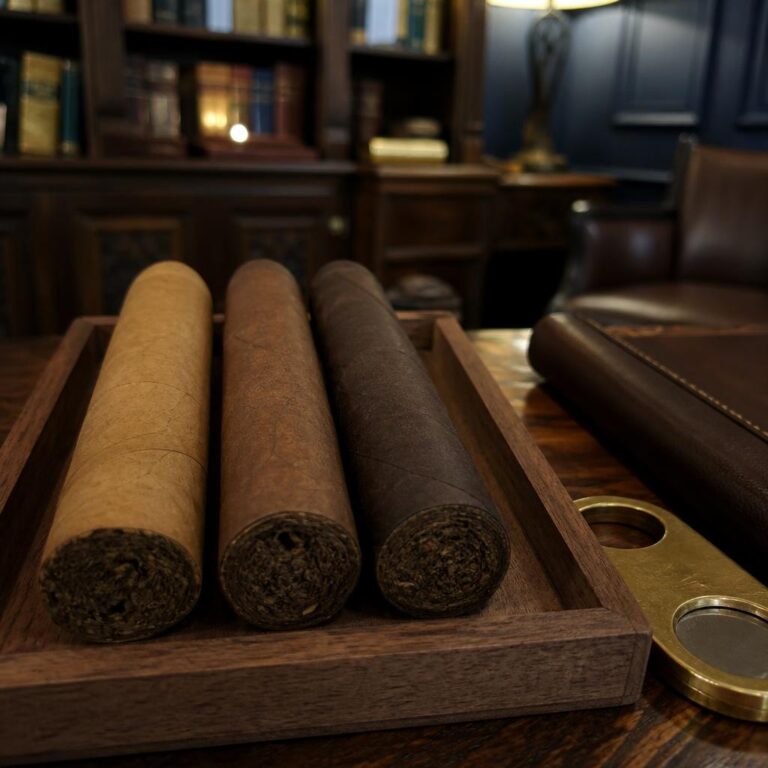
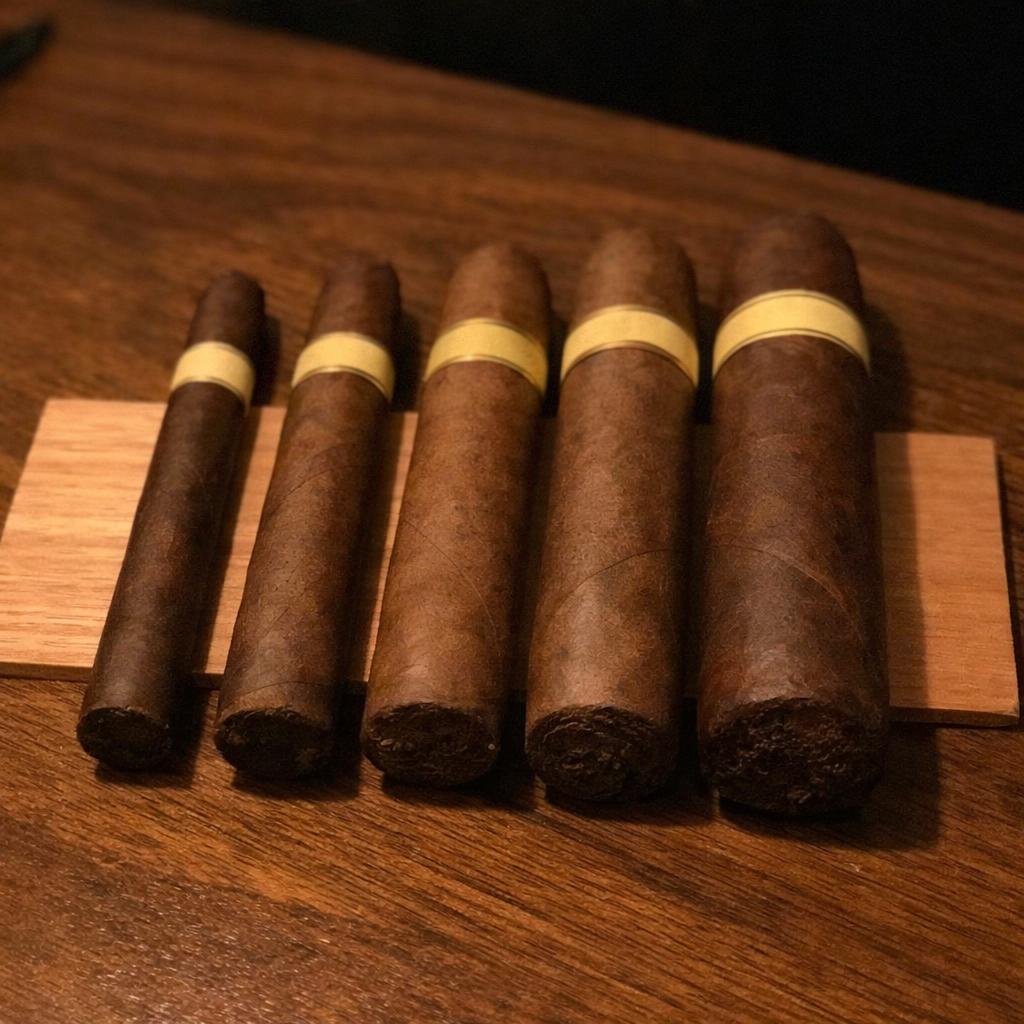
Somewhere on the box, usually just after the length, sits a second number. A robusto might read five by fifty. A lancero, seven and a half by thirty-eight. That second figure is the ring gauge, and for something so quietly printed it stirs a surprising amount of opinion.
Ring gauge is a cigar’s diameter in sixty-fourths of an inch. A fifty ring gauge cigar is fifty sixty-fourths of an inch across, which is 19.8 millimetres. A wider ring gauge changes a cigar’s character, not its strength and not its quality. What the number governs is how the cigar burns, how it draws, how long it lasts, which cutter will take it, and which part of the blend you notice most. Once you can read the number, you can choose a cigar with intent rather than habit. This guide covers the measurement, the conversions, a full chart from 38 to 100, the cutters, the history of the fat-cigar era, and how to pick a gauge for the evening you actually have.
Reading the Ring Gauge
A fifty sits a shade over three-quarters of an inch across. Push the number to sixty-four and you are at the width most people stop caring to go past. The figure is taken at the cigar’s widest point, and the length in inches is the number printed beside it.
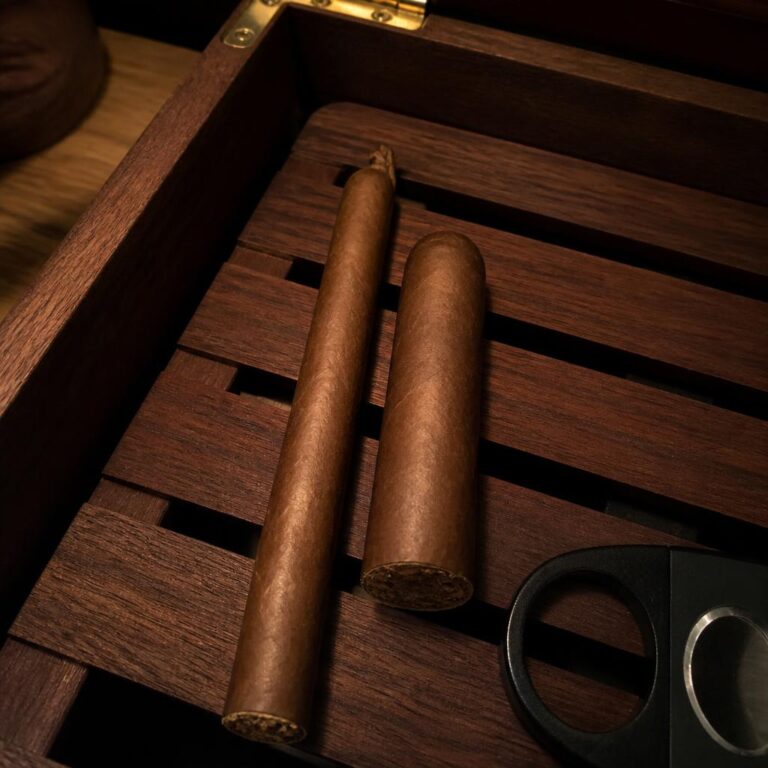
So five by fifty means five inches long and fifty sixty-fourths thick. Seven and a half by thirty-eight, the classic lancero, runs longer than most and yet sits noticeably slim in the fingers. Together they describe the shape of the cigar and very little else.
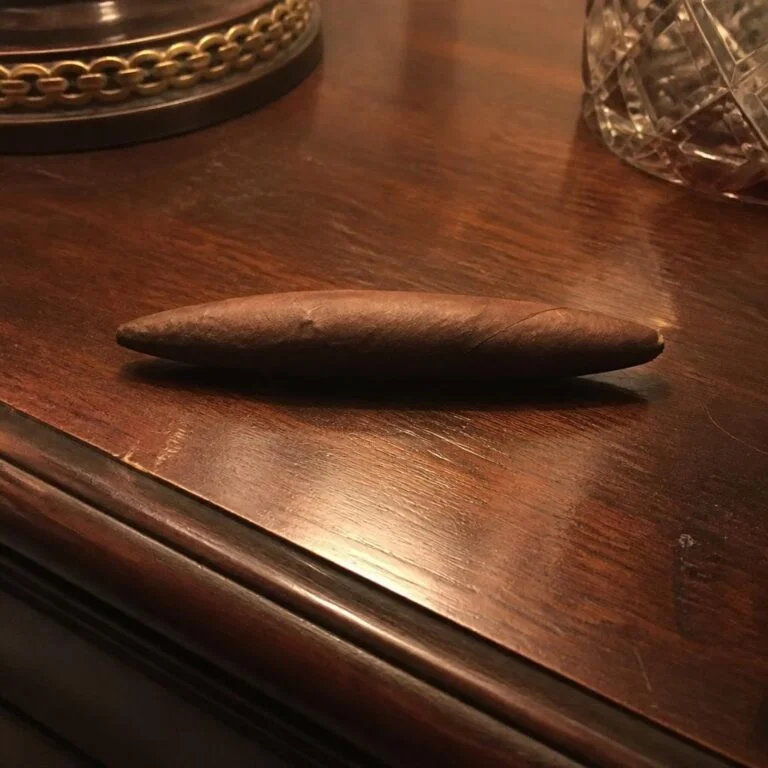
On a parejo, the straight-sided shape most cigars take, the gauge is the same from foot to head. On a figurado it is not. A torpedo is quoted at its widest point and narrows toward the head, and a perfecto narrows at both ends, so a 52 torpedo and a 52 toro feel quite different once they are cut. If the shapes are new to you, the Cigarro vitola dictionary sets them out side by side.
Ring Gauge in Millimetres
The arithmetic is simple. Divide the ring gauge by 64 and multiply by 25.4 and you have the diameter in millimetres. A quicker rule of thumb runs the other way: a cigar’s width in millimetres, multiplied by two and a half, is very nearly its ring gauge. A cigar that measures 20 millimetres across is a 50. Habanos S.A. lists its lengths in millimetres, which is why a Cohiba Robustos appears in Cuban paperwork as 124 by 50 and on a British shelf as 4 7/8 by 50.
| Ring gauge | Millimetres | Inches | Roughly the width of |
|---|---|---|---|
| 38 | 15.1 | 0.59 | Two pencils side by side |
| 42 | 16.7 | 0.66 | A millimetre or so under a US dime |
| 44 | 17.5 | 0.69 | A US dime, near enough |
| 46 | 18.3 | 0.72 | A five-pence piece |
| 48 | 19.1 | 0.75 | A US penny, almost exactly |
| 50 | 19.8 | 0.78 | A ten-cent euro coin |
| 52 | 20.6 | 0.81 | A one-pence piece, plus a hair |
| 54 | 21.4 | 0.84 | A twenty-pence piece, exactly |
| 56 | 22.2 | 0.88 | A twenty-cent euro coin |
| 58 | 23.0 | 0.91 | A pound coin, a fraction under |
| 60 | 23.8 | 0.94 | Between a one-euro coin and a US quarter |
| 64 | 25.4 | 1.00 | One inch; a two-pence piece is a touch wider |
| 70 | 27.8 | 1.09 | A touch wider than a fifty-pence piece |
| 80 | 31.8 | 1.25 | About three-quarters of a golf ball |
What is a 50 ring gauge in mm?
A 50 ring gauge is 19.84 millimetres, or 0.78 inches. It is the gauge of the classic robusto, and with the 52 it accounts for most of what sits on a humidor shelf today.
What is a 52 ring gauge in mm?
A 52 ring gauge is 20.64 millimetres, or 0.81 inches. It is the standard toro, the shape most shops now sell most of.
What is a 54 ring gauge in mm?
A 54 ring gauge is 21.43 millimetres, or 0.84 inches. Belicosos and the fuller toros sit here.
What is a 60 ring gauge in mm?
A 60 ring gauge is 23.81 millimetres, just under 0.94 inches. This is the gordo, and the size at which many ordinary guillotine cutters begin to struggle.
What is a 64 ring gauge in mm?
A 64 ring gauge is 25.4 millimetres, which is exactly one inch.
A quick tool
Ring gauge converter
Move the slider, or type a figure, and the width appears in millimetres and inches. The bar beneath is drawn to the width you have chosen.
Width shown to scale
A Wider Gauge in the Smoke
A wider cigar holds more filler leaf beneath the same wrapper. The anatomy of a cigar names the parts if they are new to you. That extra room does a few practical things. The burning coal sits in the middle of more tobacco and pulls in more air with each draw, so a fat cigar tends to burn cooler and slower, and the smoke arrives gentler on the palate. The draw feels looser and the smoke more generous in volume.
It also gives the blender more to work with. More filler means more leaves can be layered together, which is why larger sizes are often built for a rounder, more complex middle. A thinner cigar works the other way. The wrapper, which carries a good deal of a cigar’s flavour, makes up a larger share of the whole, so a slim vitola tends to taste more focused and wrapper-led, and it burns a touch hotter and quicker for the same reason. The last inch of a thin cigar can also turn harsh sooner, because the heat has less tobacco to spread through. The slim formats are the hardest to roll well, too; a plugged lancero is common enough that a free-drawing one tells you something about the factory that made it. Knowing all this is half of learning to taste what you are smoking.
Does ring gauge affect strength?
Not directly. Strength is set by the leaf in the blend, chiefly how much ligero sits in the filler, and a blender can roll the same blend into a 42 or a 60. What changes with gauge is the delivery. The slim cigar concentrates the wrapper and burns hotter, so it can read as sharper. The fat cigar dilutes the wrapper across more filler and burns cooler, so the same blend can read as rounder and milder. If a maker offers one blend in several sizes, try two of them on consecutive evenings and note the difference. It is the cheapest lesson in cigar construction there is.
The ash tells you something too
A thicker cigar carries a wider column of ash, and because it burns more slowly the ash tends to hold longer before it drops. On a well-rolled 60 an inch of ash is ordinary. On a lancero the same inch is a small achievement, and the ash will usually tell you to tap it before you have thought to. Neither is a mark of quality. It is simply geometry, and a reason to keep a proper ashtray within reach when the gauge climbs.
The Complete Cigar Ring Gauge Chart
Sizes vary between makers, so treat the vitola names here as typical rather than universal, and the smoke times as a guide rather than a stopwatch. The gauge is the fixed point; everything else in the table moves a little from house to house. Smoke times assume a relaxed pace of roughly one draw a minute. A windy terrace, a cigar kept too damp, or an impatient hand will shorten or stretch them, and a lancero’s long clock comes from its length rather than its width.
| Ring gauge | Diameter (mm) | Diameter (inches) | Vitolas or well-known cigars at this gauge | Typical smoke time |
|---|---|---|---|---|
| 38 | 15.1 | 0.59 | Lancero (7 to 7.5 x 38), slim Panetela | 60 to 90 min |
| 40 | 15.9 | 0.63 | Modern Lancero, Panetela | 55 to 75 min |
| 42 | 16.7 | 0.66 | Corona, Petit Corona, Lonsdale (6.5 x 42) | 40 to 50 min |
| 44 | 17.5 | 0.69 | Corona (upper end), Corona Grande | 45 to 60 min |
| 46 | 18.3 | 0.72 | Corona Gorda, Grand Corona | 50 to 60 min |
| 47 to 50 | 18.7 to 19.8 | 0.73 to 0.78 | Churchill (47 Cuban, 47 to 50 elsewhere) | 60 to 90 min |
| 50 | 19.8 | 0.78 | Robusto, short Toro | 45 to 60 min |
| 52 | 20.6 | 0.81 | Toro (modern standard) | 60 to 75 min |
| 54 | 21.4 | 0.84 | Belicoso, fat Toro | 45 to 75 min |
| 56 | 22.2 | 0.88 | Cohiba Behike BHK 56, Saint Luis Rey Serie G Rothchilde | 60 to 75 min |
| 60 | 23.8 | 0.94 | Gordo (6 x 60) | 75 to 90 min |
| 64 | 25.4 | 1.00 | E.P. Carrillo’s Inch line | 90 min or more |
| 70 | 27.8 | 1.09 | Perdomo Inmenso Seventy, Asylum 13 | Well past 90 min |
| 100 | 39.7 | 1.56 | JFR Lunatic Maduro, 10 x 100 (see below) | Several hours; rarely one sitting |
The Churchill and the robusto make the point nicely. Many blends offer both, and the same family of flavours smokes as a very different hour depending on which you reach for. If you want them set against each other properly, I have compared the Churchill, toro and robusto in their own right.
Standard sizes, with their Cuban factory names
The chart above runs by gauge. Most readers meet cigars by vitola name, so here are the common shapes with their usual dimensions, and the Habanos factory name for the Cuban version, which is the name you will see in the Habanos vitolario and on some Cuban box codes. Cuban factory sizes are exact; the non-Cuban figures are the typical range.
| Vitola | Typical size (inches x gauge) | Length in mm | Habanos factory name and exact size |
|---|---|---|---|
| Petit Corona | 5 x 42 | 127 | Marevas, 129 x 42 |
| Corona | 5.5 x 42 to 44 | 140 | Coronas, 142 x 42 |
| Lonsdale | 6.5 x 42 to 44 | 165 | Dalias, 170 x 43 |
| Lancero | 7.5 x 38 | 190 | Laguito No. 1, 192 x 38 |
| Robusto | 5 x 50 | 127 | Robustos, 124 x 50 |
| Corona Gorda | 5.6 x 46 | 143 | Coronas Gordas, 143 x 46 |
| Toro | 6 x 50 to 52 | 152 | Cañonazo, 150 x 52 |
| Churchill | 7 x 47 to 50 | 178 | Julieta No. 2, 178 x 47 |
| Double Corona | 7.5 x 49 to 52 | 190 | Prominentes, 194 x 49 |
| Torpedo or Pirámide | 6.1 x 52 | 156 | Pirámides, 156 x 52 |
| Gordo | 6 x 60 | 152 | None in regular production; the 50 Aniversario was 7 x 60 |

How to Measure a Cigar at Home
Most of the time the box tells you. When it does not, because the cigar came loose from a lounge or the band is all you have, there are four ways to find the gauge, in descending order of precision.
A pair of digital callipers is the only exact method and costs less than a decent cutter. Close the jaws gently on the widest point of the cigar, read the millimetres, multiply by 2.52, and round to the nearest whole number. Most non-Cuban cigars sit on an even gauge, but Cuban vitolas are often odd (47, 49, 55), so an odd reading may well be the right one. A reading of 20.6 millimetres is a 52.
A ruler works if you hold the cigar against it at eye level and read the millimetres across the body, not across the shadow. The same arithmetic applies. The margin of error is about one gauge either way, which is enough to tell a 50 from a 54 but not a 50 from a 52.
A coin is quicker than either and surprisingly good. The table above gives the matches. A cigar that just fits inside the circle of a US quarter is about a 60; one that exactly covers a twenty-pence piece is a 54, and one that hides a US penny with nothing to spare is a 48.
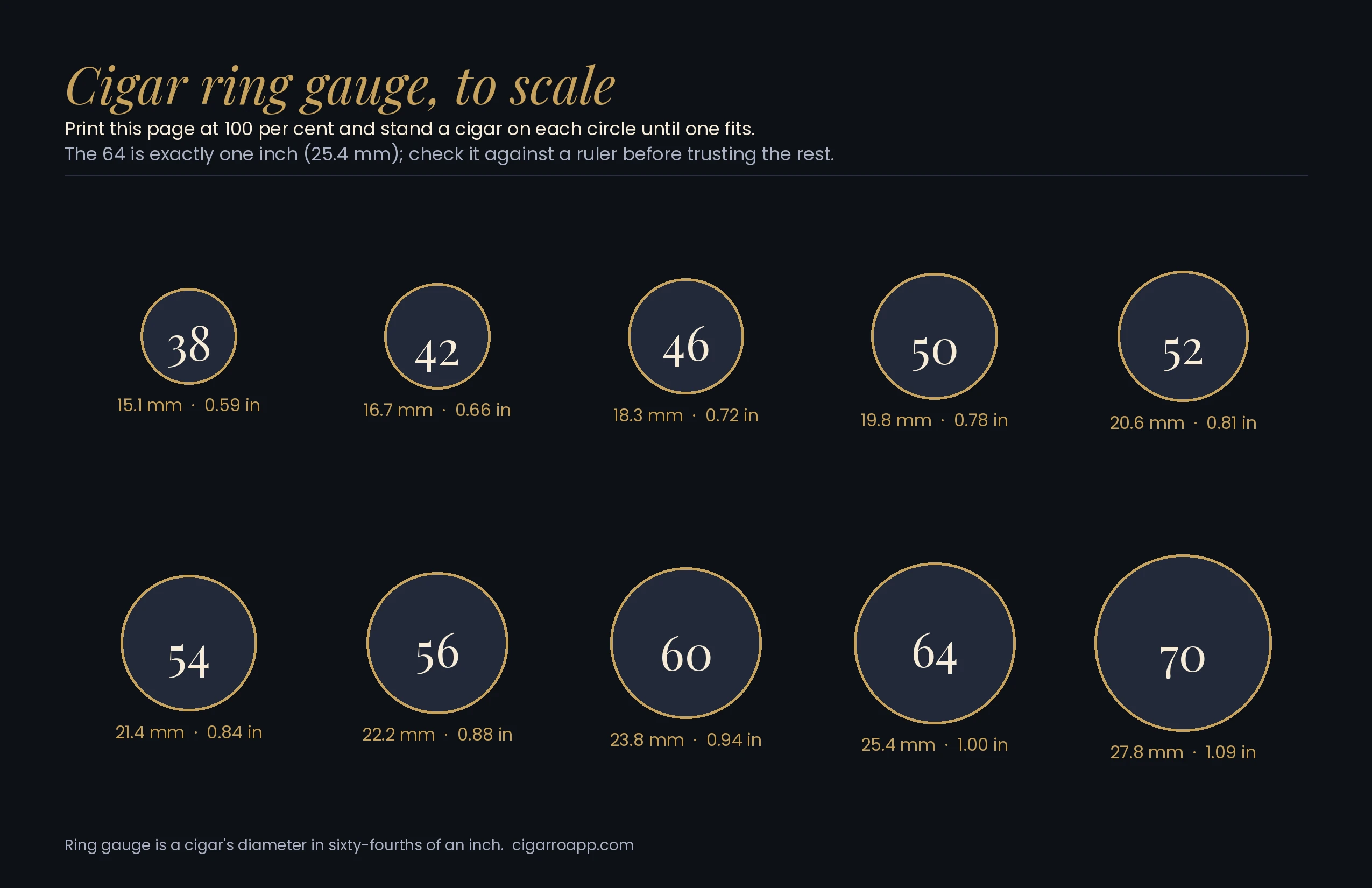
The last method is the chart on this page, printed. If your printer is set to 100 percent scale with no fit-to-page, the circles in the ring gauge chart print at their true diameters, and you can stand a cigar on each until one fits. Check the one-inch circle against a ruler before you trust the rest.
Box-pressed cigars are the exception to all of it. The gauge printed on the box is the round size the cigar was rolled at before pressing, so callipers across the flats will read low and across the corners will read high. Take both, average them, and you will land within a gauge of the label.
Which Cutter Fits Which Ring Gauge
This is the question the ring gauge number answers most usefully, and the one most guides skip. A cutter has a maximum opening, and a cigar that is wider than it will either be crushed at the cap or cut too shallow, which splits the wrapper on the first draw. Below 54 almost anything works. Above 60 the cutter wants choosing on purpose. For the mechanics of each cut, how to cut a cigar covers the straight cut, the V and the punch in turn.
| Cutter type | Typical maximum ring gauge | Notes |
|---|---|---|
| Standard double-guillotine | 54 to 60 | The everyday cutter. Many popular models are rated to 58 or 60, and a 60 fills the blades completely, so open them fully before you commit. |
| Large-ring double-guillotine | 62 to 80 | Colibri’s Cut is rated to 62. Xikar’s M8 takes a 70, and its X875 is built around a 75. Lotus’s Fury is rated to 76 and its Colossus to 80. |
| V-cutter | 54 to 60 on most, larger on the big-ring models | A V-cut suits fat cigars well, since the wedge opens the cap without removing the whole top, but check the blade width; a narrow V on a 60 gives a tight draw. |
| Punch | Any gauge the punch can reach | The punch does not care about the gauge, only the cap. On a 60 and above a single small punch gives a mean draw; my habit is a larger-diameter punch, or two overlapping holes. A punch will not work on a torpedo or any pointed head. |
| Scissors | 50 to 60, depending on the blades | Elegant, and fine for a corona or robusto. Few will open wide enough for a gordo. |
Cigar Aficionado tested the first wave of large-ring cutters in 2015 and found the 76 and 80 openings aimed squarely at people who mostly smoke fat cigars. My own rule follows from that: if you keep anything above a 60, keep one cutter sized for it and use your everyday cutter for the rest. A very wide opening gives a less controlled cut on a 42.
How Cigars Got Fat
For most of the last quarter century the market has drifted steadily wider, and the drift has dates. Cigar Aficionado has traced the timeline, and the milestones below are drawn from it.
| Year | Milestone |
|---|---|
| 1987 | Cuba Aliados releases The General, 18 inches by 66 ring, as a novelty |
| 1995 | Diamond Crown debuts with a line built around a 54 ring, every size at 54 or above, a figure considered thick at the time |
| 2001 | La Gloria Cubana’s Serie R No. 6, a 6 by 60, becomes the first nationally distributed cigar at that size |
| 2004 | Tatuaje’s Gran Cojonu, 6.5 by 60, brings the 60 to the boutique market |
| 2006 | Saint Luis Rey Serie G launches at 56, 58 and 60 |
| 2010 | Cuba joins in: Romeo y Julieta’s Wide Churchill at 55 and Cohiba’s Behike at 52, 54 and 56 |
| 2011 | Drew Estate’s MUWAT line is sold entirely at 60 ring; La Flor Dominicana’s Digger runs 8 by 60 |
| 2012 | E.P. Carrillo’s Inch line arrives at 60, 62 and 64, named for the one-inch diameter of its largest size, and Cigar Aficionado adds a Grandes category for anything 60 and above |
| 2013 | Asylum 13 ships a 7 by 70 and an 8 by 80 |
| 2016 | Cohiba’s 50 Aniversario at 60 ring becomes the only 60 Cuba has sold commercially, a run of 2,500 cigars in fifty humidors of fifty |
| 2019 | JFR’s Lunatic Gran Loco measures 5.5 by 80 |
| 2021 | Most major brands carry at least one 60 in the regular line |
Not everyone followed. A good many experienced aficionados hold that the finest wrappers show themselves most clearly in slimmer formats, and that a well-made forty-six reveals a leaf a sixty would smother. There is a fair case to it. A delicate Connecticut shade wrapper has more of a voice on a lancero than on a gordo rolled from the same tobacco. Cuba, for its part, has stayed conservative: the bulk of the Habanos catalogue still sits between 42 and 52, with a growing handful at 54 to 56 (the Wide Churchill, the larger Behikes, Trinidad’s Topes) and the 50 Aniversario as the lone outlier. Neither camp is wrong. A gordo and a lancero are simply asking for different evenings.
What About a 100 Ring Gauge Cigar?
A cigar can, in principle, keep growing forever, and every few years someone tests that principle in earnest. The hundred ring gauge cigar is not a myth or a marketing rumour. Aganorsa Leaf’s JFR Lunatic Maduro, officially called The Size That Shall Not Be Named, is a belicoso that measures ten inches long by a full hundred ring gauge, a diameter of nearly forty millimetres, wrapped in a dark Mexican San Andrés leaf over Nicaraguan binder and filler. Announced in 2023, it ships in a coffin box, production is capped at 2,500 a year, and at $39.99 it is priced more as a curiosity than an investment.
It is not even the largest cigar ever rolled. In November 2013 RoMa Craft Tobac produced a limited CroMagnon Femur at ten inches by a hundred and thirty-three and a third ring gauge, two hundred of them, each in its own coffin, a size that exists mainly to prove it can be done. Cigars at this scale are not really built for the humidor rotation. Few finish a hundred ring gauge cigar in a single sitting. They belong with the prize marrow at a village fete: worth admiring once, and a reminder that ring gauge, past a certain point, stops describing a smoke and starts describing a spectacle.
Choosing a Gauge for the Evening You Have
The most reliable way to pick is to start from the time you have, not the cigar you fancy.
| Time available | Gauge to reach for | Why |
|---|---|---|
| 40 to 50 minutes | 42, in a petit corona or corona length | Focused and wrapper-led; a complete cigar inside a lunch hour |
| 45 to 60 minutes | 48 to 50, a robusto | The cleanest read on a blend in under an hour |
| 60 to 90 minutes | 52 to 54, a toro, or a 47 Churchill | Length and width in balance; the blend has room to move through its thirds |
| An open evening | 56 to 60 | Cool and slow; the cigar sets the pace rather than the clock |
A few other habits worth borrowing. If you are new to cigars, a 46 to 52 is the forgiving band: wide enough to burn cool and draw easily, narrow enough that a mild blend does not vanish into volume. If you are choosing for a wrapper you love, go slim and let it speak. If you are outdoors on a breezy evening, the thicker cigar’s cooler, slower burn is easier to keep even, though no cigar enjoys a wind. And light the big ones with a torch rather than a soft flame; a foot the width of a 60 wants an even toast, and a single soft flame struggles to cover it. How to light a cigar shows the difference.
Ring gauge and the humidor
Width matters at rest as well as in the hand. A thicker cigar holds more tobacco at its core and comes to equilibrium with your humidor more slowly than a slim one, so a freshly arrived box of 60s tends to want a longer rest than a box of coronas before it smokes at its best. My own practice is to give anything over a 54 a fortnight more than the usual rest before judging it, and to note the gauge beside the rest date so the comparison is fair.
Capacity ratings work the same way. A humidor sold as a fifty-count assumes robustos; fill it with 60s and it holds nearer thirty-five, which is the number worth treating as the real limit. Cases and tubes are sized by gauge as well, and the classic leather three-finger case I carry, cut for 50s, will not close over a 56. If you keep a record in Cigarro, the humidor sorts by ring gauge as one of its six sort fields, so you can see at a glance how much of the shelf sits above a 54.
Common Questions on Ring Gauge
What is ring gauge on a cigar?
Ring gauge is a cigar’s diameter measured in sixty-fourths of an inch. A 50 ring gauge cigar is 50/64 of an inch, or 19.8 millimetres, across at its widest point. It is the second number in a cigar’s size, after the length in inches.
What is the most popular ring gauge?
In Cigar Aficionado’s 2025 retailer survey the toro was named best seller by two thirds of shops, with the robusto second. Those two shapes are mostly rolled at 52 and 50, which makes them the gauges you will meet most often. The 60 has become a regular-line fixture over the 2010s.
Is a bigger ring gauge stronger?
No. Strength comes from the blend, not the width. The section above on a wider gauge in the smoke explains why the same blend tends to read gentler in a 60 than in a 42.
What ring gauge is best for a beginner?
A 46 to 52, in a robusto or corona gorda length. It burns cool, draws easily, takes any cutter, and finishes inside an hour.
Why is ring gauge measured in 64ths of an inch?
Nobody has pinned down why the trade settled on sixty-fourths. The convention is American and old, and its one tidy consequence is that a 64 ring gauge cigar is exactly an inch wide.
Does ring gauge change how long a cigar lasts?
Yes, together with length. For the same length a thicker cigar lasts longer, because there is more tobacco and the burn is slower. On my own clock a 6 by 60 runs twenty to thirty minutes past a 6 by 50 from the same maker.
Bigger, Smaller, or Simply Yours
The number is a lever, not a verdict. The surest way to find your own preference is to notice it. Note the ring gauge beside your tasting notes, and after a dozen cigars a pattern tends to appear. Most enthusiasts are quietly loyal to a size long before they realise they have chosen one.