A cigar is an unusually good gift and an unusually easy one to get wrong. It carries occasion in a way few objects of the same price do, it is meant to be used rather than shelved, and it asks the giver to have thought about the person rather than the price. It also arrives with a hundred ways to misjudge it, most of which come down to buying something too strong, too rare, or too obviously chosen from a list of expensive things.
What follows is organised by occasion rather than by price, because the occasion decides almost everything: whether you want one cigar or twenty, whether the recipient will smoke it that evening or in a year, and how much of the pleasure is in the smoking and how much is in the handing over. Six occasions, two or three picks for each, all of them in regular production so nothing here is a cigar you cannot replace.
A word on the money. Prices are approximate single-cigar prices at United States specialist retailers, checked in September 2026, and they move. Canadian prices run substantially higher, often well over double, because federal excise duty and provincial tobacco tax stack on top of the shelf price, so read the bands below as relative rather than absolute. Cigarro accepts no sponsored cigars and no manufacturer or retailer consideration of any kind, which is the only reason a list like this is worth reading.
What Makes a Good Cigar Gift
Four rules cover almost every case, and they are worth stating before any brand names appear.
Buy for the recipient’s palate, not your own. This is the failure that ruins more cigar gifts than any other. An enthusiast who lives at the full-bodied end of the scale gives a full-bodied cigar to a friend who smokes twice a year, the friend spends an uncomfortable half hour and quietly concludes cigars are not for him. If you do not know what they smoke, aim mild to medium and you will almost never be wrong.
Buy something currently in production. A discontinued cigar or a limited release is a lovely thing to receive once and a frustration afterwards, because the recipient cannot go and buy another. Everything recommended here is regular production, which means it can be replaced, tracked down in a decent shop, and smoked again.
Match the format to the hour. A robusto is about forty-five minutes to an hour. A Churchill or a large toro is closer to ninety. A short perfecto is half an hour. Handing someone a ninety-minute cigar at a christening lunch is a small act of misjudgement, however good the cigar.
And give them the moment as well as the cigar. The best gift of this kind comes with no expectation that it will be smoked in front of you. Tell them what it is, mention that it is ready to smoke, and leave the evening to them. Our guide to cigar etiquette covers the rest of the small courtesies, most of which come down to not making a performance of it.
| Occasion | Pick | Body | Approx. price | Why |
|---|---|---|---|---|
| Wedding, groomsmen | Arturo Fuente Curly Head, lonsdale, Cameroon | Mild | About $4 | The genuine bulk pick, cheap enough for forty without wincing |
| Wedding, groomsmen | Romeo y Julieta 1875 Bully, robusto, Java wrapper | Mild | About $9 | A name everyone recognises, and gentle enough for occasional smokers |
| Wedding, groomsmen | H. Upmann 1844 Reserve, robusto, Ecuadorian | Medium | About $8 to $9 | A step up for a smaller party where a few guests actually smoke |
| A new father | Arturo Fuente Hemingway Short Story, perfecto, Cameroon | Medium | About $8 | Four inches, which matters when nobody has an hour to spare |
| A new father | Ashton Classic Magnum, robusto, Connecticut shade | Mild | About $13 | The classic hand-out cigar, forgiving on a night of no sleep |
| A new father | Rocky Patel Vintage 1990, robusto, Honduran wrapper | Medium | About $11 | More character than the usual mild default, still easy company |
| A promotion | Padron 1964 Anniversary Exclusivo, robusto, Nicaraguan | Medium | About $16 | The reference step up almost every smoker knows by name |
| A promotion | Oliva Serie V Melanio, robusto, Ecuadorian Sumatra seed | Medium | About $14 to $15 | Occasion weight without the price of the obvious choice |
| A promotion | Arturo Fuente Don Carlos No. 4, torpedo, Cameroon | Full | About $12 | For a recipient who already smokes seriously, not for a beginner |
| A thank-you | Romeo y Julieta 1875 Rothchilde en Tubo, robusto | Mild | About $10 to $11 | The tube means it needs no humidor at the other end |
| A thank-you | Oliva Serie G, robusto, Cameroon | Mild | About $8 | Modest enough to create no obligation, good enough to be noticed |
| A thank-you | Perdomo Reserve Champagne Epicure, toro, Connecticut shade | Medium | About $11 | A pale, polite cigar that suits an afternoon rather than an evening |
| A birthday, seasoned smoker | Padron Family Reserve No. 45, toro, Nicaraguan | Medium | About $32 | The collector’s tick, and still regular production |
| A birthday, seasoned smoker | Davidoff Winston Churchill, robusto, Ecuadorian Habano | Medium | About $24 | Refinement rather than power, which is the harder thing to buy |
| A birthday, seasoned smoker | Plasencia Alma del Campo Guajiro, robusto, Nicaraguan | Medium | About $19 | The one a jaded smoker may not have bought for himself |
| A first cigar | Oliva Connecticut Reserve, robusto, Ecuadorian Connecticut | Mild | About $9 to $10 | Gentle, well made, and forgiving of a first attempt at lighting |
| A first cigar | Macanudo Cafe Hyde Park, robusto, Connecticut shade | Mild to mild-medium | About $11 | The house standard for beginners, though ratings for it disagree |
| A first cigar | Montecristo White Rothchilde, robusto, Connecticut shade | Mild | About $14 to $16 | A recognised name, useful when the gift needs to look considered |
A Wedding, and the Groomsmen
A wedding is the one occasion where quantity is the constraint. You are buying for twenty or forty people, most of whom have never held a cigar, several of whom will light it badly, and a good number of whom will put it down half smoked. Spending heavily here is a category error. What you want is a cigar that is well made, gentle, and cheap enough that nobody feels bad about abandoning one.
The Arturo Fuente Curly Head is the honest answer at scale. A Cameroon-wrapped lonsdale from the Dominican Republic, mild, unfussy, made by a house nobody would call a budget operation, and available around four dollars a stick in the United States. Forty of them costs less than a case of decent champagne. If you want a name the guests will recognise on the band, the Romeo y Julieta 1875 Bully is a mild Dominican robusto in the region of nine dollars, which is the sweet spot when the box is going on a table for people to help themselves.
For a smaller wedding where a handful of the party actually smoke, the H. Upmann 1844 Reserve robusto is worth the step to medium. It has more to say than either of the above and still will not trouble anyone.
Two practical notes. Order in a box rather than as singles, because a sealed box arrives in condition and looks like an occasion when you open it. And buy a fortnight ahead rather than the week before, so the cigars have settled after the journey. If you want more options at the gentle end, our shortlist of mild cigars is built for exactly this problem.
A New Father
The tradition here is older than most of the customs attached to it, and the practical shape of it has changed. A new father is not going to sit down with a ninety-minute Churchill. He is going to have twenty minutes, at an odd hour, probably in a garden, probably very tired.
Which makes the Arturo Fuente Hemingway Short Story the most sensible cigar on this page. It is a four-inch Cameroon-wrapped perfecto, medium bodied, complete in half an hour, and it is one of the genuinely great small cigars. Around eight dollars, and the size is the point: he can actually smoke it before something needs him.
If the gift is going to be handed round rather than kept, the Ashton Classic Magnum is the traditional choice and deserves the reputation. A Connecticut shade robusto from the Dominican Republic, mild, immaculately constructed, around thirteen dollars, and forgiving of a man who has not slept properly in a fortnight. For someone who already smokes and would like more than politeness, the Rocky Patel Vintage 1990 robusto is a medium Honduran with real character at about eleven dollars.
Whichever you pick, buy five rather than one. A single cigar is a gesture, and five is a small supply that will still be there in three months when he finally gets an evening to himself.
A Promotion
A promotion wants a cigar with a name behind it. Not because the recipient is a snob, but because the gift is partly a statement that the achievement registered, and a cigar he has heard of does that work in a way an obscure boutique blend cannot.
The Padron 1964 Anniversary Series Exclusivo is the reference answer. A Nicaraguan robusto, medium bodied, box pressed, at around sixteen dollars, and it occupies a strange and useful position in the hobby: expensive enough to feel like an occasion, common enough that the recipient will recognise it immediately, and good enough that nobody has ever been disappointed by one. If you buy a single cigar for a colleague once a decade, buy this one.
The Oliva Serie V Melanio robusto is the alternative for about fourteen dollars, with an Ecuadorian Sumatra-seed wrapper and a fuller register than its rating suggests. And for a recipient who already smokes seriously, the Arturo Fuente Don Carlos No. 4 is a slim Cameroon-wrapped torpedo at around twelve dollars that retailers list as full despite its modest ring gauge. It is not a beginner’s cigar and it is not meant to be, which is rather the point when the gift is marking a step up. If your recipient lives at that end of the scale, our guide to full-bodied cigars has the wider field.
A Thank-You
The thank-you cigar is the most delicate of the six, because the amount matters more than the cigar. Too generous and you have created an obligation, which defeats the purpose. The target is something that reads as considered rather than expensive.
A single cigar in a tube is the neatest solution ever devised for this. The Romeo y Julieta 1875 Rothchilde en Tubo, a mild Dominican robusto in an aluminium tube at around ten dollars, can go in a coat pocket, needs no humidor at the other end, and survives a week on a hall table without any harm. That last point is the practical argument for tubed cigars generally: you are not asking the recipient to have storage they may not own.
If they do keep a humidor, the Oliva Serie G robusto at about eight dollars is a mild Cameroon-wrapped Nicaraguan that punches above its money, and the Perdomo Reserve Champagne Epicure at around eleven is a pale, polite Connecticut-wrapped toro that suits an afternoon rather than a late evening. Both are good without being grand, which is exactly the register a thank-you wants. Our round-up of Connecticut-wrapped cigars covers the shade-grown category in more depth.
A Birthday for a Seasoned Smoker
This is the hardest of the six, because the recipient can buy his own cigars and probably has. The instinct is to chase rarity, and it is the wrong instinct. A limited release he cannot replace is a small cruelty, and a cigar bought purely for its price is transparent.
Aim instead at the shelf just above where he shops for himself. The Padron Family Reserve No. 45 is the clean answer at around thirty-two dollars: a Nicaraguan toro, medium bodied, regular production, and the cigar most collectors have heard of, respect, and quietly do not buy for themselves because it is a Tuesday. That last clause is the whole logic of the gift.
The Davidoff Winston Churchill robusto at about twenty-four dollars makes a different argument. It is refined rather than powerful, Ecuadorian Habano over a Dominican core, and it suits a recipient whose taste has moved from strength towards subtlety, which is a journey most serious smokers make eventually. The Plasencia Alma del Campo Guajiro at around nineteen is the outside pick and often the most appreciated, since Plasencia grew leaf for other houses for five generations before putting its own name on a band, and it is the sort of cigar a jaded smoker may genuinely not have got round to.
If he is a devotee of the dark end, our guide to maduro cigars is a better hunting ground than any of the above, since maduro preference is specific enough to be worth respecting rather than guessing at.
A First Cigar for a Newcomer
Giving somebody their first cigar carries a small responsibility, because a bad first cigar is usually a last one. The two ways it goes wrong are strength, which makes people feel unwell, and construction, which makes them feel incompetent when a badly rolled cigar refuses to draw.
Shade-grown Connecticut wrapper is the sensible default for both problems. The Oliva Connecticut Reserve robusto at around nine dollars is mild, consistently well made, and cheap enough that a ruined first attempt costs nothing much. The Macanudo Cafe Hyde Park is the traditional house pick at about eleven dollars, though it is worth noting that its own maker calls the line mild while at least one large retailer lists it as medium, which is a neat illustration of how loose these words are. Treat it as mild to mild-medium and you will not be caught out.
If the gift needs to look considered as well as be sensible, the Montecristo White Rothchilde at around fifteen dollars is a mild Connecticut-wrapped robusto with a name the recipient will have heard, which matters more for a first cigar than experienced smokers tend to admit.
Give one cigar, not five. A newcomer with five cigars and no humidor has four drying out on a shelf. And send them something to read alongside it, because the mechanics are the part nobody explains: our guide to cigars for beginners covers what to buy next once the first one has gone well.
How to Present It
More of this gift lives in the handing over than most people expect, and the presentation costs almost nothing.
A single cigar wants a tube. Padron, Davidoff, Romeo y Julieta, Alec Bradley, Perdomo, Montecristo and Plasencia all sell tubed versions of regular lines, and a tube solves the two problems a loose cigar creates: it will not be crushed in a coat pocket, and it holds condition for weeks without a humidor. A cigar handed over in cellophane alone looks like something you had lying about, however good it is.
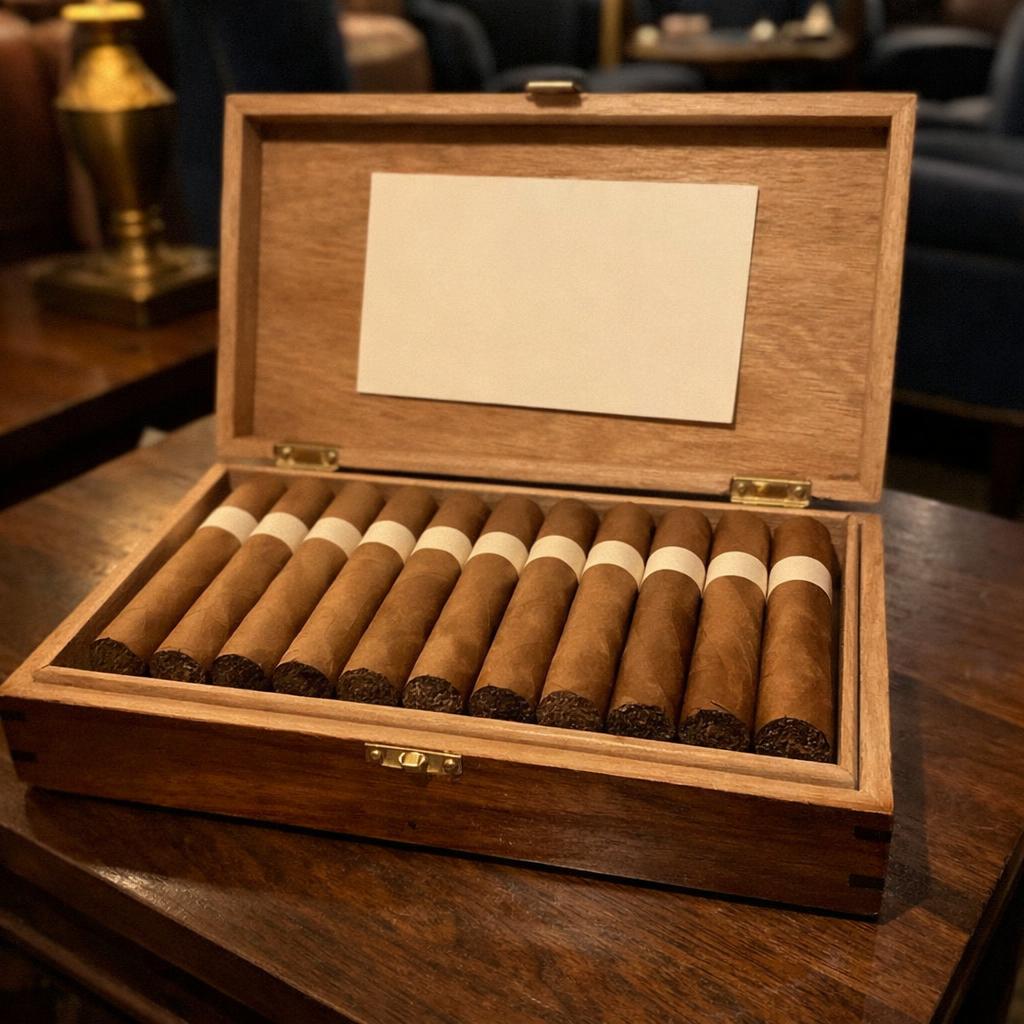
A box wants no help at all. A sealed box of twenty-five is already the most convincing packaging in the trade, and wrapping it in paper only obscures the thing that makes it impressive. Put it down closed and let the recipient open it.
Write the card. This is the part that turns a purchase into a gift and it takes two lines: what the cigar is, why you chose it for them, and when you think they might smoke it. A cigar with no explanation is a nice object. A cigar with a line about the promotion, or the wedding, or the year they have had, is the occasion itself.
And say nothing about when. The gift is finished the moment it changes hands, and the recipient owns the evening. Asking whether they have smoked it yet turns a present into an obligation, which is the one thing a cigar should never be.
Logging the Gift
Gifted cigars are the ones most likely to be smoked on a date worth remembering and least likely to be written down, which is a shame, because they are the cigars people most want to look up years later.
Logging one takes about ten seconds in Cigarro. The cigar goes into the humidor with the date it arrived and who gave it, so a box from a wedding stays identifiable as a box from that wedding rather than becoming twenty-five anonymous robustos on a shelf. When it is eventually smoked, the note records the evening as well as the cigar, and the two together are worth considerably more than either alone.
The recording itself follows the Cigarro Method, which scores strength, body and flavour separately at the first third, the second and the last. Forty seconds per third, no expertise required, and after a season it produces something no memory does: a reliable record of what you actually liked, which is precisely what you need the next time somebody asks what to buy you.
It also solves the giver’s problem in reverse. If the person you are buying for keeps their own log, ask them what their last five were. Ten seconds of looking beats an hour of guessing, and it is the single most useful thing anyone reading this page can do before spending the money.
Questions Givers Ask
What are the best cigars for a gift if I know nothing about cigars?
Aim mild to medium, buy a well-known house, and pick a robusto, which is about an hour and the most common size in any shop. The Ashton Classic Magnum, the Oliva Connecticut Reserve and the Romeo y Julieta 1875 are all safe in the sense that almost nobody dislikes them and nobody will be overwhelmed. Avoid anything described as full bodied unless you know the recipient smokes at that end, and avoid limited releases, because a cigar they cannot buy again is a frustration rather than a treat.
How many cigars should I buy for a wedding?
Roughly one for each guest you expect to smoke, plus a quarter again. In practice that usually means a box of twenty-five for a wedding of a hundred, since most guests will not take one and several who do will not finish it. Buy in a sealed box rather than as singles: it arrives in better condition, it costs less per cigar, and an open box on a table is a far better invitation than a tray of loose ones. Order a fortnight ahead so they settle after the journey.
How much should I spend on a cigar as a gift?
Between about eight and sixteen United States dollars a cigar covers almost every occasion on this page, and spending more rarely improves the gift. Bulk gifts for a wedding sit lower, around four to nine dollars, because quantity is the point. A milestone birthday for a committed smoker is the one case for going to twenty or thirty. Canadian buyers should expect substantially higher shelf prices, often well over double, because federal excise duty and provincial tobacco tax both apply.
Can I give someone Cuban cigars?
Not if you are buying in the United States. Cuban-origin merchandise remains prohibited under the Cuban Assets Control Regulations, with no personal-use allowance, so there is no lawful route to buying them there. In Canada, the United Kingdom and most of Europe they are sold openly and are a perfectly ordinary gift. Wherever you are, buy from an established tobacconist rather than an online bargain, since counterfeits are common and a fake is a poor present at any price.
Do I need to give a humidor with the cigars?
No, and for a single cigar it is usually the wrong instinct, because a humidor the recipient did not ask for becomes their maintenance problem rather than your gift. A tubed cigar solves the storage question entirely and keeps for weeks on a shelf. If you are giving a box to someone who has nowhere to put it, a sealed food-grade container with a two-way humidity pack is a more useful accompaniment than an unseasoned wooden box, and costs a fraction as much.
What is the best cigar gift for a father?
For a new father, something short: the Arturo Fuente Hemingway Short Story is four inches and finishes in half an hour, which is the realistic amount of time available. For a father with more leisure, match the cigar to what he already drinks and smokes rather than to the size of the occasion, and buy five of something good instead of one of something famous. A small supply he can return to beats a single cigar he feels obliged to save for a moment that never quite arrives.
The Gift Is the Attention
Every cigar above is a good cigar, and any of them would be received warmly. But the reason a cigar works as a gift has almost nothing to do with which one you choose and almost everything to do with the fact that choosing it required you to think about the person for ten minutes. Nobody remembers the ring gauge. They remember that someone stood in a shop and considered what they might like.
So pick from the occasion rather than the price, keep it gentle unless you know otherwise, stay with something they can buy again, and write the card. That is the whole method, and it works whether you are spending four dollars a stick for a wedding or thirty for a fiftieth birthday.
If the cigar comes back to you as a story afterwards, write that down too. Cigarro is free to start, a gifted cigar takes about ten seconds to log with the date and the giver, and a record of the ones that meant something is a better collection than a shelf of the expensive ones.