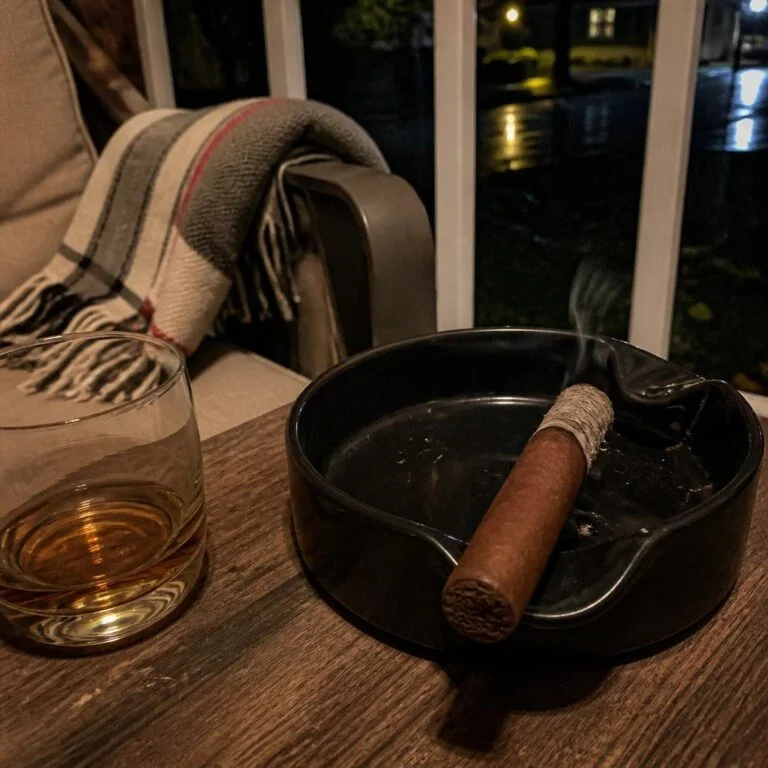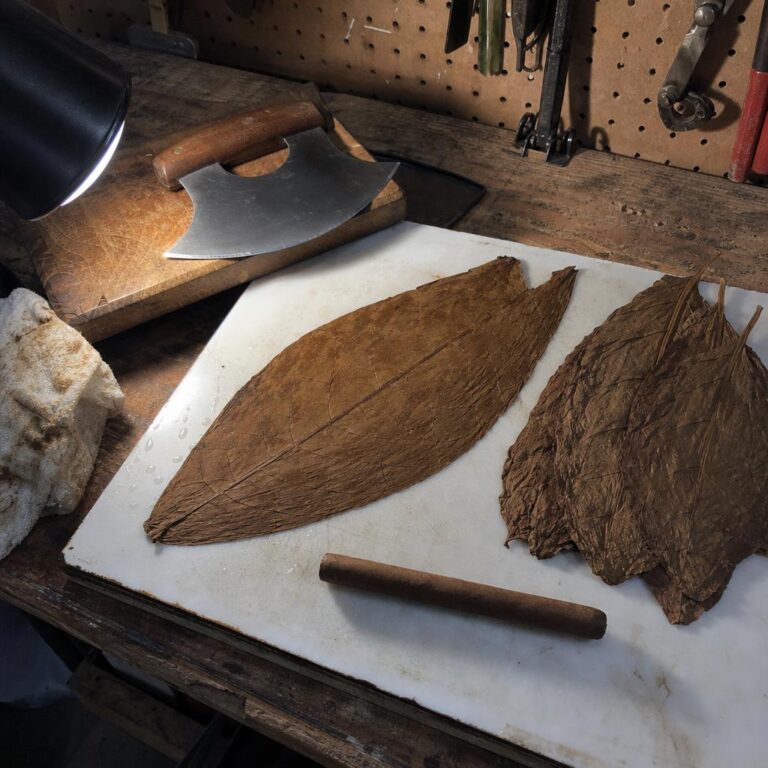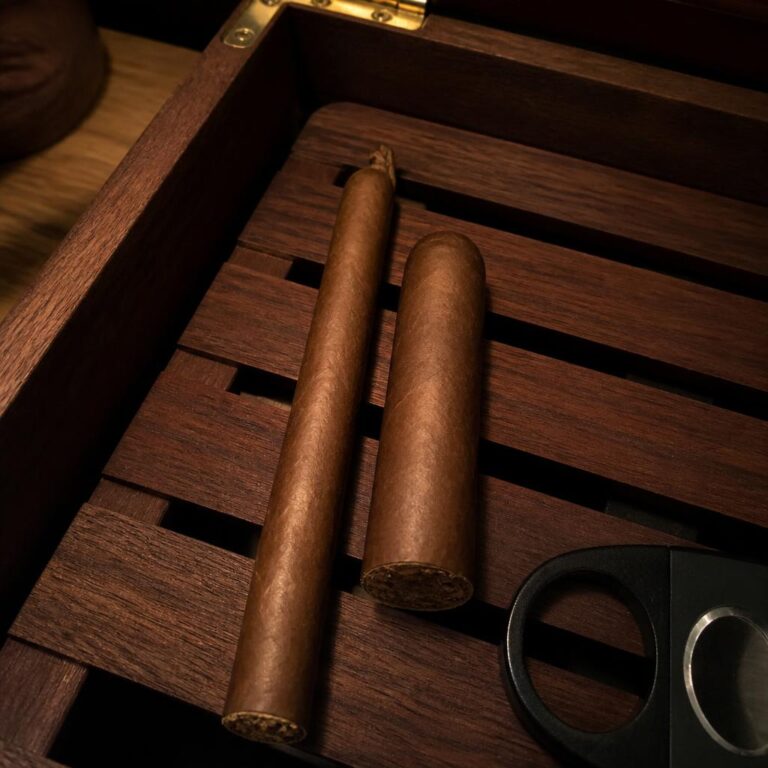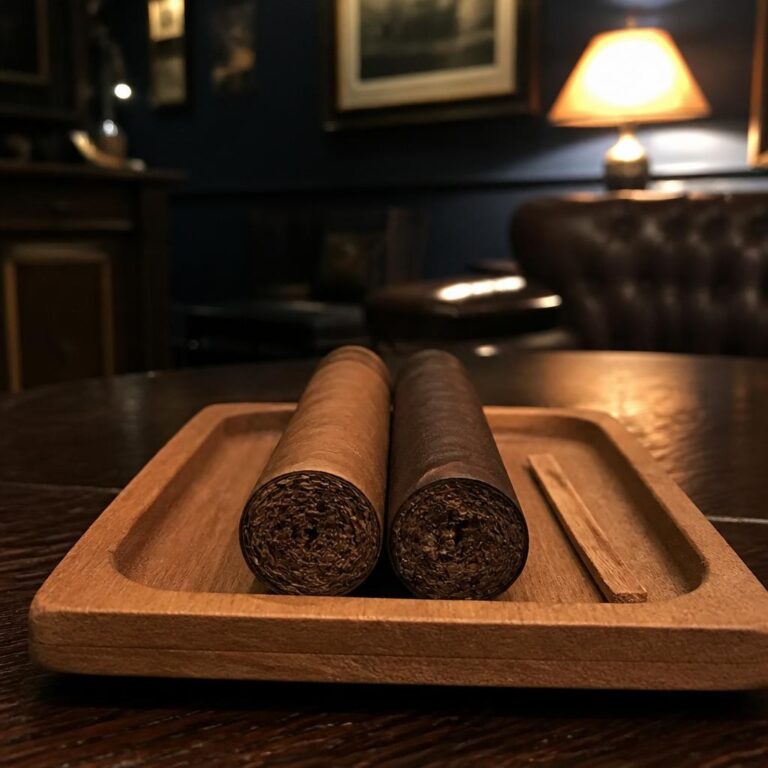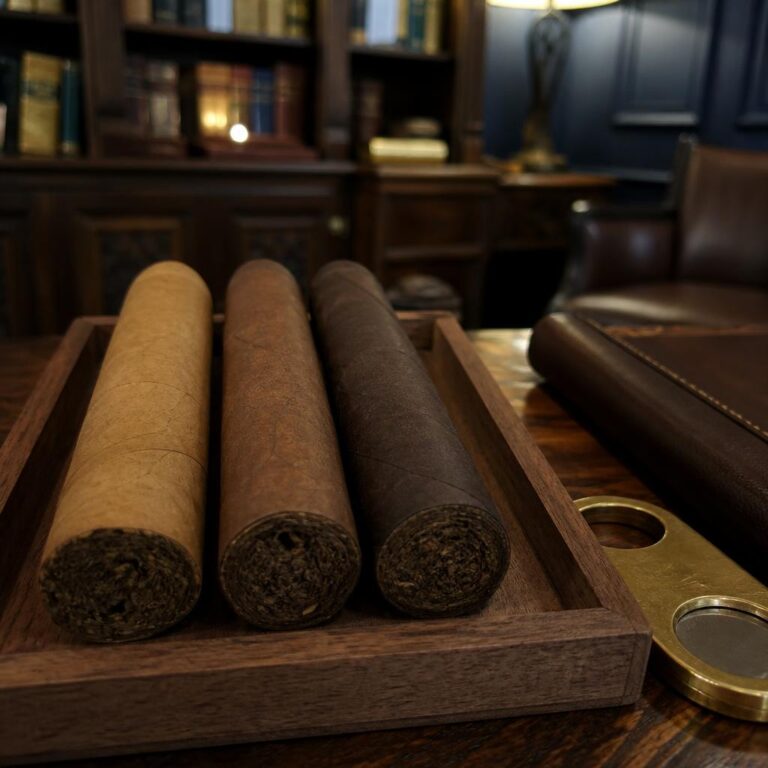
A Churchill is a cigar of seven inches by 47 ring gauge, the size the Romeo y Julieta factory in Havana calls a Julieta No. 2, and it takes between seventy and ninety minutes to smoke well. Cigar Aficionado’s tasting panel counts anything from 6 3/4 to 7 3/8 inches with a ring of 47 or more as a Churchill, which is why the shelf now carries 7 x 48s, 7 x 50s and the odd 7 x 54 under the same name. This guide names eighteen Churchills worth that hour, with sizes, blends, body, scores and current prices from specialist merchants, then covers what the other lists leave out: how long the cigar really takes, where the Churchill stops and the double corona begins, why the shops gave up on the size, and how to smoke seven inches without the final third getting away from you.
If you want the short version: the Padrón 1964 Anniversary Diplomático is the benchmark, the Brick House Churchill is the everyday one, the H. Upmann Sir Winston is the Cuban argument, and the Perdomo Champagne Churchill is the gentle hour. The full eighteen run from under ten dollars a stick to a Davidoff that costs what a decent lunch does, and three Habanos quoted in pounds from legal British retail. Every cigar here was smoked and logged in thirds, the way The Cigarro Method teaches, because a Churchill’s three thirds are twenty-five minutes apiece and a blend has nowhere to hide across that distance.
Eighteen Churchills in one table
The table below is every pick on this page in one place, sorted by lane. Prices are per stick on 3 November 2026, box maths where only a box was listed, and the Habanos are in pounds from British retail because an American reader cannot buy them lawfully at home; our country-by-country guide to Cuban cigar law explains the law, and Behind the choices, at the foot of the page, has the method. The minutes column is my own estimate at a draw a minute, from my logs, and the next section explains why it is a range; the Hemingway sits with the 47s because a perfecto tapers at both ends. Canadian readers should add duty and provincial tax to every figure and expect the result to sting.
| Cigar | Size | Wrapper | Body | Cigar Aficionado | Price per stick | Minutes at a draw a minute | Lane |
|---|---|---|---|---|---|---|---|
| H. Upmann Sir Winston | 7 x 47 | Cuban | Medium to light | 94, No. 5 of 2018 | GBP 55.60 to 68.87 (listed, out of stock) | 70 to 80 | Cuban corner |
| Romeo y Julieta Churchills | 7 x 47 | Cuban | Medium | 90 (2019) | GBP 61.49 (listed) | 70 to 80 | Cuban corner |
| Cohiba Esplendidos | 7 x 47 | Cuban | Medium to full | 93, No. 11 of 2014 | GBP 136.22 (listed, out of stock) | 70 to 80 | Cuban corner |
| Padrón 1964 Anniversary Diplomático | 7 x 50 box-pressed | Nicaraguan, natural or maduro | Medium to full | Maduro 94, No. 4 of 2013; natural 92 (2026) | $18.70 | 75 to 85 | Benchmark |
| My Father Le Bijou 1922 Churchill | 7 x 50 | Nicaraguan Habano Oscuro | Medium to full | 94, No. 7 of 2022 | $13.20 (listed, out of stock) | 75 to 85 | Benchmark |
| Oliva Serie V Churchill Extra | 7 x 52 | Sun-grown Habano | Medium to full | 95, No. 5 of 2022 | $14.55 | 80 to 90 | Benchmark |
| La Aroma de Cuba Mi Amor Churchill | 7 x 50 | Mexican San Andrés | Medium to full | 92 (2022) | $9.96 (box maths) to $10.50 | 75 to 85 | Benchmark |
| Arturo Fuente Hemingway Classic | 7 x 48 perfecto | Cameroon | Medium | 92, No. 7 of 2009 | $11.52 (box maths) to $12.60 | 70 to 80 | Benchmark |
| Highclere Castle Victorian Churchill | 7 x 48 | Ecuadorian Habano | Medium | 88 (2025) | $17.30 | 75 to 85 | Benchmark |
| Davidoff Winston Churchill The Original Series Churchill | 6 7/8 x 47 | Ecuadorian Rojiza | Medium | 87 (2025) | $29.20 (box maths) | 70 to 80 | Benchmark |
| Brick House Churchill | 7 1/4 x 50 | Ecuadorian Havana | Medium | 93, No. 10 of 2024 | $9.32 (box maths) to $9.85 | 80 to 90 | Everyday |
| Oliva Serie G Churchill | 7 x 50 | Cameroon | Medium | 91 (2025) | $8.06 (box maths) to $10.90 | 75 to 85 | Everyday |
| Rocky Patel Vintage 1990 Churchill | 7 x 48 | Honduran Broadleaf | Medium | 92 (2026) | $10.85 (box maths) to $11.45 | 75 to 85 | Everyday |
| Drew Estate Undercrown Maduro Corona Doble | 7 x 54 | Mexican San Andrés | Full | 91 (2025) | $14.35 | 80 to 90 | Everyday |
| Perdomo Reserve 10th Anniversary Champagne Churchill | 7 x 54 | Ecuadorian Connecticut, bourbon-barrel aged | Mellow to medium | Not rated | $11.00 (box maths) | 80 to 90 | Gentle |
| Camacho Connecticut Churchill | 7 x 48 | Ecuadorian Connecticut Shade | Mild to medium | 90 (2019) | $10.00 (box maths) | 75 to 85 | Gentle |
| Macanudo Café Prince Philip | 7 1/2 x 49 | US Connecticut Shade | Mild to medium | 88 (2015) | $9.22 (box maths) to $12.45 | 80 to 90 | Gentle |
| Ashton Classic Churchill | 7 1/2 x 52 | US Connecticut Shade | Mild | 86 (2023) | $13.96 (box maths) | 80 to 90 | Gentle |
Twelve of the eighteen cost under fifteen dollars a stick and only the Davidoff and the Habanos pass twenty, which is worth saying at the top because the Churchill has a reputation as an expensive size that the prices do not support. Divide the price by the minutes column and the Serie G and the Brick House come in at ten to fourteen cents a minute, the Padrón at about twenty-three cents and the Cohiba at the better part of two pounds; a Churchill is the cheapest hour in cigars once you stop counting sticks. Only three cigars on the list are the true 7 x 47 of the Cuban factories. Nothing here is a limited edition or a seasonal release. Every cigar is in regular production, so one that is out of stock on the day comes back, which matters more for a size you smoke on occasion than for one you smoke on Tuesdays.
The long hour
The one thing everybody knows about a Churchill is that it takes a long time, and the one thing nobody agrees on is how long. Holt’s puts a 7 x 49 at about an hour, against forty-five to fifty minutes for a 5 x 50 robusto and fifty-five minutes to an hour for a 6 x 52 toro, with a double corona past an hour and a quarter. Famous Smoke’s Cigar Advisor has the same Churchill at anywhere from ninety minutes to two hours, and its 2024 pacing guide talks about getting ninety minutes out of a Fuente Churchill. Cigar Aficionado’s glossary gives no Churchill figure at all, only a robusto at twenty to thirty minutes and a double corona at over an hour. On my own logs the ladder runs forty-five minutes for a robusto, sixty for a toro, seventy to ninety for a Churchill and past the hour and a half for a double corona, all at a draw a minute. Those are the trade’s own numbers beside mine, and the gap between them is not a mistake. It is the pace.
Holt’s and Cigar Advisor both land on one or two draws a minute as a civilised rate, with thirty to sixty seconds between them, and Holt’s warns that getting through a toro or a Churchill in under half an hour makes the cigar harsh. A seven-inch cigar at one draw a minute is a cigar of seventy to ninety minutes, depending on its ring. The same cigar at two draws a minute is an hour’s cigar and a hotter one. Ring gauge moves the figure a little, since a 54 carries more tobacco per inch than a 47, but far less than cadence does. So when a list tells you a Churchill lasts an hour, it is describing a brisk hour, and when another says two, it is describing an evening with a book. Both are true of the same stick. The honest answer for the eighteen above is seventy to ninety minutes at the pace I keep, with the 7 x 54s at the long end and the 7 x 47 Habanos, which draw more freely, at the short end. Our guide to how long a cigar takes has the full table by size.
That hour is the whole point of the format, and it is also the whole risk. A Churchill is three thirds of twenty-odd minutes each, which is long enough for a blend to open, settle and then do something new. Holt’s makes the useful observation that the first half of a Churchill tastes milder than the same blend in a robusto because the smoke travels further through unburnt tobacco and arrives cooler; the final third, when that cooling column is gone, is where a Churchill either rewards you or punishes you. My own practice is to log the three thirds separately on every long cigar, with a line of notes on each, and to look at the Cigar Signature the app draws across them afterwards. A cigar whose strength line climbs steeply from the second third to the last is one I will buy again for after dinner and never for lunch. A cigar whose lines stay flat for seventy minutes is a cigar that should have been a robusto.
A Churchill also wants a drink that lasts as long as it does: a large pour of something you sip, not a cocktail finished by the first third. My own habit is a dry oloroso sherry with the three Habanos, whose dry wood and light sweetness it flatters without covering, a dark rum with the San Andrés and maduro cigars, and black coffee, kept topped up, with the Connecticut-shade Churchills at the gentle end, and nothing to eat beyond a few salted almonds, since a Churchill is the course. Our guide to pairing cigars with drinks goes through the choices by cigar and by glass.
The Cuban corner
The Churchill is a Cuban invention and three Habanos belong on any serious list. All three are the factory’s Julieta No. 2, 178 millimetres by 47 ring, a diameter of 18.65 millimetres, which is the size everything else on this page is measured against. Cigar Aficionado’s own account of the format’s history, written by David Savona in 2018, says the size was named for Winston Churchill but that the timing is disputed: many believe it was created at the Romeo y Julieta factory in the late 1940s after a visit by Churchill, who favoured the brand, while others say the name first appeared on Romeo y Julieta cigars in the 1950s. Habanos S.A. itself dates the honour to his Havana visit of 1946. What is not disputed is that a Romeo y Julieta Clemenceau, named for the French statesman, existed first at exactly the same dimensions and is no longer made, and that the Punch and Hoyo de Monterrey Churchills have since been discontinued too. Our guide to every Habanos marca has the wider family.
The H. Upmann Sir Winston is the hardest of the three to find. Cigar Aficionado called it one of the last Cuban Churchills in the Habanos portfolio when it placed the cigar fifth in its Top 25 of 2018 at 94 points, and rated it 92 in 2023. Habanos lists H. Upmann as medium to light, which undersells the Sir Winston a little; it is the most refined cigar on this page, with a long dry-cedar and cream register that does not tire across eighty minutes, and it is the cigar I would hand a Cuban sceptic. Two British retailers listed singles between 55.60 and 68.87 pounds on 3 November 2026 and both were out of stock, which tells its own story.
The Romeo y Julieta Churchills is the original article, the brand’s best known vitola and the cigar Churchill the man actually smoked; Cigar Aficionado’s 1995 profile of him names Romeo y Julieta and La Aroma de Cuba as his brands. The modern cigar is medium bodied, rated 90 by Cigar Aficionado in 2019, and it was listed at C.Gars Ltd at 61.49 pounds a single. It is less consistent than the Sir Winston, and a good one is worth two indifferent ones, which is the Cuban bargain in a sentence. The Cohiba Esplendidos is the trophy: created in 1989 for the Línea Clásica, rolled at El Laguito and, Cigar Aficionado notes, now at other factories too, medium to full, 93 points and eleventh in the Top 25 of 2014, 93 again in late 2023. The one British listing I found was 136.22 pounds a stick and sold out. At that money it is a cigar for an occasion with a name, and I would want to have seen the box myself. If you buy one Habano from this lane, buy the Sir Winston and wait for stock.
The seven benchmarks
The Padrón 1964 Anniversary Diplomático is the Churchill I would use to explain the format to someone who has only smoked robustos. Seven inches by 50, box-pressed, Nicaraguan throughout and aged four years in every leaf, from a line Padrón launched in 1994 for the company’s thirtieth anniversary and rolls at Tabacos Cubanica in Nicaragua. The maduro placed fourth in Cigar Aficionado’s Top 25 of 2013 at 94 points and the natural took 92 in February 2026; both were $18.70 a single at Neptune on 3 November. It is medium to full, it is cocoa and coffee and a little black pepper from the first inch to the last, and it does the one thing a seven-inch cigar must do, which is to change without ever becoming a different cigar.
The My Father Le Bijou 1922 Churchill is the fuller argument. Seven by 50 in a Nicaraguan Habano Oscuro wrapper the Garcías call pelo de oro, over Nicaraguan binder and filler, introduced in 2009 as the house’s second core line and named for the year José Pepín García’s father was born. Cigar Aficionado gave it 94 points and seventh place in the Top 25 of 2022, and JR listed singles at $13.20 but was out of them. It is the most powerful of the benchmarks and the benchmark that most needs the full hour, because the first third is all dark fruit and the last is all pepper and leather, and a Churchill is the only size where you get both in one sitting. The Oliva Serie V Churchill Extra is the showpiece of the group: 7 x 52, a sun-grown Habano wrapper over Nicaraguan binder and filler with Jalapa ligero, 95 points and fifth in the Top 25 of 2022, and $14.55 a single at Neptune. It is medium to full and sweeter than the Le Bijou, with the Serie V’s signature of caramel over spice, and the extra five points of gauge over the 7 x 47s give it a slower, cooler burn.
The La Aroma de Cuba Mi Amor Churchill is the value benchmark and the historical joke, since Churchill smoked the original La Aroma de Cuba and this one is a Mexican San Andrés wrapper over Nicaraguan tobacco made for Ashton at My Father in Estélí since 2010. Cigar Aficionado rated the Churchill 92 in 2022 and the line’s Magnifico took sixth place in the Top 25 of 2010. Neptune listed singles at $10.50 and was out of them; JR listed boxes at $9.96 a stick, on backorder. It is medium to full, chocolate and earth, and at the money it is the best after-dinner Churchill on this page. The Arturo Fuente Hemingway Classic is the odd shape in the lane and the one I smoke most often: a 7 x 48 perfecto with a Cameroon wrapper over Dominican binder and filler, from the series Carlos Fuente Sr. revived in 1983 using old moulds found in a warehouse in Ybor City, Florida. Cigar Aficionado placed it seventh in its Top 25 of 2009 at 92 points and it was $12.60 a single at Neptune. The tapered foot lights in seconds and the first third is the gentlest on the list; by the swell at the middle it is a proper medium cigar, and the Cameroon sweetness runs the whole way.
Two more belong here on character rather than score. The Highclere Castle Victorian Churchill, 7 x 48, is Nicholas Melillo’s blend for the Earl of Carnarvon’s house: an Ecuadorian Habano wrapper over a Brazilian Mata Fina binder and Nicaraguan filler from Estélí, Jalapa and Ometepe, rolled at A.J. Fernández in Estélí since 2019. Cigar Aficionado has it at 88 and medium, Neptune at $17.30, and it is the most English-tasting cigar on the page, dry and leathery with a little black tea, which is exactly right for a format named for an Englishman. And the Davidoff Winston Churchill The Original Series Churchill is the one that carries the man’s name by arrangement: the line was created with his grandson Winston Spencer-Churchill, and this blend is its 2015 relaunch. It is 6 7/8 by 47, Davidoff’s own figure, an Ecuadorian Rojiza wrapper over a Mexican San Andrés binder and Dominican and Nicaraguan filler, made at Cigars Davidoff in the Dominican Republic. Cigar Aficionado scored it 87 in 2025 and JR’s box of twenty worked out at $29.20 a stick. It is a correct, well-made cigar at a price that is mostly the band, and I include it because it is the Churchill most readers will be offered first. The Padrón at under nineteen dollars is the better cigar, and if you buy one benchmark, it is the Padrón.
The everyday Churchills
A Churchill you smoke twice a month should not cost twenty dollars, and three of the four below cost around ten. The Brick House Churchill from J.C. Newman is the box purchase: 7 1/4 by 50, an Ecuadorian Havana wrapper over Nicaraguan binder and filler, rolled at the family’s PENSA factory in Estélí, medium bodied, from a brand that started in Cleveland in 1937 and was revived as a Nicaraguan cigar in 2009. Cigar Aficionado placed the Churchill tenth in its Top 25 of 2024 at 93 points, and eighteenth in 2022, and Neptune had singles at $9.85 with Mike’s box of twenty-five at $9.32 a stick. The quarter-inch of extra length is a small gift. It is the Churchill I keep most of, and if you buy one box from this page, make it this one.
The Oliva Serie G Churchill is the Cameroon one, 7 x 50 over Nicaraguan binder and filler, medium, 91 points from Cigar Aficionado in April 2025. Mike’s had singles at $10.90 and a box of twenty-four at $8.06 a stick, which is the cheapest per-stick figure on this page. It is the cigar for a long afternoon in the garden, nutty and gently sweet, and it never gets loud. The Rocky Patel Vintage 1990 Churchill is the old-fashioned one: 7 x 48, a Honduran Broadleaf wrapper the maker says was aged twelve years, over a Nicaraguan binder and Dominican and Nicaraguan filler, made in Honduras, medium and leaning mild in Patel’s own words. Cigar Aficionado gave the Churchill 92 in its August 2026 issue, and Neptune had singles at $11.45. It smokes like a cigar from an older, slower school, cedar, soft leather and a dusting of cocoa that never sharpens, which is what a Churchill ought to do.
The fourth is a confession. The Drew Estate Undercrown Maduro Churchill, a 7 x 48 added in 2016 that made the bottom of Cigar Aficionado’s Top 25 of 2017, has disappeared from the current retailer listings I checked, so the Undercrown at Churchill length is now the Corona Doble, 7 x 54. It is a Mexican San Andrés wrapper over a Connecticut stalk-cut Habano binder and Nicaraguan and Brazilian Mata Fina filler, full bodied, 91 points from Cigar Aficionado in February 2025, and $14.35 a single at Mike’s. By the tasting definition a 7 x 54 is a Churchill and by the Cuban one it is nothing of the kind, but it is the darkest, sweetest hour on the list and my December cigar.
The gentle end
A mild Churchill is a particular pleasure and a particular trap. Eighty minutes of a Connecticut-shade cigar is lovely in the right mood and a long time to spend with a cigar that has nothing to say, so the four here were chosen for having something to say quietly. The Perdomo Reserve 10th Anniversary Champagne Churchill is 7 x 54, an Ecuadorian Connecticut wrapper aged in bourbon barrels over Nicaraguan binder and Cuban-seed Nicaraguan filler, from the line Perdomo launched in 2004 and the first of its cigars to use the barrel-aged wrapper. JR rates it mellow to medium and had boxes of twenty-five at $11.00 a stick; Cigar Aficionado has not rated the Churchill, which is why the table says so. It is creamy, a little toasty from the barrel, and it is the cigar I give a guest who has asked for something mild and has an evening to spend on it. If you buy one from this lane, the Perdomo.
The Camacho Connecticut Churchill is the Honduran answer: 7 x 48, an Ecuadorian Connecticut shade wrapper over a Honduran corojo binder and Honduran and Dominican filler, mild to medium, from the line Camacho introduced at the 2009 trade show. Cigar Aficionado gave the Churchill 90 in 2019, and JR’s box of twenty worked out at $10.00 a stick. It has more pepper than a Connecticut usually carries, which is the Camacho house style and the reason it holds interest over an hour. The two classics finish the lane, and both come with a footnote. The Macanudo Café Prince Philip is 7 1/2 by 49 in a US Connecticut shade wrapper over a Mexican binder and Dominican and Mexican filler, mild to medium, made by General Cigar in the Dominican Republic; Neptune had singles at $12.45 and Mike’s boxes at $9.22 a stick. The Ashton Classic Churchill is 7 1/2 by 52, US Connecticut shade over Dominican binder and filler, mild, made for Ashton by Tabacalera A. Fuente; JR’s cedar chest of twenty-five came to $13.96 a stick. Both run past Cigar Aficionado’s 7 3/8-inch upper limit, and half an inch past the Cuban seven, and the magazine files both as double coronas when it rates them, 88 for the Macanudo in 2015 and 86 for the Ashton in 2023. They are on this page because the shops call them Churchills and because, for a mild cigar, the extra length is the point: the Ashton in particular is the gentlest ninety minutes in the trade. Our shortlist of mild cigars goes further down this road.
The Churchill's borders
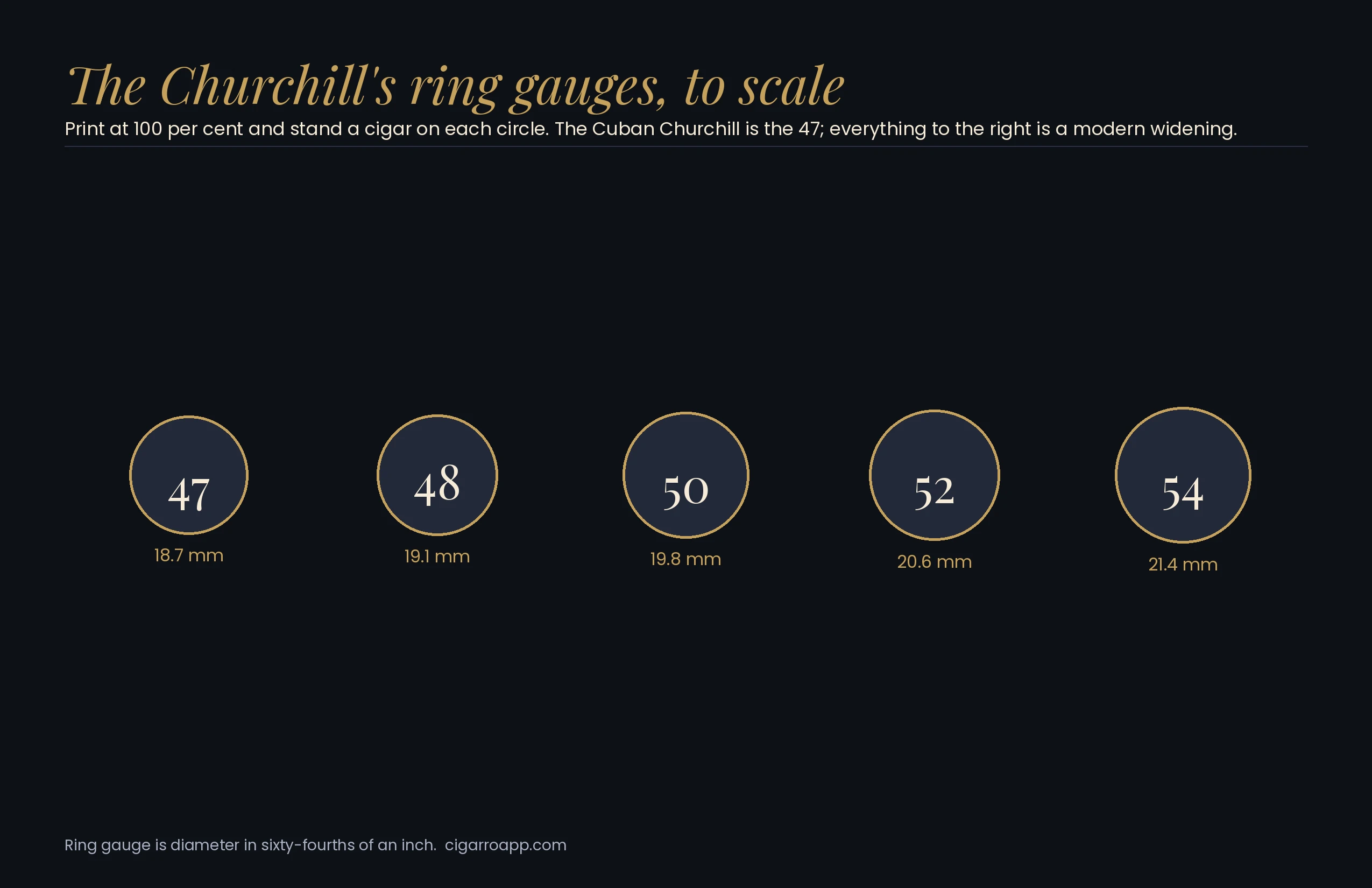
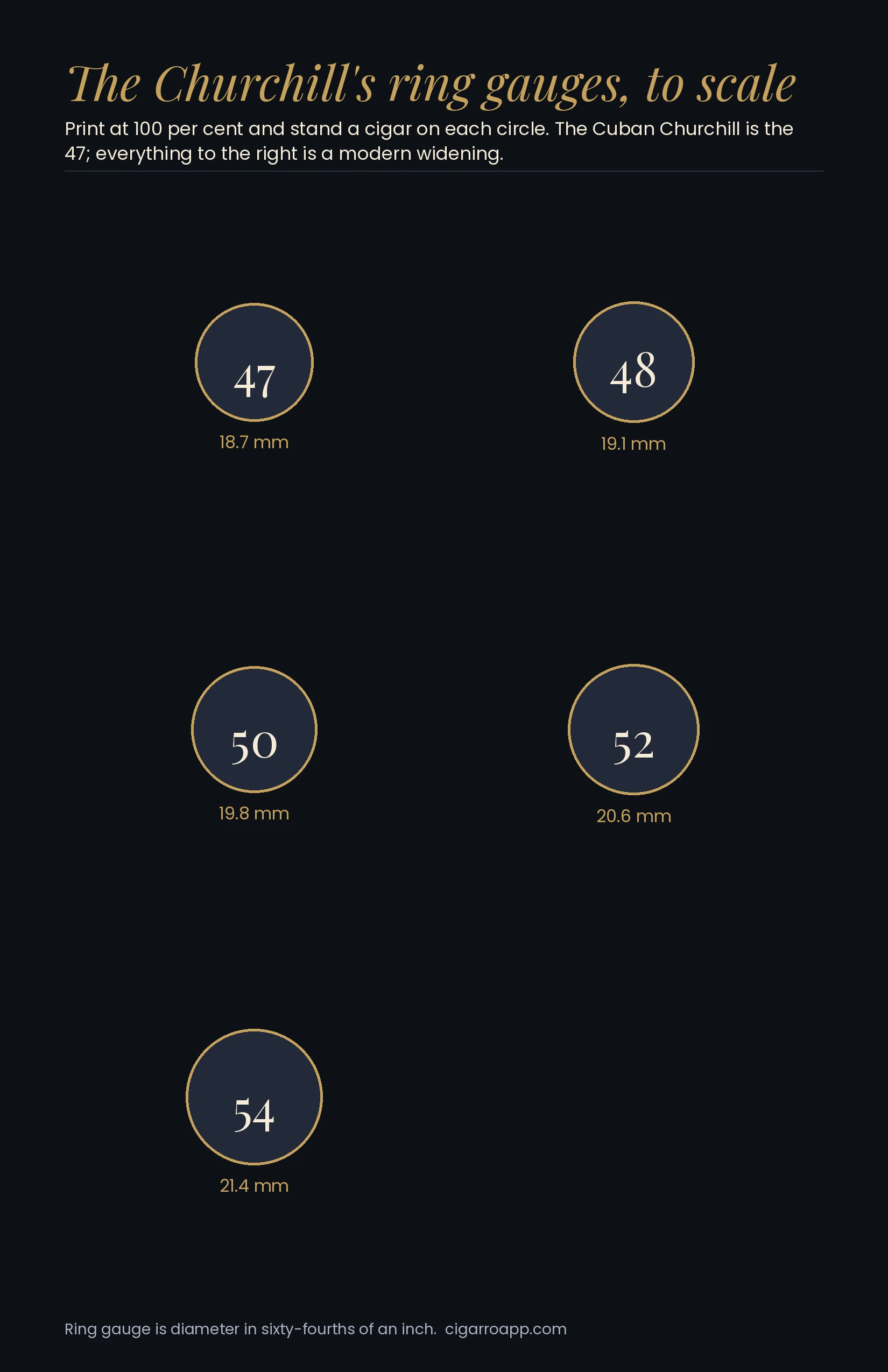
Seven points of ring gauge is under three millimetres of diameter, and most of that widening is recent.
Several sizes get sold as Churchills that are not, and the Undercrown above is a Churchill sold as a Corona Doble, so it is worth drawing the lines. The Cuban factory standard is 7 inches by 47. The magazine’s wider range, quoted at the top, admits the 7 x 48s, the 7 x 50s and the 7 x 54s on this page. Holt’s draws it at a technical minimum of 6 3/4 by 47 with 7 x 48 and 7 x 49 as the conventional figures. Above the line sits the double corona, which Cigar Aficionado defines as 7 1/2 to 8 1/2 inches by 49 to 52, the Cuban Prominente at 194 millimetres by 49; the two 7 1/2-inch classics at the gentle end are double coronas wearing the smaller name. Our vitola dictionary has every size in the family, and the ring gauge guide explains why 47 to 54 is less of a jump than it sounds.
Below the line sit Romeo y Julieta’s own spin-offs, which borrow the name and not the size. The Short Churchills, launched by Habanos in February 2006, is 124 millimetres by 50, the factory’s robusto in a Churchill band. The Wide Churchills of 2010 is 130 millimetres by 55, the Montesco vitola, and the first Habano at a 55 ring. Cigar Aficionado’s verdict is blunt: the Short, Wide and Petit Churchills really are not Churchills at all. They can be very good cigars. They are not an hour.
What the ring does to the smoke is the more useful question, and it is why the circles above are drawn to scale. A 47 at seven inches is a slender cigar with a high ratio of wrapper to filler, so the wrapper leaf has a larger say in the flavour and the draw tends to run freer and the burn faster; that is the Habanos house style and it is why the three Cubans feel lighter and quicker than their body ratings suggest. A 52 or a 54 at the same length carries noticeably more filler per inch, burns cooler and slower, and lets a blender fold in more leaves. Stanford Newman put the case for girth to Cigar Aficionado as far back as 2002, saying a thicker ring lets you blend five or six different leaves and make a better cigar, and the market agreed with him. Whether you do is a matter for your own palate, and the way to settle it is to smoke a 7 x 47 and a 7 x 52 from the same house a week apart and compare your notes on each third. Our comparison of the Churchill, the toro and the robusto is the shorter version of this argument.
The empty Churchill shelf
Here is the number that explains the empty Churchill shelf. Every year Cigar Insider asks American tobacconists which size sells best in their shop. In 2020 the toro took the top spot from the robusto, which had held it for about twenty-five years, at 51.7 per cent of retailers against the robusto’s 24.1. By 2023, across 81 retailers running 291 shops, the toro was at 69.2 per cent and the Churchill at 1.2. In 2024 the toro reached 75.8 and the Churchill 1.5. In the 2025 survey, published in January 2026, the toro took 66.2 per cent, the robusto 16.9, the big grandes 10.8, and not one retailer named the Churchill as a best seller. The magazine’s own gloss has not changed in five years: fat is a selling point and slim does not sell, buyers want bang for their buck, and finding a Churchill, a corona or a lonsdale in a shop humidor has become a real challenge. Cigar Advisor adds the obvious: the size costs more and takes longer, and most people smoke on a schedule that does not allow either.
The Churchill is no worse a cigar for any of that, but it has become one you choose on purpose, and that changes how you buy it. Three habits follow. I buy Churchills online or from a shop that keeps a long humidor, because a shop that moves one box a year has a box that has been open a year. I buy a box or a five-pack when I find a Churchill I like, since the merchant may not reorder; ten of the eighteen above were listed by the box, and where a single was also listed the saving ran from about fifty cents to over three dollars a stick. And I ask when the box arrived, because a seven-inch cigar that has sat in a dry retail case for months is the one most likely to canoe and crack on you, which brings us to the smoking of it. If you cannot find any of these, our list of the best toros is the shelf the shops have kept, and several of the same blends appear there an inch shorter.
Seven steps for the long cigar
A Churchill repays a little ceremony, simply because there is more of it to go wrong. This is the order I keep.
- Rest it first. A fortnight in your own humidor after it arrives is my minimum, and our guide to how long a cigar should rest has the longer answer. Keep the humidor at 63 to 70 per cent relative humidity, which is Cigar Advisor’s range, and leave about a fifth of the space empty for air to move. Holt’s notes that humidor capacities are quoted in toros, so a fifty-count box holds rather fewer Churchills, and a seven-inch cigar laid across a box built for six-inch ones is a cigar with its foot against the wall.
- Cut shallow, because you want the whole hour and a deep cut on a 47 ring unravels the head by the second third. Our cutting guide covers the straight cut, which is what I use on every cigar on this page except the Hemingway, where the tapered head wants only the tip taken off.
- Toast the foot properly before the first draw, holding the flame just below the tobacco and turning the cigar until the whole face glows, because an uneven start on a long cigar is an uneven cigar for ninety minutes. How to light a cigar has the full method.
- Draw once a minute, twice at most, and let the cigar rest between, because that is the pace at which a long cigar stays cool and sweet, and hurrying one makes it bitter.
- Correct a crooked burn early. If one side runs ahead and the cigar starts to canoe, turn the slow side towards whatever breeze there is and touch the slow edge with the flame; the usual causes are an under-filled roll, uneven lighting and fast puffing, and Cigar Advisor adds a humidor that is not rotated. If the centre burns ahead of the wrapper, which is tunnelling, puff a little more often and touch up the wrapper edge.
- Relight once if it goes out, by tapping off the ash, scraping the foot clean, cutting back behind the burn line if it is crooked, toasting and relighting, then blowing gently through the cigar to purge the stale smoke. How to relight a cigar walks through it. Holt’s advice is to finish a cigar in one sitting and to bin a half-smoked one within a day; never put one back in the humidor.
- Know when to put it down. A Churchill that has turned hot and bitter at the band is finished, whatever is left of it, and a cigar you are not enjoying is not improved by being expensive. Holt’s own line, when time is short, is to skip the Churchill altogether and smoke a corona or a robusto instead, and that is the right advice.
Churchill himself, by Cigar Aficionado’s account, was a poor advertisement for most of this. He smoked eight to ten a day, chewed them, let them go out and relit them, rarely finished one, and kept three to four thousand at Chartwell. He was, however, right about the size, and he arrived at it the long way: his smoking began in earnest in Havana in November 1895, where he had gone with Reginald Barnes to watch a war, and he favoured Cuban cigars for the rest of his life.
Behind the choices
Every cigar on this page was listed at a named specialist merchant on 3 November 2026 at the price given, and two of the three Habanos were out of stock at every retailer I checked, which the table says plainly. Sizes, blends and factories come from the maker’s own site, Habanos S.A. or Cigar Aficionado’s rating pages, with halfwheel and Cigar Coop for release dates. Scores are Cigar Aficionado’s and are given with the year, because a 94 from 2013 and a 92 from 2026 are not the same cigar. Body ratings are the merchant’s or the magazine’s, not mine. The tasting notes are mine, and where my palate and the magazine’s disagree I have said so. No maker or merchant paid for a place on this page, and none ever will.
Common questions
What size is a Churchill cigar?
The traditional Churchill is seven inches long with a 47 ring gauge, which is 178 millimetres by 18.65 millimetres, the Cuban factory vitola called Julieta No. 2. Cigar Aficionado’s tasting definition runs from 6 3/4 to 7 3/8 inches at a ring of 47 or more, so modern 7 x 48, 7 x 50 and 7 x 54 cigars are also sold as Churchills.
How long does a Churchill take to smoke?
Between seventy and ninety minutes at a draw a minute, and the range widens to an hour or two depending almost entirely on how often you draw. Holt’s puts a 7 x 49 at about an hour at a brisk pace; Cigar Advisor puts the same cigar at ninety minutes to two hours.
Is a 7 x 50 a Churchill?
Yes, by the trade’s working definition. It is wider than the Cuban original, which is a 47, but it sits inside Cigar Aficionado’s range for the size, and most of the best-known Churchills made outside Cuba, including the Padrón 1964 Diplomático, the My Father Le Bijou 1922 and the Oliva Serie G, are 7 x 50.
What is the difference between a Churchill and a double corona?
Half an inch and a little girth. Cigar Aficionado defines a double corona as 7 1/2 to 8 1/2 inches by 49 to 52 ring, and the Cuban Prominente is 194 millimetres by 49. A 7 1/2-inch cigar sold as a Churchill, such as the Ashton Classic Churchill, is a double corona by the tasting definition.
Why is it called a Churchill?
It is named for Winston Churchill, who favoured Romeo y Julieta cigars, and the Romeo y Julieta factory in Havana gave the size his name. Cigar Aficionado notes the timing is disputed between the late 1940s and the 1950s; Habanos S.A. ties it to his visit to Havana in 1946. A Romeo y Julieta Clemenceau of the same dimensions existed before it.
Are Churchills good for beginners?
Not as a first cigar, because the length asks for a steady pace and a new cigar lover has not yet found one. A mild Churchill such as the Perdomo Champagne or the Camacho Connecticut is a fine third or fourth cigar, once a robusto and a toro have taught you how often to draw.
What if I only have forty-five minutes?
Smoke the same blend in a shorter size. Most houses on this page roll a robusto or a petit robusto of the Churchill’s blend, among them the Padrón 1964 Anniversary Exclusivo, the Brick House Robusto and the My Father Le Bijou 1922 Petit Robusto, and a robusto finished well beats a Churchill abandoned at the band.
Why are Churchills so hard to find in cigar shops?
Because they do not sell. In Cigar Insider’s 2025 retailer survey, 66.2 per cent of American tobacconists named the toro their best-selling size and none named the Churchill. Shops stock what moves, so Churchills are now best bought online or by the box from a merchant with a deep humidor.
The size that earns its hour
The Churchill was never the sensible size. It is too long for a lunch hour and too much cigar for a Tuesday, and the shops have quietly stopped pretending otherwise. What it is, when the evening is clear and the chair is good, is the only format that lets a blend tell its whole story in one sitting: the gentle opening, the settled middle, and the last twenty minutes where it either turns on you or earns the hour. Choose one from this page, give it the time it asks for, and write down what each third did. The notes will tell you more about your own palate than any list can.