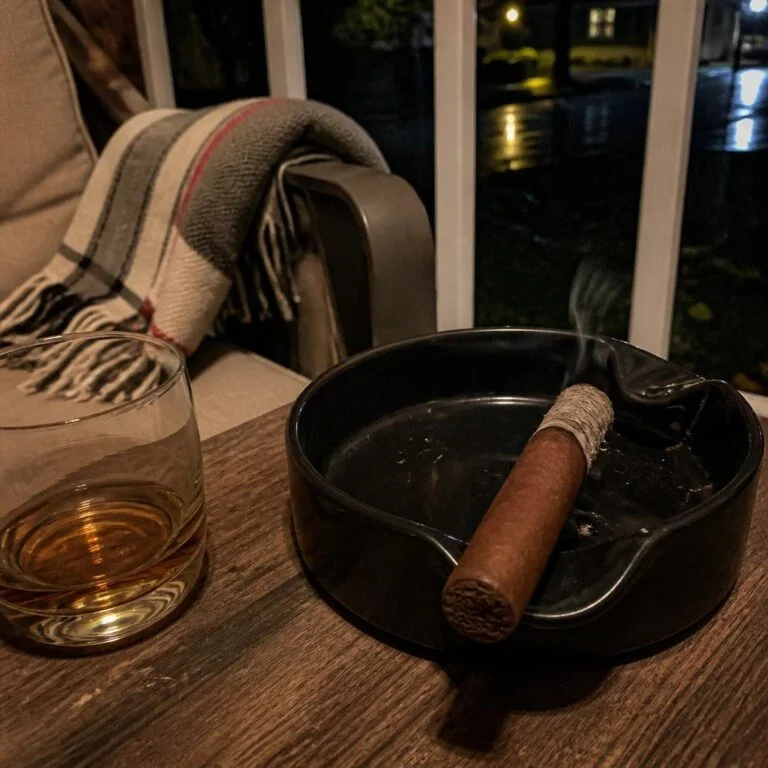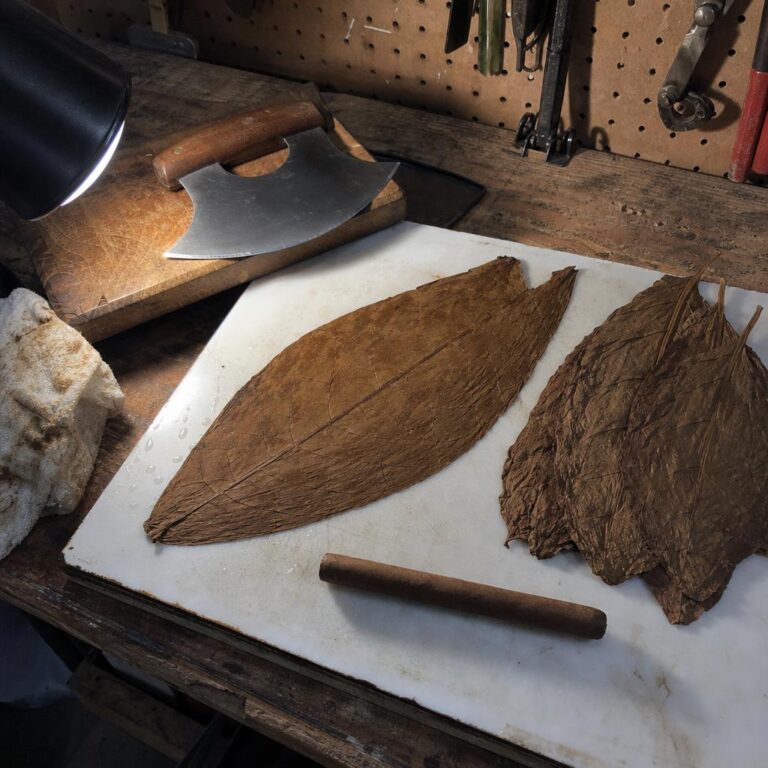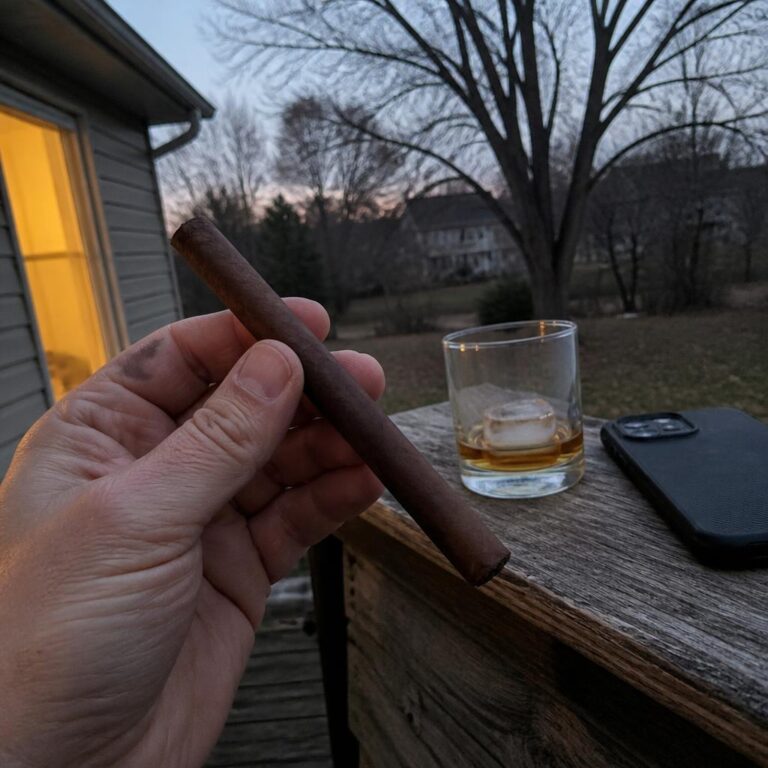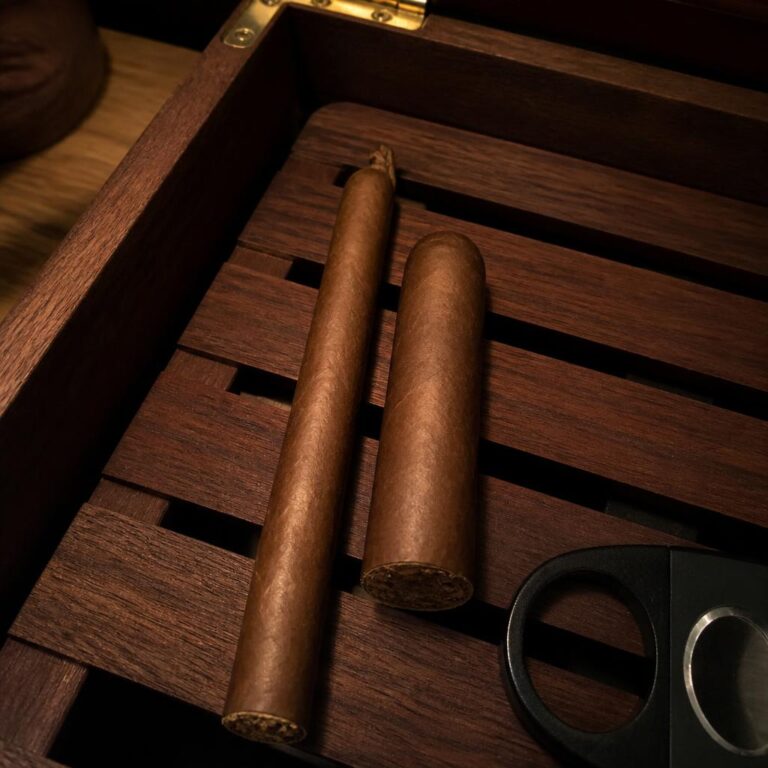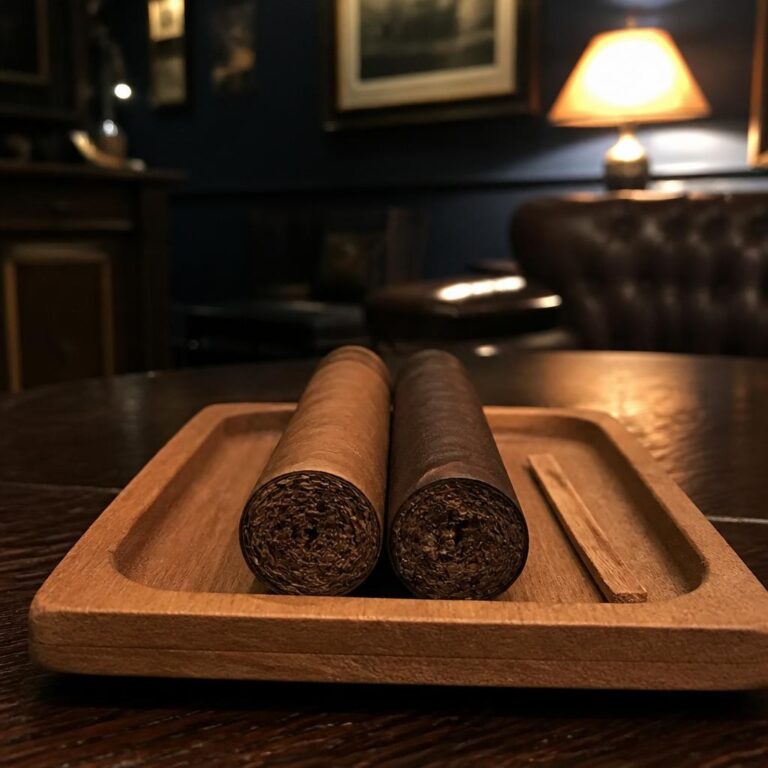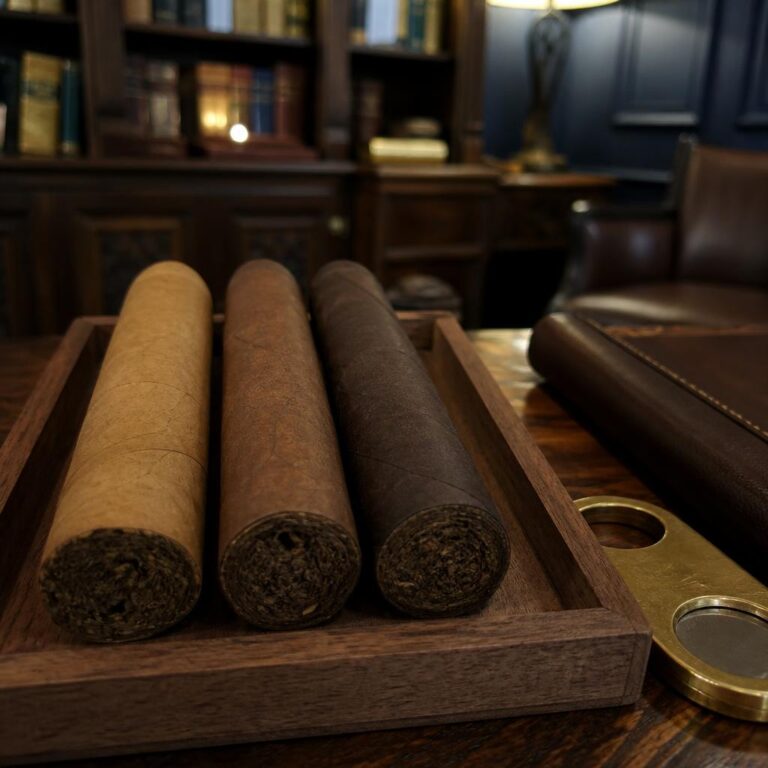
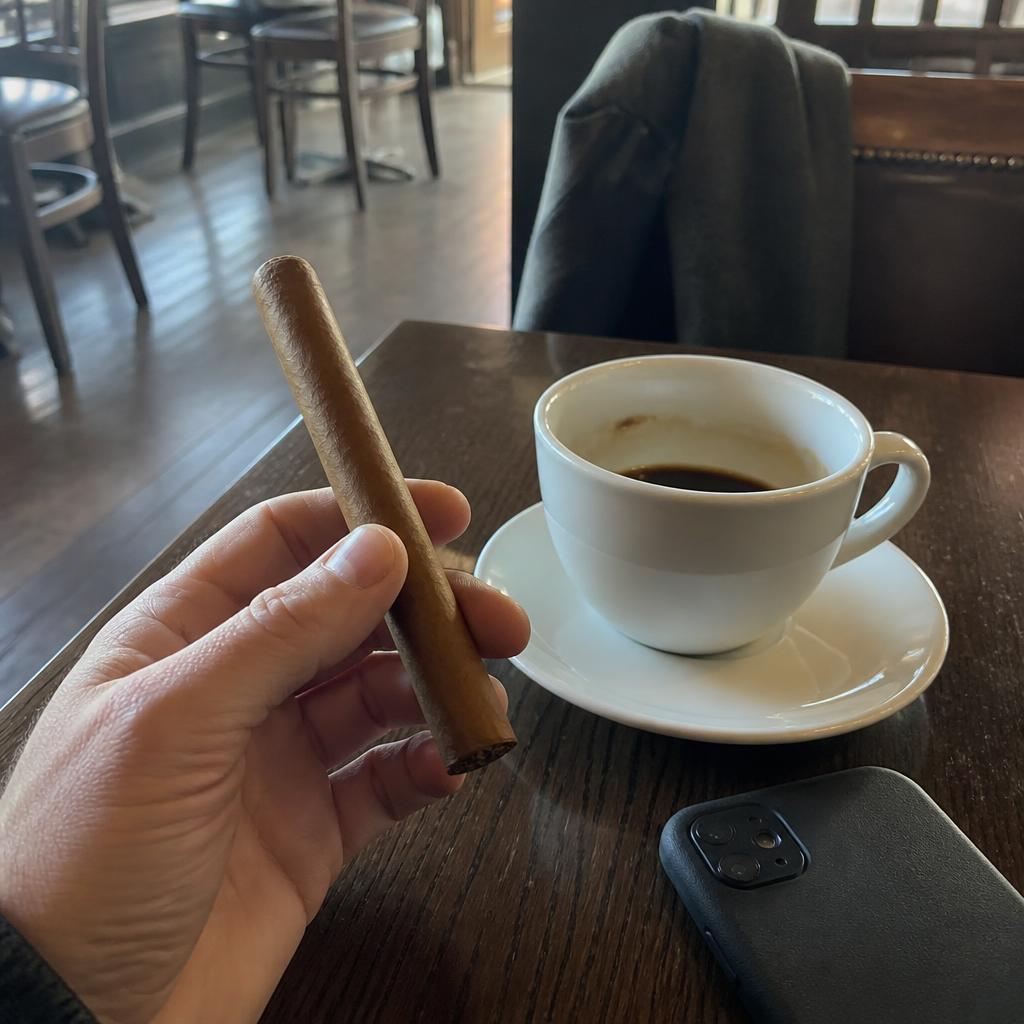
A corona is a straight-sided cigar of about five and a half to six inches with a ring gauge of 42 to 44, the size Cigar Aficionado calls the benchmark against which every other size is measured. The Cuban factories roll it at 142 millimetres by 42, which is 5 5/8 inches, and a corona takes thirty-five to fifty minutes to smoke well. This guide names eighteen coronas worth that time, four of them Habanos, with sizes, blends, body, scores and current prices from specialist merchants, then covers what the other lists leave out: the whole corona family from the petit corona to the double corona in one table, the difference between a petit corona, a corona and a corona gorda, why I judge a new blend in one, why the shops have nearly stopped stocking it, and how to smoke a thin cigar without cooking it.
The short version: the Rocky Patel Number 6 Corona is the benchmark, the Romeo y Julieta 1875 Cedro Deluxe No. 2 the everyday one, and the Ashton Classic Corona the gentle forty minutes and the first corona to buy; under ten dollars, the Warped The Devil’s Hands; thirty minutes, the Tatuaje Havana VI Angeles; full and dark, the Undercrown Maduro Corona Viva; one Habano, the Montecristo No. 3, or the No. 4 for half an hour. The fourteen from outside Cuba run from seven dollars a stick to a Davidoff at nearly nineteen, and the four Habanos are in pounds. Every cigar here was smoked and logged in thirds, the way The Cigarro Method teaches, because a corona’s three thirds are about twelve minutes apiece and a thin cigar shows its blender’s hand faster than any other size.
Eighteen coronas in one table
The table below is every pick on this page in one place, sorted by lane. Prices are per stick on 10 November 2026, box maths where only a box was listed, and the Habanos are in pounds from British retail because an American reader cannot buy them lawfully at home; our country-by-country guide to Cuban cigar law explains why. The minutes column is my own estimate at a draw a minute, from my logs, and the family column says which branch of the corona tree each cigar sits on, because five of the eighteen are corona gordas and four are petit coronas, and a reader looking for a lunchtime cigar needs to know which is which. Canadian readers should add duty and provincial tax to every figure. Behind the choices, at the foot of the page, has the method.
| Cigar | Size | Family | Wrapper | Body | Cigar Aficionado | Price per stick | Minutes at a draw a minute | Lane |
|---|---|---|---|---|---|---|---|---|
| Montecristo No. 4 | 5 1/8 x 42 (129 mm) | Petit corona, Mareva | Cuban | Medium to full | 91 (2024) | GBP 33.00 | 25 to 35 | Cuban corner |
| Montecristo No. 3 | 5 5/8 x 42 (142 mm) | Corona | Cuban | Medium to full | 92 (2024) | GBP 31.49 | 35 to 45 | Cuban corner |
| Juan López Selección No. 1 | 5 5/8 x 46 | Corona gorda | Cuban | Medium to full | 93 (2024) | GBP 36.00 | 45 to 55 | Cuban corner |
| Bolívar Petit Coronas | 5 1/8 x 42 (129 mm) | Petit corona, Mareva | Cuban | Full | 91, No. 19 of 2005 | GBP 33.00 | 25 to 35 | Cuban corner |
| Rocky Patel Number 6 Corona | 6 x 44 | Corona | Honduran Corojo | Medium | 95, No. 9 of 2020 | $10.30 (box maths) | 40 to 50 | Benchmark |
| Warped The Devil’s Hands Corona Especial | 6 x 44 | Corona | Nicaraguan Corojo 99 | Medium to medium-full | 94 (2026) | $9.92 (box maths) | 40 to 50 | Benchmark |
| Padrón 1964 Anniversary Corona | 6 x 42 box-pressed | Corona | Nicaraguan, natural or maduro | Medium | Natural 89 (2025); maduro 88 (2023) | $14.90 | 40 to 50 | Benchmark |
| Arturo Fuente Don Carlos No. 3 | 5 1/2 x 44 | Corona | Cameroon | Medium to full | 90 (2022) | $12.54 | 35 to 45 | Benchmark |
| Aganorsa Leaf Signature Selection Corona Gorda | 6 x 44 | Corona, despite the name | Nicaraguan Corojo 99 | Medium to full | 91 (2019) | $10.80 | 40 to 50 | Benchmark |
| Romeo y Julieta 1875 Cedro Deluxe No. 2 | 5 1/2 x 44 | Corona | Indonesian shade-grown | Mild to medium | 92 (2018) | $8.45 | 35 to 45 | Everyday |
| La Aroma de Cuba Corona | 5 1/2 x 44 | Corona | Connecticut Broadleaf | Medium to full | 90 (2025); 88 (2026) | $7.44 (box maths) | 35 to 45 | Everyday |
| Brick House Corona Larga | 6 1/4 x 46 | Corona gorda | Ecuadorian Havana | Medium | 93, No. 17 of 2016 | $8.60 | 45 to 55 | Everyday |
| Tatuaje Havana VI Angeles | 4 5/8 x 42 | Petit corona | Ecuadorian Habano | Medium | 92, No. 15 of 2007 | $7.00 | 25 to 35 | Everyday |
| Ashton Classic Corona | 5 1/2 x 44 | Corona | US Connecticut Shade | Mild to medium | 90 (2015) | $12.25 | 35 to 45 | Gentle |
| Davidoff Signature 2000 | 5 x 43 | Petit corona | Ecuadorian Connecticut | Mild | 90 (2026) | $18.70 (listed, out of stock) | 30 to 40 | Gentle |
| Illusione Original Documents Corojo Corona Gorda | 5 5/8 x 46 | Corona gorda | Nicaraguan Corojo | Full | 93, No. 7 of 2007, as the cg:4 | $11.90 | 45 to 55 | Corona gorda |
| San Cristobal Quintessence Corona Gorda | 5 5/8 x 46 | Corona gorda | Ecuadorian Habano | Medium to full | 92, No. 21 of 2018 | $10.85 (listed, out of stock) | 45 to 55 | Corona gorda |
| Drew Estate Undercrown Maduro Corona Viva | 5 5/8 x 46 | Corona gorda | Mexican San Andrés | Medium-full to full | 87 (2013) | $8.30 | 45 to 55 | Corona gorda |
Twelve of the fourteen non-Cuban cigars cost under thirteen dollars a stick and five cost under nine, which is the first thing to say about the corona: it is the cheapest way into a maker’s best tobacco, because a 42 ring carries about two thirds of the leaf of a 52 and the price follows the leaf. Divide the price by the middle of the minutes column and the Undercrown and the Brick House come in at about seventeen cents a minute, the La Aroma de Cuba, the Cedro Deluxe and the Tatuaje at under twenty-five, the Padrón at about thirty-three cents, and the Montecristo No. 3 at under a pound. Nothing here is limited or seasonal, and every cigar here is a regular production size, which matters for a size you may want to smoke on Tuesdays.
The corona family
Ask three merchants how big a corona is and you will hear three answers, because the word has two homes. The corona is a Cuban idea, and the Cuban factories give each size two names: the one on the box and the vitola de galera, the factory name, which is the same whatever the brand. A Montecristo No. 4 and a Bolívar Petit Coronas are both the Mareva on the rolling table. Cigar Aficionado’s glossary gives the Cuban standard for the corona as 5 5/8 inches by 42, and Habanos S.A. prints it as 142 millimetres by 42; Cigar Aficionado’s general definition is wider, 5 1/2 to 6 inches at 42 to 44, which is the range I use on this page. Our vitola dictionary has every size in the trade; this table is the branch that carries the corona’s name.
| Size | Cuban factory name | Length | Ring | Diameter | Example | Minutes at a draw a minute |
|---|---|---|---|---|---|---|
| Tres petit corona | Perla | 4 in, 102 mm | 40 | 15.9 mm | Cohiba Siglo I (not listed) | 20 to 25 |
| Short petit corona | Minuto | 4 3/8 in | 42 | 16.7 mm | Partagás Shorts (not listed) | 20 to 30 |
| Petit corona | Mareva | 5 1/8 in, 129 mm | 42 | 16.7 mm | Montecristo No. 4, Bolívar Petit Coronas | 25 to 35 |
| Corona | Corona | 5 5/8 in, 142 mm | 42 | 16.7 mm | Montecristo No. 3 | 35 to 45 |
| Corona, general range | none | 5 1/2 to 6 in | 42 to 44 | 16.7 to 17.5 mm | Rocky Patel Number 6, Padrón 1964 Corona | 35 to 50 |
| Corona gorda | Coronas Gordas | 5 5/8 in | 46 | 18.3 mm | Juan López Selección No. 1, Illusione cg:4 | 45 to 55 |
| Lonsdale | Cervantes | 6 1/2 in | 42 | 16.7 mm | Montecristo No. 1 (not listed) | 45 to 55 |
| Long corona, the 8-9-8 | Dalia | 6 3/4 in | 43 | 17.1 mm | Cohiba Siglo V (not listed) | 50 to 60 |
| Double corona | Prominente | 7 5/8 in, 194 mm | 49 | 19.5 mm | Hoyo de Monterrey Double Coronas (not listed) | 80 to 100 |
Two things fall out of the table. The first is that the corona family is a family of lengths at one ring: leave out the corona gorda and, from the Perla to the Cervantes, the diameter barely moves, between 15.9 and 16.7 millimetres, and the only thing that changes is how long you have. The second is that the corona gorda is the odd one out, the same 5 5/8 inches as the corona with four more points of ring, which is why it smokes like a different cigar. The double corona belongs to the family in name only: at 49 ring and 7 5/8 inches it is a Churchill’s bigger brother, and we treat it that way in our guide to the Churchill, the toro and the robusto. The ring gauge guide has the full millimetre chart if you want to stand a cigar on the circles.
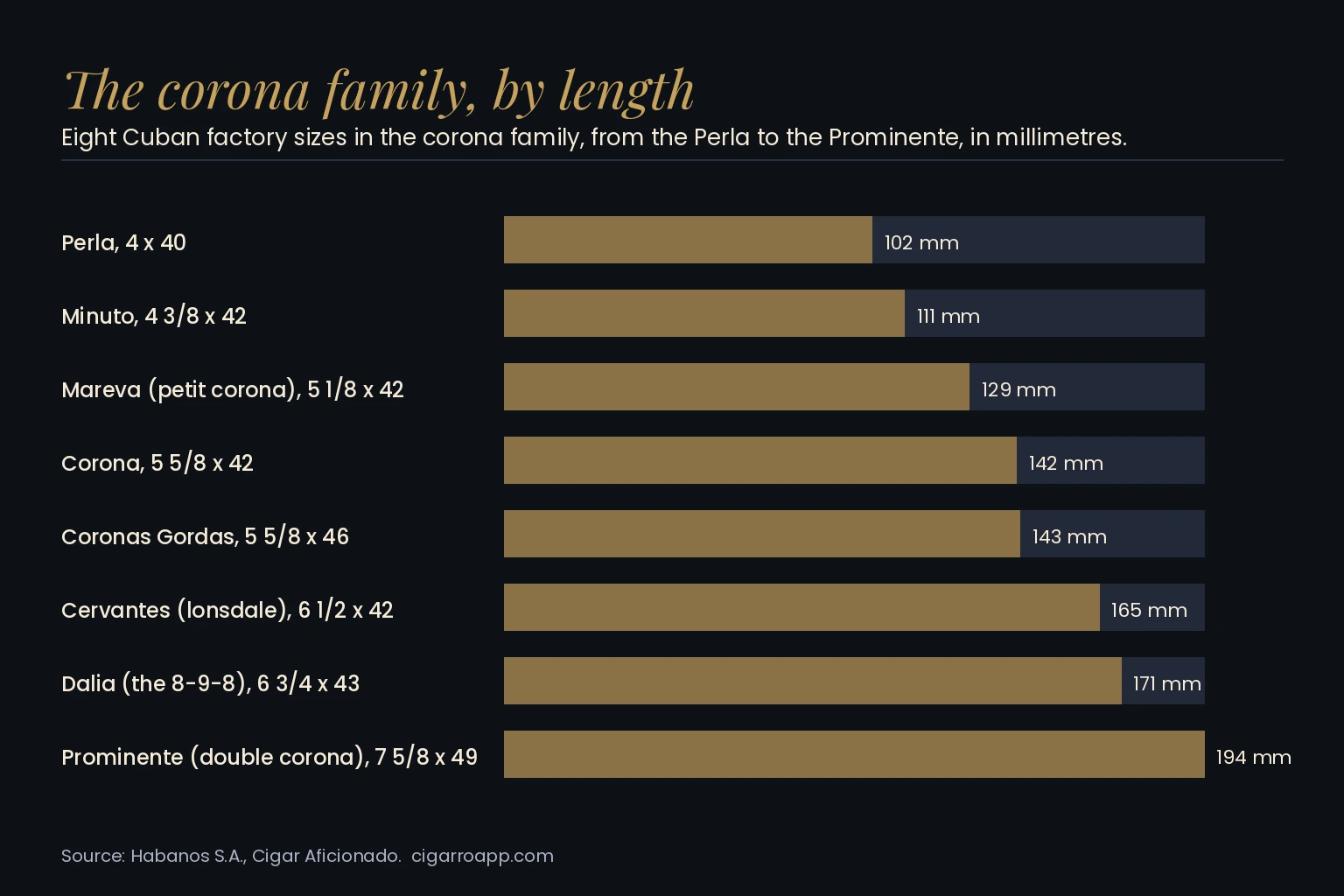
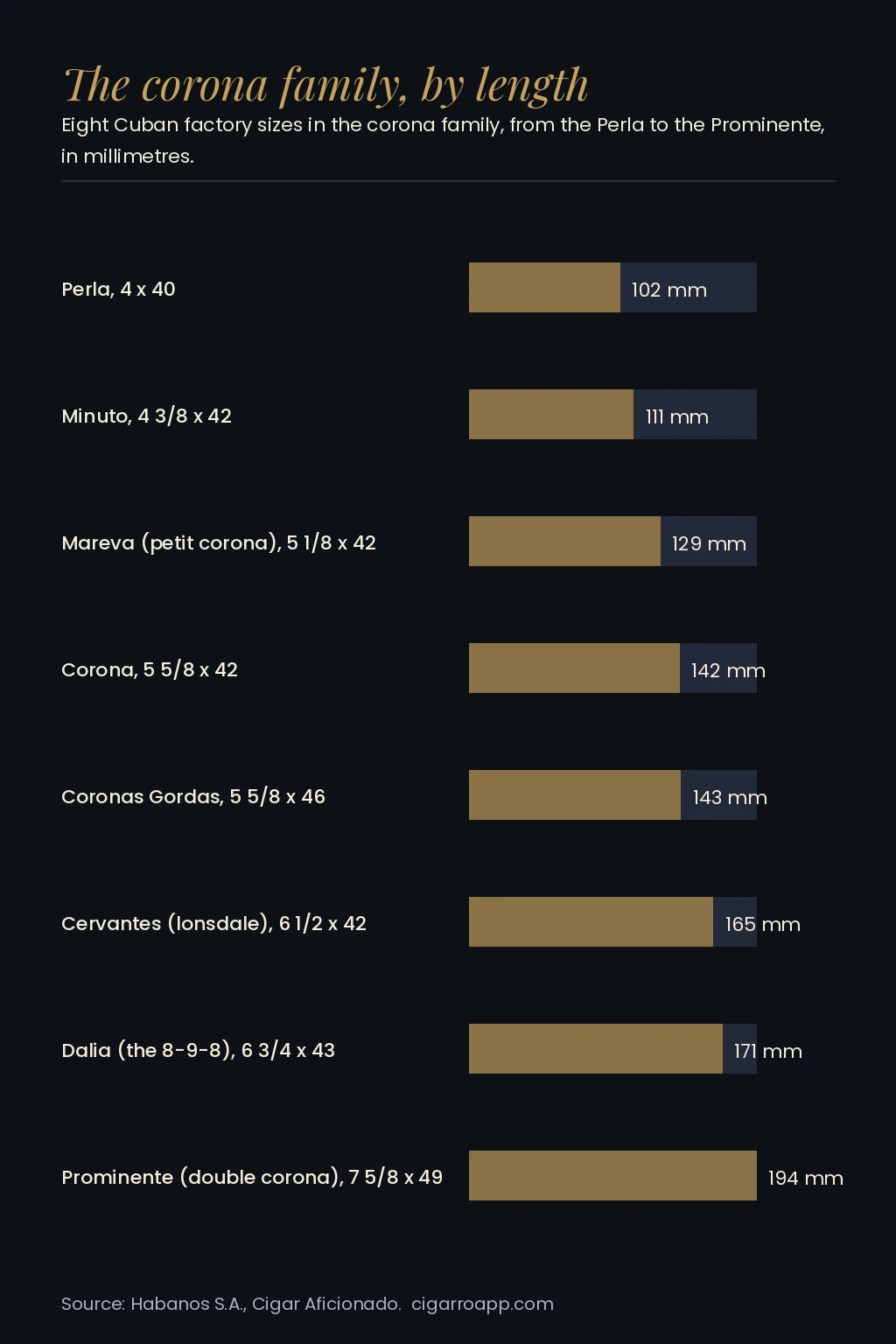
Thirteen millimetres separate a petit corona from a corona, and the corona gorda is the same length with four more points of ring.
Petit corona, corona or corona gorda
What is the difference between a petit corona and a corona?
Half an inch of length and about ten minutes. The Cuban petit corona, the Mareva, is 5 1/8 inches by 42; the Cuban corona is 5 5/8 by 42; both are 16.7 millimetres across. Cigar Aficionado’s general definition of a petit corona runs shorter still, about 4 1/2 inches by 40 to 42, which admits the Tatuaje Angeles at 4 5/8 x 42; the Davidoff Signature 2000, at 5 x 43, sits between the two definitions and I class it by length. The blend stays the same; the length decides how much of its story you get: a petit corona gives you the opening and the middle, and a corona adds the last act, where the cigar has warmed through and the heavier leaves in the filler have their say. On my own clock the Montecristo No. 4 is a twenty-five to thirty-five minute cigar and the No. 3 is thirty-five to forty-five, and the extra ten minutes of the No. 3 are the best ten minutes of either.
Is a corona gorda the same as a toro?
Nearly, and the magazine says so: Cigar Aficionado’s shapes guide treats the corona gorda, at a traditional 5 5/8 by 46, as the toro’s older name, and notes that 6 x 50 has become the popular toro size. That leaves the 46-ring corona gorda as a size of its own between the corona and the modern 6 x 50 toro. On this page it gets its own lane because it smokes differently from a corona: four more points of ring is a tenth more diameter and about a fifth more tobacco per inch, enough to cool the smoke and slow the burn by ten minutes, and enough for a blender to add a leaf. If you find a 42 too brisk and a 50 too much of a mouthful, the 46 is the answer, and the Juan López Selección No. 1 and the Brick House Corona Larga are the two to start with.
Which should you buy?
Buy the petit corona for the thirty-minute window and for trying an expensive blend without committing to an hour of it. Buy the corona when you want to judge a maker, because it is the size that shows the blend most plainly, and buy the corona gorda when you want the corona’s balance with a little more smoke and a little less heat. Buy the lonsdale, if you can find one, when you have fifty minutes and want the thinnest ring the trade still rolls at length; the very thin lancero pushes that logic further than most palates want to go. A corona is the cigar for the gap in the day: after lunch, on a platform with forty minutes, or the first of two in an evening. It fits a jacket pocket and ends before the speeches do.
Why the corona is the benchmark
The reason the magazine calls the corona the benchmark is arithmetic. A cigar’s flavour comes from the wrapper, the binder and the filler in proportion to how much of each is burning, and a 42 ring has a higher ratio of wrapper to filler than any fatter size. The wrapper leaf is the most expensive and most carefully chosen leaf in the cigar, so a corona shows it off; the filler is where a blender hides the strength, so a corona shows that too, with nowhere to hide it. Holt’s puts it the other way round in its corona-against-robusto piece: a robusto, about half an inch shorter and six to eight sixty-fourths wider, burns cooler and slower than a corona. Both are true. The robusto is the size for the blend’s volume; the corona is the size for its honesty.
That is why I think a corona is the fairest test of a blend, and why, when a house offers its line in a corona, that is the vitola I smoke first. You can run the test yourself, and it is the most useful thing I do with a new blend.
- Buy the blend in two sizes, the corona and the house toro, because the blend is the same and only the proportions change.
- Smoke them a week apart at the same time of day, after the same meal, so the palate is the constant.
- Log all three thirds of each, with a line on the flavour and a score for the strength, because the thirds are where the two sizes part company.
- Compare the two Cigar Signatures the app draws across the thirds, the lines for flavour and strength and the mouthfeel strip underneath. If the corona’s strength line climbs steeply from the second third to the last, the blend is ligero-led and the toro will be a heavier cigar than its body rating says; if the corona’s flavour line stays high and the toro’s sags in the middle, the blend is a wrapper blend that the toro’s extra filler dilutes.
The Rocky Patel Number 6, which I smoke beside its toro every autumn, is the clearest example I know of the second kind. It is a better cigar as a corona than as a toro, and Cigar Aficionado’s 95 seems to agree. This is also the reason the corona is the right size for learning to taste. Our guide to tasting a cigar asks you to notice how the cigar changes from third to third, and a corona changes faster and more clearly than any fat cigar. A toro gives you twenty minutes of the same thing before anything happens. A corona gets on with it.
The Cuban corner
Four Habanos belong on any serious list, two of them Montecristos. Habanos S.A. lists Montecristo as medium to full, and the Montecristo No. 4, the Mareva at 129 millimetres by 42, is the cigar Habanos itself calls the best-selling Habano in the world; Cigar Aficionado’s James Suckling called it the largest-production cigar on the island as long ago as 2004. It is a petit corona of dry cedar, leather and a coffee note that arrives in the second third, and the magazine rated it 91 in 2024. C.Gars Ltd listed singles at 33.00 pounds on 10 November 2026. It is the Habano I would hand a Cuban sceptic with a half hour to spare, and the cigar I would smoke first from any Cuban box of mixed sizes, because if the No. 4 is good the batch is good.
The Montecristo No. 3 is the same blend as a true corona, 142 millimetres by 42, the Corona vitola on the rolling table, and at 31.49 pounds a single it was listed cheaper than the No. 4, which is the Cuban market in a sentence. Cigar Aficionado rated it 92 in 2024, a point above the No. 4, and I agree with the point: the cedar and coffee turn darker and sweeter in the last third, and it is the cigar on this page I would choose to explain what a corona is for.
The Juan López Selección No. 1 is the corona gorda of the lane, 5 5/8 by 46 in the Coronas Gordas vitola, from a small Habanos marca that Habanos rates medium to full. Cigar Aficionado gave it 93 in February 2024, the highest Cuban score on this page, and C.Gars listed it at 36.00 pounds. It is rounder and richer than the Montecristos, with more earth, and it is what a Cuban corona gorda tastes like when the roll is right. Our guide to every Habanos marca has the house’s wider family.
The Bolívar Petit Coronas is the full-strength Mareva, from a marca Habanos lists as full, and it is the one to keep for after dinner. Cigar Aficionado rated it 91 and placed it nineteenth in its Top 25 of 2005, and C.Gars listed it at 33.00 pounds with stock. It has more pepper and more body than any other petit corona on this page, and the half hour it takes holds a whole cigar: leather and pepper in the first third, a dark sweetness in the second, and the strength arriving all at once in the last. One note on the lane. Consistency is still the Cuban gamble: of the four, the No. 4 is the one I have had the most indifferent examples of, for the simple reason that it is the one I have smoked the most.
The five benchmarks
The Rocky Patel Number 6 Corona is the cigar that made the case for the modern corona. It is 6 inches by 44, a Honduran Corojo wrapper over a Honduran binder with Honduran filler, Nicaraguan too by Cigar Aficionado’s account, rolled at Rocky Patel’s El Paraíso factory in Honduras, and the magazine rated it 95 and placed it ninth in its Top 25 of 2020, with a note that Honduras is often the forgotten tobacco territory in the world of premium cigars. JR’s box of twenty worked out at $10.30 a stick. It is medium bodied, with dry cedar in the first third, toasted bread in the second and a faint sweetness that only shows in the last, and it is the cigar I would use to show a robusto loyalist what a thinner ring does for a blend.
The Warped The Devil’s Hands Corona Especial is its Nicaraguan rival and the newest cigar on the page: a single-vitola 6 x 44, a Corojo 99 wrapper over a Criollo 98 binder with Criollo 98 and Corojo 99 filler, a Nicaraguan puro rolled at Aganorsa Leaf’s factory and announced in 2022 at eleven dollars a stick, which halfwheel reported at the time. Cigar Aficionado rated it 94 in February 2026 and found an abundance of flavour and complexity. Famous Smoke’s box of twenty-five came to $9.92 a stick, and Famous Smoke calls it medium while Atlantic calls it medium-full; I find it nearer Atlantic’s figure by the second third. It is fuller than the Rocky Patel, with the bread and cream that Aganorsa’s Corojo gives and a pepper that arrives in the second third and stays, and it is the best cigar under ten dollars I smoked this year.
The Padrón 1964 Anniversary Corona is the aristocrat, 6 x 42 and box-pressed, a Nicaraguan puro whose tobacco is aged four years before it is rolled, from the series Padrón introduced in 1994 for its thirtieth anniversary, each band numbered. Neptune had the natural and the maduro at $14.90 a stick. The magazine’s recent scores are modest, 89 for the natural in 2025 and 88 for the maduro in 2023, and the maker prefers to quote older ones in the low nineties; my own notes side with the maker on the maduro, which is cocoa in the first third, black coffee in the second and a dark raisin sweetness in the last, and with the magazine on the natural, which is good rather than great in this size.
The Arturo Fuente Don Carlos No. 3 is the Dominican benchmark, 5 1/2 x 44 in an African Cameroon wrapper over Dominican binder and filler, rated 90 by Cigar Aficionado in 2022 as considerably spicy in character with an even draw and burn. Neptune listed singles at $12.54 and a box of twenty-five at $10.66 a stick. JR calls it medium to full and Neptune calls it full; it is the Cameroon that does it, sweet and peppery at once, and I would call it medium to full and leave it until after lunch.
The fifth benchmark is a corona that calls itself something else. The Aganorsa Leaf Signature Selection Corona Gorda is 6 x 44, which is a corona by every definition on this page, and it is here because it is the purest expression of Aganorsa’s own leaf: a rosado-claro Corojo 99 wrapper over a Corojo 99 binder with Criollo 98, Corojo 99 and medio tiempo filler, blended by Max Fernández, rolled at TABSA in Estelí and shipped in August 2018. Cigar Aficionado rated it 91 in 2019, Neptune had it at $10.80 a stick with a maduro version at the same price, and halfwheel’s review noted burn trouble, which I have had too on one stick in five. When it burns straight it is the richest 44 ring on the page.
The everyday coronas
The Romeo y Julieta 1875 Cedro Deluxe No. 2 is the cigar I keep most of, 5 1/2 x 44 in a cedar sleeve, an Indonesian shade-grown wrapper over Dominican binder and filler from Tabacalera de García, mild to medium, and Cigar Aficionado’s 92 in 2018 came with the note of big, chewy nougat, pistachio and almond fortified with leather. Neptune listed singles at $8.45 and a box of twenty-five at $7.32 a stick. The cedar sleeve keeps the wrapper from the air of a crowded humidor, and the cigar is noticeably better after a month in its sleeve than straight from the box.
The La Aroma de Cuba Corona is the darker everyday cigar, the original Connecticut Broadleaf wrapper over Nicaraguan binder and filler, 5 1/2 x 44, medium to full, rated 90 in April 2025 with a sweet bready note the magazine likened to brioche, and 88 in October 2026. JR’s box of twenty-five came to $7.44 a stick. The La Aroma de Cuba Connecticut Corona sits beside it on most shelves and is a different, milder cigar in an Ecuadorian wrapper. A corona suits a short drink, and these two take different ones: an espresso with the Cedro Deluxe, a dry oloroso with the La Aroma de Cuba; our guide to pairing cigars with drinks goes through the choices by cigar and by glass.
The Brick House Corona Larga is the one corona gorda in this lane, 6 1/4 x 46 in an Ecuadorian Havana wrapper over Nicaraguan binder and filler, rolled at J.C. Newman’s PENSA factory in Nicaragua, and Cigar Aficionado’s seventeenth cigar of 2016 at 93 points, when it cost $5.55 and the magazine called it a recession special even in a positive economy. Neptune listed singles at $8.60 and JR’s box of twenty-five came to $8.16 a stick, with ten boxes left. The brand dates from 1937 and is named for the only brick house in Julius Newman’s Hungarian village. It is cedar and a little hay in the first third, toasted nuts in the second and a mild pepper at the end, and our list of the best cigars under twenty dollars has it in a shorter size; this is the one to buy.
The Tatuaje Havana VI Angeles is the cheapest single on the page: 4 5/8 x 42, an Ecuadorian Habano wrapper over Nicaraguan binder and filler, made at My Father Cigars in Nicaragua, from the six-size Havana VI line that Pete Johnson launched in 2006. Cigar Aficionado placed it fifteenth in its Top 25 of 2007 at 92 points with a finish a mile long, and Famous Smoke listed singles at $7.00 with JR’s box of twenty-four at $6.33 a stick. It is a petit corona that smokes like a corona, with a pepper and cedar profile, and it is the cigar I give to anyone who says small cigars are a compromise.
The gentle end
A mild corona is a rarer thing than a mild robusto, because the thin ring shows the filler and a mild filler can read as empty. Two cigars avoid that. The Ashton Classic Corona is 5 1/2 x 44, a US Connecticut shade wrapper over Dominican binder and filler, made for Ashton by the Fuentes, mild to medium, and Cigar Aficionado’s 90 in 2015 came with the observation that there is a lot more body than its light claro wrapper suggests, earthy and toasty. Neptune listed singles at $12.25 and a box of twenty-five at $11.04 a stick. It is the gentle forty minutes promised at the top, cream and cedar in the first third, a toasted note in the second and a little white pepper at the end, the cigar for a mid-morning coffee or for someone who has been told cigars are harsh.
The Davidoff Signature 2000 is the gentle petit corona and the most expensive non-Cuban cigar on the page: 5 x 43, an Ecuadorian Connecticut wrapper over Dominican binder and filler, mild, rated 90 by Cigar Aficionado in June 2026 as a dense smoke full of almond, honey, graham cracker and dried fig. Holt’s listed it at $18.70 a stick and out of stock, with a tubed version at $19.40. It is worth the money about twice a year, which is how often I buy one. Our shortlist of mild cigars goes further down this road in other sizes.
The corona gordas
Three non-Cuban corona gordas finish the list, all three at the traditional 5 5/8 x 46. The Illusione Original Documents Corojo Corona Gorda is the cigar that used to be called the cg:4, Cigar Aficionado’s seventh cigar of 2007 at 93 points with sweet leather, nuts and cocoa on the palate. Illusione renamed the line Original Documents in 2022 and kept the blend and the factory, a Nicaraguan Corojo puro rolled at Aganorsa, and it is a full-bodied cigar in the old Nicaraguan style, pepper in the first third, cocoa and leather in the second, and both together at the end. Neptune listed singles at $11.90 and a box of twenty-five at $11.28 a stick. It is the corona gorda I would put against any toro at twice the price.
The San Cristobal Quintessence Corona Gorda is the medium-to-full one, an Ecuadorian Habano wrapper over Nicaraguan binder and filler from the García family’s Estelí factory, Cigar Aficionado’s twenty-first cigar of 2018 at 92 as a leathery and spicy cigar well layered with sweet notes of chocolate. Holt’s listed singles at $10.85 and a box of twenty-four at $9.75 a stick, out of stock when I checked. The line’s best-known size is the Quintessence Churchill, third in the 2021 Top 25 at 95 points.
The Drew Estate Undercrown Maduro Corona Viva is the value corona gorda and the full-bodied one, a Mexican San Andrés wrapper over a Connecticut Habano binder with Brazilian Mata Fina and Nicaraguan filler, added to the Undercrown line in 2012. Neptune calls it full and Atlantic medium-full, and I side with Neptune. Cigar Aficionado gave it a cool 87 in 2013; Cigar Coop, the same year it appeared, scored it 95 and told readers not to let the talk of alternate primings make them think it a lesser cigar. Neptune listed singles at $8.30. My notes sit nearer Cigar Coop’s: it is a dark, sweet, espresso-and-earth cigar that the 46 ring keeps from getting heavy, and at the price it is the one on this page I would buy a box of without smoking a single first.
The empty corona shelf
Here is the number that explains why you will struggle to find most of these in a shop. Cigar Insider, Cigar Aficionado’s sister newsletter, regularly asks American tobacconists which size sells best in their shop. In 2020 the toro took the top spot from the robusto at 51.7 per cent of retailers against the robusto’s 24.1, and the petit corona and the lonsdale tied as the worst sellers at 1.2 per cent. In 2023 the toro and corona gorda, counted together, were at 69.2 per cent and the corona at 1.2. In 2024 the pair reached 75.8 per cent and not one retailer named the corona, the petit corona or the lonsdale. In the 2025 survey, published in January 2026, the toro and corona gorda together took 66.2 per cent, the robusto 16.9, the big grandes 10.8, the corona 3.1, the lonsdale 1.5, and the petit corona none. Gregory Mottola’s gloss on the last of these was plain: finding sizes like coronas or lonsdales in cigar shop humidors has become a major challenge.
Three consequences follow, and the first is the one that explains the drift in this page’s own table. When a size stops selling, makers widen it until it does, which is why cigars called coronas now arrive at 44 and 46 ring and why Aganorsa calls a 6 x 44 a corona gorda. The second is that the coronas a shop does carry have often sat a while, so I buy coronas online, or from a shop that keeps a long humidor and can tell me when the box came in; a thin cigar dries faster than a fat one and a dry 42 ring burns hot and fast. The third is the pleasant one: with so little demand, the prices in the table above have stayed where they are. If you cannot find the cigars above, our list of the best toros and our best robustos are the shelves the shops have kept, and many of the same blends appear on both.
Six steps for the thin cigar
A corona forgives less than a robusto, because there is less tobacco between the flame and your palate and a mistake reaches you sooner. This is the order I keep.
- Rest it first, and a little longer than a fat cigar, because a thin cigar that arrived dry has nowhere to hide it. A fortnight in your own humidor is my minimum and a month is better; our guide to how long a cigar should rest has the longer answer. Keep the humidor between 65 and 69 per cent and the coronas away from the lid, where the air moves most.
- Cut shallow. A 42 ring has a small cap and a deep cut unravels it by the second third. I take a sliver off the top with a straight cutter, enough to open a draw and no more; a punch is the other honest choice on a corona, and a V-cut is too much. The cutting guide covers the depth.
- Toast lightly. The foot of a corona is small and a torch held too close chars it in a second. Hold the flame below the tobacco, turn the cigar until the whole face glows, and take the first draw gently. How to light a cigar has the full method.
- Draw once a minute at most, and let the cigar rest between draws, because a thin cigar heats faster than a fat one and a hot corona turns bitter in its second third. I give the 44 rings forty-five minutes; the extra minutes are the difference between a cigar that tastes of cedar and one that tastes of smoke.
- Watch the burn, and correct it early. A corona canoes less than a Churchill but tunnels more, since the small core can burn ahead of the wrapper if you draw too often; if the centre runs ahead, slow down and touch the wrapper edge with the flame. If it goes out, tap off the ash, scrape the foot clean and relight it once; how to relight a cigar walks through it, and a corona relit twice is finished.
- Stop at the band, or sooner. A corona’s last inch is its hottest and the band on most of these sits about an inch from the head. The cigar has told you everything it is going to by then, and a corona put down a little early is a corona you will buy again.
Behind the choices
Every cigar on this page was listed at a named specialist merchant on 10 November 2026 at the price given, and the two that were out of stock say so in the table. Sizes, blends and factories come from the maker’s own site, Habanos S.A. or Cigar Aficionado’s rating pages, with halfwheel and Cigar Coop for release dates. Scores are Cigar Aficionado’s and are given with the year, because a 93 from 2007 and a 90 from 2026 are not the same cigar; where a cigar’s older scores are higher than its recent ones I have said so. Body ratings are the maker’s, the merchant’s or the magazine’s, not mine, and where the merchants disagree about a cigar’s body I have said so and said which I side with. The tasting notes and the minutes are mine, from my own logs, and where my palate and the magazine’s disagree I have said that too. No maker or merchant paid for a place on this page, and none ever will.
Common questions
What size is a corona cigar?
The Cuban standard is 5 5/8 inches by 42 ring gauge, which Habanos S.A. prints as 142 millimetres by 42, with a diameter of 16.7 millimetres. Cigar Aficionado’s general traditional range is 5 1/2 to 6 inches at 42 to 44, so a 6 x 44 such as the Rocky Patel Number 6 is a corona too.
What is a corona called in a Cuban factory?
The Corona. The petit corona is the Mareva, the lonsdale the Cervantes, the corona gorda the Coronas Gordas and the double corona the Prominente; the name on the box, such as Montecristo No. 3, is the brand’s and the factory name is the size’s.
Is a lonsdale a corona?
It is the corona’s long relation: the same 42 ring at 6 1/2 inches, the Cervantes on the Cuban rolling table, with the Montecristo No. 1 as the classic example, and about fifty minutes at a draw a minute.
How long does a corona take to smoke?
Holt’s puts most coronas at thirty to forty minutes; my own logs run thirty-five to forty-five minutes at a draw a minute for a 42 and forty to fifty for a 6 x 44. A petit corona is about ten minutes less and a corona gorda about ten minutes more.
Are coronas good for beginners?
Yes, and better than a robusto for learning. A corona is forty minutes rather than an hour, it costs less than the same blend in a fat size, and its three thirds change clearly enough to teach you what a cigar’s progression is. Start with a mild one, the Ashton Classic Corona or the Romeo y Julieta Cedro Deluxe No. 2, and draw slowly.
Is a corona better than a robusto?
It depends on what you want from the blend. A robusto gives the blend its volume; a corona gives the wrapper more say and wants a gentler draw. If you like a blend as a robusto, try its corona next and log the two side by side; our guide to the best robustos is the other half of the comparison.
Why are coronas so hard to find in cigar shops?
Mostly because they do not sell. In Cigar Insider’s 2025 retailer survey only 3.1 per cent of American tobacconists named the corona their best-selling size. Shops stock what moves, so coronas are now best bought online or by the box from a merchant with a deep humidor.
What is the best-selling corona in the world?
The Montecristo No. 4, a Cuban petit corona of 129 millimetres by 42, which Habanos S.A. calls the best-selling Habano in the world. It is lawful to buy in Britain, Canada and most of the world, and not in the United States.
The size that tells the truth
The corona has not been the fashionable size for thirty years. It is too thin for the shops that sell by the mouthful and too short for the evening that wants a Churchill, and the trade has quietly stopped pretending otherwise. What it is, on a weekday afternoon with forty minutes and a cup of coffee, is the size that lets the wrapper do most of the talking. Choose one from this page and write down what each third did. The notes will tell you more about the blend than any fatter size can.